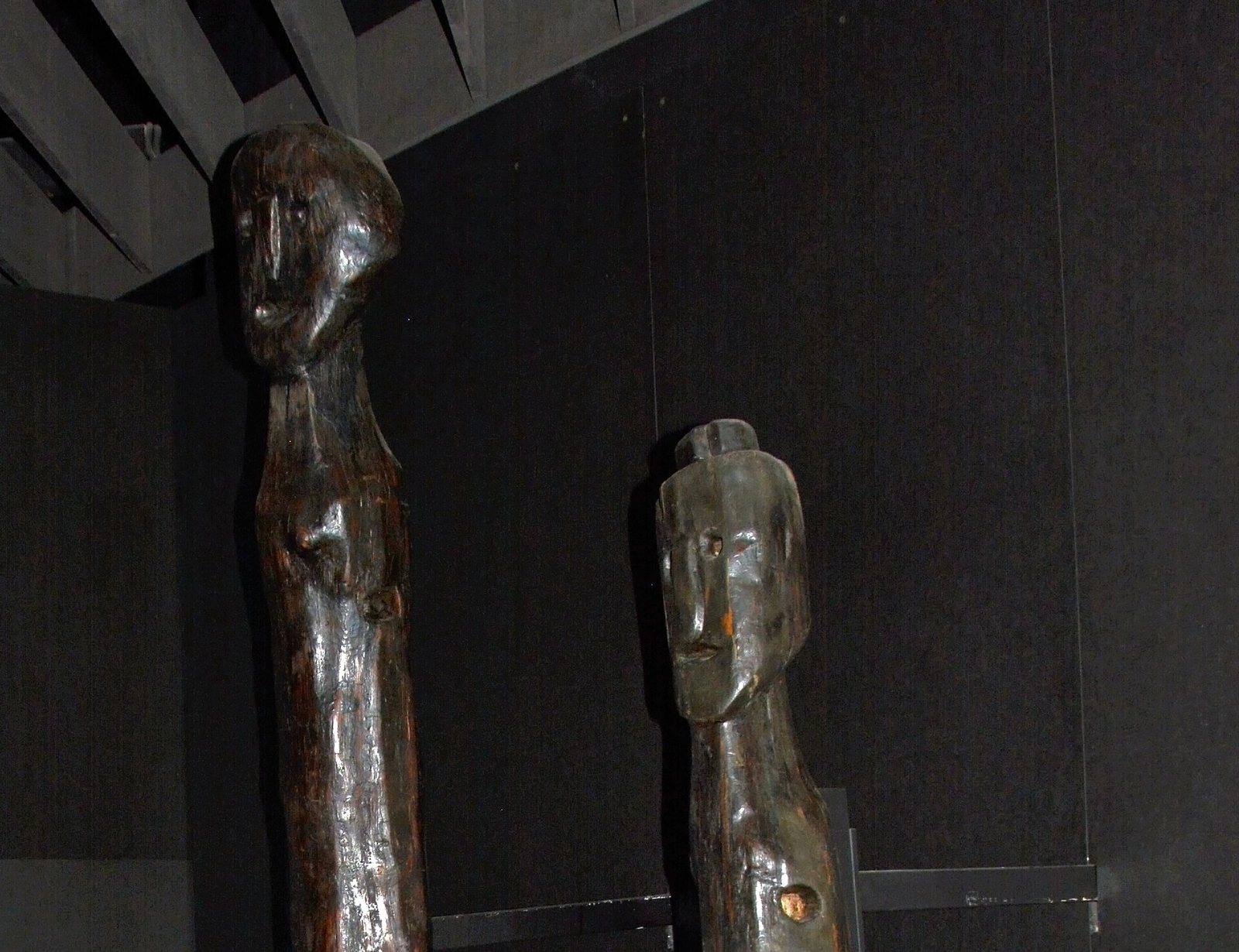
Yes, the Germanic peoples and later the Scandinavians did make images of their gods – rarely of stone, mostly of wood, and almost the only place that wood survived is the bog. Tacitus' famous line about an imageless cult is a Roman interpretation, not an inventory. Forked-branch figures from Braak and Broddenbjerg, the pole idols of Oberdorla, small bronzes like those from Rällinge and Eyrarland, and the temple statues Adam of Bremen describes at Uppsala tell a different story. Which god each one shows, however, is almost always an open question.
Picture a peat cutter in eastern Holstein, a year or two after the Second World War. His spade hits wood, black and heavy with water. It is not a root. It has a head, an open mouth, a hairstyle. Next to it lies a second piece, just as large. Two figures, almost five metres of oak between them, more than two thousand years old. And together they argue with one of the most quoted sentences ever written about the religion of the ancient North.
In AD 98 the Roman historian Publius Cornelius Tacitus published a short treatise on the lands beyond the Rhine, the Germania. In chapter nine, after listing the gods he gives Roman names – Mercury, Hercules, Mars – comes the line that still opens almost every discussion of Germanic idols:
“Moreover, they deem it inconsistent with the greatness of the heavenly beings to confine the gods within walls or to liken them to any human countenance. They consecrate groves and woods, and they call by the names of gods that hidden presence which they see only in reverence.”Tacitus, Germania 9 (our own translation)
The Latin reads nec cohibere parietibus deos neque in ullam humani oris speciem adsimulare. No temple walls, no human likeness. Instead the sacred grove, the lucus, which our article on the grove of the Semnones explores in more depth. It is a powerful, beautiful image – which is exactly why it has been repeated so uncritically for so long.
Tacitus never demonstrably set foot in Germania. He worked from second- and third-hand material: older books such as the elder Pliny's lost history of the German wars, and reports from traders, officers and captives. He also wrote with a purpose. The Germania holds up a mirror to Rome: here the simple, upright barbarians, there the decadent capital. A people who think their gods too great for walls fits that picture perfectly. That does not make it false. It does make it an interpretation rather than a field report.
Things get interesting when you read Tacitus against Tacitus. Just two chapters earlier, in Germania 7, he tells us the Germani carry effigies et signa – images and standards – out of their groves into battle. In his Histories (4.22) the rebel Batavians and their allies bring out “images of wild beasts fetched from woods and groves” as war standards. So images existed; what was missing, apparently, were god-statues of the Roman kind. In the cult of Nerthus (Germania 40) a covered wagon travels the land, and at the end “the deity herself” is washed in a secluded lake. What exactly was washed – an image, a symbol, a cloth – Tacitus does not say. And when he describes the Naharnavali and their divine twins, the Alcis, he stresses: nulla simulacra, no images at all. The very fact that he points this out suggests he found it remarkable, not self-evident.
Then there is the basic problem of any Roman description of the North. When a Roman heard “image of a god”, he thought of a life-sized bronze in a temple, of Jupiter on the Capitol. A forked branch with a notched face standing at the edge of a bog would hardly have counted as a simulacrum to him. Tacitus' sentence describes the absence of Roman-style images more than the absence of images.
We have so little to go on because of the material. Wood rots. A figure that stood in a farmyard, at a crossroads or in a grove would have crumbled within a generation or two. It survives only when it is sealed off from air – in the waterlogged, acidic peat of a bog. That skews our picture badly. We know mainly the figures that stood in bogs or were placed there, and it is tempting to conclude that idols only existed in bogs. How many stood on dry land, we simply cannot say.
Bogs were special places for many Iron Age communities. Weapons, jewellery, animals and sometimes people were deposited in them – archaeologists speak of depositions or offerings. You can read more in our articles on sacrificial bogs and bog finds and on Germanic sacrifice and sanctuaries. The wooden figures belong in that world. They often stood exactly where offerings were made.
Broddenbjerg (Jutland). In 1880 peat cutters in the small Broddenbjerg bog near Viborg came upon an oak figure 88 centimetres tall. Two branches form the legs, a third, angled branch an oversized phallus, and a roughly carved head sits on top. It has no arms. Beside it lay a heap of around 200 hand-sized stones holding an almost complete clay pot and sherds of three more. Pitch residue on the figure has been radiocarbon dated; the Danish national encyclopaedia gives 760–410 BC, the late Bronze Age into the earliest Iron Age. The figure is on display at the National Museum of Denmark in Copenhagen.
Braak (eastern Holstein). The pair from the bog at Braak, near Eutin, was found during peat cutting in 1946/47. Both figures were carved from naturally forked oak branches: the male about 2.75 metres tall, the female about 2.30 metres. They have open mouths, sockets for arms that have not survived, and strongly emphasised sexual features; the woman wears her hair in a knot. Nearby lay a pile of stones with pottery sherds and traces of fire. The dates on offer vary: radiocarbon points to the 3rd–2nd centuries BC, other sources give the 4th century BC. A warning for anyone judging them from photographs: the post-war conservator Karl Schlabow has been accused of heavily reworking finds, possibly including these figures. They are displayed at the Schleswig-Holstein State Archaeological Museum at Gottorf Castle.
Wittemoor (Lower Saxony). Here we have the rare luxury of a precise date. The timber trackway across the Wittemoor near Berne, linking the higher ground at Hude with the river Hunte, has been dated by dendrochronology to 135 BC. Excavations in 1965 and 1970 found a male and a female plank figure beside it, cut in silhouette from oak planks, each around a metre tall and without faces. The female figure shows broad hips and a vulva, the male a rectangular body. Four more posts stood at damaged points of the causeway. Guardian spirits of the road, warning markers or simply decoration? Nobody knows, and that uncertainty is the most honest thing about them.
Oberdorla (Thuringia). Germany's most important ensemble comes from the sacrificial bog near Niederdorla in the Vogtei. Finds began turning up during peat extraction from 1948, and Günter Behm-Blancke excavated the site from 1957 to 1964. It was used for cult from the Hallstatt period in the 6th century BC into the Migration Period, with isolated deposits as late as the 11th and 12th centuries AD. Along the shore of the former lake stood dozens of small shrines with wooden idols of many kinds: plain posts, forked figures – here mostly female – a tall post crowned with a horse's head from the 5th century, a female cult image beside an altar from the 3rd century. The site deserves its own article: the sacrificial bog of Oberdorla.
Ballachulish (Scotland) – for comparison. Often mentioned in the same breath, but not a Germanic find at all. The almost life-sized female figure carved from alder, with eyes of quartzite pebbles, emerged from deep peat during building work in November 1880. It lay among the remains of wickerwork, perhaps a small shrine, and National Museums Scotland dates it to around 600 BC. It shows that wooden figures in bogs were a Europe-wide Bronze and Iron Age phenomenon, found in Ireland and Celtic areas too.
From the Oberdorla material Behm-Blancke distinguished four basic types: plain posts, sometimes phallic; forked branches with a carved head; plank figures cut in silhouette; and squared posts with an inclined head, reminiscent of Roman herms. The literature often calls such figures “pole gods” – a working label, not a proof.
Because the real question is: whom were they meant to show? The options range widely. Fertility gods and goddesses, as the emphasised sexual features suggest. A divine couple, as Hilda Ellis Davidson proposed for Braak, along the lines of Freyr and Freyja. Ancestors guarding the land of the kin. Nameless beings, keepers of a spot, a path, a ford. Or simply markers of a sacred place. Archaeology can tell us where a figure stood, how old it is and what lay around it. It cannot dig up the name people gave it.
One idea helps. There is a difference between a god and a picture of a god. A post can be the seat of a power without portraying it. That fits Tacitus' wording surprisingly well: the Germani did not “liken” their gods to human form. Many of these figures are only hinted at as human, a forked branch with a notch. Perhaps the truth lay in between – not a portrait, but a place where the divine was thought to be present.
Texts confirm that wooden figures of this kind were still in use much later. The Arab envoy Ibn Faḍlān met Scandinavian-influenced traders on the Volga in 921/922, people he calls the Rūs. On arrival, he writes, they went to a tall upright piece of wood with a face like a man's, surrounded by smaller figures, with long posts set in the ground behind them. They prostrated themselves before the large image and laid down bread, meat and drink. It is an outsider's view, but an eyewitness account from the time. You can read it in context on our site: Ibn Faḍlān's account.
From the Frankish world comes the Indiculus superstitionum et paganiarum, a short 8th-century list of “superstitious” and pagan practices, preserved in a manuscript usually linked to the mission among the Saxons. Among other things it names images made of dough, images made of cloth, and an image carried around the fields. Bare headings with no explanation – but they show that Christian observers expected images, including very humble and perishable ones.
And then there is the Irminsul, destroyed on Charlemagne's orders in 772. Rudolf of Fulda, writing in the 9th century, describes it as a great upright tree trunk venerated by the Saxons under the open sky. It was probably not an image in the strict sense, more a cult pillar on a massive scale, a world pillar. It belongs to the same family as the posts of Oberdorla – just bigger, and with a name.
In the Viking Age the figures we meet are mostly small, durable and made of metal. And they show the naming problem in its purest form.
Rällinge (Södermanland). In spring 1904 a bronze figure 6.9 centimetres tall turned up on the farm of Rällinge in Lunda parish. A seated, cross-legged man with a pointed cap or helmet, a long pointed beard and an upturned moustache, one hand on his beard, ithyphallic, with spiral patterns on his shoulders and buttocks. He is dated to the late Viking Age, around AD 1000. The usual identification is Freyr, and it rests on two main pillars: the phallus, and Adam of Bremen's description of Fricco at Uppsala, which we will come to shortly. Scholars have also suggested a gaming piece for hnefatafl, a flute player, Thor blowing into his beard, or a ruler. Neil Price has pointed out that a phallus alone could equally suit Odin, dwarfs, giants or elves. The Swedish History Museum in Stockholm still presents him as Freyr – with good reason, but without certainty.
Lejre (Zealand). On 2 September 2009 a volunteer working on Roskilde Museum's excavation at Gammel Lejre found a tiny silver figure, under two centimetres tall, with niello inlay and traces of gilding, dated to around AD 900. A figure sits on a throne with animal heads on the backrest and two birds on the armrests. It was quickly hailed as “Odin on Hliðskjálf” with his ravens Huginn and Muninn. But the figure wears a long gown, an apron, strings of beads and a neck ring – as far as we can tell, women's dress. So others read it as Freyja or Frigg, and a 2018 study even raised the possibility of a high-ranking cleric. The full debate is in our article on the silver figurine from Lejre.
Eyrarland (north Iceland). Around 1815/16 a bronze figure 6.7 centimetres tall came to light on a farm called Eyrarland near Akureyri; it is now in the National Museum of Iceland. A seated, bearded man grips with both hands an object that seems to grow out of his beard. He is usually identified as Thor holding his hammer, and he too is dated to around AD 1000. The cross-like outline of the object has prompted speculation that hammer and cross merge here, fitting for the time of Iceland's conversion. The Icelandic archaeologist Kristján Eldjárn suggested instead that the figure was the king piece of a board game, by analogy with a smaller whalebone figure from Baldursheimur. For the hammer itself, see our article on Mjölnir.
Alongside these there is a whole world of tiny images that may not show gods but were probably used in cult: the paper-thin gold foil plaques known as guldgubber. Whom they depict is just as open.
The most famous description of Germanic god-statues comes from a man who never saw them. Adam of Bremen, a canon of Bremen cathedral, wrote his history of the archbishops of Hamburg-Bremen, the Gesta Hammaburgensis ecclesiae pontificum, around 1075/76. In book four he describes the temple at Uppsala. In paraphrase: in this temple, adorned entirely with gold, the people worship the statues of three gods. The mightiest, Thor, has his seat in the middle, with Wodan and Fricco on either side. Thor holds a sceptre and so resembles Jupiter; Wodan is shown armed, as “we” show Mars; and Fricco is fashioned with an enormous phallus.
Precise, vivid – and problematic. Adam relied on informants; among his most important sources on the North was the Danish king Sven Estridsen. He compares the gods to Roman ones, just as Tacitus did a thousand years earlier. And he writes as a churchman about the last great pagan cult centre still waiting to be converted. A golden temple full of idols is also a rhetorical image. Archaeologically, Gamla Uppsala with its royal mounds and large hall buildings is a central place of the first rank, but a separate temple building of the kind Adam describes has not been clearly identified. Many scholars now think rather of a great hall where feasting, rulership and cult came together. More in Gamla Uppsala – temple and royal mounds and in our portrait of Adam of Bremen.
Even so, Adam's report is the only contemporary text that assigns visual types to named gods: the enthroned Thor, the armed Wodan, the phallic Fricco. That is exactly why every small figure that fits – Rällinge, Eyrarland – gets measured against it. Fair enough, as long as we remember we are using a second-hand description as an identification key.
The Icelandic sagas, written down in the 13th and 14th centuries, are full of god-images – and we almost always meet them at the moment of their destruction. That is no accident. The authors were Christians, and the stories celebrate conversion.
In Snorri's Heimskringla, Olaf Tryggvason comes to Mære in Trøndelag in the late 990s, where the farmers press him to join their sacrifice. Inside the temple the king strikes Thor's image off its pedestal with his gold-adorned staff, and his men topple the other images. Outside, the farmers' leader Járnskeggi is killed, and the farmers accept baptism. The saga of Olaf the Saint has a similar scene in Gudbrandsdal: Dala-Guðbrandr has a large image of Thor carried in, decked with gold and silver. Olaf's man Kolbeinn smashes it with a club, and out run mice nearly as big as cats, along with snakes and toads that had been living off the offerings. The point is clear: the god is hollow, and the sacrifices feed vermin.
Even more pointed is an episode known as Gunnars þáttr helmings, preserved within Ögmundar þáttr dytts in the 14th-century Flateyjarbók. The Norwegian Gunnar flees to Sweden, joins a young priestess of Freyr and accompanies the god's image as it is driven around the country on a wagon. The image attacks him, Gunnar calls on Christ, and in the end Freyr is nothing but a piece of wood. Gunnar then takes on the god's role himself. A comic Christian tale, not a news report. Yet the motif of the god travelling on a wagon is strikingly close to Tacitus' Nerthus.
A quieter trace appears in Eyrbyggja saga. Off the coast of Iceland, Þórólfr Mostrarskegg throws his high-seat pillars, the öndvegissúlur, overboard so he can settle wherever they come ashore. Thor, the saga says, was carved on one of them. This is not a temple idol but an image in the home, at the master's place of honour. Figures on posts and furniture like this were probably far more common in daily life than large cult statues.
And the hof, the temple of the sagas? In 1966 the Danish archaeologist Olaf Olsen showed that dedicated temple buildings are hard to prove archaeologically. In many cases the hof was probably a large farm whose hall became a cult space at certain times. Since then, though, special cult buildings have been identified, for instance at Uppåkra in Scania. What such places looked like is the subject of our article Blót sites: hörgr, hof and cult hall.
This is the real crux of the whole subject. We have images without names and names without images. A figure carries no label. Anyone who calls it Freyr or Odin needs a criterion, and the criteria available are shaky.
That sounds sobering, but it does not make the finds any smaller. The Broddenbjerg figure is genuine evidence that people 2,500 years ago took a branch, gave it a head and set it up in a bog because something there deserved reverence. We can leave the name open. The reverence is documented.
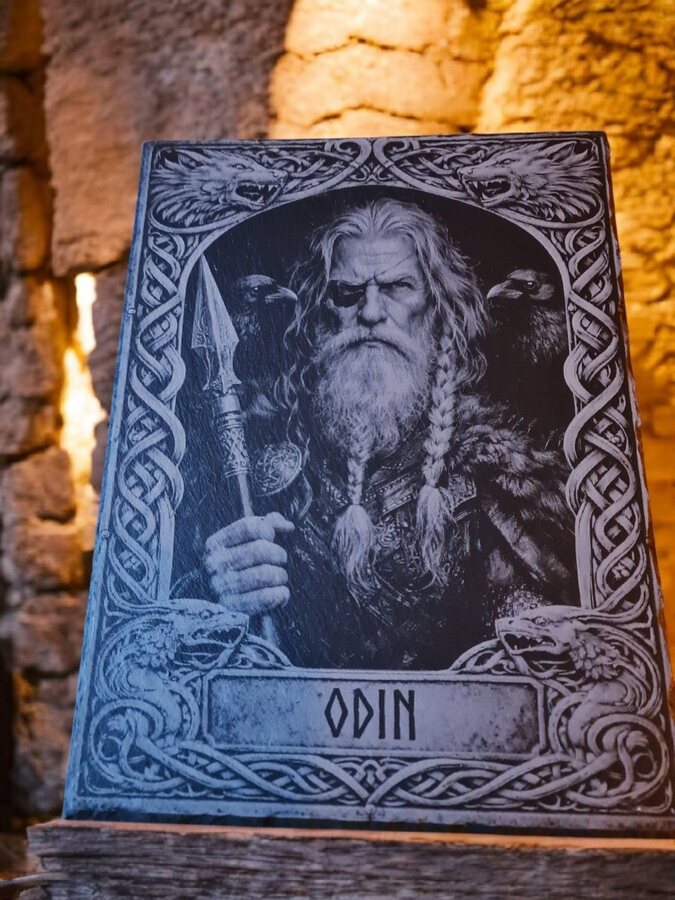
We are often asked what Odin “really looked like”. The honest answer: nobody knows, and there was never a single agreed image. When we engrave a motif, we prefer to work from real models – picture stones, bracteates, small figures like Rällinge or Lejre – and say openly what is documented and what remains interpretation. A forked-branch idol on slate has more power for us than any muscle-bound fantasy god, because it is real. For the bigger picture, see our overview of Germanic religion.
Did the Germanic peoples have statues of their gods? Not large stone statues on the Roman model, but they did have wooden god or cult images. The surviving examples come mainly from bogs such as Braak, Broddenbjerg, Wittemoor and Oberdorla.
What does Tacitus say about Germanic idols? In Germania 9 he writes that the Germani thought it unworthy of the gods' greatness to shut them within walls or depict them in human form. Elsewhere, though, he himself mentions images kept in sacred groves.
What are pole gods? The term covers wooden posts, forked branches and plank figures with hints of human features, mostly from Bronze and Iron Age bogs. Whether they represent gods, ancestors or guardian spirits is open.
Is the Rällinge figure really Freyr? That is the most common interpretation, based on the phallus and Adam of Bremen's description of Fricco at Uppsala. It is not certain; a gaming piece, Thor or a ruler have also been proposed.
Was there really a temple with god statues at Uppsala? Adam of Bremen describes statues of Thor, Wodan and Fricco around 1075 but knew the place only from reports. Large halls and royal mounds are proven archaeologically; a temple as Adam describes it is disputed.
What did the Germanic gods look like? There was never one binding image. Surviving figures are mostly simple, regionally varied and spread over many centuries, and hardly any can be securely assigned to a particular god.
For courage. For remembrance. For legends that live on.
Germanic Sacrifice & Sanctuaries · The grove of the Semnones · The Irminsul · Nerthus – the earth goddess · Germanic Religion.
All Festivals & Belief articles →
January, February, March – these names are Roman, and late arrivals at that. Only between the 16th and 18th centuries …
Read more →