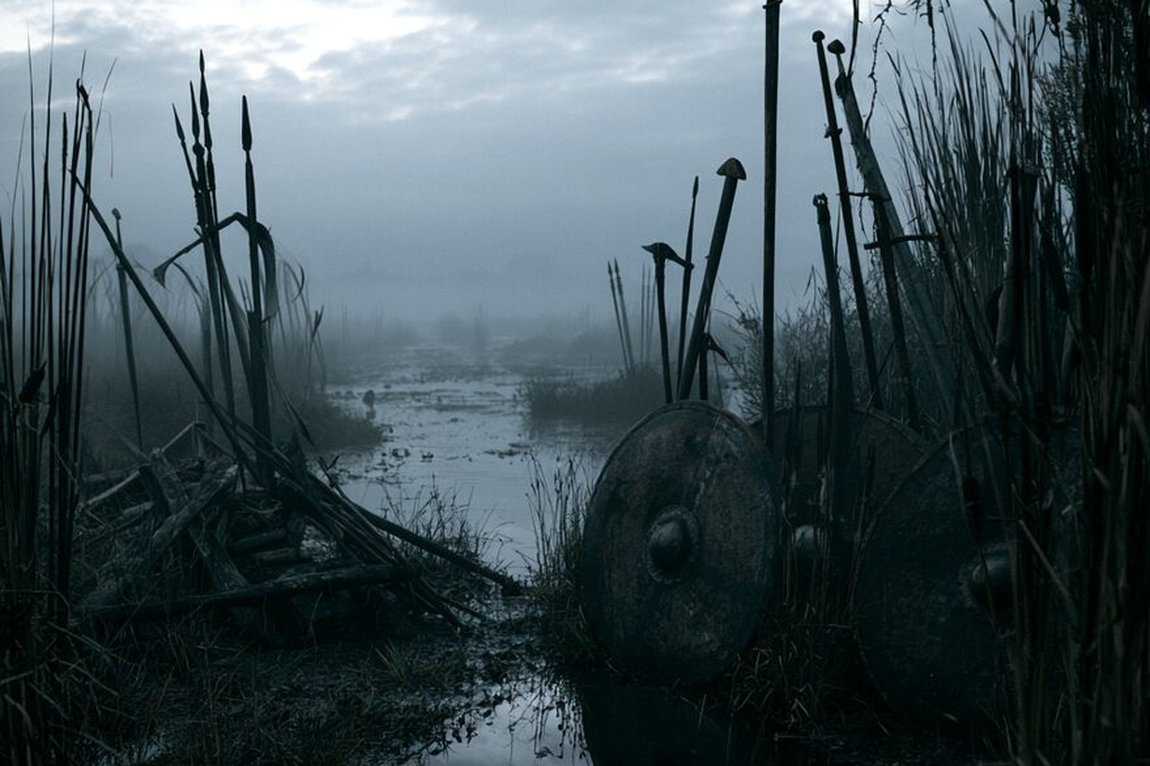
Few places have given archaeology as much as the bog. Where oxygen is absent and tannic acids halt decay, things survive that would long have crumbled anywhere else: whole boats of oak, bundles of spears, ornate bronze cauldrons, small casks of butter – and people whose faces are still readable after two thousand years. Yet the bog is more than a preservative. To the people of the North it was a threshold, a place where one gave to the powers what one believed was owed. To read bog finds honestly, two things must be kept apart: what the ground has preserved, and what we read into it.
A bog is neither solid land nor open water, neither dead nor alive in the ordinary sense. This in-between quality made it a special place for the pre-Roman and Roman-era communities of northern Europe. Whatever was given to the bog vanished from the world of the living without simply rotting away – it passed over into another realm. This is the logic of the sacrificial act: a gift to higher powers must be placed permanently beyond human reach. A sword sunk in a lake does not return; a wagon lost in the mire stays lost. The bog, therefore, was not a rubbish tip but a place of handover. At the same time, scholarship urges caution: not every deposition in a wetland was necessarily a sacrifice in the religious sense. Some may have been hiding, discarding or simple loss. The skill lies in testing each case rather than interpreting them all alike.
The extraordinary preservation rests on chemistry, not magic. In waterlogged peat bogs, almost no oxygen reaches the depths. Without oxygen, the bacteria and fungi that normally break down organic material cannot work. Added to this are the humic acids and tannins of dead peat moss (Sphagnum): they preserve much as tanning preserves leather. That is why the bog keeps precisely those materials that vanish first elsewhere – wood, leather, textile, horn, skin and hair. Metal reacts differently: iron may corrode heavily, while bronze and gold often survive the acidic conditions well. This very selectivity shapes our picture: in bogs we see an above-average share of organic material – an abundance that is lost forever at dry sites.
The most impressive sacrificial bogs of Scandinavia are the so-called army or war-booty sacrifices of the Roman Iron Age. In Denmark and Schleswig, enormous quantities of destroyed military equipment came to light: swords, lance and spear heads, shield bosses, belts, mail shirts, along with horse harness and whole boats. The most likely sequence: after a victorious battle, the captured equipment of a defeated army was not reused but ritually destroyed and sunk in a lake or bog – as thanks to the powers that had granted the victory. Many weapons were deliberately damaged first: blades bent, shafts broken, shields smashed. This intentional rendering-useless is a strong argument against mere loss and in favour of a sacrificial act. Key sites include Nydam, Illerup Ådal, Ejsbøl and Vimose. We have devoted a separate, detailed article to them – see our piece on the bog army sacrifices.
Nydam is famous for its almost completely preserved oak rowing boat, which makes the construction of northern boats tangible centuries before the Viking Age. Illerup Ådal yielded over ten thousand objects and allows the equipment of whole warrior groups to be reconstructed – down to social rank differences within the defeated army. Ejsbøl reveals the equipment for a clearly countable body of men. Vimose is among the earliest and also produced one of the oldest datable runic inscriptions of the North. Together these sites show not Vikings but the Germanic communities of the first centuries AD.
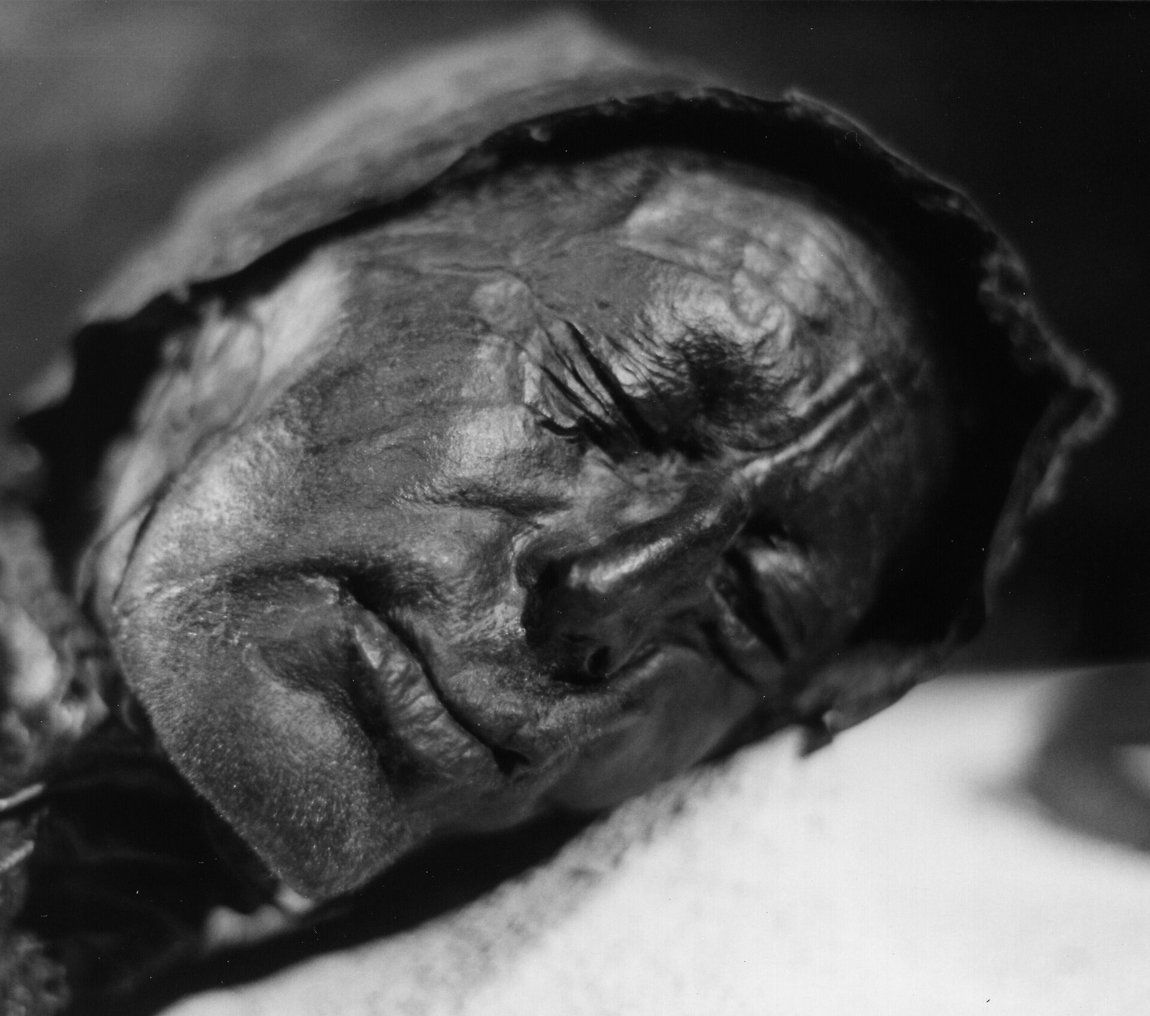
Most moving of all are the bog bodies – people so completely preserved by the peat moss that skin, hair, stubble, even the contents of the stomach survived. The Tollund Man from Jutland looks as if he were asleep; around his neck still lay the plaited cord with which he was hanged or strangled. The Grauballe Man, also from Jutland, died from a cut across the throat. In the German-speaking and southern Scandinavian region there are further finds – such as the Windeby child from Schleswig-Holstein and the Dätgen man. These finds cluster strongly in northern Germany, Denmark and the Netherlands, that is, in the north-west European bog belt.
What makes their interpretation so difficult is that the circumstances of death were often violent and strikingly "careful". Hanging, throat-cutting, sometimes additional binding or weighting – this suggests execution, punishment or ritual killing. Whether an individual case was a sacrifice, a punishment or something else, however, can almost never be decided with certainty. Here scholarship deliberately remains restrained.
It was not only weapons and people that entered the bog, but also precious equipment. From Dejbjerg in Jutland come two richly decorated, dismantled ceremonial wagons of the pre-Roman Iron Age – probably cult or procession wagons, deliberately laid down. More famous still is the Gundestrup cauldron, a large, magnificently worked silver vessel that lay dismantled in a Danish bog. Its imagery is Celtic-Thracian in character and probably originates from south-eastern Europe; in the Danish bog it is a stranger that honestly shows how far objects could travel at the time. We treat both finds separately – see our own article on the Gundestrup cauldron. Important for the overall picture: such showpieces were not lost but placed in the bog deliberately, and often dismantled. This too points to acts of ritual meaning.
Alongside the spectacular stands the everyday. In Ireland, Scotland and Scandinavia, bog butter has repeatedly been found: lumps or small casks of butter or similar milk fat, buried in the peat and sometimes preserved for centuries. Whether this was storage – the bog as a cool, preserving larder – or a sacrificial gift is disputed and must be tested find by find. Some lumps are strikingly old and were apparently never retrieved, which, at least in individual cases, suggests a gift rather than forgotten stores. Beside this we know of tool hoards, bundles of implements and single ornaments from bogs. Here too the rule holds: hoard, hiding place and sacrifice sometimes look alike in the ground.
One of the few ancient passages linked to bog finds comes from Tacitus. In his work on the Germanic peoples he reports that certain offences were punished by sinking in the mire:
Cowards, those who shrink from battle, and the shamefully depraved are sunk in mud and swamp, with wicker-work thrown on top.Tacitus, Germania 12 (rendered from the Latin text)
This passage is valuable, but it carries less weight than is often claimed. First, Tacitus writes as an outsider about a region he never visited, relying on reports. Second, he speaks of punishment of particular groups of people – not expressly of sacrificial acts to deities. One may therefore think of it alongside the bog bodies, but should not conclude that every bog body was a punished "coward". The account offers a possible interpretive frame, not proof of the individual case.
Well attested: The army sacrifices of Nydam, Illerup Ådal, Ejsbøl and Vimose consist of thousands of, often deliberately destroyed, pieces of equipment and date mainly to the Roman Iron Age (roughly the 1st–5th centuries AD). The bog bodies such as the Tollund and Grauballe men belong securely to the pre-Roman Iron Age through radiocarbon dating. The extraordinary preservation through the exclusion of oxygen and the action of humic acids is scientifically beyond doubt.
Myth check: The famous bog bodies are NOT "Vikings". The Tollund and Grauballe men lived in the pre-Roman Iron Age, that is, many centuries before the Viking Age (which only begins around AD 793). The Gundestrup cauldron, too, is Celtic-Thracian and pre-Viking. And: not every bog find is a "human sacrifice". The choice between punishment, sacrifice and loss is often open in the individual case and must be tested against the evidence – Tacitus's note on punishment is an interpretive frame, not proof.
Scarcely anything is confused about bog finds as often as their chronology. Radiocarbon dating has brought clarity here: the classic bog bodies belong overwhelmingly to the pre-Roman Iron Age and the early Roman period, broadly the last centuries before to the first centuries after the turn of the era. The great weapon sacrifices set in somewhat later and reach deep into the Imperial and Migration periods. This means: between a Tollund Man and a Viking-age warrior lies more time than between us and the High Middle Ages. To throw bog bodies and Vikings into one pot is to leap over almost an entire millennium. For an honest handling of history, this distinction is decisive.
A sound approach to a bog find follows a sober series of questions. How old is the find in fact – proven by scientific dating, not by gut feeling? In what condition did it enter the bog: intact, used, deliberately destroyed? Does it lie alone or in a larger accumulation? Does it fit a known pattern, such as that of the army sacrifices, or does it stand on its own? Only from such observations can one cautiously infer whether it is more likely a sacrifice, a hoard, a loss or a punishment. This restraint is not a weakness but the mark of serious work: the bog delivers an extraordinary number of facts – but interpretation remains work on the individual case.
In the end, the sacrificial bogs are a double gift. They give us physical testimony of a quality no dry ground offers – wood one wants to touch, faces that look back at us across millennia, weapons still bearing the traces of a single battle. And they give us a sense of how people in the pre-Roman and Roman-era North thought: that there were powers to whom one owed something, and that the threshold between land and water was the right place to give. Anyone who regards these finds with respect and precision need invent nothing and inflate nothing. The truth, as far as we know it, is impressive enough.
Sacred Places of the North · The bog army-offerings · The Gundestrup cauldron · Sacred Springs & Well Cult.
All Festivals & Belief articles →
Between the years lies a time that ticks differently: the Rauhnächte, the Twelve Nights around the winter solstice. The …
Read more →Emperor Barbarossa sits in the Kyffhäuser, his head propped on the table, his beard grown through the stone slab …
Read more →