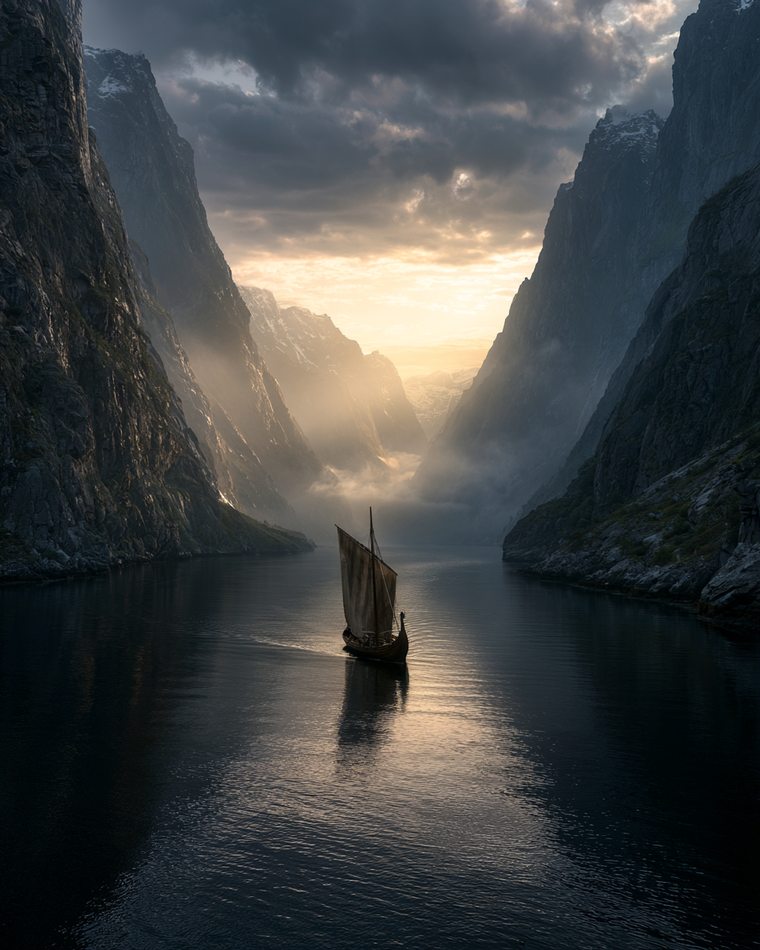
In the North a mountain is rarely just a mountain. In the sagas the dead live inside it, giants dwell in its clefts, and some rocks carry images thousands of years older than any longship. We sort out what is documented – and what modern longing reads into the landscape.
Anyone reading the old texts of the North quickly notices that mountains, rocks and waterfalls are not mere scenery. They act. A hill can house a family, a rock can be a doorway, a cliff can mark the border between the living and the dead. This idea is old and widespread – yet almost everything we know about it in detail comes from comparatively late sources. That is exactly why an honest look pays off, one that does not mistake the beautiful story for what archaeology and textual criticism actually support.
The Germanic-Norse world knew no split between "nature" and "the sacred" in the modern sense. Certain places were considered charged – not because a doctrine ordered it, but because a family knew its dead there, because a rock had carried images since time out of mind, or because a mountain loomed so heavily over a valley that people credited it with power. Holiness was local, concrete and tied to a family.
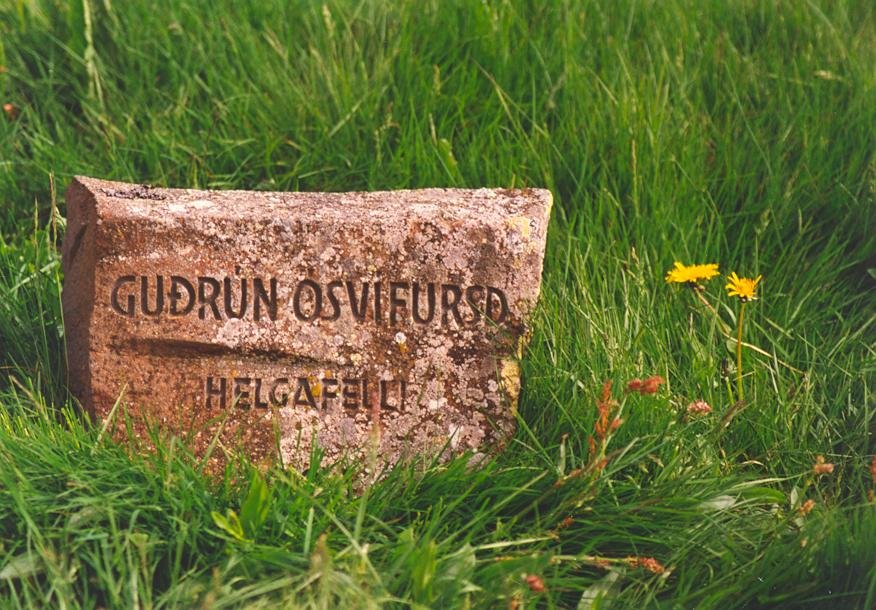
The strongest and best-known idea is the mountain as the dwelling of the departed. One "goes into the mountain" (Old Norse deyja í fjall or ganga í fjall): the dead do not leave the family entirely but move into a nearby hill or mountain and live on there, often more sociably and cheerfully than one would expect of a grave. The classic evidence is in Eyrbyggja saga: the settler Þórólfr Mostrarskegg consecrates a mountain called Helgafell – "holy mountain" – and believes that he and his kin will enter it after death.
He placed such great faith in this mountain that no one was allowed to look toward it unwashed, and nothing was to be killed on the mountain, neither livestock nor man, unless it left of its own accord. He called this mountain Helgafell and believed that he would enter it when he died, and all his kinsmen on the headland with him.Eyrbyggja saga, ch. 4 (rendering after the public-domain Old Norse edition)
Later in the same saga a herdsman sees the mountain open: inside, fires burn, there is drinking and merriment, and the dead kin welcome the newly deceased to his old seat of honour. This is not a gloomy realm of the dead but a continuation of hall life inside the rock. Similar motifs – the dead man living on, singing or keeping watch in his burial mound – run through many Icelandic sagas and through the notion of the haugbúi, the "mound-dweller".
Remarkable in the Helgafell passage is the purity rule: one must not look at the mountain unwashed, and no blood might be shed on it. This shows that holiness here came with rules of conduct – much like a vé, a fenced sacred precinct in which peace had to reign. The mountain was therefore less a pilgrimage site than a place with rules whose violation brought misfortune.
The social order inside is also striking: whoever entered took his place by rank, just as in the hall. Death did not dissolve the family; it merely relocated it. For people in a world without a firm central state, wholly dependent on family and neighbourhood, this was a comforting thought: you stayed where you belonged.
Besides the dead, another power peopled the mountains: the giants. In mythic geography Jötunheim, the home of the jötnar, lies at the rugged edges of the inhabited world – in rock wastes, ice caves and impassable highlands. Giants here are not merely monsters but the older, wilder powers from which the world itself arose: from the primeval giant Ymir the gods shaped mountains out of bones and cliffs out of teeth. In the worldview the mountains are literally "made of giants".
This double occupancy – mountain as home of the dead and as land of giants – is no contradiction. Both ideas share the same core: the rock is the zone of the Other, of what lies beyond farm and field. Whoever went into the high mountains left the ordered world of humans and entered a space belonging to ancestors and giants alike.
Countless rock faces in Scandinavia bear pecked images: ships, sun wheels, people with raised arms, animals, ploughs, footprints. At first glance they look like a window into "the old religion" – and are readily linked with Vikings. Here historical honesty matters most: the great rock-art complexes such as Tanumshede in Bohuslän or the images at Alta belong overwhelmingly to the Nordic Bronze Age (roughly 1800–500 BC), that is, many centuries to millennia before the Viking Age.
What is certain: these rocks were visited and carved again and again over long spans, often at places that then lay close to the water. Much suggests they had to do with cult, seasons and community. But what exactly the images meant we do not know – any reading as "sun god" or "fertility rite" remains interpretation. And a direct link to Odin, Thor or the runes cannot be shown: the classic Germanic god-names and runic writing appear only much later.
Evidence: The idea of the dead dwelling "in the mountain" is chiefly attested in literature – most clearly in Eyrbyggja saga (13th century) around Helgafell on Iceland's Snæfellsnes peninsula. The mountain really exists, still bears the name today, and the purity rules are part of the transmitted story. Archaeologically documented, by contrast, are the many burial mounds holding graves with grave goods – the material basis for the belief that the dead "remained" in one place.
Besides whole mountains, individual stones were held special too. In folk tradition, and already in medieval church lists of forbidden practices, "offering stones" appear – boulders or rocks at which food, fat or small gifts were laid down to ask for luck, health or a good harvest. Some of these stones carry bowl-like hollows, so-called cup-marked stones, into which offerings or liquids were poured.
Caution is needed here too: such cup marks are often prehistoric and hard to date; their use sometimes spanned millennia and shifted in meaning. The Carolingian Indiculus superstitionum, a Frankish list of pagan customs from the 8th century, expressly forbids the veneration of stones, springs and trees – an indirect but hard piece of evidence that people did exactly that. What they were thinking, however, the list does not tell us.
A motif still alive today is the hero or king who did not die but sleeps in the mountain and will one day return. The most famous form is the German Kyffhäuser legend cycle around an emperor Frederick (Barbarossa or Frederick II), whose beard grows through the stone table. Related legends are known from many European mountains.
As tempting as the bridge to the Norse mountain-of-the-dead idea is, one should not overstretch it. The "sleeping kings" are overwhelmingly high- and late-medieval to early-modern legends, often with a Christian and national flavour. They show the same age-old feeling that a mountain can "keep" someone, but they are not a direct continuation of heathen ancestor belief. It is a kinship of motifs, not an unbroken thread.
In the north of Scandinavia an independent religious tradition lives to this day that must be kept clearly separate from "the Vikings": that of the Sámi. In Sámi religion there were and are sacred mountains and sieidi – striking rocks, stone formations or lakes regarded as the seat or intermediary of powers and at which offerings were made, for instance with fish fat, antlers or reindeer parts. Whole mountains could be considered holy and might be entered only under rules.
This practice was partly contemporary with the Viking Age, and there was neighbourly exchange between North Germanic peoples and the Sámi. But it is not an offshoot of Norse mythology; it is a distinct, ancient culture with its own language, its own deities and its own worldview. To lump it in with Odin and Thor would be disrespectful and simply wrong. Whoever speaks of the sacred mountains of the North should name the Sámi tradition – and at the same time keep it cleanly apart.
Across all cultures, humans draw a line at certain points in the landscape between the everyday and the otherworld. A mountain outlasts generations while the human passes; a rock carries images no one can explain any longer; a cliff feels like a threshold. From such experiences grows the sense of holiness – not from a theory but from the experience of permanence, size and strangeness.
That is precisely why the subject stays compelling without our having to inflate it. The Northerners thought their dead into the mountains, the giants to the edges of the world, and their forebears carved images into the rock long before them. That is more than enough history – no need to make an "energy mountain" of it.
Myth check: "Going into the mountain" is attested mainly in the Icelandic sagas of the 13th century – roughly 200 years after the end of the heathen era, written down by Christian authors. How widespread the belief was in the Viking Age itself is uncertain. The famous rock carvings are overwhelmingly Bronze Age, thousands of years older than the Vikings, and have nothing to do with Odin, Thor or runes. From the modern esoteric "power mountain" or "energy site" no path leads back to the sources – that idea is an invention of the 19th and 20th centuries. And Sámi sacred mountains and sieidi belong to a culture of their own; they are not "Viking sanctuaries" and must not be blended with Norse mythology.
Sacred Places of the North · The sleeping kings in the mountain · Jotunheim · Helheim · Sacred Trees & Groves.
All Festivals & Belief articles →
Where water rises from the earth, the familiar world ends and another begins. To the people of the Germanic and Norse …
Read more →There are cosier Christmas figures than a house-sized cat that prowls through the winter night to check who did not …
Read more →