They carry their boats overland from lake to lake and raid the Norwegians across the mountains. That is all we learn about the Kvens at first hand. A trader from northern Norway tells it at King Alfred's court around 890, a scribe writes it down, and so begins a story made almost entirely of gaps. Later an Icelandic saga gives the Kvens a king, and a canon of Bremen turns their country into a realm of women. We sort out what holds up.
From the Viking Age there is exactly one source on the Kvens that comes from someone who knew the region. Add to it a handful of mentions from the eleventh to thirteenth centuries, none of them based on first-hand knowledge. That is thin. Anyone who draws precise maps of "Kvenland" today or gives the Kvens a list of kings is writing more than the sources allow.
We say this not to belittle the subject. Quite the reverse: precisely because there is so little, every line deserves a close look. And there is a second problem to keep in mind along the way – the word Finnr. More on that shortly.
Around 890 a man called Ohthere came to the court of Alfred the Great. He came from Hålogaland, lived, by his own account, furthest north of all the Norwegians, and told what he knew about his homeland and the peoples around it. His report was inserted into the Old English version of Orosius' world history. Who he was and where he sailed we tell in detail under Ohthere of Hålogaland. Here only one passage matters.
Ohthere describes Norway as a long, narrow land between sea and mountains. To the south, beyond the mountains, lies Sweden; to the north, Cwena land. Then he says:
Þa Cwenas hergiað hwilum on ða Norðmen ofer ðone mor, hwilum þa Norðmen on hy. And þær sint swiðe micle meras fersce geond þa moras, and berað þa Cwenas hyra scypu ofer land on ða meras and þanon hergiað on ða Norðmen; hy habbað swyðe lytle scypa and swyðe leohte.
"The Kvens sometimes raid the Norwegians across the mountains, and sometimes the Norwegians raid them. And there are very large freshwater lakes up in the mountains, and the Kvens carry their ships overland to the lakes and raid the Norwegians from there; they have very small and very light ships."Old English Orosius, account of Ohthere; our translation
It is brief but concrete. For Ohthere the Kvens are a people of their own with a land of their own, not Sámi – those he calls Finnas and describes elsewhere as hunters, fishers and fowlers. The Kvens appear as opponents on equal terms: raids go both ways. And they travel the way people really did travel in the interior of northern Scandinavia and Finland, in light boats on lakes and rivers, carried overland between one water and the next.
The geographical introduction of the same Old English translation also knows the country. It says, in effect, that north of the Swedes, beyond the wastelands, lies Cwenaland. That is probably not an independent second source but the same knowledge from the same circle. It does show that the name was understood at Alfred's court as part of a map of the North.
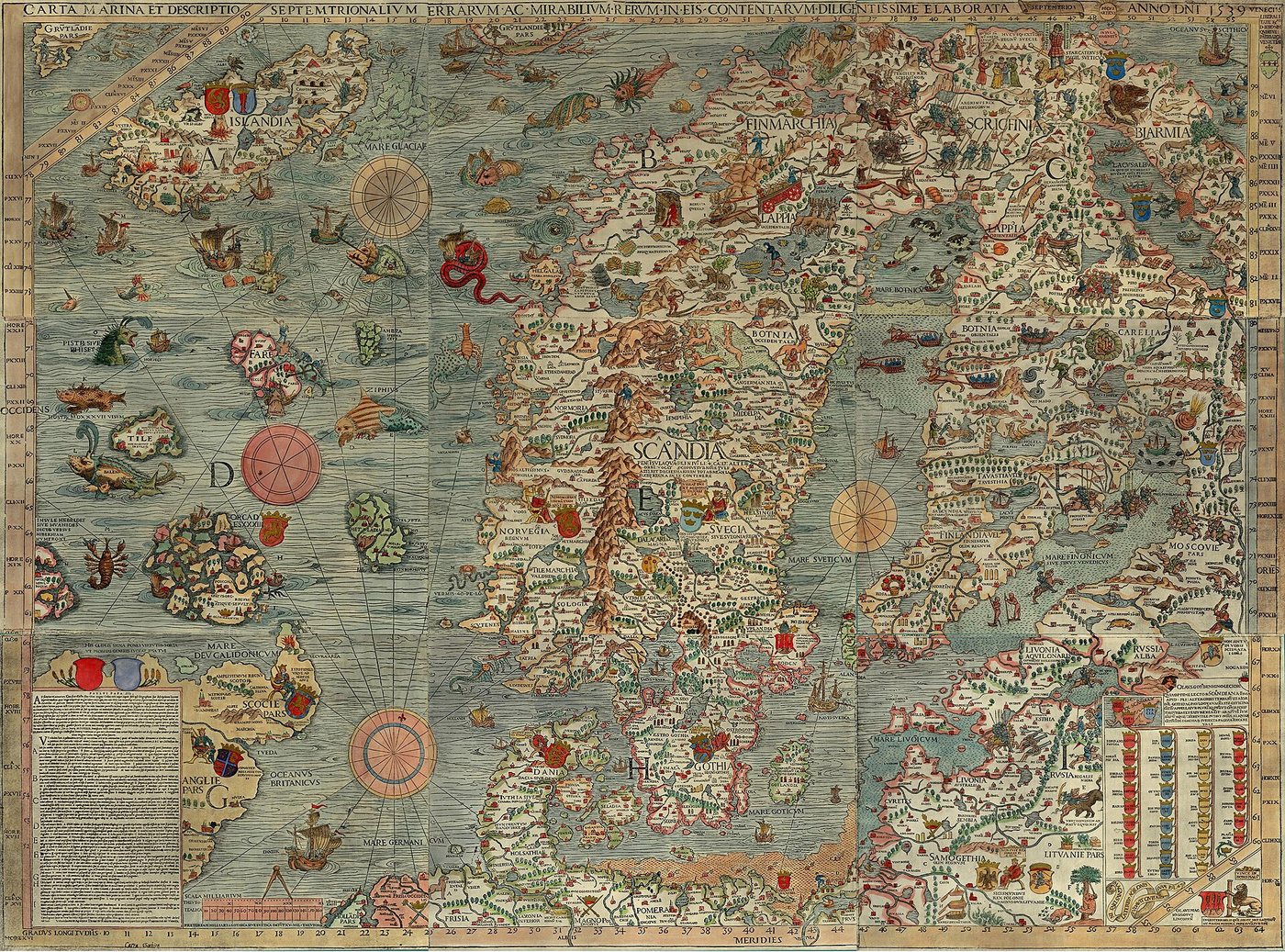
Ohthere says "north" – meaning, seen from southern Norway, the direction in which one crosses the mountains. Most scholars therefore place Kvenland at the northern end of the Gulf of Bothnia, in today's northern Sweden and Finnish Ostrobothnia, where from northern Norway one could cross the mountains and continue by lake and river. It is a well-founded interpretation, but an interpretation. Ohthere gives no places, no distances, no names.
The origin of the name is disputed too. There are several proposals, among them a link to the Finnish regional name Kainuu. None is generally accepted. We do not commit ourselves, because the sources do not allow it.
Some three hundred years after Ohthere, the Kvens get a story. In Egils saga, usually dated in Iceland to around 1220–1240, Thorolf Kveldulfsson, uncle of the poet Egill, goes north as King Harald's man to collect tribute from the Sámi. There he meets envoys from Kvenland. Their king, Faravid, asks for help against the Kirjálar, the Karelians, who are ravaging his land. Thorolf crosses the fells in winter with a hundred men, the two make an alliance, defeat the Karelians and share the plunder.
It reads well, and it is the only time a king of the Kvens is named. Still, it should not be read as a ninth-century report. The saga is literature with a historical core that cannot be checked for this episode. Faravid appears in no other source. What the saga does show is that thirteenth-century Iceland still knew there had been a land of the Kvens east of the mountains, and imagined relations with them as a mix of war, alliance and trade. That fits Ohthere. It is no evidence for Faravid.
Around 1075 Adam of Bremen wrote his history of the archbishops of Hamburg, with a long description of the North in its fourth book. He never travelled there himself; his knowledge came from conversations, above all with the Danish king Sven Estridsson, and from classical authors. In several places he mentions a terra feminarum, a "land of women", on the shores of the Baltic, where Amazons were said to live. In one story Anund, son of a Swedish king, sets out to enlarge the realm, reaches the patria feminarum and dies with his army because the women have poisoned the springs.
Since the nineteenth century it has been suspected that a mishearing lies behind this. The Old Norse word kván or kvæn means "woman, wife", and the name of the Kvens sounds almost the same. Anyone who heard of Kvenland in Old Norse with the Amazons of antiquity in mind could easily turn it into a land of women. There was a literary model as well: at the end of his Germania Tacitus writes of the Sitones in the North, who are ruled by a woman.
This explanation is obvious and widely held. It cannot be proved. Adam never names the Kvens as such, and he places his land of women closer to the eastern Baltic than to the Gulf of Bothnia. Whether he meant Kvenland or simply put an old scholarly fable at the edge of his map remains open. We think it likely that both played a part.
The Latin Historia Norwegie, usually dated to the second half of the twelfth century, lists the heathen peoples living north and east of Norway: Kiriali et Kwæni, Cornuti Finni ac utrique Biarmones – Karelians and Kvens, "horned Finns" and both peoples of the Bjarmians. Who the horned Finns are supposed to be, nobody knows for certain. What matters here is that the Kvens stand next to the Karelians, as a people of the east, not as part of the Sámi.
Deeper into legend lead the short tale Hversu Noregr byggðist and a passage at the start of Orkneyinga saga. There a king called Fornjót rules a land "called Finland and Kvenland", and his descendants settle Norway. That is origin myth, not historical knowledge. It shows, though, that in the thirteenth century Kvenland was still a term with which one could describe the beginning and the edge of one's own world.
Here lies the second trap. Old Norse Finnr, plural Finnar, almost always means in sagas and laws what we now call the Sámi. Finnmǫrk, Finnmark, is the land of the Sámi, not of the Finns. When a saga says a hero travelled to the Finns to fetch furs, or that a "Finnish woman" knew sorcery, the Sámi are meant. Ohthere's Finnas are Sámi as well.
Finns in today's sense, the people east of the Gulf of Bothnia, appear in the sources under other names: as Kvens, as Karelians, as Tavastians, and also under the regional name Finnland, found on runestones and in later texts. So when a translation says "Finns", check what the original says. More on the Sámi and how the Old Norse texts portray them is in our article on the Sámi in the Norse sources.
The name has not vanished. In northern Norway, above all in Troms and Finnmark, there are people who call themselves Kvens. Their ancestors came mostly in the eighteenth and nineteenth centuries from Finnish-speaking areas of northern Sweden and northern Finland, such as the Torne valley. Norway has recognised the Kvens as a national minority since the late 1990s, and their language as a minority language in its own right since 2005.
Whether there is a direct link between these Kvens and Ohthere's Cwenas is an open question in research. The name is the same, the sources in between are sparse, and the modern immigration is well documented. More cannot honestly be said, and we will not claim more here.
Contemporary evidence is exactly one account: Ohthere around 890, with Kvens who carry boats overland and raid Norwegians across the mountains, and Norwegians who do the same in return. Add the mention of Cwenaland in the geographical introduction of the same work.
Archaeologically a people called Kvens cannot be pinned down. Finds from northern Scandinavia and Finland show trade, hunting and contact, but no label with a people's name on it.
Later tradition is King Faravid in Egil's saga, the Kvens in the list of the Historia Norwegie, and King Fornjót ruling Finland and Kvenland.
Modern interpretation covers the location of Kvenland on the Gulf of Bothnia, the origin of the name and the explanation of Adam's land of women as a misreading of kvæn. All well argued. None of it certain.
What remains is a people made of a few lines who still cannot be left out of the history of the North: light boats on distant lakes, and the mountains between, crossed in both directions. For courage. For memory. For legends that live on.
Ohthere of Hålogaland · The Sámi in Norse Sources · Adam of Bremen · Egill Skallagrímsson · Danes, Swedes, Norwegians · The Jämtlanders.

