 A goddess, a rash bargain with a king, and a single night in which four giant oxen rip a whole island out of the ground: the Gefjon story is one of the rare tales in which a Norse goddess herself shapes the land. Let us look closely – honestly, with an eye on the sources.
A goddess, a rash bargain with a king, and a single night in which four giant oxen rip a whole island out of the ground: the Gefjon story is one of the rare tales in which a Norse goddess herself shapes the land. Let us look closely – honestly, with an eye on the sources.
Snorri Sturluson counts Gefjon (also Gefjun or Gefion) expressly among the Æsir. In his list of goddesses in the Prose Edda he places her among the Ásynjur and adds a note that says much about her image in tradition: she is served by those women who die unmarried. Gefjon is thus at once a mistress of maidens and – through the plough – a figure of fertility and tillage.
The name itself points in a giving, granting direction; linguistically it is linked to the verb “to give.” The etymology is not fully secure, but it suits a goddess who wins something from a king and creates a new piece of earth in return. In the surviving texts Gefjon remains a minor figure with one great scene – and it is precisely that scene that made her immortal.
One linguistic trace is worth noting, drawn by some scholars: the Old English word “geofon” means the sea, the flood. Whether Gefjon’s name is related and once denoted a water- or sea-linked deity remains conjecture – it is not certain. What is certain is that in the North she was closely tied to the plough and to the border between land and water. It is exactly on that border – where land is torn from the sea and water is left behind – that her most famous deed unfolds.
The tale opens Snorri’s “Gylfaginning” (the “Beguiling of Gylfi”) and appears again in the “Ynglinga saga,” the first part of his kings’ history “Heimskringla.” Gylfi ruled the land “now called Sweden.” When a wandering woman had entertained him well with her art, he promised her as a reward as much ploughland as she could turn with four oxen in a day and a night.
A generous but careless offer – for the wandering woman was no ordinary travelling singer but Gefjon of the race of the Æsir. The motif is ancient: a powerful man gives a rash promise, and a cunning figure takes him at his word. What sounded to Gylfi like a handful of fields became the loss of a whole tract of land.
Snorri sets the scene deliberately at the very start of his work. In the “Gylfaginning” it is this same Gylfi who later – grown curious about who these mighty Æsir really are – journeys to Asgard and is drawn into long conversations about the world of the gods. The Gefjon episode is thus a kind of prologue: it shows from the outset that the Æsir surpass humans in cunning and power. That Snorri also placed the same tale in his kings’ history reveals how important the link between god-tale and Danish national history was to him.
Gefjon fetched four oxen from the north, from the giant-land of Jötunheim. Snorri says plainly who these beasts were: her own sons, begotten with a giant. She yoked them to the plough, and the team drew a furrow so deep and vast that the land tore loose and was dragged out to sea.
The oldest witness to this scene is not a storyteller but a skald: Bragi Boddason, who was already composing in the 9th century. Snorri quotes his verses, and they are the true foundation of the tale:
Gefjun drew from Gylfi, rich in stored-up treasure,
The land she joined to Denmark. Four heads and eight eyes bearing,
While hot sweat trickled down them, the oxen dragged the reft mass
That formed this winsome island.
Bragi Boddason, Ragnarsdrápa (quoted in Snorri’s Gylfaginning), trans. A. G. Brodeur 1916
“Four heads and eight eyes” – the image of the straining ox-team with its steaming flanks is one of the most vivid in all Norse poetry.
The torn-out land, says Snorri, the oxen dragged westward into the sea, where it came to rest: the Danish island of Zealand (Sjælland). Where the land had been lifted out, water remained. In the “Ynglinga saga” Snorri calls this lake “Lögrinn” – today’s Lake Mälaren in Sweden. He even adds a neat observation: the bays of the lake correspond to the headlands of Zealand, as if one had been cut out of the other.
A popular version to this day names Lake Vänern instead, because its outline resembles Zealand. Snorri’s text does not say so – he names the Mälaren. Either way it is the same narrative principle: a landscape becomes the memory of a divine deed, a hole here answering to an island there. Such aetiologies – explanatory tales for mountains, lakes and islands – are at home in many cultures; in the North, Gefjon’s night of the plough is the finest example.
In the flyting poem “Lokasenna” Gefjon is given a small but telling role. When she speaks up in warning, Loki at once turns on her: he accuses her of having given herself to a young man for a jewel. Odin defends her, saying that Gefjon knows the fates of the world as well as he does himself.
The passage is delicate and read in various ways. It seems to clash with Snorri’s picture of the mistress of those who die unmarried – or it adds a different, older facet: a goddess concerned with fertility, gift and favour, one who does not follow the Christian-tinged ideal of chastity of a later age. Loki’s taunt is in any case no factual report but the weapon of a slanderer eager to pin something on everyone at the table.
Behind the island-tale lies a deeper idea: Gefjon is the goddess who drives the plough. The plough breaks the earth open, makes it fruitful, turns wilderness into field. That a goddess of all people – with her own children as draught animals – accomplishes this work binds motherhood, strength and tillage into a single image.
Some scholars have therefore placed Gefjon near the great fertility goddesses of the North, in the circle of Freyja or of the earth-bound Vanir. Such an equation cannot be proven; the texts treat Gefjon as a figure in her own right. What can be held onto: she belongs to those female powers through which the North thought about giving, growing and cultivating – and she is one of the very few to own a landscape-tale of her own.
It is also striking that Gefjon draws her power not from herself alone but from her children. The four oxen are her sons – motherhood and muscle, origin and work flow together in a single image. Where other creation stories tell of giant-bodies or divine words, here land arises from family labour: the goddess guides, the sons pull. Perhaps that is the real reason the tale has stayed so alive across the centuries – it tells of creation not as a distant miracle but as one night of hard, shared work.
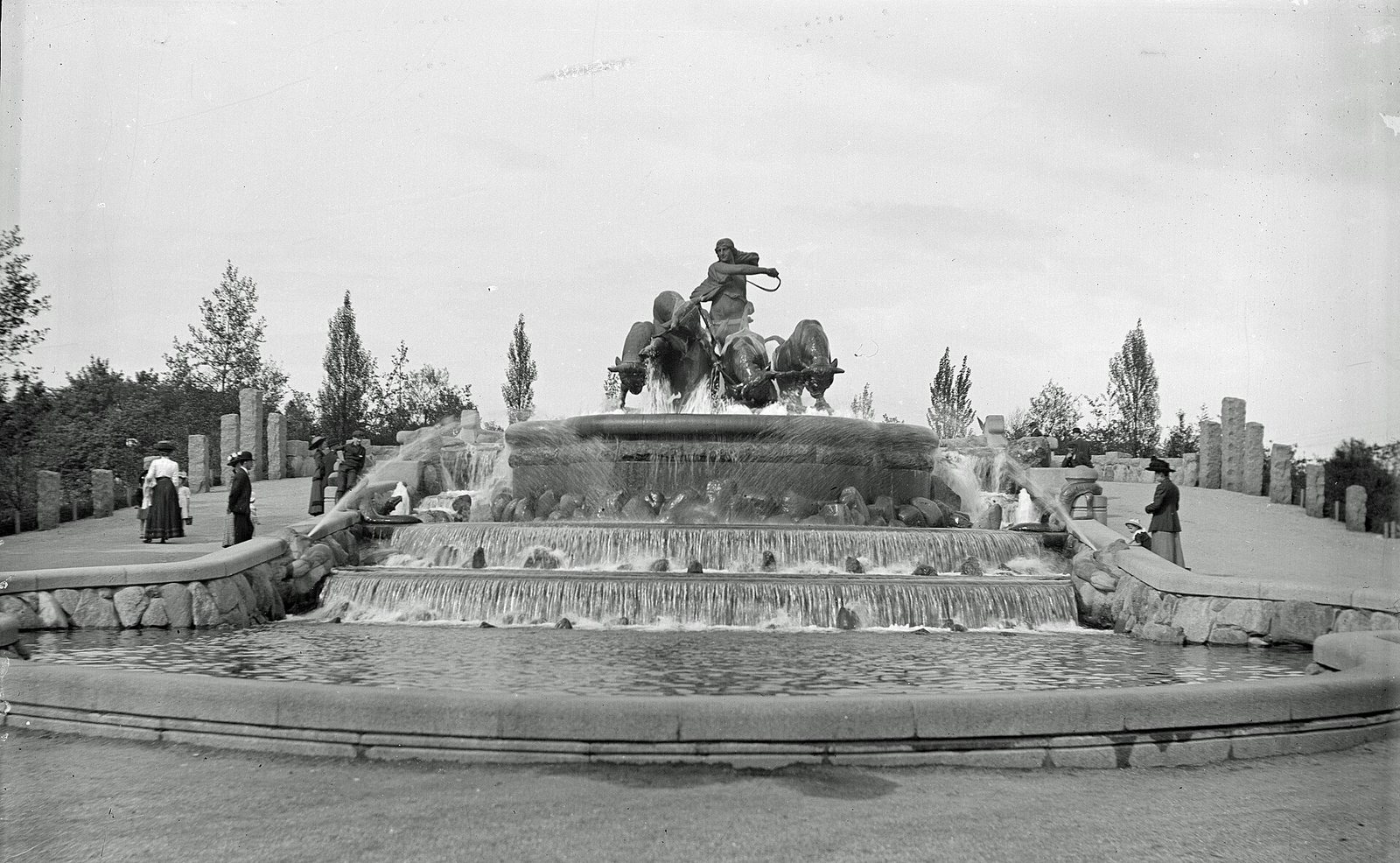
Anyone looking for Gefjon today will find her most prominently in the harbour of Copenhagen. The great Gefion Fountain (Gefionspringvandet) shows the goddess driving her four oxen with tremendous force, water crashing down the rock steps. The image is striking – but young: the sculptor Anders Bundgaard created it, funded by the Carlsberg Foundation; the fountain was unveiled in 1908.
The fountain is a work of the modern age, not of the Viking Age. It shows how alive the old tale has remained and how gladly the 19th and early 20th centuries pictured the Norse gods as heroic monuments. Enjoy it for what it is: a grand artistic retelling – not a historical witness to any actual cult of a goddess named Gefjon.
Gefjon is a quiet goddess with a loud scene. We know little of any cult, almost nothing of feasts or temples. But we do have one of the loveliest explanatory tales of the North: the night in which an Ásynja outwitted a king, yoked her sons to the plough and tore Zealand out of Sweden. That story holds everything that makes Norse poetry what it is – wit, force, and a way of seeing the land that turns every lake and every island into the trace of a divine deed.
The Gefjon tale is well attested: its oldest core is a stanza by the skald Bragi Boddason (9th c.), which Snorri quotes in the “Gylfaginning” (Prose Edda, c. 1220); the fullest narrative stands there and in the “Ynglinga saga” of the “Heimskringla.” Gefjon’s rank as an Ásynja, her sons as oxen, the torn-out Zealand and the lake left behind belong to the firm stock of these texts. “Lokasenna” names her too. Gefjon is thus one of the few goddesses with a story of her own that the sources can actually pin down.
Much hangs on Snorri, who wrote some two centuries after conversion and often ordered and interpreted the gods. Whether the lake “behind” Zealand is the Mälaren (so Snorri) or – as in the popular version – Lake Vänern is narrative, not geography. Gefjon’s role as “goddess of maidens” (Snorri) and Loki’s taunt (Lokasenna) contradict one another and cannot be reduced to a single note. And the famous Gefion Fountain in Copenhagen is a monument of 1908 – a modern work, not a Viking-Age witness.
Freyja · Frigg · The Norse pantheon · Njörðr – god of the sea · Aesir & Vanir.
All Gods & Goddesses articles →
Heimdall is the watchman who never sleeps – the god who hears the grass grow and the wool sprout on the sheep. Born of …
Read more →Not every dead man came to Valhalla. Most people – all who died of sickness and age – went to Hel. She is the mistress …
Read more →