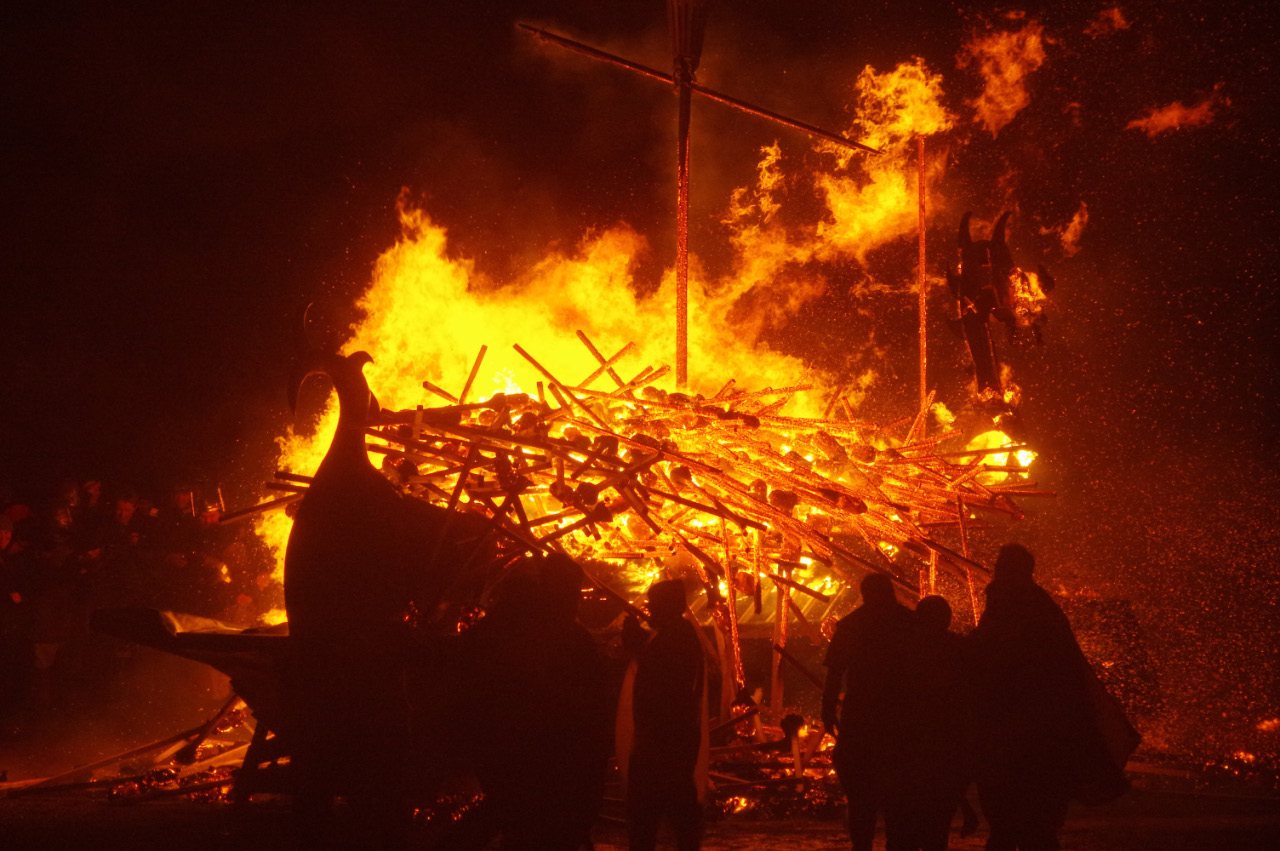
Up Helly Aa 2027 takes place in Lerwick on Tuesday 26 January – the last Tuesday in January, as every year. The Guizer Jarl leads his Viking squad through Shetland’s capital, and at 7.30 pm close to a thousand torchbearers march a replica longship to a playing field and set it ablaze before partying in the halls until dawn. It looks ancient, but it is a 19th-century creation. Here is the programme, the real history, and where Shetland’s Viking past genuinely lies.
Half past seven on a January evening in Lerwick. It has been dark for hours and the wind comes straight off the Atlantic. Then a rocket hisses up over the Town Hall, and in the same moment some nine hundred torches flare into life. A river of fire begins to move. At its head marches a squad in mail, helmets and cloaks, and between them rolls a ten-metre longship with a dragon’s head. Half an hour later the ship is a roaring pyre and the crowd is singing.
This is Up Helly Aa, Scotland’s best-known fire festival and quite possibly the most famous “Viking festival” on earth. Which is exactly why it deserves a closer look: what is genuinely Viking Age here, what is Victorian romance, and what is simply Shetland community spirit? Fair warning: the festival is not a thousand years old. But the story it tells has a very real core.
The rule is simple: Lerwick holds Up Helly Aa on the last Tuesday in January. For 2027 the organising Up Helly Aa Committee gives the date on its official website as Tuesday 26 January 2027. The following day is a local public holiday in Lerwick, which is just as well, because the celebrations run into the small hours.
The festival has not always gone ahead. According to the committee it was cancelled in 1901 after the death of Queen Victoria, from 1914 to 1919 and from 1940 to 1948 because of the two world wars, and in 2021 and 2022 because of the Covid-19 pandemic.
If you are planning a whole year of Viking events, have a look at our guide to Viking festivals in 2027 and our events page.
A guizer is someone in disguise – from “guise” – and masked, costumed visiting at New Year has a long history in Scotland. The Guizer Jarl is the chief guizer and the festival’s leader, a jarl for a day. “Jarl” comes from Old Norse and meant an earl or ruler; in the northern isles the earls of Orkney held power for centuries, and Shetland long belonged to their sphere.
Nobody becomes Guizer Jarl overnight. The usual route is some fifteen years on the committee. The Jarl takes on the persona of a figure from the sagas. In 2024 Richard Moar appeared as King Harald Olafsson; in 2025 Calum Grains took on King Eystein Magnusson, who ruled Norway from 1103 to 1123; the 2026 festival was built around the saga of Knut the Great. The character and the ship stay secret until the day.
Around the Jarl stands the Jarl Squad, made up of his own family and friends – around sixty strong in 2025. They are the only squad in Viking dress. The committee says their preparations begin in February, almost a full year ahead. The other squads, around 46 of them, wear entirely different costumes, often sending up politics, pop culture or local goings-on.
Up Helly Aa runs to a timetable a ferry company would envy. Based on the committee’s published programme, the day goes roughly like this:
The Bill, also called the Proclamation, is above all a large painted board set up at the Market Cross before dawn. The Jarl Squad stops in front of it in the morning, and the town reads it all day long. According to the committee, the first Bill of this kind appeared in 1899, originally to announce the building of the galley. Local jokes and satire crept in almost immediately.
A small committee writes the text in secret, the lettering is hand-painted the day before, and the Jarl signs it that evening. The heading shows a scene from his saga. Anyone mentioned in it gets laughed at by the entire town, and usually takes it in good part. That is a thoroughly Scottish, thoroughly Shetland tradition of mockery – and it owes very little to the kings’ sagas.
The heart of the evening is the torches. Across the senior and junior festivals, the committee says more than a thousand are made each year, over nine hundred of them for the senior procession. Made of hessian sacking with a small concrete “shoulder”, they are soaked in fuel on the Monday before. Volunteers build them over the winter, along with the galley, in the festival’s own workshop, the Galley Shed.
The galley is a replica Viking ship roughly ten metres long, with a dragon prow and painted shields along its sides. It is built new every year and given its own name – in 2024 the main ship was called Ethena and the junior galley Fenrir. In the procession the Guizer Jarl stands at the helm while his squad flanks the ship.
At the King George V playing field the torchbearers circle the galley, and then the torches are hurled in. Within minutes the ship is engulfed, and the burning is accompanied by singing. The burning site itself is closed to the public and the press, so you watch from the pavements along the route.
Once the galley has burned down, the part Shetlanders love most begins. Around a dozen halls – schools, community centres, the ferry terminal, the Town Hall – host the party. They are ticketed events run by volunteers. Each squad moves from hall to hall to perform its act: a sketch, a song or a dance, often in the costume of its own send-up. In the 19th century private households received the guizers; today almost every family in Lerwick is involved in some way.
The real history is younger and rowdier than the helmets suggest. The standard study is the historian Callum G. Brown’s Up-helly-aa: Custom, Culture and Community in Shetland (Manchester University Press, 1998), which traces how a noisy winter custom became a tightly organised community festival within a few decades.
It starts with Christmas and New Year. According to the committee and the Shetland Museum, soldiers and sailors returning from the Napoleonic Wars brought rougher habits and firearms back to Lerwick. A visiting Methodist missionary noted that on Old Christmas Eve 1824 the town was “in an uproar”. Around 1840 came tar-barrelling: gangs of young men dragged blazing tar barrels on sledges through the narrow lanes, rival groups clashed, and respectable residents complained about the danger and the mess.
Can we draw a line from this back to pagan Yule? Not on the evidence. Centuries of Christian and early modern holiday customs lie in between.
Tar-barrelling ended in the 1870s. The committee says the young men simply moved on; other accounts stress pressure from the authorities, and dates for the final end range from about 1874 to 1880. What came next is clear: a group of young, educated men named the festival Up Helly Aa, moved it to the end of the Yule season in January, and replaced the barrels with disguises and an orderly torchlight procession.
The milestones, following Brown and the committee: in 1876 the first Yule torch procession; in 1877 the first hints of Viking themes; in 1881 the first torch procession on Up Helly Aa day itself; in 1882 an especially grand edition for the visit of Alfred, Duke of Edinburgh. The first galley was built and burned in 1889 by the usual reckoning (the official history says “the late 1880s”). The first Bill followed in 1899. The official history dates the first Guizer Jarl to 1906, and only after the First World War did a Viking Jarl Squad appear every year.
So the festival was some thirty years old before it fully took on its now-famous Viking form. An attempt to cancel it during the hard winter of 1931–32 failed, and from 1949, after the Second World War, it became the precisely organised event we know today.
The name sounds Norse, but only partly is. It goes back to the Scots Uphalieday, the day when the Christmas holidays came to an end. John Jamieson’s Etymological Dictionary of the Scottish Language explains “up” in this sense as “at an end, over”, linking it to Old Norse uppi. “Helly” is the holy day or holiday, and “Aa” is usually read as Scots a’, “all”. Roughly: “the holidays are all over”.
In rural Shetland there is also a recorded custom of marking the 24th day after Christmas as “Antonmas” or “Up Helly Night”, though the committee notes there is no evidence for it in Lerwick itself. Shetland’s Scandinavian roots lie less in the festival’s name than in the islands’ old language – more on that below.
Why Vikings, of all things? Because the late 19th century was obsessed with them. Britain, Scandinavia and Germany all went through a Nordic revival: sagas were translated – Snorri’s kings’ sagas, for example, by the Orcadian Samuel Laing in 1844 – painters and poets discovered the “noble Norseman”, and sensational finds such as the Gokstad ship, excavated in 1880, made Viking ships suddenly tangible. The era also gave us the horned helmet, unknown from real finds.
In Shetland this fashion met a particular sense of self. Norwegian until the late Middle Ages, the islands found in that heritage an identity distinct from mainland Scotland. A key figure was the blind Shetland poet J. J. Haldane Burgess. According to the BBC, his novel The Viking Path (1894) strongly shaped the festival’s Viking theme, and he also wrote the Up Helly Aa song that is still sung today.
Brown therefore reads Up Helly Aa as an “invented tradition” in the historian’s sense: not a fraud, but a deliberately shaped festival that gives a community a history it can be proud of. It is authentic all the same – authentic to the 19th century rather than the 9th.
The festival may be young, but the Vikings in Shetland are no invention. By the 9th century at the latest, settlers from Norway had made their homes on islands that lay almost on their doorstep as they sailed west. For the wider picture of the North Atlantic islands, see our overview of the Viking islands.
We have a full article on the site: Jarlshof in Shetland.
A second piece of evidence is printed on every map: the place-names. The great majority of Shetland place-names are Norse in origin. Lerwick comes from Old Norse Leirvík, “mud bay” or “clay bay”; Scalloway, the old capital, from Skálavágr, “bay of the hall(s)”. In the sagas the islands themselves are called Hjaltland.
Third, the language. Into the early modern period, people in Shetland and Orkney spoke Norn, a West Norse language closely related to Faroese and western Norwegian dialects. Norn gave way to Scots over the course of the 18th century; exactly when the last fluent speaker died is not securely known. But the Shetland dialect still carries a wealth of Norn words, especially for weather, sea, landscape and farming.
Politically, Shetland was long part of the world of the Orkney earls, whose story is told in the early 13th-century Orkneyinga saga. After a failed rising against King Sverre, crushed at the battle of Florvåg in 1194, the Norwegian king took Shetland away from the earl of Orkney in 1195 and placed it directly under the crown. It remained Norwegian for almost three centuries; in 1066 Harald Hardrada sailed for England by way of Shetland and Orkney.
The turning point came in 1468–69. Christian I, king of Denmark and Norway, pledged Orkney (1468) and Shetland (1469) to James III of Scotland as security for the dowry of his daughter Margaret. The pledge was never redeemed, and in 1472 the islands were formally annexed to the Scottish crown.
Ironically, the most hotly debated “tradition” of recent years had nothing to do with the Viking Age. For decades the Lerwick squads were men only; women ran the halls, cooked and danced, but did not march. A campaign called “Up Helly Aa for All” pushed for change. Other festivals had moved earlier: the South Mainland Up Helly Aa had its first adult female Guizer Jarl, Lesley Simpson, in 2015.
In June 2022 the committee announced that Lerwick squads could now choose their own members – explicitly including women and girls aged 16 and over who meet the usual five-year Shetland residence rule. The rule has applied since the January 2023 festival, the first after the pandemic break, and it includes the Jarl Squad. The Junior festival, which has run since 1956, opened up at the same time: in 2023, 27 of its 108 participants were girls. In 2024 women marched in the Jarl Squad for the first time.
That is no betrayal of Viking heritage: the men-only rule was a festival rule of the 19th and 20th centuries, not an inheritance from the Viking Age. For the evidence on women back then, see our articles on women in the Viking Age and the shieldmaiden myth.
Lerwick has the biggest festival, but not the only one. The season runs from January into March, mostly on Fridays, and dates shift each year, so check before you travel. According to a NorthLink Ferries guide for 2026, they include:
By ferry: NorthLink Ferries sails overnight every day from Aberdeen to Lerwick, arriving at around 7.30 am. Depending on the sailing the crossing takes about 12 or 14 hours; the longer one calls at Kirkwall in Orkney. Cabins around Up Helly Aa go early.
By air: Loganair runs several flights a day to Sumburgh Airport at the southern end of Mainland, roughly 40 kilometres from Lerwick. January weather can disrupt both flights and ferries, so build in a spare day.
Accommodation: Lerwick is small. Hotels, guest houses and self-catering places are often booked out months ahead. If you stay elsewhere on Mainland, plan how you will get back after midnight.
Weather and clothing: In late January Lerwick gets only a little over seven hours of daylight. Temperatures around freezing are normal, with wind, rain or sleet. Windproof layers, a hat, good boots – and warm hands for the camera.
In our Alsdorf workshop we engrave Viking-inspired motifs every day. Up Helly Aa shows that young and honest can go together. Shetlanders celebrate not the Viking Age itself but their connection to it – Jarlshof, their bay names, their dialect. And then it all goes up in flames, so the work can start again in February.
When is Up Helly Aa 2027? On Tuesday 26 January 2027 in Lerwick, Shetland. It is always held on the last Tuesday in January, and the torchlight procession starts at 7.30 pm.
How old is Up Helly Aa? The festival in its current form developed from the 1870s out of older Christmas and New Year customs involving burning tar barrels. The first galley was burned in the late 1880s, usually dated to 1889.
Is Up Helly Aa a real Viking festival? No, it is a 19th-century festival with a Viking theme. Shetland’s Viking Age is real, though: Norwegian settlers arrived in the 9th century, as Jarlshof and the Norse place-names show.
Can women take part in Up Helly Aa? Yes. Since the 2023 festival Lerwick squads may include women and girls aged 16 and over, and in 2024 women marched in the Jarl Squad for the first time.
Can tourists join the Up Helly Aa procession? You can watch the procession and read the Bill freely, but guizers in Lerwick must have lived in Shetland for five years. The Bressay festival, however, opens its procession to everyone.
How do I get to Up Helly Aa in Shetland? Take the NorthLink overnight ferry from Aberdeen to Lerwick or fly with Loganair to Sumburgh. Book travel and accommodation months in advance.
For courage. For remembrance. For legends that live on.
Jarlshof and the Shetlanders · The Earls of Orkney · The Vikings in Ireland, Scotland & the Isles · Boat burial – the burning ship · Viking festivals 2027 · Jól – the Yule feast.
Are you the thinker or the protector? The trickster or the watcher? The Norse pantheon isn't a distant gallery of idols …
Read more →Three big Viking festivals have fixed their 2027 dates so far: Up Helly Aa in Lerwick on 26 January, the Jorvik Viking …
Read more →The Norse world is full of strong women: Freyja, who rules over love and battle alike, the Norns who weave fate, Idun …
Read more →A tie, another shower-gel set, one more mug with a slogan — for birthdays and Christmas, men often get exactly what …
Read more →
