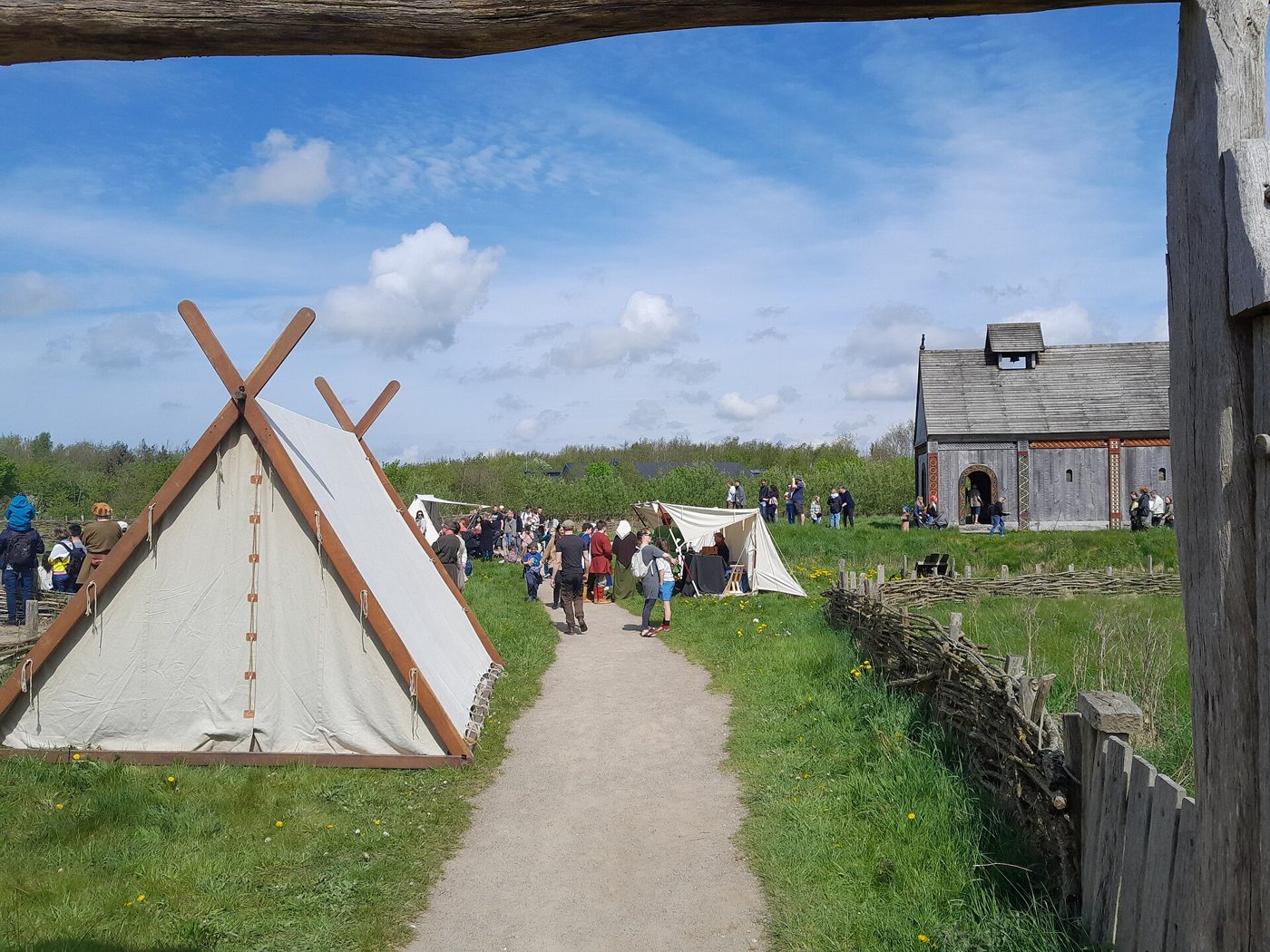
The Vikings were people from Denmark, Norway and Sweden who lived from about 793 to 1066. Most of them were not warriors at all, but farmers, craftspeople, traders and fishers. Some sailed off on raids, while others crossed the ocean to Iceland, Greenland and even North America. In this guide you will discover how Viking families lived in longhouses, what they ate, which toys children played with, which gods they believed in and which Viking myths are simply wrong. Plus: tips for your school project.
Picture a small island off the coast of England. On it stands a monastery, where monks live, pray and copy books by hand. The date is 8 June 793. Suddenly, sleek, fast ships with big square sails appear on the water. Men jump ashore, grab gold, silver and precious books, and carry off people as captives. The island is called Lindisfarne, and this raid is usually seen as the start of the Viking Age. You can read the full story in our article on Lindisfarne 793.
No wonder Vikings have a reputation as raiders. But that is only a small slice of the story. Most people in the North never went raiding. They sowed barley, milked cows, spun wool, built boats and told stories around the fire at night. And their children? They played, helped out, learned things and were probably bored now and then, just like you.
“Viking” was not originally the name of a whole people. In Old Norse, the language of the North, a víkingr was roughly “someone who goes on an expedition”. It meant men who set off by ship to trade, fight or raid. A farmer who stayed at home was, strictly speaking, just a farmer. Today we use the word for everyone in Scandinavia at that time.
Historians usually say the Viking Age ended in 1066, when the Norwegian king Harald Hardrada was killed at the Battle of Stamford Bridge in England. Dates like this are signposts historians use to find their way around the past. Like a school bell: it rings on time, but life carries on.
Key point: not all Vikings were warriors. Most lived as farming families. There were blacksmiths, comb makers who carved combs from antler, weavers, traders and fishers. Busy trading towns such as Hedeby, called Haithabu in German, near Schleswig in what is now northern Germany, were full of people from many lands.
The raids were real, though, and there is no point pretending otherwise. Vikings attacked monasteries, towns and villages in England, Ireland, France and elsewhere. They took treasure and captured people, whom they sold as slaves or forced to work for them. For the people who were attacked, it was terrifying. Other rulers of the time fought brutal wars too; history is rarely black and white.
A Viking child did not have a bedroom of their own. The whole family lived in one big room, or a few rooms, in a building called a longhouse. It was long and fairly narrow, often with gently curved walls, a bit like an upside-down boat.
Depending on the region, the walls were made of timber, of woven branches plastered with clay (called wattle and daub), or, in Iceland, of thick blocks of turf, grass cut out with the soil still attached. Roofs were covered with straw, reeds or turf. There were no glass windows. In the middle of the floor burned the long hearth, a long fireplace that was heating, cooker and lamp all in one. There was no chimney, so the smoke drifted out through a hole in the roof. Warm, yes, but pretty smoky too.
Along the long walls ran wide benches made of earth and wood. During the day people sat, worked and ate on them; at night they slept there on furs and blankets. On many farms the animals also spent the winter under the same roof, in a byre (a cattle shed) at one end of the house. They gave off extra warmth, and yes, you could smell them.
A farmhouse was often 20 to 40 metres long. Chieftains had enormous halls. At Borg in the Lofoten Islands in Norway, archaeologists found the remains of a chieftain’s house around 83 metres long, and a reconstruction now stands at the Lofotr Viking Museum. More in our guide to the Viking longhouse.
Pizza, chips and chocolate: no chance. Potatoes, tomatoes, maize and cocoa only reached Europe from the Americas centuries later, and nobody in the North had sugar. Sweet things meant honey, berries, apples and hazelnuts.
The most important food was grain, above all barley, plus oats and rye. People cooked it into porridge and baked flat bread on hot stones or iron plates. With that came peas, broad beans, onions and cabbage. Meat came from pigs, cattle, sheep and goats. With no fridges, meat and fish had to be smoked, salted or dried. In Norway, cod was hung up in the cold wind until it was as hard as a plank; this dried fish keeps for years. Milk became butter, cheese and curds.
People drank water, milk and whey, the liquid left over when you make cheese. Adults also drank ale, and mead made from honey at feasts. The Icelandic sagas, stories written down in the 13th century, often mention two main meals, one in the morning and one in the evening. For more, read our article on the Viking diet.
There were no schools like yours: no timetable, no homework. But children didn’t get the day off. The National Museum of Denmark in Copenhagen explains that children were put to work from a young age: indoors helping with the fire and the cooking, outdoors with the animals, in the fields and gathering firewood, berries and fruit.
Children learned by watching and joining in. A girl watched her mother spin and weave, then had a go herself. A boy helped with ploughing, fishing or mending a boat. On a farm, everyone had to pitch in.
In the evenings, people told stories by the fire: about gods, giants, heroes and their own ancestors. With no books yet, children had to remember a lot.
Childhood was shorter back then. According to the National Museum, boys in Iceland counted as legal adults at 16, and girls often married very young. Sadly, many children also died young from illnesses, because there were no vaccines and none of the medicines we have today. For more about families and growing up, read our article on children in the Viking Age.
This is where real finds help us. Archaeologists, the scientists who dig up traces of the past, have found Viking Age toys. The National Museum of Denmark lists small wooden ships, swords, dolls and animal figures. A wooden sword let a child practise long before they held a real one, if they ever did. Three examples for your project:
Wood only survives in very wet ground such as wells, harbours and bogs, so children probably had far more toys than we know about.
Board games were popular with children and adults alike. The best known is hnefatafl (“king’s table”): a king sits in the centre, his defenders try to get him to a corner, and the attackers try to surround him. Gaming pieces of glass, bone and amber are common finds. Modern rules are reconstructions. Find out how to play in our article on hnefatafl.
In winter, children headed for the ice. At Birka in Sweden, at Hedeby and at York in England, archaeologists have found ice skates made of bone. People tied horse or cattle bones under their shoes and pushed themselves along with a pointed stick. The sagas also describe ball games and wrestling, though these were written down later.
No ships, no Vikings. In a land of fjords and islands, the sea was the main road. They built in oak using clinker building: the planks overlap like roof tiles and are fastened with iron rivets. Along the bottom ran the keel, a strong beam like a fish’s backbone. A woollen sail and plenty of oars drove the ship along.
Slim longships were fast and could sail into shallow water and up rivers. Wider cargo ships, called knarrs, had room for goods, animals and whole families. Famous real ships include the Gokstad and Oseberg ships from Norwegian burial mounds and the five Skuldelev ships at the Viking Ship Museum in Roskilde, Denmark. More in our article on dragon ships.
With no compass, they steered by the sun, stars, coastlines, birds and whales, and sailed ever further west:
In 1960, the Norwegians Anne Stine Ingstad and Helge Ingstad found the remains of timber-and-turf buildings at L’Anse aux Meadows on the island of Newfoundland in Canada. The site has been a UNESCO World Heritage Site since 1978. In 2021 scientists dated wood cut there with metal tools to the year 1021. A huge solar storm in 993 left a mark in tree rings worldwide, like a time stamp. So Vikings reached America nearly 500 years before Columbus, though they did not stay long. The full story is in our article on Vinland.
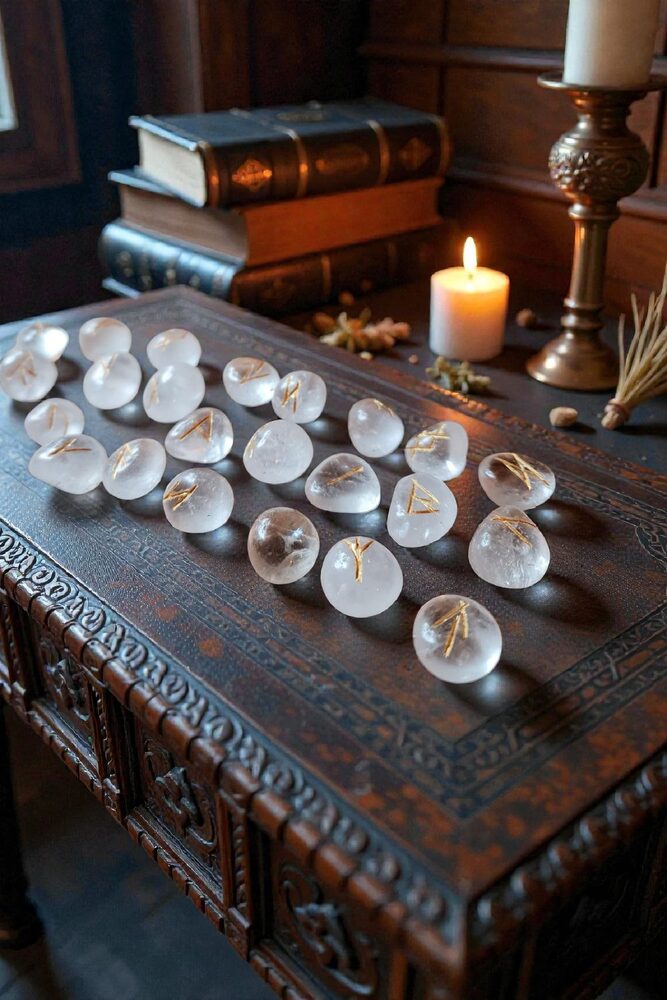
The Vikings had their own writing: runes. They are made of straight lines because people carved them into wood, bone or stone, and curves are hard to cut with a knife. The rune row is called the futhark, after its first six letters: f, u, þ (said like “th”), a, r, k. That’s how “alphabet” comes from Greek alpha and beta.
In the Viking Age people used the Younger Futhark, which had only 16 signs; the older one had 24. That meant one sign often had to stand for several sounds, a bit like a text full of abbreviations.
Lots of runes survive on runestones, which were mostly put up in memory of someone who had died. Sweden alone has thousands. On the great Jelling stone in Denmark, King Harald Bluetooth boasts that he made the Danes Christian. And yes, the Bluetooth symbol on your tablet is made from his initials in runes. You can try writing runes on our rune page, and our honest introduction to runes explains the background. Runes were an ordinary alphabet. Secret magic powers, as some websites claim, do not belong in your project as fact.
Before they became Christians, people in the North believed in many gods and goddesses. We call the stories about them Norse mythology. A myth is a story that explains the world, such as where thunder comes from. These are stories people believed in back then. Today we know how thunderstorms really work, but the stories are still retold in books, comics and films.
Thor was the god of thunder and the strongest of the gods. He rode in a chariot pulled by two goats and fought giants with his hammer, Mjölnir. Thursday is named after him: “Thor’s day”. Read more in Thor – thunder over Midgard.
Odin was the father of the gods: wise, mysterious and a little bit spooky. He had only one eye, because he gave the other away for a drink from a well of wisdom. His ravens, Huginn and Muninn, flew over the world every day and told him everything they had seen. See Odin.
Loki was a shape-shifter and trickster who helped the gods and caused them trouble just as often. He has little in common with Marvel’s Loki. There were also Freyja, goddess of love and fertility, Odin’s wife Frigg and many more. People imagined nine worlds joined by a giant tree, Yggdrasil; humans lived in Midgard, the middle world.
How do we know all this? Most of the stories were written down after the Viking Age, in Iceland in the 13th century, about 200 years later. The two most important collections are both called the Edda. One was written around 1220 by an Icelander called Snorri Sturluson, a Christian who retold the old stories as he knew them. So we can’t be sure the Vikings told them in exactly the same way.
1. Pick a focus. “The Vikings” is a huge topic. You will do better with two or three areas, such as “daily life and children”, “ships and exploration” or “gods and runes”.
2. Plan a clear structure.
3. Show something. A picture of the Gokstad ship, your name in runes or a home-made hnefatafl board brings your talk to life.
4. Use good sources. A source is the place where you found a piece of information. Museum websites, non-fiction books and encyclopaedias are good choices, for example DK’s Eyewitness Viking by Susan M. Margeson. Wikipedia can be a starting point, but check important numbers somewhere else too. TV series are fun, but much of what they show is made up.
5. List your sources properly. Put a list at the end. For a book: author, title, publisher, year. For a website: who made it, the page title, the address and the date you read it, for example: National Museum of Denmark, “Children in the Viking period”, en.natmus.dk, accessed 8 October 2026.
6. Visit a museum. Nothing beats seeing real finds. In the UK, JORVIK Viking Centre in York is built on the site of a Viking Age street; in Germany, the Viking Museum Haithabu near Schleswig is the place to go. More ideas in our guide to Viking museums.
We checked these resources on the official websites in October 2026.
Viking Museum Haithabu (Germany): the page Das Wikinger Museum für Kinder (in German) lists a free children’s media guide for ages eight and up, activity sheets for children and school groups, and a museum backpack to borrow. School programmes are under Bildung und Vermittlung.
Viking Ship Museum, Roskilde (Denmark): its school service runs indoor and outdoor activities on ships and voyages, and entry is free for under-18s: School visits.
National Museum of Denmark, Copenhagen: we did not find a dedicated children’s pack on the Viking Age in English, but the knowledge page Children in the Viking period is short, clear and works well in class.
Swedish History Museum, Stockholm: the Skola pages (in Swedish) list programmes for younger classes and classroom material, and the museum’s major exhibition is Vikingarnas värld (The World of the Vikings).
Children this age ask very direct questions about violence, slavery and death. We think it is better to answer them calmly and factually than to skip them.
Did Vikings have horns on their helmets? No. The only nearly complete Viking helmet, the Gjermundbu helmet from Norway, has no horns. Horned helmets were invented in the 19th century for paintings and opera costumes.
What toys did Viking children play with? Archaeologists have found toy ships, wooden swords, dolls, animal figures such as a little horse from the Faroe Islands, and spinning tops. Children also played board games like hnefatafl and skated on bone skates in winter.
Did Viking children go to school? No, there were no schools like today’s. Children learned at home and on the farm by watching adults and helping from an early age.
When did the Vikings live? The Viking Age lasted from about 793 to 1066. The Vikings came from what is now Denmark, Norway and Sweden.
Were the Vikings the first to reach America? They were the first Europeans we know of, around the year 1000, as the dig at L’Anse aux Meadows in Canada shows. Indigenous peoples had of course lived there for thousands of years.
What did Vikings eat? Mainly porridge and flat bread made from barley, plus fish, meat, dairy foods, peas, beans, cabbage, berries and nuts. Honey was the only sweetener, and there were no potatoes yet.
For courage. For remembrance. For legends that live on.
Viking Childhood · The Viking Longhouse · What did Vikings look like? · Runes & their meaning · Thor · The horned-helmet myth.
All Everyday Life & Craft articles →
When we picture Viking art, we see runestones, silver jewellery and golden brooches. Yet the true material of the North …
Read more →Unwashed, lice-ridden barbarians with greasy beards? Or the cleanest people of their age? Both pictures cling …
Read more →No child of the Viking Age was born a "little Viking". It was born, sprinkled with water, named — and usually grew up …
Read more →Coarse brown sacking, a shaggy fur collar, and of course the obligatory horned helmet – that is the Viking of film and …
Read more →
