Say “Viking” and most people picture a sword, an axe and a shield wall. The bow barely features in that image, and the fault lies not with the Norsemen but with the soil. Wood rots, iron survives. Arrowheads fill museum drawers by the thousand while almost nothing remains of the bows that shot them. This is an attempt to gather what actually survives: a complete yew bow from the harbour of Hedeby, a second from an Irish crannog, arrows released from Norwegian high-altitude ice after centuries, a law demanding twenty-four arrows per rowing bench – and a handful of stories in which a snapping bow loses an entire kingdom.
Archaeology is rarely fair. It preserves what is chemically stubborn and forgets what was once alive. An iron sword survives a thousand years in a grave, rusted but recognisable. A yew bow in ordinary soil lasts a few decades and then becomes humus. That is precisely why our picture of Viking Age weaponry is lopsided: we see the metal parts and mistake them for the whole.
The effect is measurable. Arrowheads are among the most common weapon finds of the entire period – in graves, settlement layers, harbour silt and battlefield horizons. Complete bows from the whole of Viking Age northern Europe, by contrast, can be counted on one hand, and almost all of them come from waterlogged deposits where the absence of oxygen preserves organic material. Anyone who reads that distribution as proof that the Norse rarely shot is confusing preservation with reality. The bow is not a rare weapon; it is a poorly preservable one. What follows is what happens when you take the few surviving pieces seriously and set them beside law, poetry and picture stones. For the other weapon categories, see our weapon guide.
The most important single piece turned up where you would least expect it: in the mud of a trading harbour. The harbour excavations at Hedeby in the 1960s produced a complete bow along with fragments of several more. The find horizon runs from the ninth to the eleventh century, straight through the Viking Age.
The measurements are soberly practical and strikingly large: roughly 191 centimetres long, about 4 centimetres wide and 3.3 centimetres thick at the grip. The material is yew, as with most of the fragments; one piece is elm. The cross-section is D-shaped – flat side towards the archer, rounded back outwards – with a thin layer of sapwood on the back. Anyone who has built a bow reads the intention immediately: sapwood takes tension, heartwood takes compression, and if you leave both layers where nature put them, the stave behaves like a natural composite. It is also striking that some of the Hedeby pieces appear to have been made from very young, slender yew stems. That is not improvisation but method: a thin trunk supplies the correct sapwood-to-heartwood arrangement by itself.
In 1932 a second complete bow was recovered from crannog Ballinderry No. 1 in County Westmeath, Ireland, again in yew, again preserved in wet ground. It measures around 185 centimetres, roughly 3.8 centimetres wide at the centre and 2.85 centimetres thick – figures remarkably close to the Hedeby stave. Same D-shaped section, same clear separation of heartwood and sapwood. It is dated to the late tenth century.
The context suits a prosperous household in a Scandinavian-influenced region: the same site produced spearheads, an axe head and a gaming board. Two bows from opposite corners of the Norse world, agreeing in length, timber and cross-section – that is archaeologically worth more than twenty isolated pieces with no counterpart. It means there was a form, a body of craft knowledge, a norm. The Viking Age bow was not an improvised branch but a product built to rules. That the literature long treated the Irish find as an under-appreciated weapon says more about research history than about the weapon.
To see what a Norse archery inventory looked like in quantity, you have to go to the bog at Nydam in southern Jutland. Conrad Engelhardt's excavations of 1859 to 1863 and the Danish National Museum's renewed work from 1989 produced some forty bows and well over a hundred arrows, along with wooden quivers, shields, spears and the famous boats. These are war booty offerings: captured equipment, deliberately destroyed and sunk in a lake.
And here comes the caveat that cannot be argued away. Nydam belongs to roughly 250 to 550 AD. That is three to five centuries before Lindisfarne. The Nydam bows are therefore not Viking bows but their ancestors – selfbows of yew, elm or ash, mostly between 1.65 and 1.9 metres long. That the dimensions stay stable all the way to Hedeby and Ballinderry argues for a very long continuity of the form in the north. But it remains an argument from analogy, not proof. Selling Nydam material as “Viking bows” skips a span of time longer than the Viking Age itself.
Among European timbers yew is the special case. Its heartwood takes compression exceptionally well; its sapwood is elastic and strong in tension. Work a stave out of the trunk so that sapwood sits on the back and heartwood on the belly, and you get for free what modern bowyers achieve with fibreglass and glue. That yew appears at Nydam, Hedeby and Ballinderry alike is not fashion but applied materials science.
Elm and ash are the obvious substitutes and do occur in the finds. Both are tough and forgive tillering errors more readily than yew, but deliver less cast at the same length. One point is easily overlooked: yew grows only patchily in Scandinavia and was regionally scarce. For Norway and Sweden that means good bow timber may well have been a traded commodity, as it demonstrably was across late medieval Europe. A Viking Age yew trade is not documented; the distribution of finds merely makes it plausible. And the timber incidentally explains a mythological detail we will return to below.
The surviving pieces are all selfbows: one stave, one timber, no laminated layers. That sounds simple and is not. The trunk is split, not sawn – the split follows the grain, and only that keeps the fibres running unbroken along the whole length. Then comes tillering, the gradual working of the limbs until both bend evenly under draw. Two millimetres too much in the wrong place and the stave breaks at the first serious pull.
The grip section of the finds is not cut away, merely slightly narrowed; the bow bends through the handle. The tips carry simple nocks or notches, in some reconstructions with horn overlays – for the Viking Age pieces that is more reconstruction than certainty. What no find records but every bowyer knows: such a stave must season slowly, often for years, and it is not stored strung. The bow is therefore an object with lead time, rather like a good blade. It does not come into being the evening before the voyage.
Here things get honestly awkward. We have two complete bows. Of their strings we have nothing – not a single securely identified Viking Age bowstring from Scandinavia. Everything written about hemp, linen, sinew or horsehair is analogy: drawn from later sources, other regions, and what simply works.
The plausible candidates are plant fibres – hemp and flax were grown in the north and made into ropes and nets – and animal sinew, which is enormously strong in tension but softens in damp. In a North Sea climate that is a real objection. From Waterford in Ireland comes a tablet-woven silk cord interpreted as a bowstring, but it dates to the mid-twelfth century and is therefore post-Viking. From York comes a lump of beeswax with a groove that may have been worn by a drawn cord – a charming hint at waxing strings, and no more than that. With the string the evidence stops and reconstruction begins. That line should not be blurred in the telling.
The honest answer is that we do not know; we can only rebuild it. Draw weight is measured on a strung bow, and none of the originals is shootable today. Everything you read comes from replicas.
Those replicas are instructive nonetheless. Reconstructions of the Hedeby and Ballinderry bows typically come in at 80 to 100 pounds of draw weight measured at the modern 28-inch draw length – roughly 36 to 45 kilograms. The experimental archaeologist Harm Paulsen built a particularly heavy yew version of about 108 pounds; in testing it reached some 180 metres and broke after around 200 shots. Both figures teach something. One hundred and eighty metres is a maximum distance mark, not a combat range: aimed shooting happens at a fraction of that. And a bow that gives up after 200 shots tells you what kind of object it is – a consumable, not an heirloom. A sword passes to the son. A bow breaks.
What bows lack in numbers, arrowheads supply in bulk. In 1971 the Swedish archaeologist Erik Wegraeus published what remains the standard typology of Viking Age arrowheads in Sweden, sorting them into groups A1, A2, B, C, D1, D2, E1 and E2. Anyone classifying Scandinavian heads today works with that sequence or a descendant of it.
Three basic ideas can be distinguished by form. Leaf-shaped and lozenge heads are all-rounders – they cut, they bleed, they work on game and on unarmoured people alike. Barbed heads make extraction difficult and are built for effect in soft tissue. And then there are the long, narrow heads of square or lozenge section that English calls the bodkin: not a cutting tool but a spike, meant to burst mail links and leather apart. The old rule of thumb that leaf equals hunting and bodkin equals war is convenient and not defensible in that hard form – the same shapes turn up in both contexts. What the type reveals is intended effect rather than occasion.
An arrow is more than its head, and it is precisely the rest that almost never survives. From the Hedeby material, arrows have been described with parallel-sided birch shafts, tanged heads and in some cases nocks of copper alloy. Best of all: impressions of the feathers survived in the birch-tar adhesive clearly enough to identify the bird – white-tailed eagle.
This is one of those moments when a tiny observation makes a whole workshop visible. Feathers were split, cut to length and set with resin or birch tar, usually bound down with fine thread as well. Three feathers per arrow is the technical norm, because two give too little spin and four too much drag. For shafts the finds use whatever is straight and stays straight: birch, pine, spruce. What reconstructions routinely underestimate is the labour. An archer with two dozen arrows is carrying dozens of working hours around with him – and loses them on the first miss into the undergrowth.
Hedeby has produced fragments of leather quivers from which a slightly conical tube can be reconstructed, about 62 centimetres long with an opening some 9 centimetres across, a fringed rim and two applied leather pieces with slits, probably for a shoulder strap. Nydam has yielded wooden quivers, showing that the type had a long northern pedigree.
This is more practical than it sounds. A quiver protects not so much the heads as the fletching, which is acutely vulnerable to damp and crushing. A lid or fold-over flap is no luxury on an open ship. Things get interesting with the quiver mounts from Birka's garrison: they belong to the closed quiver type of the Eurasian steppe, not to the northern tube quiver. Anyone discussing archery equipment in the north is therefore dealing with at least two traditions, one native and one imported. More on that shortly.
The most famous passage on Norse archery is not a saga but a statute. The provisions on the leiðangr, the naval levy, require in the older Gulathing law that every man provide at least an axe or a sword in addition to spear and shield – and that every rowing bench, normally two men, supply a bow and twenty-four arrows.
That is an unusually solid piece of evidence, and it still needs a large caveat. The Norwegian provincial laws were only committed to writing in the eleventh and twelfth centuries, that is at the end of the Viking Age or after it. They describe an order that is probably older, but they describe it from the viewpoint of an already organised royal administration. What you may read from it: the bow was such a self-evident part of shipboard equipment that the legislator set a quota for it. What you may not read from it: that this is how things stood in 793. The same legal world contains the herǫr, the war arrow passed from farm to farm as a summons – fail to follow the arrow and you had a case to answer. The arrow was not only a missile but a legal token.
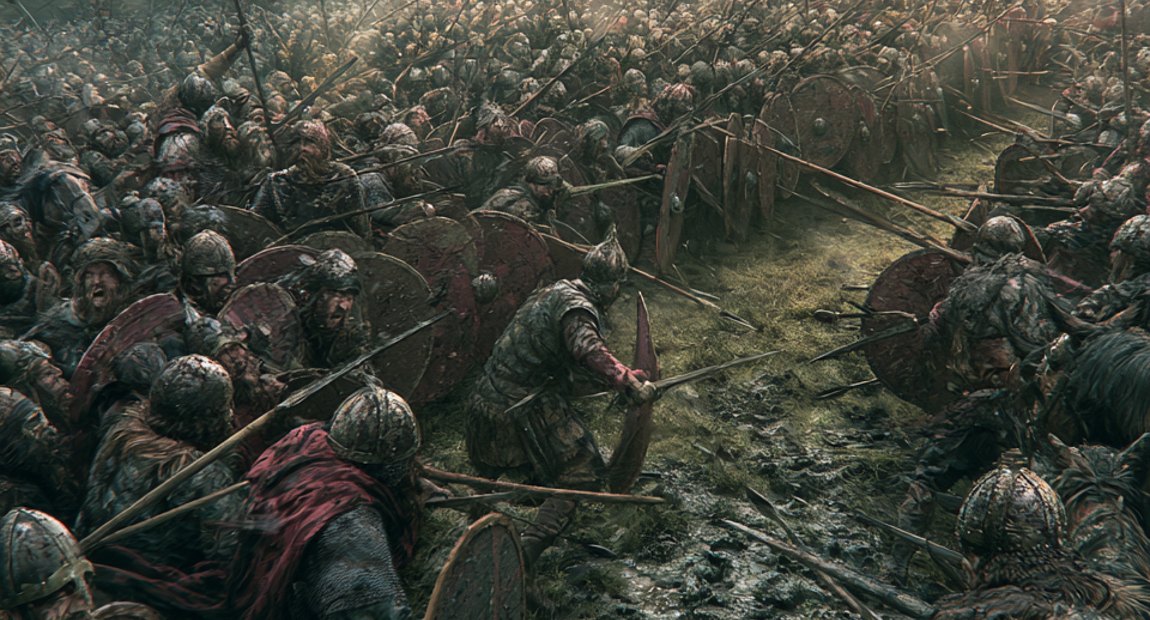
Norse sea battles were not manoeuvring engagements. Ships were lashed together and the fighting went on across the gunwales much as on land, only with less room and no line of retreat. In exactly that situation the bow is the one weapon that reaches over the enemy's shield line. On an open rowing ship there is no cover except the neighbour's shield.
The best-known archery scene in Old Norse literature takes place at Svolder around the year 1000. Snorri has Einarr Þambarskelfir shooting at Jarl Eirik from Olaf Tryggvason's ship; an enemy archer strikes Einarr's bow at the very moment of the draw, and it bursts with a loud crack.
The king said: “What was it that broke so loudly?” Einarr answered: “Norway from your hand, king.”Snorri Sturluson, Heimskringla, Óláfs saga Tryggvasonar ch. 108 (chapter numbering varies by edition); Old Norse text in the public domain, translation: Glanz & Gravur
Snorri goes on to have Olaf hand the archer his own bow, which Einarr draws briefly and dismisses as too weak for a king's bow. As a historical source the scene needs handling with care: Snorri writes a good two centuries after the event and is composing a set piece. As testimony to the standing that a good bow and a good archer held in northern imagination, it is hard to beat.
The second great archery scene is far less romantic. After the battle of Stiklestad in 1030 the skald Þormóðr Kolbrúnarskáld sits in a barn used as a casualty station with an arrow in his side. The healing woman cooks a mash of crushed leek and herbs and feeds it to the men with belly wounds; then she smells the wound. If the leek comes through, the gut is pierced and the man is beyond help.
Þormóðr refuses the mash – he is not, he says, sick with porridge – pulls the arrowhead out himself, looks at the fat clinging to the barbs and dies in the middle of a verse. The scene is literature, not a medical report, and Snorri has built it with care. But it carries two factual cores that match the archaeology: arrow wounds were an ordinary part of the battlefield, and the barbed head was feared precisely because it destroys more coming out than going in. For how battle order worked, see the shield wall.
Arrows were loosed far more often at animals than at people, and it is here that recent research has produced the most spectacular finds. Stationary ice patches in the Norwegian high mountains are melting, releasing what hunters lost there over millennia. At the Langfonne ice patch in Jotunheimen, 68 arrows have been recovered, the oldest around 4100 BC, the youngest around AD 1300.
The reason for the concentration is biological: in summer reindeer retreat onto cool snowfields to escape insects, and hunters followed them there. Add wooden scaring sticks used to drive animals into the line of shot, and hunting emerges as organised labour rather than lucky stalking. One clarification is needed, because it is regularly muddled: the well-known site of Lendbreen is primarily a mountain pass with transport finds, including the famous wool tunic; the great arrow series comes from Langfonne and other hunting ice patches. And strictly speaking these are ice patches, not flowing glaciers – which is exactly why the objects stay where they were dropped.
Birka's garrison and its associated graves contain material that has no business being in the north: bone plates of the kind used to stiffen composite bows of wood, horn and sinew, together with mounts from closed quivers and an object interpreted as a thumb ring. Comparable plates are known from Staraya Ladoga. Both lie far outside the composite bow's natural range, and the backs of the plates are smoothed for gluing – so this is manufacture or repair on the spot.
That is strong evidence for eastern contact but not for a Scandinavian composite bow tradition. The thumb ring belongs to the so-called Mongolian release, a completely different technique from the Mediterranean three-finger draw implied by long selfbows. Whoever shot a composite bow with a thumb ring in the north had most likely learned the craft in the east – in the world of the Rus, the Khazars, the steppe. In the north-west the norm remained the long yew bow. Two traditions, one trading place: a thoroughly Viking Age constellation.
Ullr lives, according to Grímnismál 5, in Ýdalir, the “yew dales” – and the Old Norse word ýr for yew is also used to mean the bow itself. Snorri lists him among other things as bow-god, hunting-god, ski-god and shield-god. To place a deity in the yew dales is to say, in imagery, that this is where the bow lives.
On runestone U 855 from Böksta in Uppland, reasonably placed in the mid-eleventh century, a hunting scene is carved: a rider with a spear, two dogs, two birds, an elk – and a second figure on skis with a drawn bow. It is Sweden's oldest surviving depiction of a skier. The identification as Ullr is attractive and widely repeated, but it remains an interpretation: the stone names no god, and a hunting scene with a skier is nothing supernatural in a central Swedish winter. As for Höðr, the popular image of a mistletoe arrow is at best imprecise. Snorri writes that Höðr took the mistletoe and shot; no bow is named, and in Saxo, Høtherus kills Baldr with a sword.
Established: two complete Viking Age bows survive from waterlogged deposits – Hedeby, about 191 cm, yew, from the harbour excavations of the 1960s, and Ballinderry No. 1 in Ireland, about 185 cm, yew, late tenth century; both D-shaped in section with sapwood on the back. Established: thousands of iron arrowheads, classified since Wegraeus 1971 into groups A to E, including 25 heads of type D1 in Birka grave Bj 581. Established: leather quiver fragments from Hedeby and wooden quivers from Nydam. Established: the provision of the older Gulathing law requiring a bow and twenty-four arrows per rowing bench – written down, however, only in the eleventh or twelfth century. Established: composite bow bone plates and eastern quiver mounts from Birka's garrison and from Staraya Ladoga. Established: 68 arrows from the Langfonne ice patch in Jotunheimen, spanning roughly 4100 BC to around AD 1300.
“The Vikings hardly used bows” is false. The impression comes from preservation: wood decays, iron survives. Law, poetry, picture stones and finds all attest the bow as a routine part of the kit. – “The Vikings shot composite bows” is equally false. The bone plates from Birka and Ladoga are exceptions and document eastern contact, not a northern construction method; the norm was the long yew selfbow. – Flaming arrows setting ships alight are a cinema image: incendiary arrows have poor range and poor ignition reliability, the Norse sources describe sea combat as boarding and close fighting, and there is no archaeological evidence for a burning funeral voyage at sea. – The Nydam bows are not Viking bows but 300 to 500 years older. – The twenty-four arrows per rowing bench come from a law written down after the Viking Age. – The Ullr reading of the Böksta stone is plausible but not proven, and in Snorri, Höðr shoots the mistletoe with no bow mentioned.
The Norse themselves did not talk the bow down – their laws set quotas for it, their poetry celebrates it, their gods carry it. Posterity talked it down. The image of the Viking as a close-quarters fighter with axe and shield comes from nineteenth-century national romanticism and twentieth-century cinema, and it sits badly with a fighter who kills at seventy metres. Missile weapons read as unheroic in that mode of storytelling, and what does not fit the heroic image gets left out.
Archaeology is slowly correcting this. Where soil is systematically sieved and stratigraphy recorded in detail, arrowheads appear in quantities that previously fell straight through the mesh. Where ice melts, whole arrows emerge complete with shaft, binding and the seat of the fletching. The picture is shifting – not because new Vikings have been discovered, but because we are finally seeing material that was always there.
In the end the bow is interesting precisely because it is so unheroic. It is cheap next to a sword but expensive in hours. It lasts not generations but a few hundred shots. It kills at a distance, and it feeds a family – the same weapon you stand with on the rowing deck brings the reindeer down off the plateau in autumn.
That double role is the real finding. Swords and ornamented axes are status markers of an elite; the bow is household tool and weapon of war at once, and it therefore sits closer to actual Viking Age life than anything glittering in a display case. There is no need to imagine it more dramatic than it was. A split yew stave, two dozen birch shafts fletched with eagle feathers, a leather tube over the shoulder – and the certainty that the most expensive part of the outfit was not the iron but the time inside it. What remains of all that in the ground is a handful of rust. What can be reconstructed from it is a surprisingly complete weapon.
Weapon Lore · The Spear · The Viking Shield · Hedeby · The shield wall · Ullr – the god on skis.
All History & Finds articles →
Sometimes history is found not with the spade but with the computer. For a long time four of Harald Bluetooth's famous …
Read more →