 Between field work, voyage and feud there was still time for contest and play. The sagas are full of wrestling bouts, ball games and trials of strength – some ended in laughter, some in manslaughter. What we really know about Viking sport, and where the good story begins.
The North was harsh, and whoever wanted to endure had to be strong, skilful and tough. No wonder strength and skill counted – in earnest and in play. The Icelandic sagas tell again and again of contests fought for honour, and sometimes for life itself.
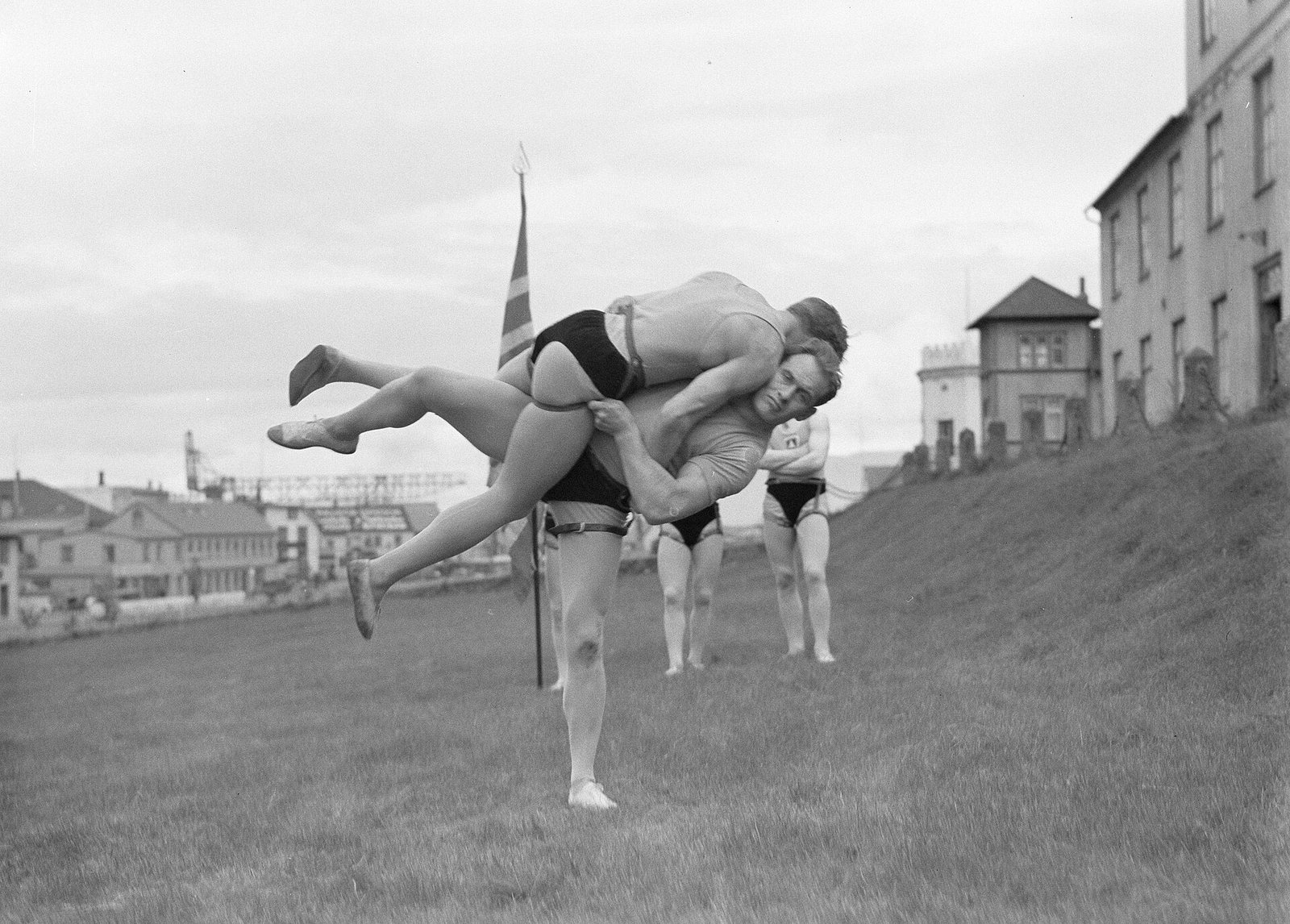
The best known is wrestling, still called glíma in Iceland today. In the sagas the wrestling is fang and the grips fangbrögð. Two men took hold of each other, sought the throw and the fall – as a trial of strength among friends, as proof of manhood, occasionally in deadly earnest. In Grettis saga the overpowering Grettir wrestles; in other sagas a friendly grip quickly becomes broken bones. The honest point matters: that wrestling took place is well attested – but no fixed set of rules survives from the Viking age. Today's Icelandic sport of glíma with its trouser-belt was only fixed as a national sport around 1900.
Most puzzling is Knattleikr, a ball game that appears in several sagas – most fully in Egils saga and Gísla saga. It was played, it seems, with a hard ball and a bat, on ice or frozen ground, often for hours and with spectators. The sources reveal little more: a coherent set of rules is NOT preserved, and all modern reconstructions are guesswork. Only the tone is certain: Knattleikr was rough. In Egils saga the young Egill, quarrelling over the game, sinks an axe into an older boy's head – a ball game becomes a feud. Sport and violence lay close together in the North.
Beside wrestling and ball, much that steeled the body counted. Swimming (sund) was held a high art; the sagas tell of men who raced in ice-cold water or held their opponent under the surface. To this day heavy steintök, lifting stones, stand at Icelandic farms, on which men measured their strength – a custom whose roots reach far back. Add to that archery, spear-throwing, riding, and in winter skiing and skating on bone skates. The "ideal" man of the sagas mastered many of these arts (íþróttir) – from poetry to swimming.
Not every contest needed muscle. On the long, dark winter evening people sat by the fire over the board game Hnefatafl, the "king's table". Found playing pieces of glass, bone and amber, and boards like the one from Ballinderry, show how popular it was. A king in the middle, hemmed in by a superior force, must find his way to the edge – a game of flight and siege that suited a world of feuds well. The exact rules are, as so often, not fully preserved and were reconstructed only later.
Fire is the best / for the sons of men,
and the sight of the sun,
if his health a man / can have,
and a life not stained with sin.Hávamál 68, translation after Henry Adams Bellows 1923 (public domain)
Sober as the Hávamál sounds, health and a capable body were a high good in the North. Contest and play kept men fit, decided their standing – and made the long winter bearable.
Hnefatafl – Viking chess · The Mästermyr tool chest · Everyday Viking life · Viking clothing & fashion · Berserkers.
All Everyday Life & Craft articles →
How do you pay when there is no money of your own? The Vikings had a simple answer: with silver, weighed on the scales …
Read more →Long before chess came to the North, people sat on the long winter evening over a different board: Hnefatafl, the …
Read more →In the darkest time of the year the Norsemen celebrated Jól. Some customs of this winter feast live on in our Christmas …
Read more →When archaeologists open a Viking-age grave, one find is almost always there: a comb. The comb was the most personal …
Read more →