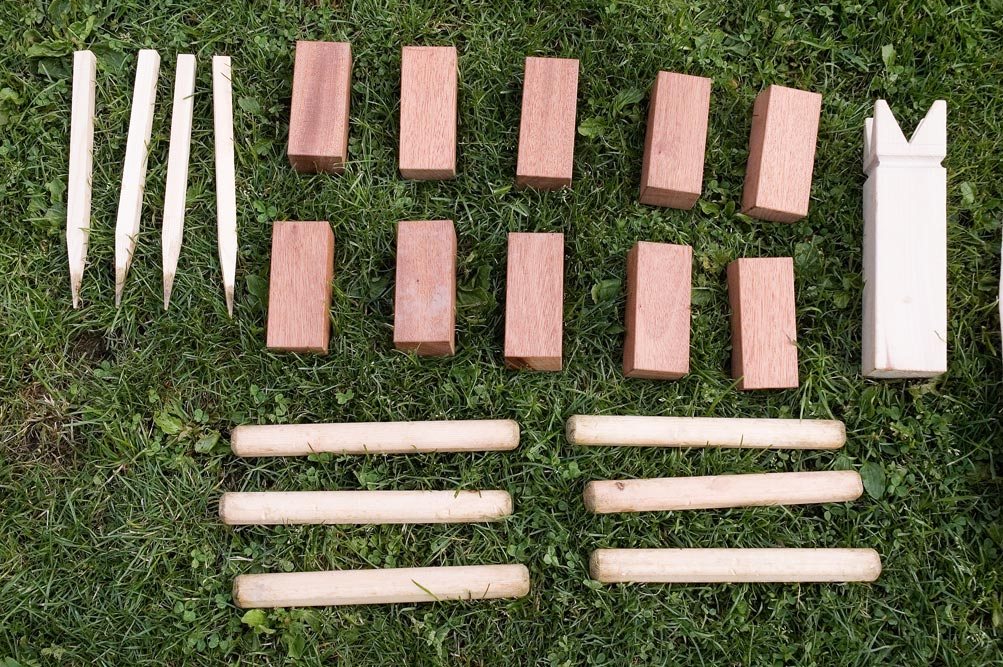
Five by eight metres of lawn, ten wooden blocks, six throwing batons, a king in the middle. Kubb is the best garden game we know: ten minutes to learn, ten years and still not exhausted. German boxes almost always call it "Wikingerschach", Viking chess, sometimes with a story about the skulls of slain enemies. That story is invented. Kubb is a young game, and that takes nothing away from it – you should just know what you are throwing.
The pitch is a rectangle five by eight metres, staked out with four corner pins and divided by a centre line. Five kubbs stand on each baseline: squat wooden blocks, seven by seven centimetres in section and fifteen centimetres tall at tournament size. The king stands in the middle, thirty centimetres tall and noticeably thicker. You throw with six round batons, thirty centimetres long and a good four centimetres across.
Two teams, one baseline each. You throw underhand, both feet behind your own throwing line, and try to hit the opponent's kubbs. What falls does not leave the game: the opponent collects the fallen blocks and, on their next turn, throws them across into the other half. There they are stood up where they came to rest. Now they are field kubbs.
That changes everything. Whoever is throwing must fell every field kubb before any baseline kubb counts at all. Knock over a baseline kubb too early and it is simply stood back up. In return you get something: your throwing line advances to the level of the nearest standing field kubb. The further the opponent throws their kubbs, the closer you may come.
Once all field kubbs and all the opponent's baseline kubbs are down, you may go for the king. He has to be felled from your own baseline, not from the advanced line, and with a single baton. Then the game is over.
Knock the king over too early and you lose. Immediately. With a baton, with a thrown kubb, by accident while setting up – it does not matter. The tournament rules put it dryly as wood against wood: contact is enough, if the king goes down.
It sounds like a footnote and it is the heart of the game. It forces everyone to judge their own skill honestly. The last baseline kubb is standing right beside the king and you still have four batons in hand. Do you throw? Anyone who has played kubb for a while has lost a game exactly that way. We have.
Kubb has few rules and plenty of grey areas. Four of them are enough for any quarrel.
The helicopter. The baton must come from below and rotate end over end, not flat like a rotor blade. But when is it flat? The world championship rules ban the helicopter throw and draw the line at thirty degrees of horizontal rotation; other rule sets speak of no more than forty-five degrees off the vertical. Nobody in a back garden owns a protractor. So the arguing starts.
The throw-in. Fallen kubbs must be thrown into the opponent's half and stay there. You get two attempts. If both fail, the block becomes a penalty kubb: the opponent places it wherever they like, only no closer to the king or a corner pin than the length of a baton. A good thrower-in – inkastare in Swedish – is worth more to a team than a good shooter.
Where the field kubbs lie. They are stood up where they land. Two kubbs in a line can be taken with one baton. Whether a kubb leaning against another one counts as standing is the question that stays open at the end of every barbecue season.
The throwing line. Both feet behind it until the baton leaves the hand. On an unmarked lawn, that line sits roughly where the thrower would like it to be.
The Kubb World Championship has been held at Rone on Gotland since 1995, every year in early August. Twenty-eight teams entered the first one, and the name was, to put it kindly, ambitious: the tournament was a purely Gotlandic affair.
It did not stay that way. Fifty-nine teams came in 1996, 102 in 1998; the first foreign entries – two Dutch sides – arrived in 1999, and by 2002 there were 183 teams on the fields. Teams are six a side, and to this day there are no skill divisions – everyone in one pot, from the village side to the defending champions. A "little world championship" was invented for the early losers so that nobody drives home after two hours.
In Germany the game spread from the 1990s onwards, and since 2011 there has been a European Championship in Berlin. In 2013 the Gotland title went to a team from outside Scandinavia for the first time: the German "Kubb'Ings". The United States hold their national championship at Eau Claire, Wisconsin; Belgium alone counted more than fifty tournaments in 2012. A game that came out of nowhere on a Baltic island reached half the world in twenty-odd years.
And now the part that appears on no box.
In 1912 Stockholm hosted the Olympic Games, and in that context Sweden's traditional games were collected and described. Kubb was evidently unknown on Gotland at the time. The earliest known mention of the name dates from 1931, when a Gotlandic ethnologist recorded it on Fårö, the small island north of Gotland. That is the oldest evidence for the word. Not for a Viking Age game – for the word, in the twentieth century.
Predecessors do exist. The researcher Sören Wallin identified the Swedish kägelkrig, literally skittle war, as the real forebear; it is described in a 1911 reference work and attested on the Swedish mainland by 1878 at the latest. Further back lie games built on the same idea: two sides, toppled pins travelling to the other half, a king pin in the middle. A Polish game of the sixteenth century works like that, and so do the "Kaisers" played around 1800 in Leipzig – though those were played with balls rather than batons.
In the 1980s kubb became a local craze on Gotland, the first commercial production started late in that decade, the world championship followed in 1995, and with the export came the legend. "Viking chess", "Old Norse Viking outdoor game", German "Wikingerschach" – these are selling points, not citations. The version with the skulls of slain enemies as kubbs and a thighbone as the baton is pure marketing invention. No medieval text, no excavation, no picture stone shows anything of the kind.
The annoying thing about the invented pedigree is that it is unnecessary. There is plenty of genuine play in the ground.
The best known northern game is hnefatafl, a board game with unequal sides: a king and a few defenders in the middle, a superior force around the edge. Boards have been found – real wooden ones, with holes or squares – at Coppergate in York from around 950 to 1025, at Toftanes in the Faroes from the tenth century, in Ireland and in Orkney. The board sizes vary, which means there was not one rule set but a family of variants.
Gaming pieces turn up in graves, and not rarely. In the boat burial at Scar on Sanday, Orkney, dated between 875 and 950, the man was buried with a sword, a quiver and gaming pieces. Birka grave 886 produced twenty-five hemispherical pieces of bone or horn. The ship burials at Salme in Estonia, laid down around 750, just before the Viking Age proper, held seventy-one gaming pieces and dice. Dice belong to the picture; people played and gambled everywhere.
Anyone buried with a board game played it in life. That is the evidence. That children handled wooden swords, toy boats and spinning tops alongside is shown by finds from the trading places – more on that in our piece on childhood among the Vikings. And outdoors there was wrestling, ball play, swimming contests and horse fights; the written evidence comes from the sagas and what they say about glíma and knattleikr.
None of this rules out a throwing game with wooden blocks. But such a game would be archaeologically invisible. Ten plain wooden blocks on a meadow leave nothing that anyone could identify as a game a thousand years later. Absence of evidence is not proof of absence – but it is not evidence either. And the chain of written mentions that hnefatafl has is entirely missing for kubb.
There is a punchline after all. Kubb comes from the island that was connected to the wider world in the Viking Age like almost nowhere else. Gotland holds more buried silver hoards than anywhere else in Scandinavia, and the Gotlandic picture stones show ships, riders and scenes that are still argued over.
Just no kubb. The island gave the world two things, a thousand years apart: the silver and the game. Both are real. Only not at the same time.
Documented: the name "kubb" on Fårö from 1931, the closely related kägelkrig in Sweden by 1878 at the latest, related skittle games with a king pin since the sixteenth century, the Gotland boom of the 1980s, the first world championship at Rone in 1995.
Archaeologically documented for the Viking Age: board games and gaming pieces in graves and settlements, dice, and the boards from York, Toftanes and elsewhere.
Modern marketing: the names "Wikingerschach" and "Viking chess", the skull story, and every claim that dates kubb to the ninth or tenth century.
Modern interpretation: the descent from kägelkrig – well argued, but a reconstruction, not a document.
The false pedigree does not bother us because it makes the game worse. It bothers us because it hides a real story: a Baltic island that turned a village pastime into a world tournament in thirty years. Keep throwing. Just not at the king while anything else is standing. For courage. For memory. For legends that live on.
Hnefatafl – Viking chess · Viking Childhood · Glíma & Knattleikr · Viking Symbols & their meaning – genuine or invented? · Danes, Swedes, Norwegians · The Gotlanders.