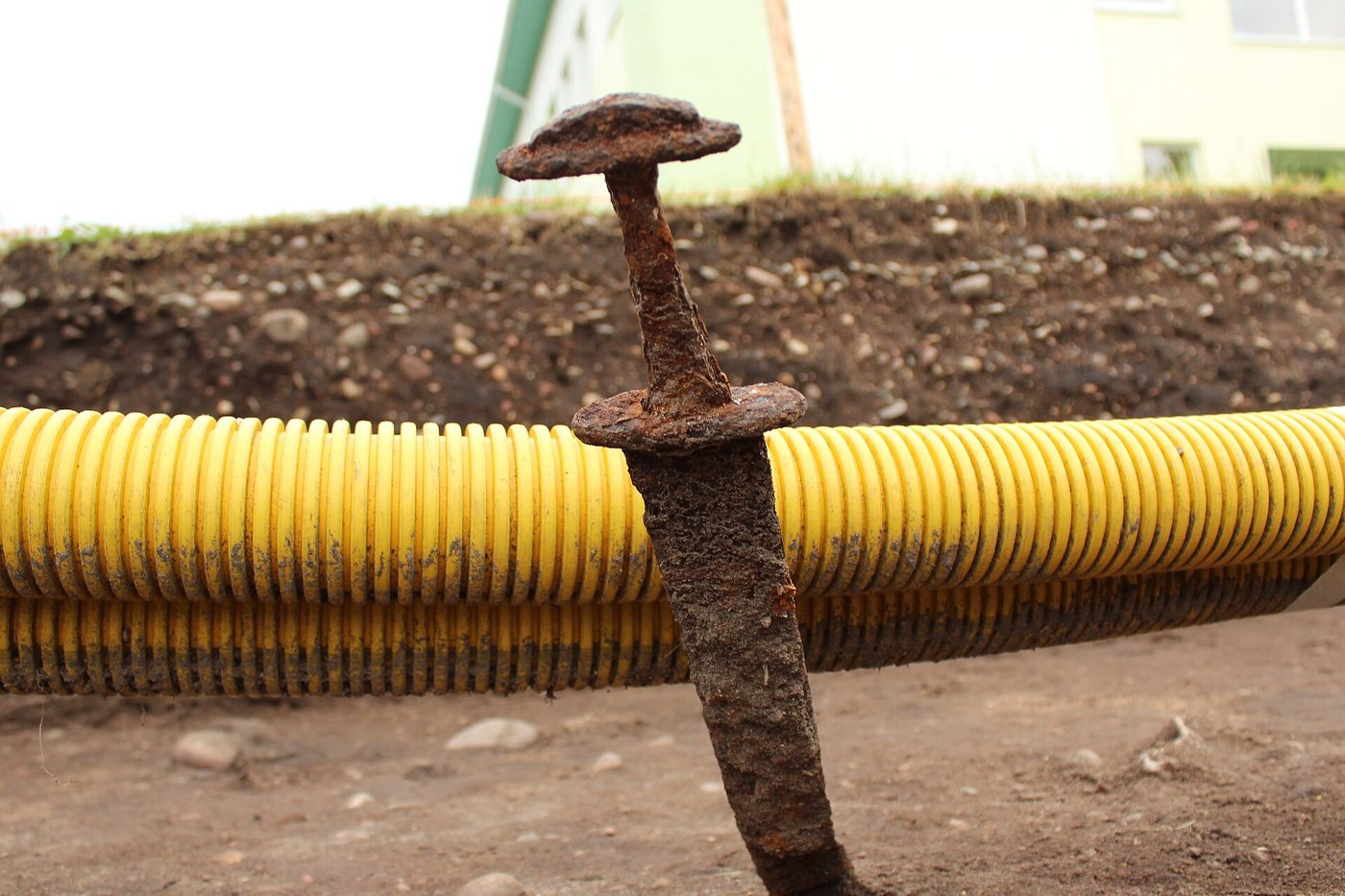
In 2008 workers digging a cable trench in the village of Salme on the Estonian island of Saaremaa hit bones and iron. What they had found was a ship. Two years later a second, larger one turned up next to it. Inside: more than forty dead men, dozens of swords, hundreds of gaming pieces. They died around 750, a good forty years before Lindisfarne, and they were not from here. Isotopes and DNA point west across the Baltic, to the lands around Lake Mälaren. Salme is the oldest armed expedition from Scandinavia that we can dig up.
Salme lies in the south of Saaremaa, where the island narrows into the Sõrve peninsula. Today the sea is some way off. Around 750 the site lay on the beach: the land has been rising since the Ice Age, and the shore has moved outwards since. So the two ships were not hauled inland; they were buried where they had come ashore or been brought ashore.
The first ship, now called Salme I, was discovered during earthworks in 2008 and excavated that same year. Salme II followed in 2010, close by. The excavations were led by the Estonian archaeologist Jüri Peets; the anthropologist Raili Allmäe studied the human remains and the archaeozoologist Liina Maldre the animal bones. Their reports are the basis of everything that follows.
Salme I is a rowing boat about 11.5 metres long. Seven young men lay in it. Salme II, at a good 17 metres long and about 3 metres wide, is considerably larger, clinker-built with a keel. The excavators think it may have carried a sail, which would make it one of the earliest hints of sail in the Baltic. That is not certain, since the mast and sail themselves do not survive.
In Salme II lay at least thirty-four men, in four layers one above another. The phrase that keeps turning up in reports is "like firewood". Yet the arrangement was not careless: the dead were laid carefully in the hull, and there are signs that they were covered with cloaks or cloth before sand went over them. Together that makes forty-one dead from two graves dug at the same time.
Many skeletons bear the marks of violence. Skulls show blade wounds, other bones cuts and stabs, and arrowheads lay scattered through the ship, more than ninety in all. These men did not die of disease or drown in a storm. They fell in a fight, and the survivors buried them.
The grave goods fit warriors of rank. Salme II produced some forty swords, some with hilts of gilded bronze set with garnets, along with spearheads, knives, axes, shield bosses, whetstones, antler combs, beads and bear-tooth pendants.
And games. Altogether there were 326 gaming pieces, 75 in Salme I and 251 in Salme II, many of them whalebone, plus dice. By one man in Salme II a gaming piece with an iron pin lay close to the mouth; many accounts turn this into the "king in the mouth". Whether the piece was deliberately placed in the mouth or slipped there cannot be said for certain from the find. Which game they played we do not know exactly either. A forerunner of the board game later called hnefatafl is an obvious guess, nothing more.
In Salme I lay the remains of two decapitated birds of prey, hawks according to the excavators. In Salme II there was a dog cut in half; across both graves there are said to have been at least six dogs. Hawks for hunting were costly, and training them was a pastime for people of means. Bones of pig, sheep or goat and cattle suggest a meal at the grave. Whoever buried these men took their time. This is not a hurried scraping of earth while in flight.
From the start the equipment looked Scandinavian. The swords, the ships and the manner of burial recall what is known from the Mälaren region in the late Vendel period. But a style is not yet an origin. Weapons were traded, given, captured.
In 2016 T. Douglas Price, Jüri Peets, Raili Allmäe, Liina Maldre and Ester Oras published an isotope study. They examined tooth enamel, above all the ratio of strontium isotopes, together with oxygen and carbon. Strontium enters the body through water and food and is locked into the enamel formed in childhood. It reflects the bedrock of the region where a person grew up.
The result was clear: the values do not fit Saaremaa or the rest of the eastern Baltic. They fit central Sweden. Combining isotopes and archaeology, the authors name the Mälaren region as the most probable homeland – the country around Uppsala and the later Birka. The men had come across the Baltic.
In 2020 Nature published the largest genetic study of the Viking Age to that date, led by Ashot Margaryan and Eske Willerslev, with genomes from more than four hundred people. Among them were dead from Salme II. Two results matter for us.
First, the DNA confirms the isotopes: the Salme men are genetically closest to the populations of present-day Sweden. Second, relatives turned up. Four men were brothers and lay side by side. Another was related to them in the third degree, an uncle or cousin, say. Families sailed together here, not a random crew of mercenaries.
That matches what later rune stones show, where brothers and fathers appear together on the same voyages. Salme shows it some two hundred and fifty years earlier, and not in an inscription but in the bones.
What these men wanted on Saaremaa neither isotopes nor DNA can say. This is where interpretation begins, and it is open.
The obvious reading is a raid gone wrong. Armed men from the Mälaren region land on a foreign coast, are attacked, lose more than forty and bury them before withdrawing. The eastern shore of the Baltic was no empty land. On Saaremaa and along the coast of present-day Latvia lived peoples who went to sea themselves, among them the Curonians. In his ninth-century life of Ansgar, Rimbert reports Swedish campaigns against the Curonians. Salme is a hundred years earlier, but it belongs to the same world.
Other scholars point to the hawks, the costly swords and the gaming pieces. These, they argue, are not what one takes on a raid but the belongings of an embassy or a high-ranking company attacked on the way. A journey to negotiate, to make an alliance, perhaps a bridal voyage have all been suggested.
The find does not decide it. What is certain: the men belonged to an elite, they came together, they died together, and their companions had the time and the means to bury them with full honours. That rather suggests the group as a whole survived the fight.
Hardly had Salme become known than a name appeared in the newspapers: Yngvar. In the Ynglinga saga, written down by Snorri Sturluson in Iceland around 1230, there is a Swedish king of that name, son of Eysteinn. He is said to have made peace with the Danes and then gone east:
Á einu sumri hafði hann her úti ok fór til Eistlands ok herjaði þar um sumarit, sem heitir at Steini. […] Hann er heygðr þar við sjá sjálfan; þat er á Aðalsýslu.
"One summer he was out with an army, went to Estland and raided there during the summer at the place called 'at the Stone'. […] He lies there in a mound right by the sea; that is in Aðalsýsla."Snorri Sturluson, Ynglinga saga, chapter on Yngvarr (ch. 36 in the heimskringla.no numbering, which varies between editions); our translation
The Estonians, the saga says, raised a great army; Yngvar fell and his men fled. Snorri draws on a stanza of the Ynglingatal, a poem attributed to Þjóðólfr of Hvinir, which speaks of the people of Sýsla and of the eastern sea.
One can see why the link is tempting: a Swedish king, a fight in Estonia, a grave by the sea. But it does not hold. The Ynglinga saga is some five hundred years younger than Salme. The age of the Ynglingatal is disputed, with dates ranging from the ninth to the twelfth century. In Norse sources Aðalsýsla usually means the Estonian mainland, whereas Saaremaa is Eysýsla, the island Sýsla. And Snorri speaks of a burial mound for a king, not of two ships with forty-one dead. Salme does not prove Yngvar, and Yngvar does not explain Salme. What the legend shows at most is that the memory of Swedish expeditions to Estonia was still alive in the north centuries later. More on those Swedes and their fleets under the Suiones.
Archaeological evidence: two contemporary ship burials around 750 with at least forty-one men, many of whom died violently, together with swords, gaming pieces, hunting birds and the remains of a meal. Isotopes and DNA identify the dead as people from central Sweden, probably from the Mälaren region; four of them were brothers.
Contemporary written sources for Salme do not exist. Around 750 nobody in the Baltic was writing.
Later tradition is the story of King Yngvar in the thirteenth-century Ynglinga saga and in the Ynglingatal. It is a legend and cannot be tied to Salme.
Modern interpretation is the question of whether Salme saw the end of a raid, an embassy or something in between, and whether the larger ship carried a sail.
Forty-one men who did not come home, buried by those who did. They never got a rune stone. We know them all the same. For courage. For memory. For legends that live on.
The Suiones · Birka – the trading hub · The Curonians · The Gotlanders · The Ingvar Expedition · Danes, Swedes, Norwegians.

