The Curonians were not Vikings. They spoke a Baltic language, related to Latvian and Lithuanian, and they lived on the coast that Swedish and Gotlandic ships reached first when they sailed east. Around 850 they stopped paying tribute. A Danish army came to grief against them; then the Swedish king Olof arrived and burned one of their strongholds to the ground. That, at least, is how a monk from Hamburg tells it. What is true in his story, what Grobiņa shows in the ground, and how the Curonians later became the "Vikings of the Baltic" – a search for traces.
The Curonians lived in what is now western Latvia and north-western Lithuania, between the Baltic coast and the hinterland around Kuldīga. The land still bears their name: Courland, in Latvian Kurzeme. Old Norse texts call it Kúrland; Rimbert and Adam of Bremen call the people Cori.
Their language belonged to the Baltic branch, not the Germanic one. In the early modern period it merged into Latvian and survives only in place names and personal names. Anyone who lines up "the Curonians" alongside Danes, Norwegians and Swedes is mistaking neighbourhood for kinship. The Curonians were the Scandinavians' neighbours, trading partners, enemies and at times tributaries. They were no more a Viking people than the Scandinavians themselves: "Viking" was something people did, not something they were.
The oldest report of the Curonians is in the Vita Anskarii, the life of the missionary Ansgar, written by his successor Rimbert in the years after Ansgar's death in 865, by about 876 at the latest. In chapter 30 Rimbert inserts an account of a war. A people far from the Swedes, the Cori, had once been subject to Swedish rule but had long since broken away.
The Danes, he says, tried to take advantage of this. They came with a large fleet to plunder and subdue the Curonians. But the Curonians rallied and defeated them; half of the Danes were killed and their ships plundered, and the victors took gold, silver and much booty.
Rimbert gives no year. He places the events during Ansgar's second stay in Birka, which scholars date to around 852. That puts the campaign in the early 850s. We cannot be more precise.
When Olof, king of the Swedes, heard that the Danes had failed, he marched against the Curonians himself with a large army, Rimbert says. He first attacked a stronghold called Seeburg, held by seven thousand fighting men, took it, plundered it and burned it.
Then he turned against a second stronghold, Apulia. Fifteen thousand men are said to have stood there. For eight days there was fighting and the Swedes made no headway. The men wanted to go home, Rimbert writes, and cast lots to learn whether their gods would help them. The gods were silent. Then merchants who knew Ansgar's teaching advised them to ask the God of the Christians, and the lot fell favourably.
In the end the Curonians made peace. They handed over the gold and weapons they had taken from the Danes the year before, paid half a pound of silver for every man in the stronghold, promised to pay tribute again and gave thirty hostages.
The story has to be read as Rimbert meant it: as a mission narrative. The war is the backdrop; the real hero is the Christian God, who helps the Swedes when their own gods fail them. The figures – seven thousand, fifteen thousand – are a storyteller's figures, written far away in Hamburg and Bremen. Even so, most historians accept that there was a Swedish campaign against the Curonians, that the Curonians had paid tribute before, and that two of their strongholds were called Seeburg and Apulia. No other source, however, knows of a king Olof around 850.
Seeburg is today almost universally identified with Grobiņa near Liepāja, Apulia with the hillfort of Apuolė in north-western Lithuania. Both identifications are well argued; neither is proven. Other suggestions have been made, such as Pilten near Ventspils for Apulia.
What makes Grobiņa so important lies in the ground. Around the hillfort of Skabārža kalns there are several cemeteries – Priediens, Smukumi, Porāni and Atkalni – that are wholly or partly Scandinavian in character. The Swedish archaeologist Birger Nerman excavated here in 1929 and 1930, and Latvian archaeologists continued the work until the late 1980s. Priediens alone probably had some two thousand burial mounds originally.
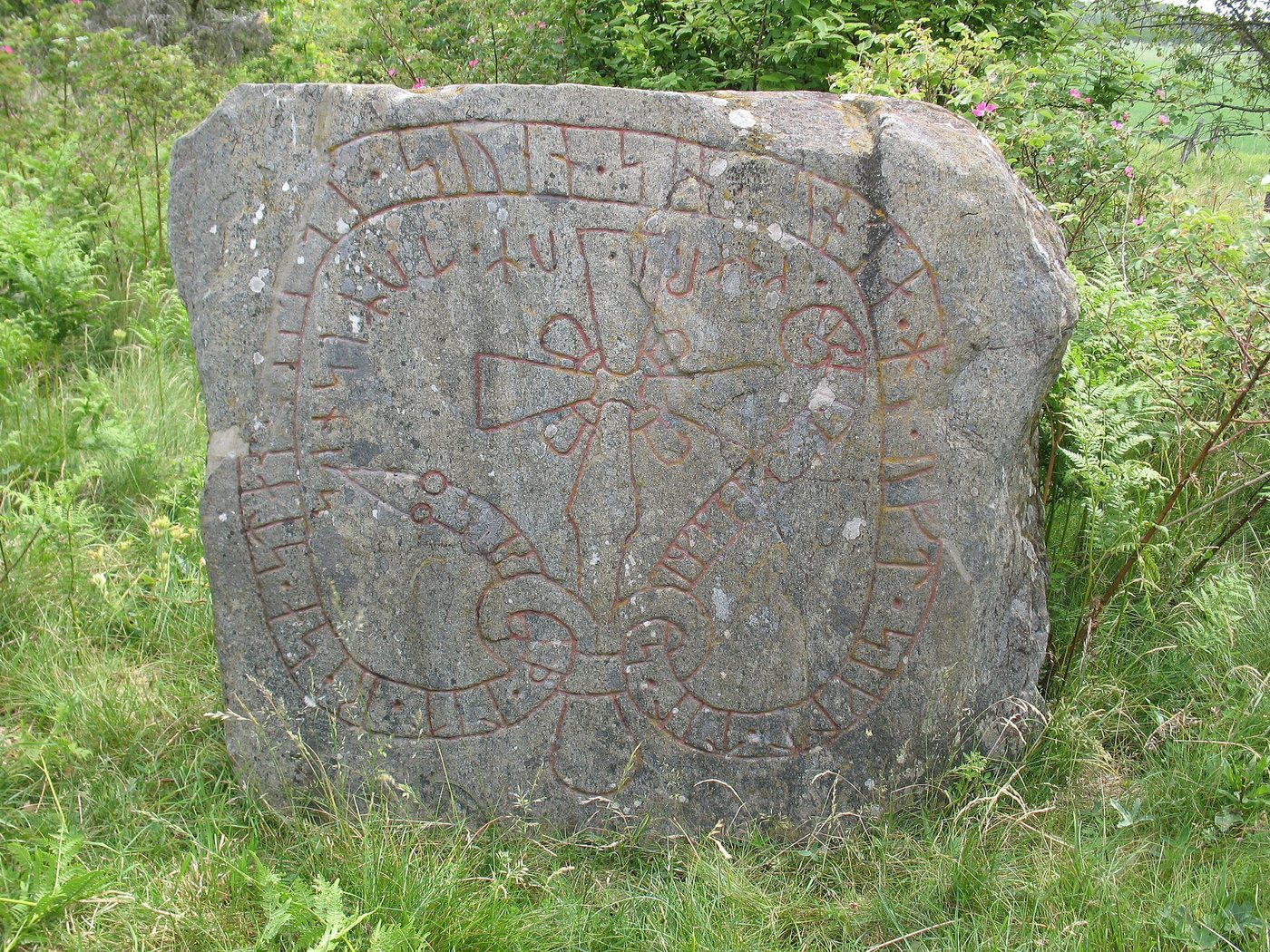
The graves run from roughly the middle of the seventh century into the ninth. Nerman distinguished two groups: women's and family graves with Gotlandic-style jewellery, which he attributed to settlers from Gotland, and mounds with weapons, which he linked to warriors from the Mälaren region. That division is still the starting point, though the details are debated. There is also a picture stone of Gotlandic type from Priediens, decorated with two water birds – a piece of Gotland on the Curonian coast.
The picture that emerges is not one of conquest but of coexistence. Curonian cemeteries lie next to the Scandinavian ones, and each side borrowed forms from the other. Grobiņa was a trading place with a Scandinavian community, perhaps paying protection to Sweden, perhaps not. The Scandinavian graves end in the ninth century. Whether that has anything to do with Olof's campaign we do not know. It fits Rimbert, but archaeology and text cannot be pinned together to the year here.
The boat burials of Salme on Saaremaa are about a century older than the latest graves at Grobiņa: there, Scandinavians who fell fighting far from home; here, Scandinavians who settled on a foreign coast. Both finds show that the Baltic was a sea of routes long before 793.
Anyone looking for runestones that explicitly name the Curonians will be disappointed. Much clearer is a stone from Södermanland, Sö 198 at Mervalla on the island of Selaön in Lake Mälaren, from the eleventh century:
Sigríðr lét reisa stein þenna at Svein, bónda sinn. Hann opt sigldi til Seimgala dýrum knerri um Dómisnes.
"Sigrid had this stone raised in memory of Sven, her husband. He often sailed to Semigallia in a costly knarr around Domesnes."Runestone Sö 198, Mervalla; normalised reading after the Samnordisk runtextdatabas, our translation
Domesnes is Cape Kolka, the northern tip of Courland, where reefs run far out to sea. Semigallia lies to the south of it on the Gulf of Riga. So Sven sailed along the Curonian coast as a trader, not a raider. On Gotland, the stone G 135 from Sjonhem names a place where a man died; some read it as Windau, today's Ventspils in Courland. That interpretation is not certain.
In Icelandic literature of the thirteenth century Courland becomes a land of adventure. In chapter 46 of Egil's saga, Thorolf and Egill Skallagrímsson go raiding in Courland; Egill is captured, frees himself and plunders a farm. It is a good story, but it is not a report on the tenth century. The saga is some three hundred years younger than the events it describes.
Around 1075, in the fourth book of his history of the church of Hamburg, Adam of Bremen describes the islands and coasts of the Baltic. He takes Courland, his Churland, to be an island. Its people, he says, are feared for their idolatry; there is much gold and there are excellent horses, and every house is full of soothsayers, augurs and sorcerers. People come from all over the world, especially from Spain and Greece, to seek oracles there. There is a single church, built through the efforts of a merchant whom the Danish king had persuaded with gifts.
Adam never went to Courland. His picture is that of a churchman who heard from merchants and probably from the Danish king Sven Estridsson what lay across the Baltic. The soothsayers from Spain can safely be read as exaggeration. What is useful is the report that merchants came and went and that the Curonians were still pagan around 1075.
The Curonians earned their reputation as feared seafarers mainly later. The sources for it date from the twelfth and thirteenth centuries: Saxo Grammaticus mentions Danish kings fighting Curonians and Estonians, and the Livonian Chronicle of Henry, written around 1225, reports how a Curonian fleet attacked the young town of Riga in 1210. In that period the Curonians really were a power at sea, until the Teutonic Order subdued Courland in the second half of the thirteenth century.
Who destroyed Sigtuna in 1187, on the other hand, is an open question. Erik's Chronicle from the early fourteenth century names Karelians, later tradition Estonians, and modern accounts often Curonians too. None of these attributions is securely attested. The same goes for the claim that Danish churches prayed for protection from the Curonians: it circulates in books and on websites, but we have found no medieval evidence for it.
From all this came the catchphrase "Vikings of the Baltic". It is catchy and not entirely wrong, but it shifts the timeline. For the ninth century the sources show the Curonians mainly as the ones being attacked – successfully defending themselves against the Danes, then losing to the Swedes. The Curonian fleets belong to the High Middle Ages, when the Viking Age in Scandinavia was long over.
One name is particularly misleading: the Curonian Kings, in Latvian kuršu ķoniņi. They were not rulers of the Viking Age but the inhabitants of seven villages between Kuldīga and Aizpute who, under the Teutonic Order, lived as free farmers on their own land and served as light cavalry. The first charter on their special status dates from 1320, and their rights ended only with the Latvian land reform of 1920. That their ancestors were Curonian nobility is a widespread assumption, not an established fact.
Contemporary written source is Rimbert's Vita Anskarii from the years between 865 and about 876, written from a missionary's point of view and with figures that need not be trusted. Then Adam of Bremen around 1075 and, for the later period, Henry of Livonia and Saxo.
Archaeologically attested are the Scandinavian cemeteries at Grobiņa from the seventh to the ninth century, Gotlandic and central Swedish forms, the Priediens picture stone and the coexistence with Curonian cemeteries. The Mervalla runestone attests voyages around Domesnes in the eleventh century.
Later tradition includes Egill's raid in Courland and the Courland voyages of other saga heroes.
Modern interpretation includes the identification of Seeburg with Grobiņa and Apulia with Apuolė, the end of the settlement through Olof's campaign, and the label "Vikings of the Baltic".
The Curonians were not bit players in a Scandinavian story. They were the people across the sea with whom the Swedes and Gotlanders traded, quarrelled and lived side by side. For courage. For memory. For legends that live on.
The Salme Warriors · The Suiones · Birka – the trading hub · Ansgar · Adam of Bremen · The Gotlanders.

