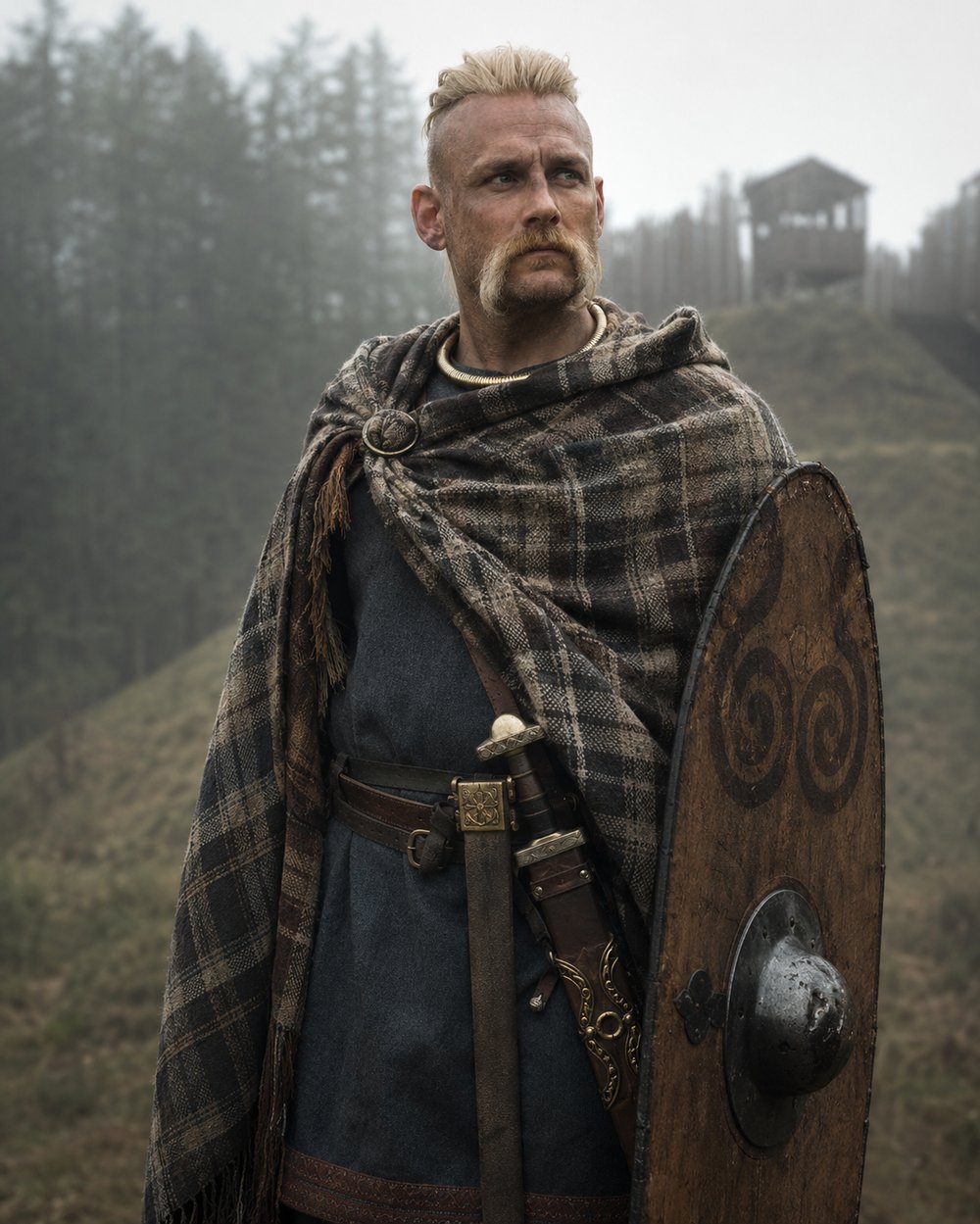
When Caesar landed on the coast of Britain in 55 BC, his army saw something the Mediterranean world had long abandoned: light, two-wheeled war chariots racing along the battle line at a gallop, hurling javelins and vanishing again. Let us look at how these chariots were built, how they were fought with, what the Celtic chariot burials actually reveal – and why the famous "scythes" on the wheels are pure invention.
Few images from the Celtic world have stuck as firmly as the war chariot: dust flying, a full gallop, a roaring warrior on top. The picture is partly true – and partly Victorian kitsch. The Celtic chariot really was a remarkable piece of craftsmanship and a serious weapon. But it was neither a tank nor a rolling blade machine, and by Caesar's day it had almost disappeared from the European continent. It is precisely this tension between evidence and legend that makes the subject so rewarding.
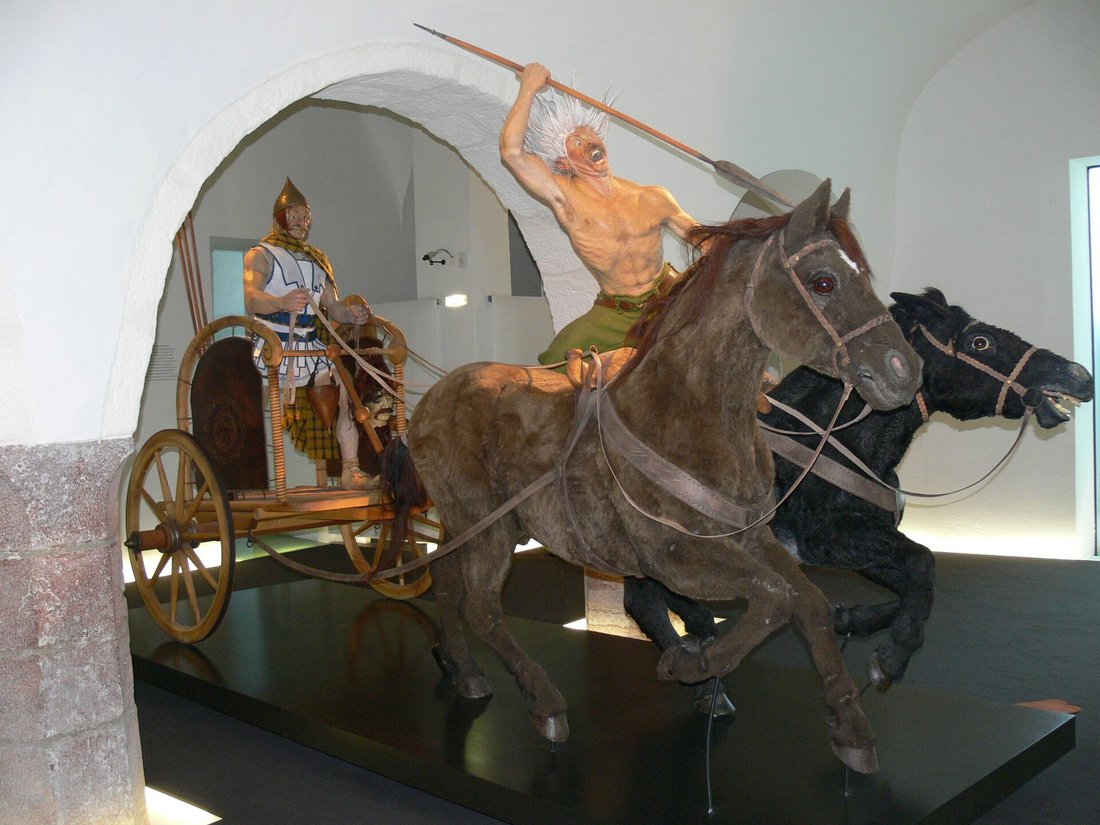
To a late-Republican Roman army the chariot was an anachronism. In the Greco-Roman world, fighting from a car had been given up centuries earlier – cavalry had long since proved superior. All the more unsettling, then, was what Caesar's soldiers met in Britain: a vehicle that combined the mobility of horsemen with the staying power of the foot soldier. The chariot was the tool of a warrior aristocracy, and it demanded years of training from man and beast alike. Whoever mastered it belonged to the elite – much like the Celtic warriors in general, whose rank could be read from their equipment and skill.
Above all, the chariot was light. Its frame was made of bent hardwood – ash, elm, oak – joined with straps and tenons rather than heavy iron. Two spoked wheels carried a small, open platform, just big enough for two people. A long pole ran forward to the yoke, where two small horses pulled. Metal was used sparingly and deliberately: at the hubs, on the harness fittings, on the connecting rings. The aim was a vehicle that accelerated quickly, stayed nimble, and yet absorbed the jolts of rough ground. A heavy, clumsy plank cart would have been useless in a fight – Celtic chariot-building aimed at the exact opposite.
The most impressive detail lies in the wheels. They usually measured around 90 centimetres across (the Ferrybridge find shows iron tyres of roughly 900 mm), were finely spoked, and carried a seamless, ring-shaped iron tyre. This tyre was placed red-hot over the wooden felloe and shrunk on as it cooled: the shrinking iron clamped every part of the wheel tightly together. The seamless iron tyre is regarded as a Celtic invention – a technique that shaped European wheelwrighting for centuries and survived at the wheelwright's bench into modern times. It made the wheel light and extremely strong at once. It is exactly these tyres that survive in the chariot burials, long after the wood has rotted away.
Another feature is surprising: the platform was apparently suspended. Instead of sitting rigidly on the frame, the floor of the car hung from straps or ropes in a kind of cradle, so that it swung gently over every bump. This cushioned the shocks – an early forerunner of suspension. For a warrior who had to throw javelins accurately at a full gallop, this was no luxury but a precondition. Reconstructions show that this suspension noticeably improved both comfort and accuracy. This too argues against the image of a lumbering war cart: the Celtic chariot was a carefully thought-out precision instrument.
The chariot was drawn by two small horses, barely bigger than today's ponies. They ran under a double yoke on the pole. Here lay the real art: keeping two animals calm and steerable at a gallop, over rough ground, amid the din of battle, was the fruit of relentless training. The Celtic horse-goddess Epona and the countless horse images of the period show what rank the horse held in this world. A chariot team was expensive to keep and tied up people and animals for years – making it a status symbol before it ever rolled into battle.
So how did one fight with this thing? Our best source is Caesar himself, who describes the British chariot fighters – the essedarii – from personal observation. His account is strikingly sober and technical:
Genus hoc est ex essedis pugnae. Primo per omnes partes perequitant et tela coniciunt atque ipso terrore equorum et strepitu rotarum ordines plerumque perturbant, et cum se inter equitum turmas insinuaverunt, ex essedis desiliunt et pedibus proeliantur.Caesar, De Bello Gallico IV,33 – "This is their manner of fighting from chariots: first they ride about in all directions and hurl missiles, and by the very terror of the horses and the noise of the wheels they usually throw the ranks into disorder; and once they have worked their way in among the squadrons of cavalry, they leap down from the chariots and fight on foot." (own translation)
The chariot, then, was not a weapon of close combat but a fast delivery system: it brought the warrior to the right spot in an instant, let him throw javelins as he raced past and grind down the enemy ranks – and then set him down to fight on foot.
Two men stood on the chariot: the warrior and his driver. Caesar goes on to report that, once the fighter had dismounted, the driver withdrew a little and kept the chariots ready – as a safe line of retreat should the warrior come under pressure. And he describes an almost acrobatic skill: that the men could run out along the pole, stand on the yoke, and dart back into the car in a flash, reining in the excited horses even on steep slopes and at full speed. The driver was no mere coachman but a highly specialised partner – arguably more valuable than the fighter, for without him there was no retreat.
The Romans had several words for Celtic vehicles, and keeping them apart helps avoid confusion. The essedum was the light, two-wheeled war chariot – exactly the vehicle Caesar met in Britain. The carpentum was a covered travel or ceremonial car, the petorritum a four-wheeled Gaulish waggon. These terms passed into Latin along with the vehicles themselves – proof of how much the Romans admired Celtic chariot-building. What matters is the word Caesar does not use in Britain: covinnus, later linked with the "scythed chariot". More on that shortly.
Our most solid knowledge comes from graves in which the dead were buried together with their vehicle. On the continent such finds cluster in Champagne and the Marne region – for example La Gorge-Meillet and Somme-Bionne of the 5th to 4th century BC – along with the splendid grave of Waldalgesheim. But here lurks a trap of confusion: the famous four-wheeled ceremonial waggons of the earlier Hallstatt period, above all the waggon of the "Lady of Vix" (around 500 BC) or the Hochdorf waggon, are princely graves with ceremonial parade waggons – not two-wheeled war chariots. To lump them together is to turn a hearse into a weapon of war. The true war chariot is the light two-wheeler of the La Tène period.
The two-wheeled chariot is most densely attested, of all places, in Britain – in the so-called Arras culture of East Yorkshire (roughly 4th to 2nd century BC). Here the dead were regularly buried with their vehicle: the real "chariot landscape" of the Celtic world. In Yorkshire the vehicles were often dismantled and the wheels laid flat in the grave, unlike some continental burials. The chariot burials proper belong to a short horizon centred on about 200 BC. The grave goods reveal rank and role: two of the dead were women given iron mirrors; men received swords or a shield. The chariot, then, was not a men's affair alone.
A few names stand out. Wetwang Slack and neighbouring Wetwang Village yielded several chariot burials (excavated 2001/2002), including the woman's grave with a mirror. At Ferrybridge (Ferry Fryston) in 2003, during motorway construction, a rare grave came to light whose iron-tyred wheels stood upright in the ground. Especially striking are the more recent finds at Pocklington: in 2017 and 2018 further chariot burials emerged there, one with a man laid crouched in the chariot box, an outstandingly preserved bronze shield decorated in La Tène style, and – unusually – horses buried upright alongside. The shield ranks among the finest testimonies of Celtic metalwork and belongs to the same formal world as the famous Gundestrup cauldron or the early La Tène swords.
Evidence: The two-wheeled Celtic chariot is doubly secured. First by an eyewitness: in De Bello Gallico IV,33 Caesar describes the tactics of the British essedarii from his own observation. Second by archaeology: the Arras-culture chariot burials (Wetwang, Garton Slack, Kirkburn, Ferrybridge, Pocklington) and the continental La Tène graves yield iron tyres of about 90 cm, hub fittings, and yoke and harness parts. Seamless iron tyres and the suspended platform are demonstrable technical features, not conjecture.
For a long time the richly buried chariot warriors were taken to be an immigrant elite from the continent – the Arras culture looks strikingly like continental models. Yet modern isotope analyses (strontium, oxygen, carbon, nitrogen, sulphur) on seven chariot burials from Wetwang, Garton Station and Kirkburn paint a different picture: most of the buried were born locally and lived there too. So the idea of the chariot grave may have travelled – but the people themselves were largely locals who adopted a continental burial custom. A neat example of how science corrects old migration legends.
Because the graves preserve only metal and soil stains, reconstructions are our window into how the chariots were actually driven. For the Wetwang finds, faithful vehicles were rebuilt on the basis of the ground traces. Such experiments confirm much of Caesar's account: the light chariots accelerate quickly, are astonishingly nimble, and the suspended platform is what makes throwing on the move possible at all. At the same time they show the limits: on truly broken or boggy terrain the team quickly becomes useless. The chariot needed open, firm ground – and well-trained horses. That also explains why it flourished in some landscapes and never really took hold in others.
Myth check: Three errors persist stubbornly. First: by Caesar's day the continental Gauls had largely given up the war chariot and fought as cavalry – which is exactly why the British chariot tactic surprised the Romans so much. Second: "scythed chariots" with blades on the hubs are a Persian-Hellenistic and literary motif; for British or Gaulish chariots they are not attested. Caesar, the eyewitness, mentions no blades and calls the vehicles essedum, not covinnus. Boudicca's famous scythed chariot is a romantic invention – popularised by Thomas Thornycroft's Victorian bronze group by Westminster Bridge (erected 1902), whose chariot moreover looks more Roman than Celtic. Third: the four-wheeled ceremonial waggons of the princely graves (Vix, Hochdorf) are not war chariots – do not confuse ceremony with war.
In the end the chariot was more than a weapon. It was expensive, demanded a well-drilled team and a trained driver, and tied up horses, craftsmen and years of practice. Whoever rode into battle with one displayed wealth, rank and the power to bend other people and noble animals to his service. Even in the grave this held true: the chariot accompanied its owner into the afterlife and proclaimed his standing there too. It is precisely this blend of craftsmanship, status and honest history that fascinates to this day – and it deserves to be told without scythed wheels and without Victorian pathos.
The Celtic Warriors · Celtic Princely Graves · The Gundestrup cauldron · The Britons.
All History & Finds articles →
Viking Age Scandinavia has given us thousands of swords, countless axes, spearheads and shield bosses. Mail shirts it …
Read more →