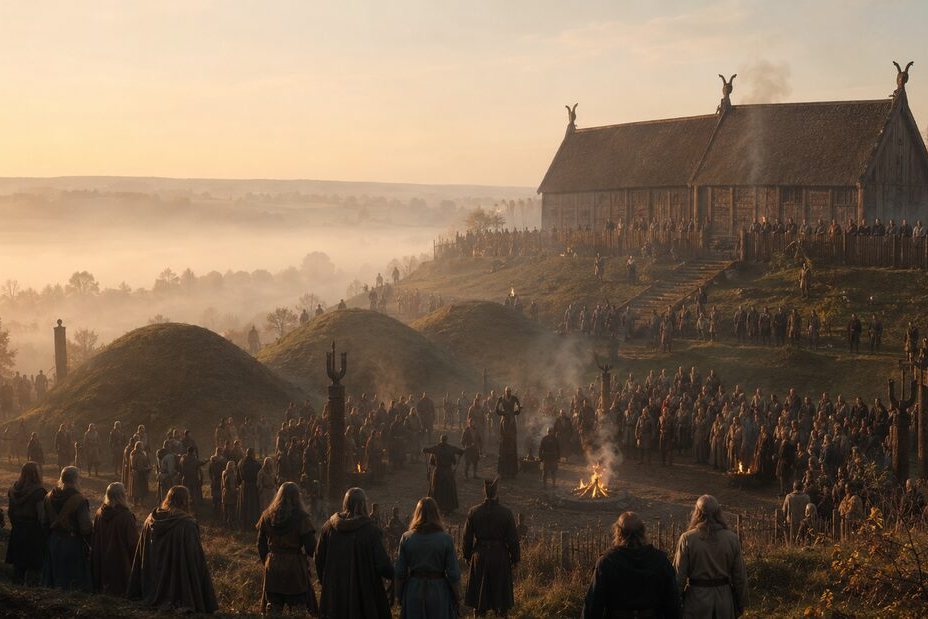
 Anyone reading about the Polabian Slavs is served the same tidy arrangement: four tribes, one confederation, one common enemy. The Kessinians are the people on whom that arrangement breaks. They appear late in the sources, they fight their own confederates, and a century later three hundred Circipanian horsemen ride against them in a Saxon army. Their land lies today between Rostock, Bützow and Güstrow – the German Baltic coast, not some distant elsewhere.
Most Polabian tribes are documented from the ninth century onwards. Not the Kessinians. Their name first appears in the events of 1057 – as Chizzini in Adam of Bremen, later as Kizini in Helmold of Bosau. That is remarkably late, because their territory had long been densely settled by then.
Scholars therefore call them a late-formed tribe. The sharpest piece of evidence is a silence. Otto the Great's charter of 965 for the monastery of St Maurice in Magdeburg lists the tributary Slavic peoples – Ucrani, Riezani, Riedere, Tolensane, Zerezepani. No Kessinians. And when Otto III marched from Mecklenburg to the Tollensians in 995 he must have crossed their later territory. Again: not a word about Kessinians.
Kessinian territory reached from the Baltic coast near Rostock along both banks of the Warnow some forty kilometres south towards Bützow, followed the Nebel south-east to Güstrow, and in the east extended beyond the Recknitz to Tessin and Laage. In 2006 Fred Ruchhöft was able to isolate two separate settlement chambers from the find sites: a northern one around Rostock, and a more densely settled southern one around Bützow and Güstrow, with find-poor zones between them interpreted as unsettled woodland.
Two northern sites carry real weight. The seaborne trading place at Dierkow, today a district of Rostock, was multi-ethnic and can be dated dendrochronologically to 749 through preserved timbers. The fortification at Fresendorf was probably built in the ninth century, judging by its pottery. People here produced a surplus for trade from the very beginning – the same Baltic world in which Menzlin on the Peene, Ralswiek on Rügen and Wolin on the Oder lay.
The Kessinians probably did not immigrate; they split off – from the Circipanians. Circipanian cohesion may have broken in 955, when a Saxon army under Otto the Great destroyed the combined force of Circipanians and Tollensians at the battle on the Raxa. Widukind of Corvey reports that the Slavic leader Stoignew was killed. Recent work on river finds suggests the Raxa was the Recknitz – later the eastern boundary of the Kessinians.
In parallel, several older strongholds in the southern settlement chamber are abandoned, and around the year 1000 the castle district of Werle emerges. Many small centres of lordship become one. Research places tribal formation exactly in that window, the late tenth to early eleventh century. But this remains a model built from archaeology and inference, not a statement in any source. No text tells us how or why the Kessinians became Kessinians.
Then, all at once, they stand in the middle of politics. Adam of Bremen, a canon at Bremen and the key witness, describes a war among the Lutizians themselves. Four peoples, he says, contended for rank and power: Kessinians and Circipanians on this side of the Peene, Tollensians and Redarians beyond it. The quarrel escalated into war – three times, and three times the Circipanians prevailed.
Only then did the losers call in outside help: the Obodrite overlord Gottschalk, the Saxon duke Bernhard and the king of the Danes. For seven weeks they maintained the army of the three rulers from their own resources, while the Circipanians, as Adam concedes with something like respect, fought back bravely. In the end the Circipanians bought peace with 15,000 talenta. Helmold of Bosau, who copies Adam, converts this into marks – anyone repeating the figure should add that even the unit shifts between the two chroniclers.
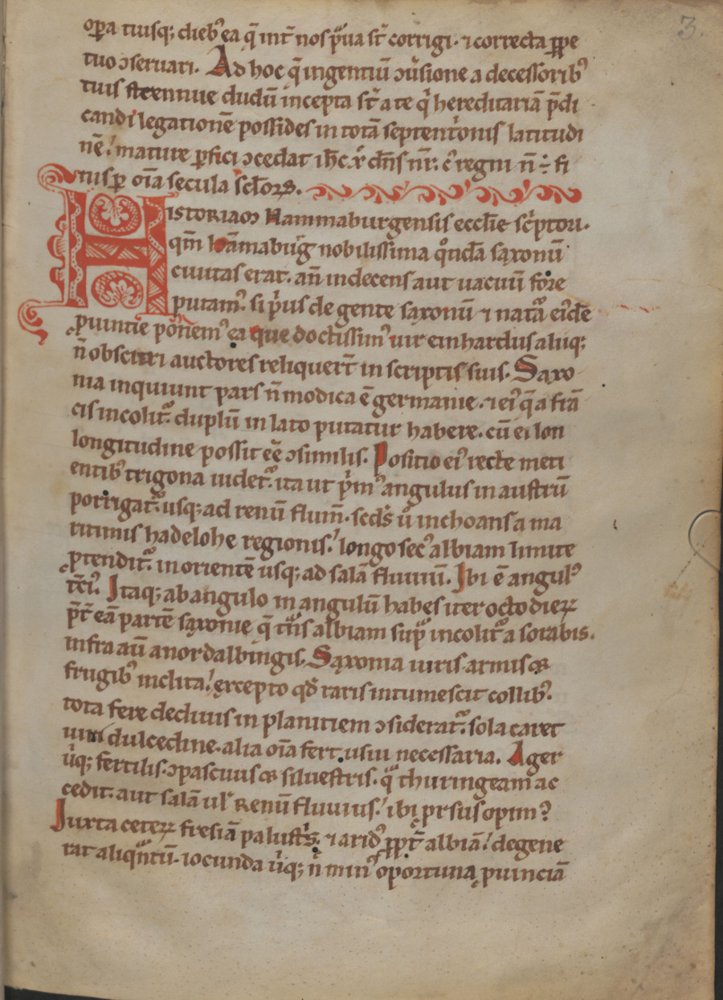
Hii sunt scilicet Chizzini et Circipani, qui habitant citra Panim fluvium, Tholosantes et Retheri, qui ultra Panim degunt. Cumque his perveniret ad bellum, Tholosantes et Rheteri, quamvis auxilio Chizzinos haberent, nichilominus victi sunt a Circipanis. […] Nostri cum triumpho redierunt, de christianitate nullus sermo, victores tantum praedae intenti.
“These are the Kessinians and the Circipanians, who live on this side of the river Peene, and the Tollensians and Redarians, who live beyond the Peene. And when it came to war over this, the Tollensians and Redarians, although they had the Kessinians as their help, were nevertheless defeated by the Circipanians. […] Our men returned in triumph; of Christianity there was no mention, the victors were intent on plunder alone.”Adam of Bremen, Gesta Hammaburgensis ecclesiae pontificum III,21 (ed. Waitz, MGH SS rer. Germ., Hanover 1876; III,22 in other numbering); translation: Glanz & Gravur
The popular short version runs: Kessinians and Circipanians against Redarians and Tollensians. Adam's wording says something else. Geographically he does group the Kessinians with the Circipanians – both citra Panim, on this side of the Peene – but in the sentence about the fighting they appear as auxiliaries of the other side: quamvis auxilio Chizzinos haberent, “although they had the Kessinians as their help”. The Circipanians win three times, and they win against the Kessinians too.
This is not a detail; it is the heart of the matter. If the manuscripts are right, in 1057 the Kessinians did not fight alongside their neighbouring tribe but against it. Whether they changed sides, whether Adam was imprecise, whether a scribe slipped – that cannot be decided. What can be decided is this: a confederation in which such a thing is possible was never a bloc. Adopting the neat fourfold scheme means adopting an ordering device of the chroniclers, not reality.
And Adam himself is an interested party. He is a cleric of a church that wants to convert these peoples. His bitterest sentence about the campaign is therefore aimed not at the Slavs but at his own side: there was no mention of Christianity, the victors were intent on plunder alone. Reading Adam purely as a record of events misses how much he writes in order to admonish.
The chroniclers name the cause plainly. The Redarians and Tollensians claimed precedence because they held themselves to be the older and more respected, and because the central sanctuary lay in their territory. The Kessinians and Circipanians refused to pay the silver levy for it. A confederation without princes needs a centre – and that centre was a cult site, not a throne.
Which also says what we do not know about that cult site. Rethra has never been located; the famous Prillwitz idols, long adduced as evidence, are an eighteenth-century forgery. That concerns the Redarians, however, not the Kessinians. For Kessinian belief itself there is virtually no independent tradition – anything colourful you read about it is almost always borrowed from accounts of Rethra or of Arkona on Rügen.
After the defeat of 1057 the Kessinians were placed under the Obodrites and paid tribute to Gottschalk. When he was killed in the pagan rising of 1066 they apparently did not rejoin the princeless confederation: by the early twelfth century they have a leadership of their own. The Annalista Saxo names two men, Dumar and Sventipolk.
In 1114 a Saxon force under Duke Lothair of Supplinburg and Margrave Henry of Stade moved against Dumar and his son. That force included three hundred Circipanian horsemen. A relief army of the Rani hurrying to help the Kessinians was surrounded and had to surrender; Dumar handed over his son as a hostage. Two generations after the civil war, then, the Circipanians stood on the other side – in the Saxon army. Honesty requires an addition: which tribe Dumar actually belonged to is disputed, with Redarians, Tollensians and Pomeranians proposed alongside the Kessinians.
Seven years later Lothair returned, this time against Sventipolk. Under the year 1121 the Annalista Saxo notes among the captured strongholds one quarum una Kizun dicebatur famosior et opulentior ceteris – one of which was called Kizun, more famous and richer in treasure than the rest. This is the first secure mention of the fortress that gave the tribe its name.
A distinction is worth making here, because it is often muddled. The famous siege of Dobin on Lake Schwerin does not belong to this story. It falls in the Wendish Crusade of 1147 and was aimed at Niklot, not at the Kessinians. Kizun lies on the lower Warnow, Dobin more than eighty kilometres further west.
And so to the most uncomfortable point: where the stronghold of Kessin lay is still not established. It very probably did not lie at today's Kessin near Dummerstorf, which bears the name. Current research places it south-west of Fresendorf, where a ridge more than two hundred metres long rises, known locally as the Schloßberg. Excavations there have produced intensive settlement of the Slavic period.
The claim that the slight north-easterly orientation of the site argues for a cult place is sometimes made – that is an interpretation, not a finding. What is certain is its position within the system. The Warnow was the waterway to the Baltic, and whoever controlled it sat on the link between inland and sea. Which is precisely why, a few kilometres downstream, a town later arose that inherited the advantage.
From 1148 Niklot, as a vassal of Henry the Lion, levied tribute on the Kessinians. In 1150 they began refusing to pay. Niklot turned to Duchess Clementia, received a force of two thousand men under Count Adolf II, and marched with it into Kessinian territory. Helmold reports that they destroyed a famous sanctuary and compelled the Kessinians to render the arrears and more.
The constellation is worth noting: a Slavic prince fetches a Saxon army to force a Slavic tribe to pay tribute. Anyone telling this period as a simple opposition of Germans and Slavs is telling it wrong. It was about lordship and money, and the lines ran crosswise.
On no other point of Kessinian history has so much nonsense been written as on their supposed chief god Goderac. People have even read the name as a “god of time or of the year among the West Slavs” and placed his main sanctuary at Kessin. Except that this god never existed.
The origin is a misreading. Around 1210 Arnold of Lübeck wrote of Bishop Berno of Schwerin that he felled the sacred groves and decreed that in place of Gutdraccus the bishop Godehard should henceforth be venerated. Behind this lies the endowment charter of Henry the Lion for the bishopric of Schwerin of 1171, which states soberly: et villam sancti Godehardi, que prius Goderac dicebatur – “and the village of Saint Godehard, which was previously called Goderac”. Goderac is a place name, not the name of a god.
This was demonstrated as early as 1892 by the Slavist Aleksander Brückner. Slavic studies duly struck Goderac from the lists of Slavic gods – historical writing only half did so, because Karl Koppmann was just then preparing an essay on the village of Kessin and briskly declared Brückner's arguments “by no means convincing”. Helge Bei der Wieden reopened the case in 1975 and also showed where the name belongs: the Knýtlinga saga calls the Warnow Gudakrsá, Saxo Grammaticus Gudacra. A confirmation charter of Pope Urban III from 1186 names in terra Kizin duas uillas, villam sancti Godehardi scilicet et aliam sibi adiacentem. Goderac therefore lay on the river and in the land of Kessin – a village renamed Saint Godehard's village, which the locals nonetheless went on calling after the neighbouring stronghold.
Securely attested in writing are: the first mention in 1057 in Adam of Bremen III,21, with the four Lutizian peoples, the threefold Circipanian victory and the peace bought for 15,000 talenta; Helmold of Bosau on the same war (I,21), on Werle near the land of Kessin (I,88) and on the campaign of Niklot and Adolf II in 1150 (I,71); the Annalista Saxo with the princes Dumar (1114) and Sventipolk and the stronghold of Kizun (1121); the charter of Henry the Lion of 1171, in which a Pribizlauus de Kizin appears and a village of Saint Godehard is named that was formerly called Goderac. Archaeologically secure are the trading place of Dierkow with timbers dated to 749, the Fresendorf fortification from the ninth century onwards, and intensive Slavic-period settlement on the Schloßberg south-west of Fresendorf.
The Kessinian god Goderac is an invention born of a misreading: the charter of 1171 names a village, and Arnold of Lübeck turned it into an idol. Brückner 1892, Bei der Wieden 1975. Equally unproven: the location of the stronghold of Kessin, which despite all proposals is not established, and its interpretation as a cult site. The tidy scheme “Kessinians and Circipanians against Redarians and Tollensians” is not what Adam writes; he expressly lists the Kessinians as help for the other side. The “four tribes of the Lutizians” are also in good part an ordering device of the chroniclers. Rethra has not been located and the Prillwitz idols are an eighteenth-century forgery – both concern the Redarians, not the Kessinians. And the tribal affiliation of Prince Dumar remains open in scholarship.
The Wendish Crusade of 1147 did not pass the Kessinians by, but it settled nothing for them. The decision came between 1160 and 1171. Niklot fell in an ambush before the stronghold of Werle in 1160, his sons Pribislaw and Wertislaw were driven out for a time, and in 1161 the Danish king Waldemar I, allied with the Saxons, destroyed the princely stronghold of Kessin. Wertislaw was taken prisoner by the Saxons at Werle in 1162.
In 1164 Pribislaw received parts of the land back as a fief; in 1171 he signs as Pribizlauus de Kizin. The reconstruction is complete: the tribal prince becomes a territorial lord within the Empire, and the land of Kessin later becomes the lordships of Rostock and Werle. In 1211 the bishop of Schwerin received parts of the castle district, among them the village of Goderac – the very village that lent the myth its name. The stronghold itself lost importance and decayed, while a few kilometres downstream a new, urban order arose, as it did elsewhere along the Baltic.
The Kessinians are no exotic footnote. Their land is the district of Rostock. The name of the city is Old Polabian and refers to water flowing apart; Bützow, Güstrow, Laage and Tessin all carry Slavic names, and the dynasty from which Mecklenburg grew traces itself back to Niklot. Standing on the Warnow means standing in a landscape whose names are older than any German charter about it.
And the Kessinians themselves? They are the most honest case in this whole world between the Elbe and the Oder – the Wagrians to the west, the Polabians inland, the Sorbs to the south. No closed confederation, no unified people, no pure war of defence, but neighbours who switched alliances, refused tribute, beat one another and finally grew into a new order. It is less heroic than the postcard version. It is, in exchange, true.

The Liutizi · The Circipani · The Abodrites · The Rani (Rügen) · The Wagri.
