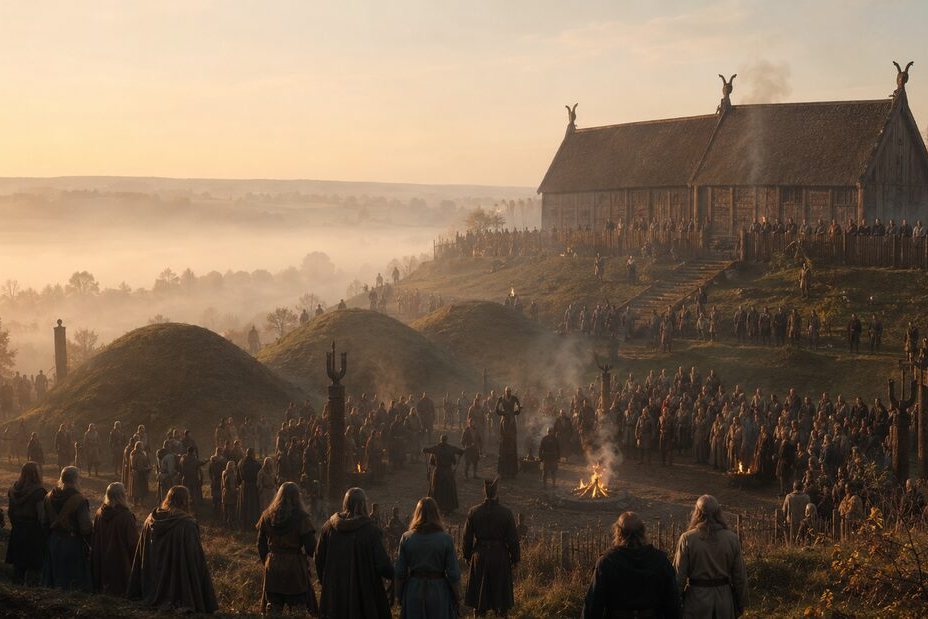
 Between the Recknitz and the Peene, in what is now Mecklenburg-Vorpommern, lived a West Slavic tribe almost nobody remembers: the Circipani. They were one of the four core peoples of the Lutici federation, they beat their own allies three times running in 1057, and they built strongholds on islands reached by timber bridges hundreds of metres long. Almost everything written about them came from men who wanted them gone; the rest comes out of waterlogged ground that preserved their building timbers. This is the story of a people named after a river and undone by an argument about silver.
Drive today from Güstrow to Demmin and you cross old Circipania. The tribal territory lay roughly south of the Recknitz and the Trebel and west of Lake Malchin and Lake Kummerow – a country of shallow lakes, bogs, streams and gently rolling ground moraine. On current research it covered the later castle districts around Demmin, Dargun, Krakow am See, Sukow and Altkalen; Teterow, Malchin and Demmin count as the principal strongholds.
Slavic groups settled here from the seventh century onward. Out of them, across generations, formed the tribe that Latin sources first name in the tenth. Water governed everything: it protected the forts, it moved goods, and it forced bridge-building on a scale this quiet landscape no longer betrays. To understand the Circipani you first have to understand the Peene – the river that gave them their name and that later became the fault line along which their federation split.
The sources give them as Circipani, Zcirizspanis, Zerezepani. The familiar derivation is Latin: circum („around“) plus Pane, the Latin name of the Peene – hence „those around the Peene“. That explanation is old and convenient, but it explains a Slavic name by way of somebody else’s language.
The linguistically stronger reconstruction starts from a West Slavic word for „across, beyond“; Polish scholarship therefore writes the tribal name as Czrezpieniane, „those beyond the Peene“. The river name itself is usually traced to an Old Polabian word for „foam“. Both readings arrive at the same point: this tribe was named for its position relative to a river – by somebody standing on the other bank. „Beyond“ is not a location, it is a point of view. Whether the Circipani ever used that name for themselves, we do not know. Similar positional labels attach to the Polabians („those on the Elbe“) and the Hevelli on the Havel.
The earliest mention stands in the Annals of St Gall under the year 955. The entry is short and brutal: King Otto and his son Liudolf fought on the feast of Saint Gall against Abodrites, Wilzi, Circipani and Tollensians, won, killed their leader named Ztoignavo and made them tributary. This is the battle on the river Raxa – a river whose location is still disputed; a study of 2001 argues for the Recknitz, that is, for the Circipanian heartland.
The basic problem of all northern Slavic history is already visible here: the sources disagree with one another. Widukind of Corvey reports at length that the Slavic leader Stoignew was killed; Flodoard of Reims writes only that Otto defeated two Slavic kings. Ten years later, in 965, the Zerezepani appear among the tributary tribes in Otto I’s charter for the monastery of St Maurice at Magdeburg. So at that point the Circipani were subjugated – and they evidently had a princely leadership that could be cut down. Both facts were about to change within a generation.
During the tenth century a political creature took shape north-east of the Elbe that baffled its neighbours: the Lutici federation. It had an assembly but no central authority, no king, no dynasty – which made it hard for principalities such as Saxony, Denmark or Poland either to grasp or to negotiate with. Its core peoples are counted as the Redarians, the Tollensians, the Circipani and the Kessinians. For the federation itself see Lutici.
Within that group of four the Circipani and Kessinians occupy a special place. Most scholars hold that before 983 both belonged rather to the orbit of the Obodrites. The Kessinians do not appear in written sources until 1057 – so late that research calls them a „new tribe“; they most likely split off from the Circipani around the year 1000, possibly as a delayed consequence of the collapse of Circipanian princely rule in 955. Across this whole region people spoke a Polabian dialect of Lechitic, that is West Slavic – the same family as the Pomeranians and the Wagrians. How these peoples fit into the wider map east of Elbe and Saale is set out in our overview at germanische-staemme.html.
The federation had no political centre but it did have a religious one: the temple site in Redarian country. Thietmar of Merseburg calls it Riedegost and the god worshipped there Zuarasici; Adam of Bremen, writing some fifty years later, calls the place Rethra. The descriptions mention a wooden temple, several gates, a sacred white horse used for divination, and lot-oracles. Comparable practice is reported from the Svantevit sanctuary of the Rani at Arkona and from the Triglav cult at Stettin.
Where Rethra stood, nobody knows. Since the seventeenth century dozens of locations have been proposed, mostly between the Müritz and Lake Tollense. Not one is archaeologically confirmed. For the Circipani the sanctuary still matters – because money hung on it. The federated tribes apparently paid a silver levy for the temple, and in 1057 that levy turned into a war.
On 29 June 983 the rebelling Elbe Slavs stormed the bishop’s seat at Havelberg; three days later Brandenburg fell. The tradition agrees that the rising started from the Lutici sanctuary, and it ended Saxon tributary rule east of the Elbe for well over a century. Missionary structures built up over decades vanished within days. The Circipani were free of their tribute too.
What followed is remarkable even by medieval standards. From 1003 the emperor Henry II recruited the pagan Lutici as allies against Christian Poland; in 1005 and again in 1017 Lutici contingents marched with their divine standards in the army of a German king, to the visible discomfort of the clergy travelling alongside. In 1045 a Saxon army was destroyed in Lutici territory, and in 1056 another under William of the Nordmark near Havelberg. Two generations of success – and a confidence the federation ultimately did not survive.
It began with a claim. The Redarians and Tollensians, east of the Peene, claimed overlordship over the Circipani and Kessinians: they were older, they stood in higher esteem, and the shared sanctuary happened to lie in their country. The Circipani and Kessinians disagreed. They refused the silver levy for the temple – and with that the federation was effectively over, because the sanctuary was its only shared institution.
Militarily the outcome was a surprise – and here the exact wording matters, because the widespread short version “two against two” is not what the source says. Adam writes that the Tollensians and Redarians were defeated by the Circipani although they had the Kessinians as support: quamvis auxilio Chizzinos haberent. The war was fought three times, and three times the Circipani won. The Kessinians, geographically their immediate neighbours on this side of the Peene, therefore stood on the opposing side in battle – whether they changed sides, whether Adam was imprecise, or whether a scribe erred cannot be decided. By the transmitted text, the victors were the Circipani alone. Only then did the losers fetch help from outside: Gottschalk, overlord of the Obodrites and a determined champion of Christianisation, his father-in-law the Danish king Sweyn Estridsson, and the Saxon duke Bernhard II. That tipped the balance. What happened next was recorded by Adam of Bremen with a bitterness he never quite manages to suppress:
At last the Circipani offered fifteen thousand in silver and bought peace with it. Our men returned home in glory; of Christianity there was no word, the victors thought only of plunder.Adam of Bremen, Gesta Hammaburgensis ecclesiae pontificum, Book III, chapter 21 in the MGH count (III,22 in another count; chapter numbering varies between editions), own translation
The sentence is valuable precisely because it comes from a cathedral canon who would much rather have reported a missionary success and instead found himself minuting a raid for loot. The figure needs caution: Adam speaks of pounds, Helmold of Bosau – writing roughly a century later – of 15,000 marks of silver. Converted, that would run to several tonnes of bullion. Numbers like this in medieval chronicles are rhetorical orders of magnitude, not bookkeeping. Helmold, incidentally, does not call the conflict a „war of brothers“ at all; he calls it plainly a civil war and names it after the Tollensians. The term now current comes from modern scholarship.
The price was not only silver. The Circipani and Kessinians were placed under Gottschalk’s rule and thus incorporated into the Obodrite confederation – by force and against their stated will. The Lutici federation never recovered; as a supra-regional power it was finished long before German armies finally broke it. A league whose only clamp was a temple levy does not survive a second test.
In 1066 Gottschalk was killed in a rising. In the same context the sources report the death of Bishop John of Mecklenburg, whose head is said to have been offered up at the Lutici sanctuary – a report that survives exclusively from Christian, that is hostile, pens, and must be read accordingly. How torn the region had become shows in a marginal note for 1114: when Duke Lothar of Saxony and Margrave Henry of Stade campaigned against the Kessinians, three hundred Circipanian horsemen rode in the Saxon levy. Yesterday’s neighbours, against yesterday’s kin.
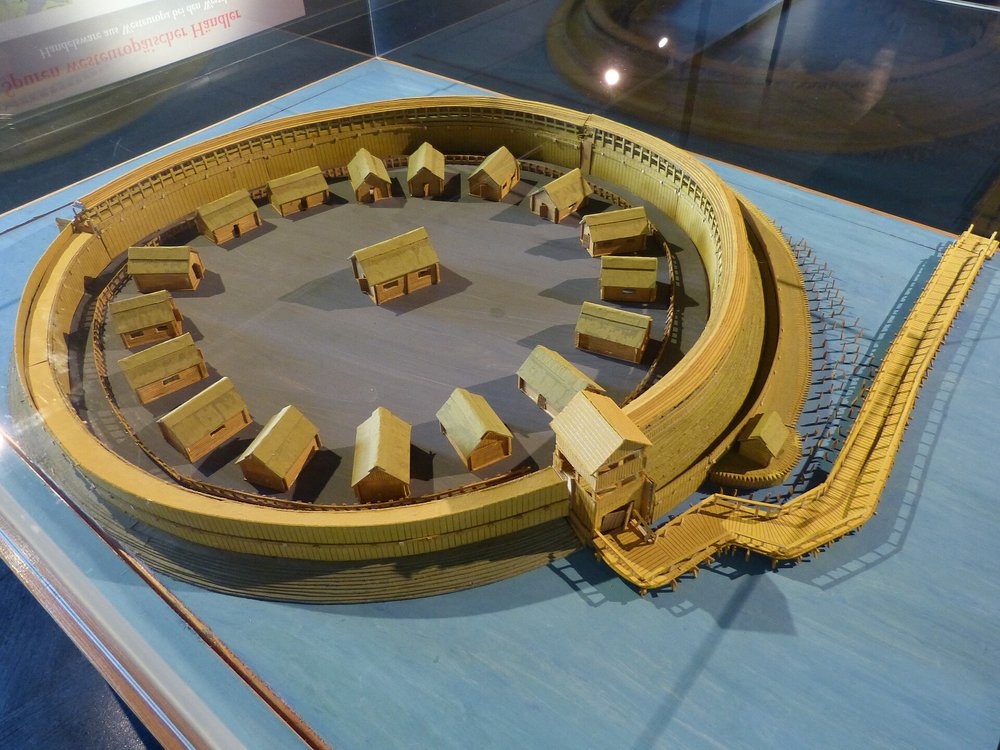
What really survives of the Circipani is not in chronicles but in the ground. On the rampart island in Lake Teterow lay a complex that the excavators of the 1950s interpreted as a tribal centre: a comparatively small main fort of about 0.6 hectares of interior space, plus an outer bailey. The rampart still stands nearly six metres high today; in Slavic times it probably reached nine or ten metres, topped by an oak palisade. A bridge of roughly 750 metres led to the mainland – one of the longest bridges known from the Slavic period anywhere.
Better investigated still is the island fort at Behren-Lübchin, one of the tribe’s principal strongholds. Ewald Schuldt excavated it from 1956 to 1961 and found timber in quantities only wet ground can preserve: box constructions, a roofed wooden wall-walk, a probably two-storey gate tower, wooden shutters facing the lake, and a bridge over 300 metres long. Two building phases could be distinguished. Honesty is due here: heights, roofing and internal buildings are reconstructions drawn from post holes and horizontal timbers, not facts read off the ground. Parts of this fortification have been rebuilt at the open-air archaeological museum at Groß Raden – if you want to feel what Circipanian defensive architecture was like, that is where you go.
Forts are the conspicuous part, not the important one. Around every one of these ramparts lay villages, fields and pasture. People farmed grain, kept cattle, fished and kept bees; craftsmen worked in the outer baileys, and markets were sometimes held there too. The late Slavic pottery of this region is so distinctive that archaeology simply named its wares after find spots – the Teterow and Vipperow types carry the names of places in and around Circipania and serve today as chronological markers for the whole of northern Germany. It is a quiet honour: the clocks of north German early history are named after Circipanian villages.
This was no backwater. By way of the Peene and the Baltic it hung on the great northern trading network in which Arab silver, glass beads, amber and wax circulated – the same currents that fed the trading places at Menzlin, Ralswiek and Wolin. And bridge-building should not be filed under trivia: driving a 750-metre bridge across a lake requires felling, transport, carpentry and above all organised labour sustained across years. A society that builds such a thing can plan, calculate and lead people. None of that appears in any chronicle.
In the twelfth century Circipania became a corridor for other people’s ambitions. In 1128 the Pomeranians pushed deep into the tribal territory and annexed the southern part of what later became Hither Pomerania to their duchy. On the western side, from the 1130s at the latest, the Obodrite prince Niklot ruled, and most scholars credit him with overlordship over the Circipanian districts as well.
Then came 1147. The Wendish Crusade was a sub-enterprise of the Second Crusade, proclaimed by Bernard of Clairvaux and confirmed by the pope – and driven by thoroughly worldly interests. The northern army under Henry the Lion besieged the fort at Dobin; the larger army under Albert the Bear moved via Havelberg and Malchow, where a pagan sanctuary was destroyed, to the fortress of Demmin and laid siege to it. Demmin – Slavic Dimin, a stronghold on an artificial island where the Peene, Tollense and Trebel meet – was the key point on the river. Part of the army then moved on to Stettin, where the besieged pointed out that Otto of Bamberg had baptised them long ago, hung crosses on the walls and negotiated their way out. Helmold of Bosau also preserves the most cynical thought of the whole campaign: knights in both armies are said to have asked why they were ravaging land that was meant to become their own, and killing the people who were supposed to pay them dues.
The last act came from the sea. After 1170 the Danes under Valdemar I campaigned repeatedly in this country. Saxo Grammaticus describes, under the year 1171, the storming of an island fort reached by a long bridge: the defenders tore down almost all of the bridge and built a fighting tower on the final stretch, but the piers remained; the Danes rebuilt the bridge at heavy cost, took the tower and then the fort. The men were killed, the women and children carried off. This is very probably Behren-Lübchin. The second fort, put up immediately afterwards on the same spot, was taken and destroyed around 1200; the coin finds do not say by whom.
Niklot had fallen in 1160 and his sons became vassals of Henry the Lion. In 1172 Danish Cistercians from Esrom founded the monastery of Dargun – in the middle of the old tribal territory, under the Pomeranian prince Casimir and Bishop Berno of Schwerin; in 1209 it was resettled from Doberan. After the Treaty of Kremmen in 1236 and the Mecklenburg advances of the 1230s, Circipania was divided: the western bulk with Güstrow and Teterow to Mecklenburg, the eastern part around Demmin to Pomerania. As a political name Circipania disappeared; in the ecclesiastical structure of the diocese of Cammin the old boundary lingered rather longer. The heavily reduced Slavic population was Christianised and, in the course of the Ostsiedlung, assimilated – not an end in a single day but an absorption across generations, much as the Sorbs experienced, except that there a remnant survives to this day.
Surprisingly much, once you look. Teterow, Malchin, Dargun, Demmin, Güstrow, Krakow – the place names of this landscape are Slavic, and anyone who pronounces them is speaking a little Circipanian without noticing. The ramparts on the island in Lake Teterow still stand; the island is reached today by cable ferry. At Groß Raden you can walk through reconstructed timber fortifications of this kind, at Dargun the ruined monastery sits on old tribal ground, and further west at Starigard/Oldenburg you can see how a Slavic princely seat of the same period was excavated and presented.
What is missing is their own voice. No Circipanian text survives, no prince’s name apart from Stoignew, killed in 955, not one sentence from their side. What remains is timber, sherds, rampart fill – and the reports of their enemies. Making a people legible whose entire written record came from the pens of those who subdued them is the real work in this subject. It begins with not mistaking interpretation for evidence.
The Liutizi · The Rani (Rügen) · The Abodrites · The Pomeranians · The Wagri.
All History & Finds articles →
Many call the Varus battle the „big bang of Germany". Yet another battle shaped our lands far more deeply – one in …
Read more →