Its name means “the god's lake.” On the shore of Tissø on the Danish island of Zealand lay, for centuries, one of the largest and richest seats of the Viking Age – a place of power and cult, where a farmer while ploughing chanced to lift a ring of pure gold weighing almost two kilograms from the earth. A look at a place where kingship and belief in the gods lay close together.
The name itself is a statement. Tissø means “the god's lake,” or more precisely “Tyr's lake” – after the old war god Tyr, whose name is contained in many Danish place names. The lake was a holy place where offerings were laid down over a long time, and weapons have indeed been recovered from the water, interpreted as offerings to a god – perhaps Tyr. More on this god is in our piece on Tyr.
“Týr is the boldest and most courageous of the gods; he has much power over victory in battle.” after Snorri, Gylfaginning (public-domain translation tradition)
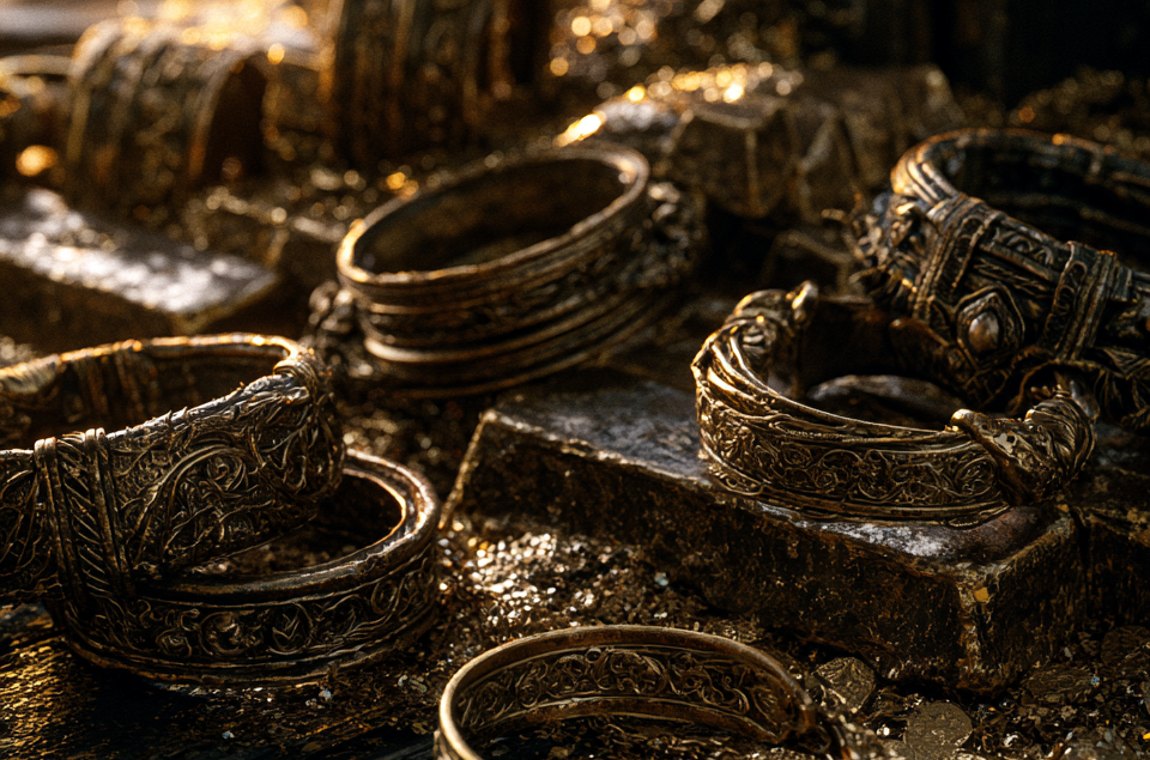
The attention of archaeologists was drawn in 1976 by a spectacular chance find: during ordinary ploughing, a large gold neck-ring made in the 10th century came to light – about 30 centimetres in diameter and, at some 1.8 kilograms, one of the largest gold finds in Denmark. Whoever wore or owned such a thing stood at the very top. The ring led researchers to one of the most important places of the Viking Age.
Large excavations between 1995 and 2003 uncovered at Fugledegård on the western shore a royal seat of about 50 hectares – huge for its time. Its heart was a mighty hall of roughly twelve by forty-eight metres, surrounded by further buildings, some of which likely served ritual purposes. In 2012 the remains of another large hall were found. The complex so closely resembles the seats of Old Lejre and Järrestad that it is thought Tissø was a seasonal residence of the royal family – a place the court visited at certain times.
Tissø was not only a residence. Here rule, trade and sanctuary met: a market where goods and silver changed hands, a cult place where offerings were made, and a lordly seat from which power was exercised. Besides the great gold ring, Thor's hammers, weapons and fine jewellery were found. It is this coexistence – gold and gods, market and hall – that makes Tissø a key site for understanding how a Viking-age realm worked.
Tissø shows the other side of the Vikings: not the raider, but the lord of a hall who held feasts, entertained guests and sacrificed to the gods. And it shows what a role the precious, whole object – the gold ring – played as a sign of rank. A ring, a hall, a lake that belongs to a god: that is the Viking Age beyond the cliché.
At Tissø (western Zealand), near Fugledegård/Kalmargården, lay a Viking-age royal seat of about 50 hectares with a hall of roughly 12 × 48 m; in 2012 another large hall was identified. In 1976 a golden neck-ring of the 10th century came to light during ploughing (c. 30 cm in diameter, ~1.8 kg) – one of the largest gold finds in Denmark. The name means “the god's lake” (to Tyr); weapons interpreted as offerings have been recovered from the lake. The complex resembles Old Lejre and Järrestad; it is regarded as a possible seasonal royal seat. Finds are in the National Museum of Denmark and Kalundborg Museum.
That Tissø was a seasonal seat specifically of the Lejre royal family is a well-founded assumption, not proof – who exactly ruled here we do not know. The attribution of the lake weapons to the god Tyr rests chiefly on the place name. What is certain is the find: an exceptionally large seat with hall, market and traces of cult, plus one of the largest gold rings in Denmark.
Thyra Danebod – Denmark's mightiest woman · Trelleborg – Harald's ring fortresses · Guldgubber – the tiny gold gods · The oath rings · Týr – the god who gave his hand.