Search for "Viking symbol birth month". You get tables: January the hammer of Thor, April the Vegvísir, October the valknut, each with a character reading, ready to share. The lists look old, they sound old, and they contradict one another from page to page – which is the first clue. No Old Norse source, no runestone and no manuscript contains a system of symbols assigned to birth months. What does exist is something else, and frankly it is more interesting.
The lists come in three shapes. A symbol per month, usually from the familiar repertoire – Thor's hammer, valknut, Vegvísir, Ægishjálmr, Yggdrasil, troll cross. A rune per month, drawn from the Elder Futhark, often with a personality profile. Or a "Norse horoscope", twelve or thirteen segments with animal or god names, built like a zodiac.
Compare any two such pages. The assignments do not match. Thor's hammer belongs to January here and to June there. The year starts on 1 January, or at the winter solstice, or somewhere in October. That is not a problem of transmission. That is the signature of content invented independently and then copied from one site to the next.
On the symbols themselves: Thor's hammer is attested as an amulet by the hundred, the valknut on picture stones and in the Oseberg find. The Vegvísir, by contrast, first appears in an Icelandic paper manuscript of 1860, the Ægishjálmr in early modern books of spells. Which Norse symbols are old and which are not we have sorted out elsewhere, along with the special case of Vegvísir and Ægishjálmr. None of them was ever tied to a month.
The blueprint is well documented – it simply belongs to the twentieth century.
In 1948 the English poet Robert Graves published The White Goddess. In it he built a "Celtic tree calendar" out of the letter names of Irish ogham: thirteen moons, a tree for each, a meaning for each tree. Graves did not draw on medieval Irish sources but, among other things, on Ogygia, a seventeenth-century work. Celtic studies have rejected the calendar outright; the historian of religion Ronald Hutton calls Graves's book a major source of confusion about the ancient Celts, and Hilda Ellis Davidson accused him of misleading his readers with eloquent but deceptive statements. The construction has no relation to any historical Celtic calendar.
It succeeded anyway. The tree calendar produced "tree horoscopes", the tree horoscopes produced birth-tree lists, and from there it is a short step to birth-month runes and birth-month symbols. The format was in place; only the filling had to be swapped.
The second building block came in 1982, when Ralph Blum published The Book of Runes. The book turned rune casting into a mass phenomenon and introduced a blank rune that occurs in no historical futhark – in no inscription, on no stone, in no manuscript. Anyone buying a rune set with an empty tile today is buying an invention of 1982. More on the difference between script and oracle under runes.
Runes are letters. They have names, and about those names we do know something – from the three rune poems. The Old English poem is probably early; its manuscript burned in 1731 and survives through George Hickes's printing of 1705. The Norwegian poem exists in a seventeenth-century copy of a thirteenth-century original, the Icelandic in manuscripts from around 1500 onwards.
These poems are mnemonic verses, often built like riddles. The first stanza of the Old English poem runs:
Feoh byþ frofur fira gehwylcum; sceal ðeah manna gehwylc miclun hyt dælan, gif he wile for drihtne domes hleotan.
"Wealth is a comfort to every man; yet every man must share it out freely if he wants to win esteem before the Lord."Old English Rune Poem, stanza 1 (feoh); English rendering our own
That is a statement about riches and generosity, framed as a memory aid for a letter. It is not a character description, not a month assignment and not an oracle. The rune poems give the runes no seasons, no birth dates and no personalities.
What the sources do provide is names for the months – from several Germanic language areas.
Around 725 Bede lists the Old English month names in De temporum ratione and explains some of them: Eosturmonath is named after a goddess Eostre; Blodmonath is the month of offerings, when the cattle to be slaughtered were consecrated to the gods; Solmonath is the month of cakes offered to the gods. Einhard reports in the Vita Karoli Magni, chapter 29, that Charlemagne gave the months Frankish names, and lists them: Wintarmanoth, Hornung, Lentzinmanoth, Ostarmanoth, Winnemanoth, Brachmanoth, Heuvimanoth, Aranmanoth, Witumanoth, Windumemanoth, Herbistmanoth, Heilagmanoth.
In the North the Old Icelandic calendar survives, with Þorri, Gói and Einmánuður in winter, Harpa, Skerpla, Sólmánuður, Heyannir, Tvímánuður and Haustmánuður in summer, plus Gormánuður, Ýlir and Mörsugur. Most of these names appear in medieval sources, among them Snorri's Edda around 1220; in practice the three last winter months seem to have been used most often. Our article on Germanic month names goes into detail.
These names describe work and weather: harvest month, wood month, hay month, fat-sucker month. Not one of them carries a sign, an animal or a character reading. They say what has to be done in the year – not who you are.
Something else argues against a birth-month system: the month was not the decisive unit in the first place.
Around AD 98 Tacitus writes two sentences about the Germani that fit everything later remarkably well:
Coeunt, nisi quid fortuitum et subitum incidit, certis diebus, cum aut incohatur luna aut impletur. […] Nec dierum numerum, ut nos, sed noctium computant.
"They assemble, unless something sudden and unforeseen occurs, on fixed days, when the moon is new or full. […] And they count not the number of days, as we do, but of nights."Tacitus, Germania 11; English rendering our own
Time was counted in nights – the trace survives in the English word fortnight. It was counted by the moon, and it was counted in half-years. The Old Icelandic calendar knows two misseri, summer and winter, six months each, the year exactly 52 weeks long; every few years a leap week was inserted, the sumarauki. A person born into that order was born in summer or in winter, in a particular week, under a particular moon – but not under a "sign". How lunar reckoning feels in practice can be followed on our moon calendar page.
Here comes the turn we like best: there really are runes in calendars. They just work nothing like the birth-month lists claim.
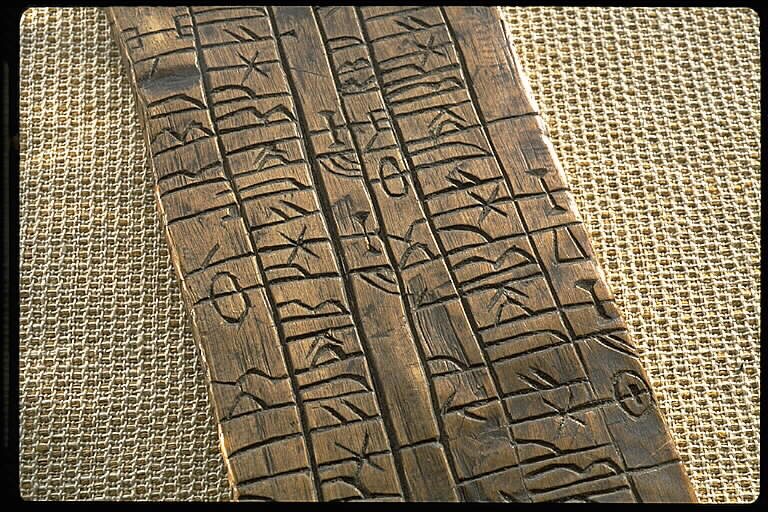
The Nordic runic calendars, called primstav in Norway, are perpetual calendar staves. On them the first seven runes of the Younger Futhark run through fifty-two times and mark the weekdays. Beside them stand nineteen signs for the Golden Numbers of the nineteen-year lunar cycle, by which the new moon could be found. The oldest known staff of this kind comes from Nyköping in Sweden and is dated to the thirteenth century; a primstav of 1457 is kept at the National Museum in Copenhagen. Most surviving examples are younger, sixteenth and seventeenth century.
So the runes there stand for weekdays and moon phases. Not for months, not for character, not for birthdays. And the staves are Christian household objects – they mark saints' days.
That leaves the question whether there was Norse astrology at all. The answer is short: none survives from heathen times.
Constellations were known. Snorri tells how Thor threw the frozen toe of the giant Aurvandil into the sky, where a star has been called Aurvandils tá ever since; elsewhere Odin throws up the eyes of the giant Þjazi. A few further sky names are recorded, such as ulfs keptr, wolf's jaws, for the Hyades and fiskikarlar, fishermen, for Orion – though these are late attestations. A zodiac, a system of houses, a reading of birth charts: none of that.
The signs of the zodiac reached Iceland only with Latin learning. The Icelandic computus manuscripts, beginning with Rím I of 1192, draw on Isidore of Seville, Bede and Honorius Augustodunensis. That is twelfth-century Christian calendar science imported from the south – not an inheritance from the Viking Age.
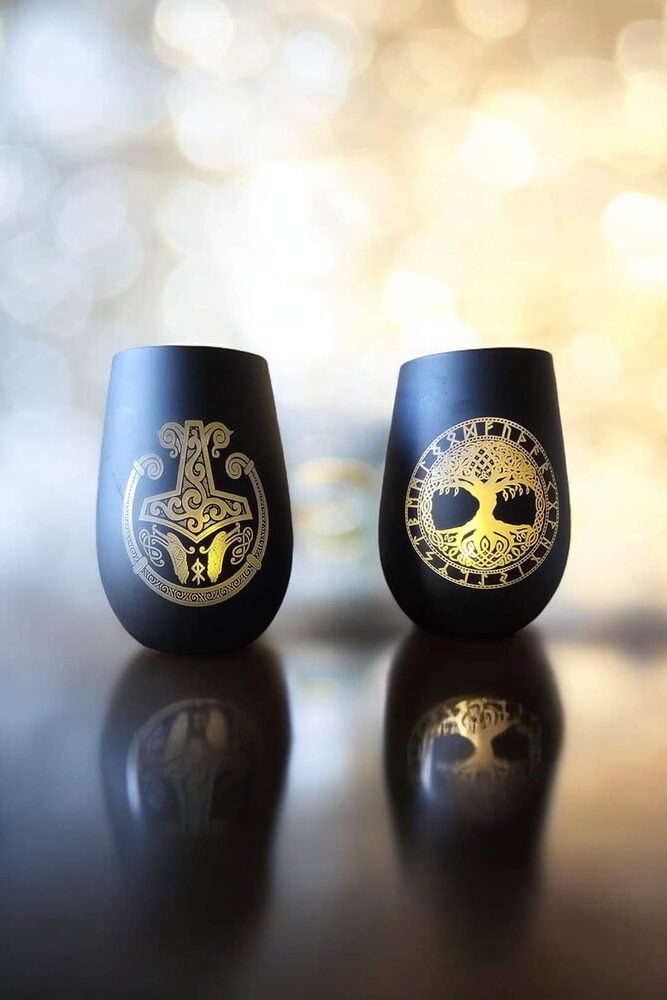
We engrave a lot of birthday pieces, and we get this question often. Our answer is not a refusal but a swap.
Take the month name itself. Gormánuður, the slaughter month, for someone born in October. Sólmánuður for June. It is attested, it sounds good, and you can explain why.
Or take a rune – by meaning, not by date. The rune poems give each rune an image. Choosing one because it fits a person is exactly what an eleventh-century carver would have done: a deliberate choice rather than an allocation.
Or take the feast nearest the birthday. Jul, the summer or winter half-year, a date in the old year's round. That is genuinely attested, and it has the advantage that nobody later discovers with mild embarrassment that their "birth rune" came from a blog post written in 2019.
Archaeological evidence: Thor's hammer amulets, valknut images on picture stones and in the Oseberg find, runic inscriptions in their thousands, runic calendar staves from the thirteenth century onwards. No find links a sign to a birth month.
Contemporary written sources: Tacitus on lunar reckoning and counting by nights; Bede on the Old English month names; Einhard on the Frankish ones. All three name months; none names month symbols.
Later tradition: the Old Icelandic calendar with its misseri and leap week, recorded from the twelfth and thirteenth centuries; the three rune poems; Icelandic computus from Rím I (1192) onwards, which takes over the Latin zodiac. The Vegvísir appears in 1860, the Ægishjálmr in early modern spell books.
Modern interpretation: Robert Graves's "Celtic tree calendar" (1948), Ralph Blum's rune oracle (1982) with its blank rune, and every internet birth-month list derived from them. That is twentieth- and twenty-first-century esotericism – enjoy it if you like, just do not mistake it for something old. We find the real thing stronger anyway: a month named after the work done in it. For courage. For memory. For legends that live on.
Forgotten Germanic month names · Viking Symbols & their meaning – genuine or invented? · Vegvísir & Ægishjálmr · Runes & their meaning · Jól – the Yule feast · The old year's cycle up close.