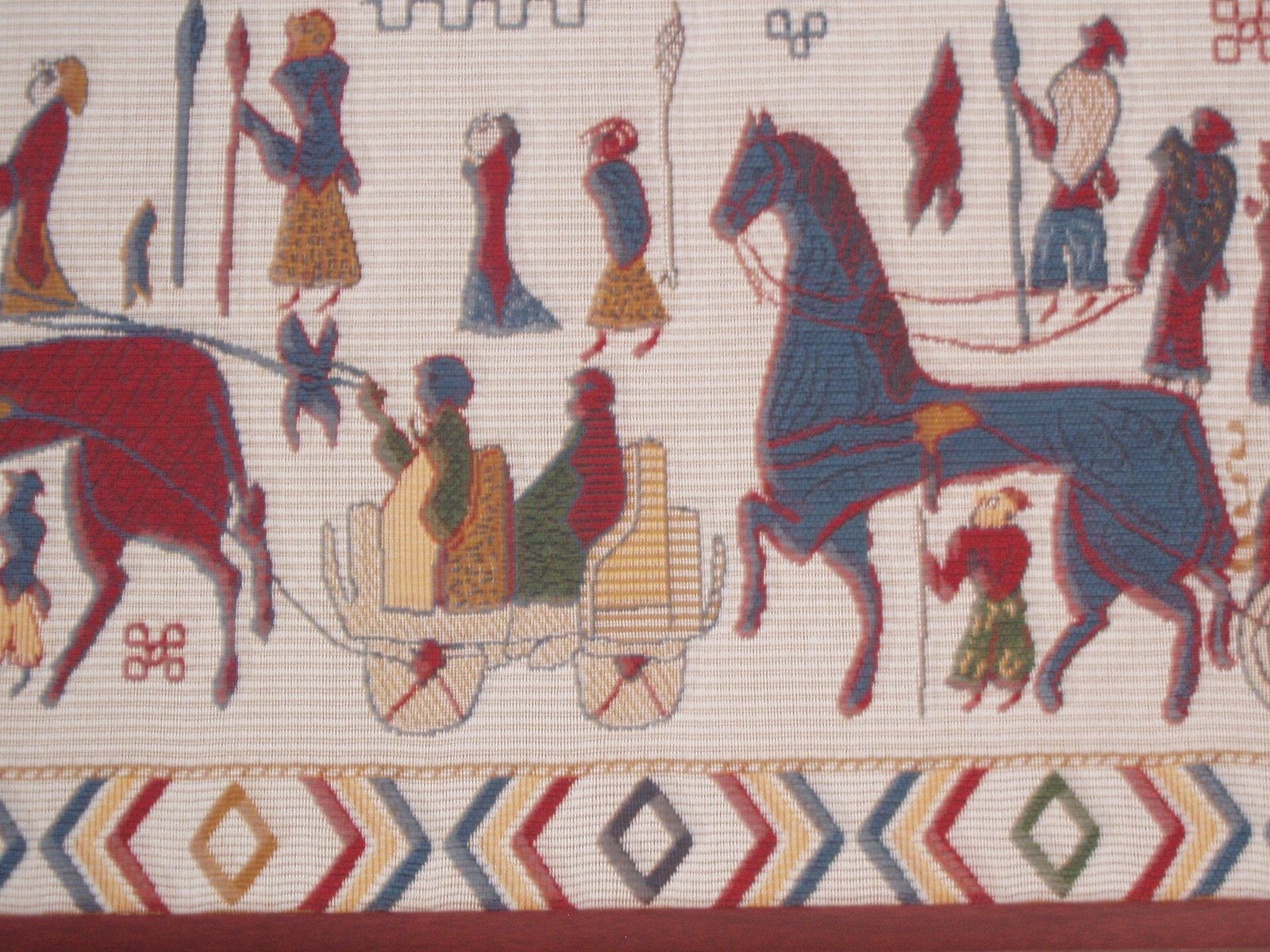
The Viking Age was anything but grey. When people picture Norsemen today, they often imagine mud-brown tunics and sooty wool – an image that comes from television, not from the finds. Textile fragments from Hedeby, Birka and the Oseberg ship, chemical dye analyses and the Old Norse sources tell a different story: of glowing red, deep blue, rich yellow and costly imported silk. In this piece of colour lore we look at which colours were available, how they were made, what they revealed about the wearer – and where honest colour lore has turned into modern colour magic.
Every colour began with wool. Viking-Age sheep naturally provided a broad spectrum – white, cream-yellow, several shades of grey, brown, almost black. That alone allowed people to weave patterned cloth without touching a single dye pot. But they did not stop there. Those who could afford it dyed their cloth, and dyed it strongly. The surviving textile fragments from the great trading centres show red, blue, yellow, green and violet, often combined with colourfully woven braids and silk trims.
The picture of the uniformly grey, unwashed Viking is therefore a cliché. There was, of course, plain undyed everyday clothing too – dyeing cost time, plants and know-how, and not every farm went to the trouble for every garment. But the idea that colour was the exception turns things upside down. Colour was a visible sign of skill, trade and wealth, and anyone who wanted to make an impression did so through the colour of their clothes.
The most sought-after red of the Viking Age came from the root of the madder plant (Rubia tinctorum). The root contains the dye alizarin, which with a mordant – usually alum – produces a deep, lasting red. Madder did not grow everywhere in the North on its own; some of it was traded, which made the red even more expensive. Alongside madder, certain lichens yielded a purple-tinged red, and local plants gave warmer rust tones.
Red was therefore a colour of status. A red-dyed cloak or a red tunic announced means and connections. In the visual language of the age red also carried a powerful, living note – the colour of blood and fire. One should not, however, derive a fixed symbolic chart from this: what is documented above all is that red was expensive and desirable, not that every red garment carried a particular message.
Blue was obtained from woad (Isatis tinctoria), a plant whose leaves yield the same dye as tropical indigo. The process was demanding: the leaves had to ferment, and the dye vat worked through a delicate chemical process. A rich, dark blue was therefore also a sign of effort and standing. Blue textile remains are among the more common finds of better-quality clothing.
Linguistically this is where it gets especially interesting. The Old Norse word blár by no means denotes only what we today call blue. It covers a spectrum from deep blue to almost black – a dark, muted, heavy blue. It is precisely this meaning that turns the word into a literary signal in the sagas.
In the Icelandic sagas it is a recurring motif that a character throws on dark-blue clothing before setting out to kill someone. The attentive medieval listener knew at once: now things are getting serious. The dark blue was the garment of resolve, and often of impending violence.
He put on a blue cloak, took his axe in hand and went out – and all who saw him knew that he had no peaceful errand in mind.Paraphrased after the narrative tradition of the Icelandic sagas (incl. Njáls saga, Laxdæla saga), public-domain motif; rendering: Glanz & Gravur
The honest framing matters here: this is a narrative signal within saga literature, which was written down in the 13th century – long after the Viking Age. It proves that colour in clothing could carry a message. It does not prove that every Viking followed a fixed colour code in daily life, or that blue was "magically" linked to death. It is dramaturgy, not sorcery.
Yellow was comparatively easy to obtain. Weld (Reseda luteola) gave a clear, strong yellow, and birch leaves, heather, tansy and many other native plants added to the palette. Because the raw materials were widespread and cheap, yellow was among the more accessible colours – not as prestigious as a deep red or blue, but suited to everyday use.
Green did not exist in nature as a single dye. It was produced by overdyeing: first yellow with weld, then blue with woad – or the other way round. The mixture created green. This shows how much craft knowledge lay behind the colours: sequence, mordant, temperature and concentration all determined the result. Dyeing was an art, not mere dipping.
At the very top of the colour hierarchy stood true purple and imported silk. Purple in the strict sense – from Mediterranean sea snails – was fabulously expensive in antiquity and remained a luxury in the North that almost no one owned. More common were violet and purple-tinged shades achieved through elaborate plant dyeing and overdyeing.
Silk itself reached the North over long trade routes – along the eastern route from Byzantium and the Orient. The Oseberg ship contained numerous silk fragments, some in precious patterns, some cut into narrow strips and used as trim. Silk was so valuable that it was applied in thin bands to clothing, to make the greatest impression with the least material. Those who wore silk and glowing colours wore their rank literally on their body.
Alongside the dyed cloths, the undyed natural tones of wool kept their firm place. White, cream, grey and brown-black wool could be combined into patterns – for instance in woven checks or stripes in which the natural fleece colours alone form the design. These fabrics were robust, everyday-ready and could be made without any dyeing effort.
Here too a linguistic note is worthwhile: svartr (black), hvítr (white) and grár (grey) were established colour words. Grár could mean more than just the shade – it carried a note of "uncanny", "hard" or "grim", for example when speaking of a grey wolf or a grey garment. Colour words thus conveyed not only appearance but also mood.
Old Norse had a differentiated colour vocabulary: rauðr (red), blár (dark blue to black), grænn (green), gulr (yellow), hvítr (white), svartr (black), grár (grey), brúnn (brown). These words do not always map one-to-one onto our modern colour terms – blár is the best example, because it embraces both blue and black.
In the narrative texts, colour adjectives are often more than description. They are signals. A blue garment announces violence, a red one shows wealth, a particular colour can characterise a figure. For us today this means: whoever understands Old Norse colour words reads the sagas more precisely – but should not press every shade into a rigid grid of meaning. Meaning arises from context, not from a table.
Colour was not confined to clothing. Shields were painted – finds and pictorial sources suggest strong fields of colour, often in red, black, white or yellow, sometimes with patterns or sections. A painted shield was both protection and display piece. Houses, doorposts and carvings also bore colour; the elaborately carved timbers of the Oseberg burial show that ornament and, in all likelihood, colour belonged together.
The runestones are especially revealing. What we know today as bare grey stone was originally painted. Traces of colour have been detected on numerous stones – above all red, black and white, used to pick out runes, tendrils and animal figures. A runestone was a glowing, coloured monument, not a silent grey block. This vividness is one of the reasons colour was so central to the Viking Age: it made messages visible.
Our knowledge of the colours rests not on guesswork but on finds and science. In the waterlogged soils of Hedeby, in the graves of Birka and in the Oseberg burial, textile remains have survived. Their dyes can be identified chemically – with methods such as high-performance liquid chromatography (HPLC), which detects individual dye molecules. This is how madder, woad and weld were documented in specific fabrics.
An honest reservation matters here: colour fades, and organic dyes decay over a thousand years. Much of what we now pull grey or brown from the ground was once bright. The analyses therefore show that more was dyed than the naked eye still recognises on the find. Anyone who wants to know more about the workshop behind the colours – about madder, woad, mordants and the women at the dye pots – will find the details in our pieces on the dyeing craft and on weaving.
Dyeing – the colours of the Vikings · Natural Dyeing the Viking Way · Viking clothing & fashion · Viking Weaving.
All Everyday Life & Craft articles →
They ran the farm, could inherit and divorce – and yet the truth about the Viking woman is more nuanced than modern …
Read more →A stone that burns like coal, charges electrically when rubbed like amber, and polishes to a deep black shine: jet is …
Read more →Say "Viking jewellery" and people picture glittering gold. The truth is quieter and finer: it was above all silver that …
Read more →