Few gemstones carry a name as poetic and as misleading as moonstone. It has nothing to do with the moon – and yet a soft, bluish-white light seems to float inside it, shifting with every movement as if lit from within. Here we explain honestly what that glow is, where the name comes from, how antiquity interpreted the stone, and why today we simply offer it as a beautiful gemstone – with no miracle promises.
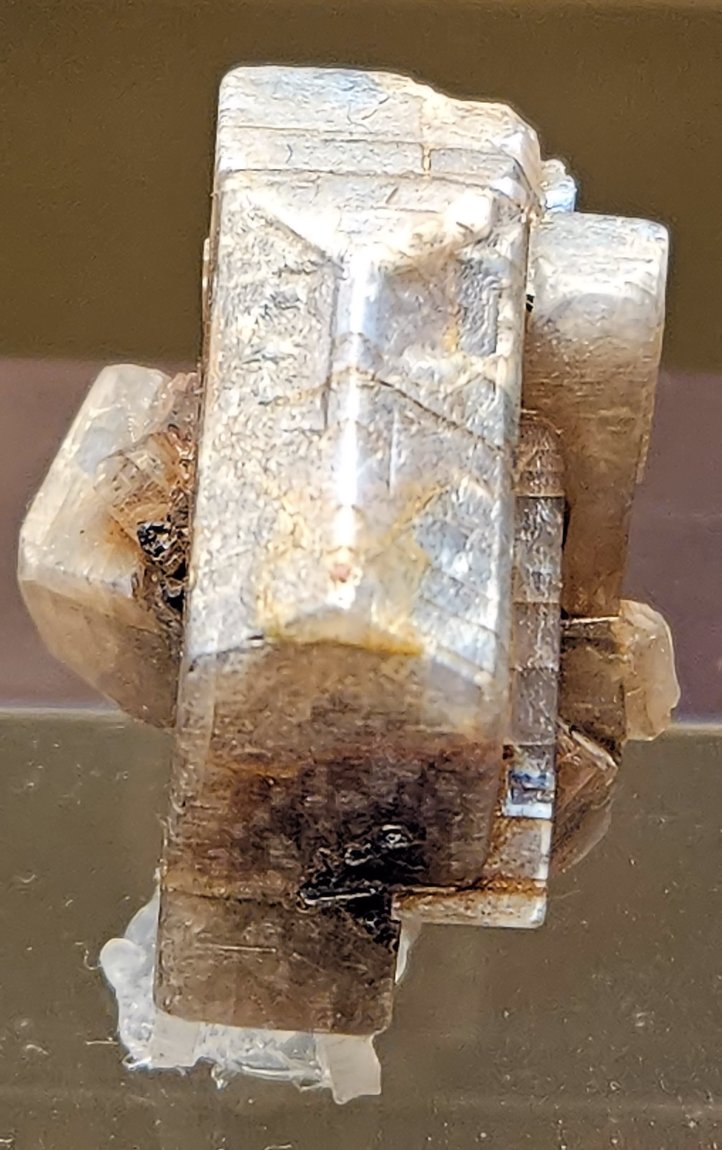
Moonstone belongs to the large mineral group of feldspars – the silicates that make up most of the Earth's crust. More precisely, gem moonstone is usually a potassium feldspar called adularia (a variety of orthoclase), often with a share of sodium feldspar (albite). That origin is already hidden in the stone's gemmological second name: adularia, named after the Adula massif in the Swiss Alps, where it was described early on.
Chemically, then, moonstone is nothing exotic but a close relative of the rock we walk on every day. Its magic lies not in its composition but in its internal structure – and in what light does inside it. A moonstone without its glow would be a pale, milky feldspar; only the optical play turns it into a coveted gemstone.
The floating, blue-white glow of moonstone has its own technical term: adularescence. It arises because orthoclase and albite inside the crystal do not stay cleanly mixed as they cool slowly, but separate into wafer-thin, alternating layers. These layers are thinner than the wavelength of visible light. When light strikes them, it is scattered and diffracted at the many boundaries.
Because the short-wave part of light – the blue – is scattered more strongly than the long-wave part, the glow appears bluish where the layers are finest; with coarser structures it looks more milky-white to silvery. The effect does not sit on the surface but seems to float at a certain depth, and it travels as you tilt the stone. It is exactly this travelling – this living, almost liquid shimmer – that separates a fine moonstone from an ordinary feldspar.
Incidentally, adularescence is related to other feldspar phenomena: labradorite shows a colourful play (labradorescence), sunstone a golden sparkle from tiny metallic platelets. Moonstone is the quiet, cool member of this family – its schiller usually stays within the range of white and blue.
The name "moonstone" is old and travels across languages: Greek selenites (from Selene, the moon goddess), borrowed into Latin, and plain "moonstone" in English. It arose not because of feldspar chemistry – unknown in antiquity – but because of appearance: a stone holding a milky, moon-like light.
An honest point matters here: the ancient name selenites did not necessarily mean the same stone jewellers call moonstone today. In ancient and medieval lapidary science, minerals were named above all by appearance, colour and lustre, not by chemical analysis. "Moonstone" was more a description of the impression than a mineralogical identification. What Pliny describes as selenites is, by modern understanding, most likely a translucent variety of gypsum (still called "selenite") – not the feldspar moonstone of the jewellery case. Only modern mineralogy separated the names cleanly.
The oldest famous description comes from Pliny the Elder, who in the 1st century AD gathered the knowledge of his time in his Natural History. There we find the heart of the moonstone folk belief: the notion that the stone carries the image of the moon within it and even changes with its phases.
The stone called "selenitis," or "moon-stone," is white and transparent, with a yellowish reflection like that of honey. It contains the image of the moon, and, if we are to believe what is said, it reflects the various phases of that luminary, according as it increases or wanes, from day to day.Pliny the Elder, Natural History, Book 37 (public-domain translation by Bostock & Riley, 1855)
Remarkable is the caveat Pliny builds in himself: "if we are to believe what is said". Even the ancient author passes the story on as hearsay, not as his own observation. This caution was often lost in later tradition – the careful report became a firm "fact": the stone that breathes with the moon.
The idea that a moonstone grows brighter as the moon waxes and dimmer as it wanes is a beautiful image, but physically untenable. A moonstone's glow depends solely on its internal layered structure and on the incoming light. A stone in a drawer "knows" nothing of the moon's phase; its schiller changes when you turn it or alter the lighting – not because the moon is growing outside.
The ancient belief is still understandable: an object that shows a wandering, elusive light practically invited people to link it with the most changeable of celestial bodies. They saw a resemblance and turned it into a connection. That is how many stone legends form – out of observation, analogy, and the wish that things should belong together.
As a gemstone moonstone has a long, if never quite continuous, history. In Roman antiquity translucent, shimmering stone was valued and set into rings and pendants. Its great stage came much later, however: in Art Nouveau around 1900. Artists and goldsmiths of that era loved soft, dreamy materials with an inner glow – and moonstone fitted perfectly with flowing lines, enamel and the symbol-laden nature jewellery of the time.
The French master Rene Lalique, for instance, set moonstone alongside horn, enamel and semi-precious stones and made the quiet schiller a design device. The English Arts and Crafts movement also took to the stone. In this period moonstone became what it remains today: a romantic, coolly glowing gemstone with a hint of melancholy.
Because at Glanz & Gravur we work in the Norse-Germanic niche, an honest classification matters to us: moonstone is not a characteristic find of the Viking Age or of Germanic prehistory. Where jewellery in the North was set with coloured stones, it was mostly with imported materials such as carnelian, rock crystal, amber or glass paste – stones that travelled along the great trade routes to the Mediterranean and the Orient. No cult of moonstone, let alone a "Norse" meaning of the stone, can be derived from the finds.
Moonstone as we see it in jewellery today is therefore overwhelmingly a modern gemstone – shaped by the lapidary culture of the 19th and 20th centuries, not by the Norse of the early Middle Ages. Whoever wears it wears a beautiful natural material, not a Viking-age tradition. That is no drawback, simply the honest statement.
What did genuinely exist was the significance of the moon itself for the Norse reckoning of time. The moon's course helped structure the year, and lunar months played a role in the transmitted calendar ideas. This connection is attested – but it concerns the celestial body and the reckoning of time, not a feldspar called moonstone. Anyone interested in the moon in the Norse year will find a Germanic lunar calendar as a tool on our site, one that makes exactly this reckoning of time tangible. The stone and the calendar thus share only the name of the moon, not a common history.
The classic moonstone is whitish-transparent with a blue schiller – this "blue moonstone" (often from Sri Lanka) is considered especially desirable because the shimmer floats clear and deeply blue. Beside it there is rainbow moonstone (strictly speaking a shimmering labradorite), which shows a broader play of colour, as well as variants in peach, grey or smoky tones. For quality, what counts above all is the clarity of the body, the intensity and richness of the schiller, and how cleanly the glow travels across the stone.
Because the effect is direction-dependent, the cut is decisive: moonstone is almost always cut as a cabochon – a smooth, domed shape without facets. Only then does the light gather and the schiller float visibly over the curved surface. The cutter must orient the internal structure correctly so that the glow sits centrally and does not vanish at the edge.
As romantic as moonstone looks, it should be handled with care. With a Mohs hardness of about 6 it is noticeably softer than quartz (7) and, over time, is scratched dull by dust, which often contains quartz grains. Add to this the good cleavage of feldspars: a hard knock or fall can split the stone along its internal planes.
In practice this means: do not store moonstone jewellery together with harder stones in one compartment, but separately and softly cushioned. For cleaning, lukewarm water with mild soap and a soft cloth is enough; ultrasonic and steam cleaners should be avoided, as should aggressive chemicals, perfume and long contact with skin sweat. As a ring on the active hand moonstone is less suitable than in earrings or pendants, where it is knocked about less.
Moonstone is a good example of how we handle stones at Glanz & Gravur: with delight in their beauty and respect for the facts. Its bluish, floating light needs no invented effect to convince – it is enough to understand that here tiny crystal lamellae split the light and give us a wandering glow. That, honestly, is more fascinating than any healing-crystal claim.
When we offer moonstone, we offer it as what it is: a fine, delicate, beautiful natural gemstone with a long cultural history and a name borrowed from the sky. No magic, no healing, no Norse cult stone – but honest craftsmanship and a stone in which the light goes for a walk.
Gemstones in the North · Amethyst · Rock Crystal · Carnelian – the Vikings' red beads.
All Everyday Life & Craft articles →
Again and again, peat-cutters in Ireland, Scotland and Scandinavia find the same riddle: a lump of waxy, ancient …
Read more →No object of the Viking Age is as colourful as a bead – and few are so often misunderstood. Look at the strings of …
Read more →No longship would ever have put to sea, no sword ever been drawn, without the woman and man at the anvil. Ironworking …
Read more →