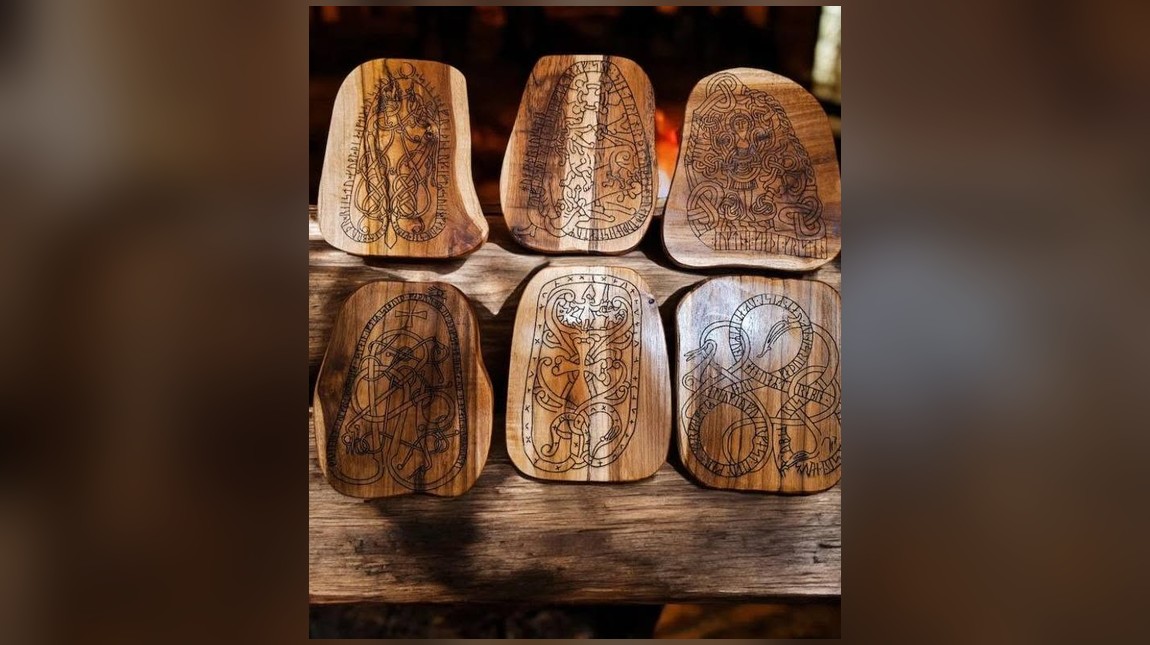
Few questions reach our workshop as often as this one: „Is that symbol really old?" We love engraving Norse signs – but honestly. So here is the big overview: what is attested from the Viking Age, what comes from later Icelandic magic lore, what is purely modern – and which signs are politically tainted today. That way you can choose your engraving with a clear conscience.
The market is full of „Viking symbols". Some are genuine and over a thousand years old, some were only written down a few centuries ago, and some were literally invented in a 1980s novel. That is no reason to dislike a sign – but when we engrave it into stone or wood, it should last forever, and then you want to know what you wear. So we sort cleanly into three drawers: attested (from the Viking Age or earlier, secured by finds and texts), modern (real in its own tradition, but younger, often from Icelandic grimoires or the Romantic era) and misused (historical signs hijacked by the far right). Let us start with the genuine ones.
A word first on the sources: much of what we think we know about „Norse symbolism" does not come from the Viking Age itself, but from far later records. The Poetic and Prose Edda were only written down in 13th-century Iceland – two to three hundred years after Christianisation. Images on stone and metal, by contrast, can be dated directly, yet rarely tell us what their makers called them. So a sign can be archaeologically genuine while its „meaning" is pure conjecture. That is exactly the distinction we make throughout.
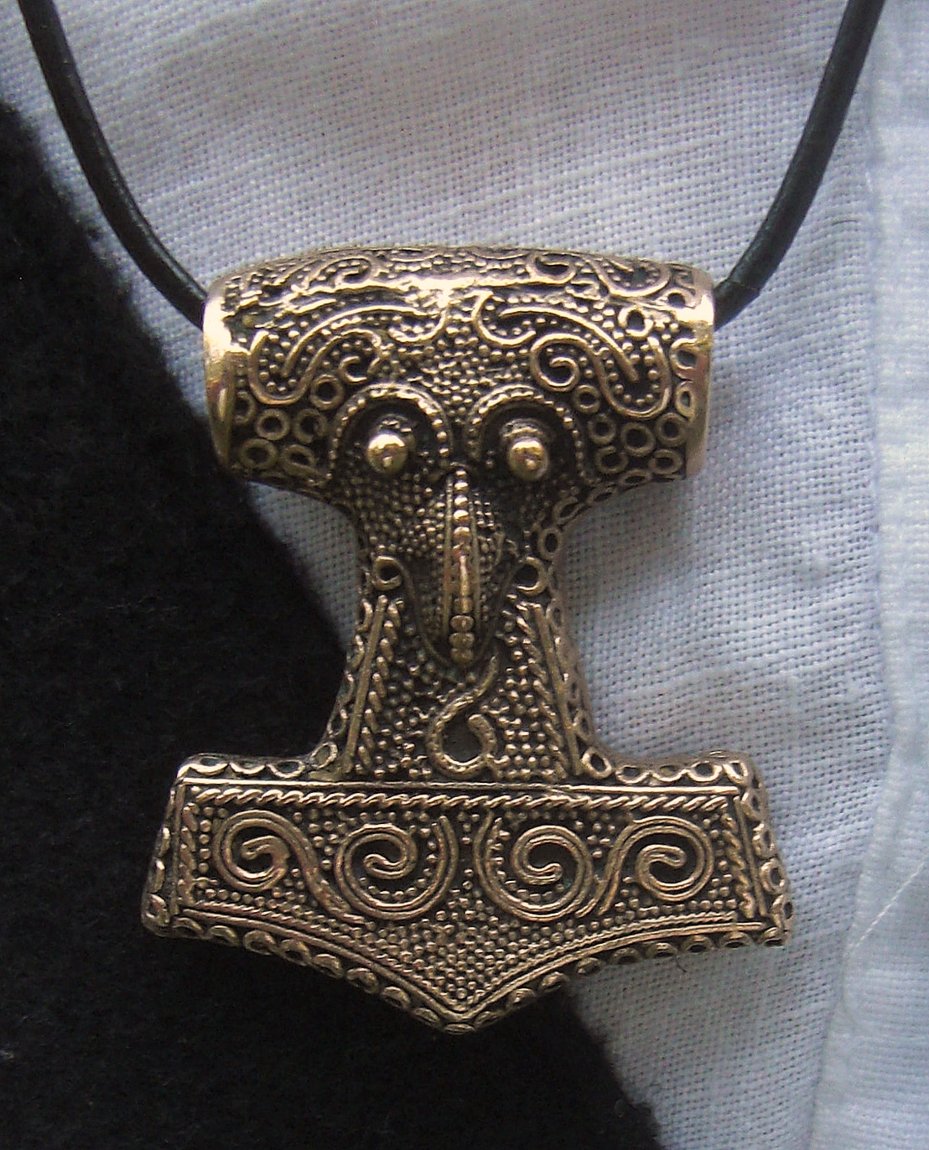
If any symbol deserves the title „the Norse sign", it is this one. Over a thousand Thor's-hammer pendants are known from Viking-Age graves and hoards, from plain iron to fine silver. The Trendgaarden mould even cast a hammer and a cross at once – one craftsman served both customers. The amulet from Koebelev bears the runes „This is a hammer". The Mjöllnir was protective sign, blessing mark and declaration in one, especially as Christianity advanced. Anyone engraving a Thor's hammer today draws on genuine, attested heritage. More in our detailed article on Thor's hammer.
Honesty applies here too: the richly decorated filigree hammer sold most often today is attested by only a few originals (Staecker's type 2.3), whereas the commonest form was a plain iron hammer. The runestones bearing a Thor blessing – „Þórr vígi" (may Thor hallow) on the stones of Glavendrup, Soender Kirkeby and Virring – show that the hammer was meant as a hallowing gesture, not a fashionable logo. A good reason to engrave it with due respect.
Three interlocking triangles: the Valknut really does appear on Viking-Age picture stones (Gotland) and on carvings from the Oseberg find, often beside Odin, horses and fallen warriors. So the sign itself is genuine. What is NOT old is its name: „Valknut" (from Norwegian valr „the slain" and knut „knot") was coined only in recent times; we do not know what the Vikings called it. The reading „symbol of death and Odin" is plausible but a modern attribution too. Honestly engraved that means: real sign, modern name. Details in the Valknut article.
The triquetra, the endless triangular knot, does appear in Norse interlace – for example on gold bracteates and in the Ringerike and Urnes styles. But careful: it is a pan-European ornament, found equally on Celtic stones and in the Book of Kells. It had no fixed, exclusively „Viking" meaning. As a woven decorative element it is entirely fitting; as a „secret Viking symbol with a clear message" it is overloaded. We happily use it as an honest ornament. More in the triquetra article.
The world tree Yggdrasil is firmly anchored as an idea in the Poetic and Prose Edda – the ash that bears nine worlds, with an eagle, deer, the squirrel Ratatoskr and the dragon Nidhoggr. As an elaborate, symmetrical „tree emblem" on pendants, however, today's common motif is a modern artistic condensation; not a single find bears an inscription „Yggdrasil". The myth is genuine and ancient, the graphic logo is interpretation. A beautiful engraving motif – one just should not claim the Vikings wore exactly this image.
The „Celtic tree horoscope" often sold alongside it, assigning a tree to each birth date, has nothing to do with Yggdrasil or the Vikings either: it was invented by the poet Robert Graves in 1948. Whoever engraves a world tree carries a powerful mythic image – but not a birth oracle.
Runes are genuine writing, not a collection of spells. There were three great rows (the Elder Futhark with 24, the Younger with 16, the Anglo-Saxon Futhorc with up to 33 signs). Bind runes – two or more runes merged into one sign – are attested too, mostly as a space-saving ligature, not as secret magic. Important for engravings: any transfer of modern names into runes is a convention, not a „true alphabet" with fixed correspondences. The Younger Futhark, for instance, has no sign of its own for g, d or e. We will advise you which row suits your purpose. Everything about the script is in our great rune lexicon.
And what about „rune magic"? Formula words such as alu, laukaʀ or laþu do appear on bracteates and amulets, and curse inscriptions like those on the stones of Björketorp and Stentoften prove that runes were also used for conjuration. Yet the majority of all rune inscriptions are entirely mundane: marks of ownership, names, memorial formulas, trade notes. Runes were writing first and magic only at the margins. The idea that each single rune is a „magic card" with a fixed message is modern and goes largely back to 20th-century esoteric works – such as the blank „Odin rune" invented by Ralph Blum in 1982, which never existed historically.
„Do you know how to cut them? Do you know how to read them? Do you know how to stain them? Do you know how to prove them?" Sigrdrifumal 9 (Poetic Edda), translation Henry Adams Bellows 1923 (public domain)
These verses show that even the sources knew rune-cutting demands skill – not the mere copying of a symbol. That is exactly our standard with every engraving.
Wheel-shaped sun signs are indeed ancient in Northern Europe – think of the Bronze Age sun chariot of Trundholm, around 1,400 BC, long BEFORE the Vikings. As a plain sun or wheel motif this is entirely harmless. It only becomes problematic when a sun wheel takes the specific form of the so-called „Black Sun" – more on that shortly in the misuse section.
Now for the biggest surprise for many: the „wayfinder" Vegvisir and the „helm of awe" Aegishjalmur are NOT Viking symbols. The familiar graphic forms come from Icelandic grimoires (galdrabaekur) of the early modern period, roughly 1600 to 1860 – the Huld manuscript that the Vegvisir comes from was only compiled in 1860. That is around 600 to 800 years after the Viking Age. Interestingly, the WORD Aegishjalmur is old (it already appears in the Fafnismal of the Edda), but there it means no drawn star, rather an overwhelming effect of terror. That does not make these signs worthless – they have their own honest Icelandic tradition. One just should not sell them as „Viking". The full context in our article on Vegvisir and Aegishjalmur.
These galdrabaekur, the Icelandic grimoires, are a fascinating chapter in themselves: they arose in an already Christian society, mixing scraps of Latin prayer, Bible verses and magical staves (galdrastafir), and were aimed at illness, theft or evil magic. In Iceland's great 17th-century wave of witch trials people were even convicted over such signs – a serious historical background, but roughly half a millennium after Leif Erikson. So whoever wears the Vegvisir wears genuine early-modern Icelandic folk culture, not the amulet of a longship helmsman.
The „web of fate" (Web of Wyrd), a grid-like sign of nine crossing staves, is often offered as an ancient norn symbol. The concepts behind it are genuine: wyrd (Old English) and urdr (Old Norse, the norn Urd) mean fate. The drawn symbol itself, however, is new: the phrase was popularised by Brian Bates' novel „The Way of Wyrd" (1983), and the graphic form only appeared in the 1990s. A modern sign with an old idea – honestly classified as such. More in the article on the Web of Wyrd.
The troll cross (trollkors), an iron ring bent into a cross, is marketed as an old protective symbol. The BELIEF in iron as protection against trolls is indeed old and folk-based. The amulet in its present form, however, is new – it goes back to the Swedish smith Kari Erland, who made it in the late 20th century and attributed it to an old family tradition. An old motif in spirit, a young object in fact.
Here the fun stops, and we are very clear. Some signs of historical origin were hijacked by the National Socialists and are used by the far right to this day. The „Black Sun" in its familiar wheel form is NOT an old symbol – it was invented in the 1930s for the SS (the floor mosaic at Wewelsburg castle) and is today a recognition sign of the far-right scene. The Othala rune (Odal, home/heritage) and the doubled Sowilo rune (sun) are genuine, old runes with a harmless original meaning – but the doubled Sig rune became the SS sign, and the Othala rune is still used by the far right. In Germany the use of such signs can even be a criminal offence (Section 86a of the Criminal Code, depending on context). We do not engrave such things and will advise you on genuine, untainted alternatives. The full context is in our explanatory article on the Black Sun.
A small shift of perspective that helps a lot with engravings: the Vikings often thought less in single „symbols" than in whole ornamental styles. Over the centuries six great animal styles succeeded one another – Oseberg, Borre, Jelling, Mammen, Ringerike and Urnes – with interlaced gripping beasts, ribbons and the characteristic „great beast" motifs. These styles are excellently attested (the Oseberg carvings, the Jelling stones, the Urnes stave-church portal) and give an engraving genuine Norse character, entirely without dubious promises of meaning. „Celtic knots", by the way, are something else: even though both interlace, the Norse animal styles follow their own visual language.
Quite simply: we tell you honestly which drawer your desired motif belongs in. If you want something demonstrably Viking-Age, we recommend Thor's hammer, the Valknut or a cleanly transferred rune inscription. If you love the Vegvisir, we will gladly engrave it – with the honest note that it comes from later Icelandic magic lore. We never engrave tainted signs and instead offer you strong, historically fitting motifs. That way you get a piece that is not only beautiful, but that you can wear with a clear conscience and with knowledge. You will also find a compact overview in our big symbol guide Norse symbols – genuine or invented.
Attested and Viking-Age: Thor's hammer, the Valknut (without an old name), the sun wheel as a motif, runes and bind runes as writing. Genuine in their own, later tradition: Vegvisir and Aegishjalmur (Icelandic, 1600–1860), the troll cross (20th century). Modern despite an old idea: the Web of Wyrd (from 1983/1990s). And the clear line: we do not engrave the Black Sun or the misused Othala and doubled Sowilo runes. Whoever chooses honestly wears their sign more strongly.
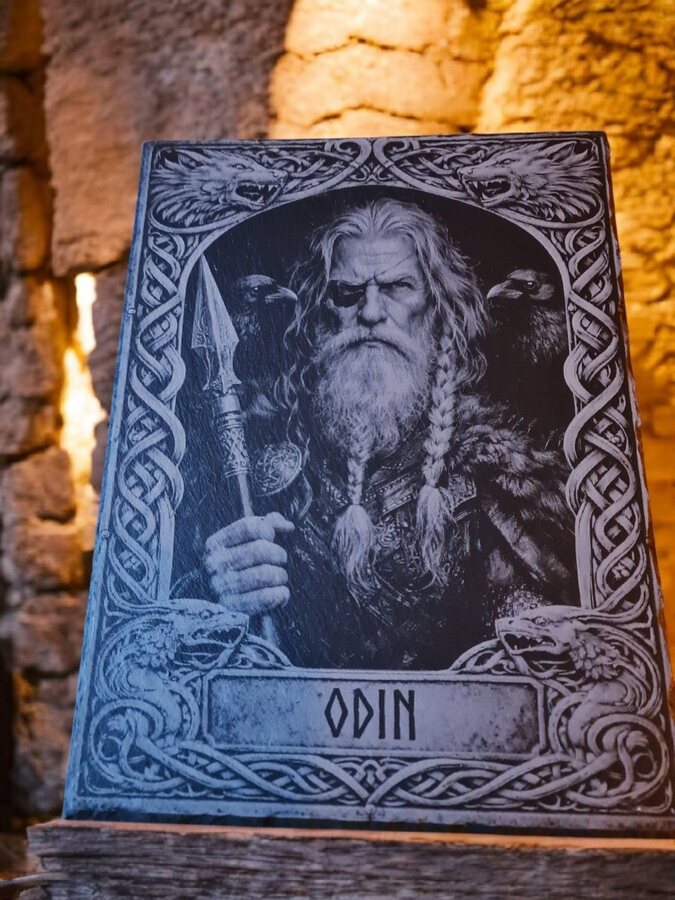
Thor's Hammer · The Valknut · The Triquetra · Vegvísir & Ægishjálmr · Norse symbols: real or invented? · The Black Sun.
All History & Finds articles →
The Vikings had no central state power. Law and politics arose at the assembly of free people – the Thing.
Read more →A handle that turned out too short, a fly at the bellows and over a thousand silver amulets in the earth: Thor's hammer …
Read more →