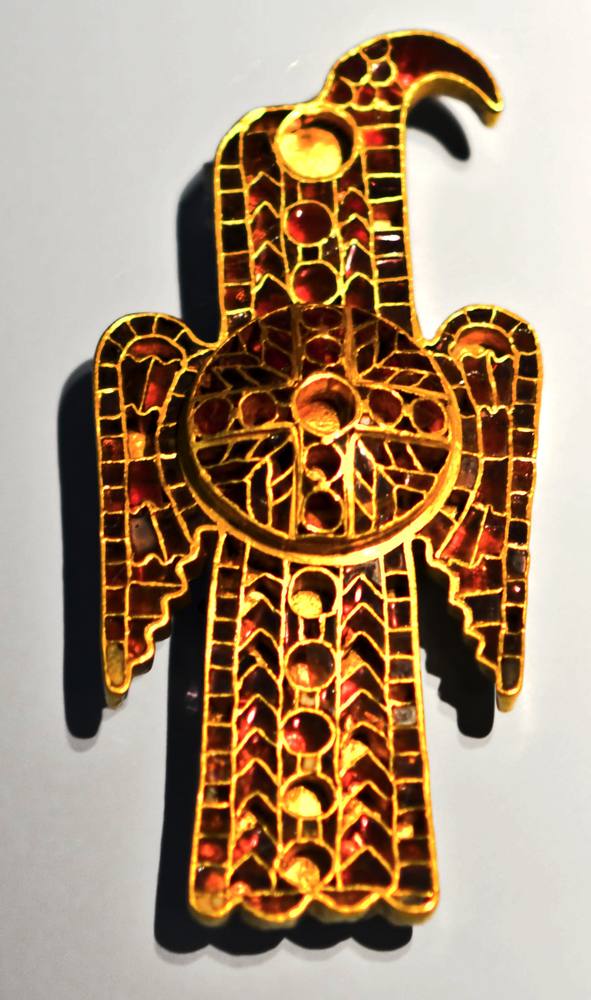
They hardly loom large in any history book, yet their trail runs from the plains north of the lower Danube to Poitou: the Taifali fought beside the Romans, against them, and under them. They left no testimony of their own, and their language is lost. This article gathers what Ammianus Marcellinus, Zosimus, the Notitia Dignitatum and Gregory of Tours actually write, separates it from later interpretation, and says plainly where we could read only secondary literature.
The Taifali (Latin Taifali, in Zosimus Thaifaloi, in Gregory of Tours Theifali) left not a single line. No inscription, no letter, no tale in their own language survives; even the language itself cannot be grasped. What we know comes from Roman and Frankish pens: from a soldier and historian of the 4th century, from an official army list, from a bishop of the 6th century. It is a window with dirty panes, but it reaches surprisingly far, from the plains north of the lower Danube to the country around Poitiers.
The name itself gives little away. There is no secure derivation; anyone who offers one is guessing. More telling is how the sources handle it: they consistently treat the Taifali as a gens of their own, a people that stands beside others and allies with them without dissolving into them. That still holds later in Gaul, where the name clings to the landscape for centuries.
The earliest mention regularly cited in the literature dates to the year 291. An orator delivered a speech before the emperor Maximian; such speeches were later gathered as the Panegyrici Latini, the "Latin Panegyrics". In it the Thervingi, one branch of the Goths, are said to have fought alongside the Taifali against Vandals and Gepids. I could not check this passage in its wording; I know it only from secondary literature (Wikipedia, which leans on Herwig Wolfram). All that is certain, then, is that scholars see the oldest attestation here, not what exactly the orator wrote.
Now and then one also reads of a raid as early as 248 into Lower Moesia, alongside Thervingi, Vandals, Peucini and Carpi. That claim appears in German Wikipedia; I found no primary source for it. It stays here as a pointer, not as fact.
The Thervingi and the Greuthungi are the two great Gothic groups that Ammianus Marcellinus distinguishes at the end of the 4th century; the former lived farther west near Dacia, the latter farther east on the steppes north of the Black Sea. More on the Goths as a whole is in the article on the Goths; the neighbours to the west appear in the articles on the Gepids and the Vandals.
The brief for this article spoke of "wars against Constantine the Great and Constantius". That cannot be held in this form. There is one passage in Zosimus and one in Ammianus, and they say different things.
Zosimus, a historian of the late 5th or early 6th century who was no friend of Constantine the Great, tells in his second book (2.31.3) that the Thaifali, whom he calls a "Scythian" tribe, invaded Constantine's territory. The emperor, he says, did not take the field against them, lost most of his troops, watched the enemy plunder up to his entrenchments, and saved himself by flight. That is how it reads in the anonymous English translation of 1814 which I consulted at Livius.org, and only through a summary of the retrieved page, not by looking at a printed copy. Zosimus gives no year.
Caution is needed. "Scythian" was an old catch-all word for steppe peoples north of the Black Sea; it tells us little about where the Taifali came from. Zosimus also wrote as a pagan and wanted to show Constantine as a weak ruler. Wikipedia summarises the passage differently, as a running fight with a 500-strong Taifal cavalry detachment in 332; in the text I could retrieve I found neither cavalry nor a year. Anyone who needs certainty has to open the Greek original (for instance in Paschoud's Zosime, Histoire nouvelle).
That Constantine regularly fought, subdued or resettled the Taifali in Asia Minor, as some accounts write, I could confirm in no passage I was able to read. It remains a claim of secondary literature.
With Ammianus Marcellinus the ground firms up. The man probably came from Antioch, served as an officer, and near the end of the 4th century wrote a history of Rome in Latin, the Res gestae, of which books 14 to 31 survive. The Taifali appear in it in three places.
The first lies in book 17 (17.13.19-20). The emperor Constantius II is at war with the Sarmatians, an Iranian-speaking horse people north of the Danube, and with their rebellious subjects, the Limigantes. When the Romans move against the group called Picenses, who held out in difficult terrain, they call in "Taifali and free-born Sarmatians" to help. The regular troops take the ground nearest Moesia, the Taifali the stretch nearest their own settlements, the free Sarmatians the strip in front of their former position. Scholars usually place these events in the year 358; in the passage I read, Ammianus names no year himself.
Three things follow. At this time the Taifali are neither enemies nor subjects of Rome; they stand ready as allies, foederati as one would later say, meaning partners who do military service in return for something. They have "settlements" directly on the Danube frontier. And they fight beside Sarmatians, not beside Goths, which illuminates their neighbourhood to the Sarmatians but says nothing yet about kinship.
The second passage (31.3.7) leads into the year 376 and the realm of the Thervingi. As the Huns pressed west, the Gothic leader Athanaric, says Ammianus, had a high wall raised that was to run "from the heights of the river Gerasus to the Danube", skirting the lands of the Taifali. Which river the Gerasus is remains disputed: Yonge's translation has the Pruth, other editions the Siret. That cannot be settled here. Something else matters more. The Taifali live between the Gothic heartland and the Danube; their land therefore lies where modern authors place Oltenia and Wallachia, in the south of today's Romania. That is a reconstruction from the text, not a location given by the source.
Ammianus goes on to say that Athanaric could not finish the wall because the Huns took him by surprise. The Gothic union broke under the pressure; a large part moved to the Danube under Fritigern and asked to be admitted to the empire. That the Taifali were caught in the same movement emerges from the third passage. Ambrose of Milan is said to have described the chain as well: Huns against Alans, Alans against Goths, Goths against Taifali and Sarmatians. I know this too only from Wikipedia; the wording is unchecked.
The third passage (31.9.3-4) is the fullest, and it exposes another error in the brief. It asked about a "death of Frigeridus". The Roman Frigeridus, a senior officer with the title dux (commander of a frontier sector), does not die in this passage. He kills.
According to Ammianus the Goths had gone after him; Frigeridus withdrew over mountains and forests into Illyricum and met on the way Farnobius, a leader of the Goths ("Gothorum optimatem"), who was roaming with a plundering band. With him were Taifali whom he had recently taken in as allies and who had crossed the river while the Roman soldiers were scattered by fear of the peoples nearby. Frigeridus attacked. Farnobius fell with many of his men. The survivors begged for mercy and Frigeridus spared them. He assigned them land near the Italian towns of Mutina, Regium and Parma, that is Modena, Reggio and Parma, where they were to work as farmers.
Rome customarily took in defeated groups if they could till the soil. Such farmers are called coloni, tenants tied to the land. The case shows what the empire intended for the Taifali: not annihilation but labour and, where possible, service. Ammianus gives no year; scholars reckon with 377. Whether Ammianus counts Farnobius among the Greuthungi is not clear from the passage I read; Wikipedia places him there, the text simply calls him a Goth.
Directly after the victory comes (31.9.5) a description of the Taifali that every account cites and almost always shortens. It is delicate, and so it deserves a sober rendering. Ammianus writes that "we have learned" that this people was sunk in shameful dissipation. Young men, he says, were joined with boys in a sexual relationship that wore out both sides physically. But whoever was already grown and alone caught a boar or killed a huge bear was released from this defilement.
But if one who is already grown catches a boar single-handed or kills a monstrous bear, he is freed from the stain of unchastity.Ammianus Marcellinus, Res gestae 31.9.5 (Latin: "porro siqui iam adultus aprum exceperit solus vel interemerit ursum immanem, conluvione liberatur incesti"); own translation; Latin wording checked via The Latin Library (retrieved only as a text fragment)
Two points should be held fast. Ammianus relies on hearsay ("as we have learned"); he was not there. And the report fits a pattern: Roman authors liked to describe peripheral peoples through sexual customs said to deviate from the Roman standard. Whether the description hits something real, such as a form of age classes or warrior-band rites with a test of courage, or whether it follows a literary topos, cannot be decided. That the trial of hunting a boar or bear alone marked the passage into the circle of adult men is a plausible reading, nothing more. I know of no comparable evidence from other sources for the Taifali.
The third great witness is an official directory. The Notitia Dignitatum, compiled around 400 and updated into the 420s in one version, lists offices and units of the eastern and western empire. The Taifali appear there in several contexts, and here I report secondary literature explicitly, since I did not inspect the manuscript text.
Most secure is the entry for Gaul: a "Praefectus Sarmatarum et Taifalorum gentilium Pictavis in Gallia", a prefect for Sarmatians and Taifali settled as gentiles, seated at Poitiers. Gentiles denotes contingents of foreign origin settled on Roman soil who had to supply recruits to the army; the line between them and the similar laeti is disputed among scholars. Added to this are cavalry units with Taifal names, according to secondary literature one in Britain (Equites Taifali), one in Gaul (Equites Honoriani Taifali iuniores) and possibly one in Africa. Number, assignment and date of raising vary between accounts. That Taifali served in the Roman army is certain; where exactly, when and in what strength cannot be stated clearly on my source base.
More than two centuries later the name surfaces again, now in the west. Gregory of Tours, a bishop, wrote the Ten Books of Histories (Historiae, often called the "History of the Franks") and several saints' lives in the late 6th century. The Theifali appear in three places.
In Historiae IV.18 he tells of Austrapius, a duke who had fled to the basilica of St Martin at Tours from the rebel prince Chramn and was later ordained a bishop. He expected to succeed Bishop Pientius at Poitiers. King Charibert (reigned 561 to 567), however, installed someone else, Pascentius. Austrapius protested in vain, returned to his stronghold, and there, in the Latin wording, an uprising of the Theifali broke out against him ("mota super se Theifalorum seditione"). He was struck by a lance and died. The Theifali had, according to the summary of a regional article, been "often oppressed" by him; I read the full Latin sentence only in excerpts. German Wikipedia says the Taifali killed their bishop because the Frankish king had forced him on them; in the text I read it is not a bishop who is killed but Austrapius, who himself wanted to become one. Wikipedia's version is inaccurate here.
In Historiae V.7 the priest Senoch dies at Tours, whom Gregory expressly calls "genere Theifalus", of Taifal descent. His life fills a chapter of its own in the Vitae Patrum (XV). According to secondary literature his home lay in that district of Poitiers "which they call Theiphalia". I could read that Latin sentence only through third parties. It shows that in the 6th century there was a district in Poitou named after the Taifali, in which their origin was still remembered.
The place Tiffauges in today's Vendée and the name of a medieval pagus Theofalgicus are regularly cited as echoes of the Taifali. That is plausible and widely held; it is not compelling. A regional article considers Tiffauges too far from the scenes in Gregory and places the Taifali rather around Lusignan. I know of no generally accepted solution.
At the edge of the record lie further hints, all from secondary literature only. The place name Taivalo in Emilia, later San Giovanni in Persiceto, is said to recall in Lombard times those settled by Frigeridus. With the Visigoths, it is said, Taifali reached Aquitaine in 412 and later lived as their subjects. In 507 they are supposed to have stood on the Frankish side at Vouillé when Clovis defeated the Visigothic army; as far as I can see that rests on a single modern reading (Bachrach) with no clear line in the sources behind it. By these accounts the last mention as a people of their own would fall in 565. I could check none of these statements against a primary source.
Place names such as Touffailles, Chauffailles or Taphaleschat are also read as echoes of the name. Linguistically that is conceivable; it cannot at present be proven clearly. Similar sounds can arise elsewhere and from other roots.
Whether the Taifali were "Germanic" is a question that arises with particular stubbornness here. There is no clear answer. Some accounts count them among the East Germanic peoples and see them as closely tied to the Goths. Others, as I read in the secondary literature, stress a closeness to the Sarmatians or even an Asiatic origin; Otto Maenchen-Helfen, for instance, found "no evidence" that they were Germans. Wolfram, according to Wikipedia, considers a possible Celtic "cult name" or a link to the Vandalic Lacringi. All of these are interpretations, each with its own assumptions.
What the sources themselves yield is slender. Ammianus places the Taifali beside Goths and Sarmatians but separates them from both. Zosimus calls them "Scythians", which merely means he assigned them to the steppe world. No ancient passage calls them Germans; the word Germani does not appear in this connection in the passages I read. Their language is not transmitted. A secure archaeological attribution I could not establish. A multilayered union is conceivable. Modern observation points the same way: the Thervingian leadership is said to have been composed of many groups, among them Taifali, Sarmatians, Dacians and Carpi. Whether that finding can be carried over to the Taifali themselves remains open.
Anyone who labels the Taifali "Germanic", then, makes a decision that goes beyond the sources. Anyone who calls them "close to the Goths" at least reflects what the evidence shows: close political ties, joint campaigns, but a name of their own.
A short sorting stands at the end. Established, in terms of the sources read, are the appearances in Ammianus (358 as an allied people, 376 as neighbours of the Gothic wall, around 377 as allies of Farnobius), the settlement of survivors in northern Italy, and the figure of the Theifali in Poitou in Gregory. Plausible are the link between Hunnic pressure and the collapse of the union, the connection of the Poitou Taifali with the Notitia Dignitatum entry at Poitiers, and the derivation of some place names. Interpreted remain their ethnic affiliation, the meaning of the boar-and-bear ritual, and the notion of a long continuous line from the lower Danube to the Loire.
A people from whom no words survive, and whose traces lie in Roman administrative lists, a battle report and a Frankish bishop's chronicle, cannot be described without gaps. Marking the gaps is therefore part of the description itself: whoever fills them is inventing.

The Goths · The Gepids · The Vandals · The Heruli · The Gutones.
All History & Finds articles →
Little is recorded about the Tarbelli, and that little is unusually solid. A geographer calls their land the richest in …
Read more →The Taurisci were Celtic peoples of the Eastern Alps, in the area of today's Austria and Slovenia. They formed the core …
Read more →The Tencteri and Usipetes were two Germanic tribes who in 55 BC, under pressure from the Suebi, crossed the Lower Rhine …
Read more →The Vikings had no central state power. Law and politics arose at the assembly of free people – the Thing.
Read more →