Almost everything we know about Travunia comes from a single chapter of a Byzantine emperor's handbook for his son — and yet that chapter reveals a surprising amount about a small ruling family wedged between the hills of Herzegovina and the Bay of Kotor.
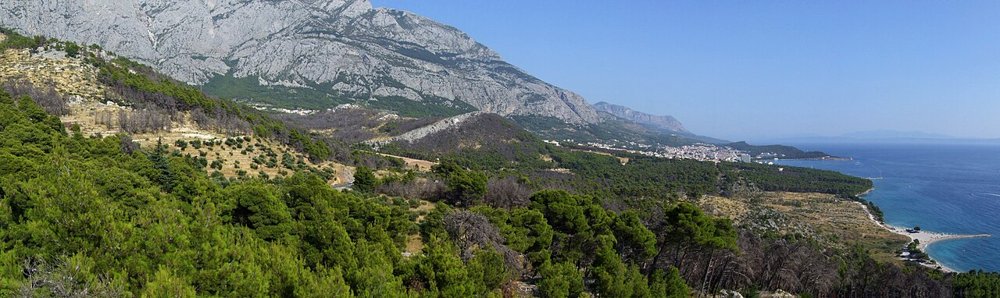
Look south from Trebinje today, across the hills between Herzegovina and the Bay of Kotor, and you are standing in territory that tenth-century Byzantines called Terbounia and that we usually know by its Slavic name: Travunia. The name itself probably predates the principality this article is about. Ancient and late antique geographical texts record a place called Tribulium in roughly the same location, and some scholars see in that form the linguistic ancestor of Terbounia and, through it, of Trebinje — from a root that might mean something like "the three hills." That reading remains a hypothesis rather than an established fact: whether the Slavic settlers who moved into the hinterland of the Adriatic coast from the late sixth and seventh centuries onward actually inherited the ancient place name, or whether this is simply a phonetic coincidence, cannot be settled with the sources available today. What is certain is that the name stuck to this one place across the centuries — a rare case of toponymic continuity in a region whose politics were anything but continuous.
Almost everything we know about early medieval Travunia comes from a single work: De Administrando Imperio, a kind of foreign-policy handbook that the Byzantine emperor Constantine VII Porphyrogenitus had compiled around the mid-tenth century for his son and successor, Romanos II. It is not a history book in the modern sense but a collection of diplomatic notes-to-self: who lives on the empire's borders, where these peoples supposedly came from, how to negotiate with them, what weaknesses can be exploited. Chapter 34 bears the title "Of the Terbouniotes and the Kanalites, and of the country in which they now dwell," and aside from a few passing remarks in neighbouring chapters on Dalmatia and Serbia, it is essentially the entire written record of this principality. Every statement about Travunia is therefore also a statement about what a Byzantine court, roughly a century after the events it describes, considered worth knowing — filtered through diplomatic interests, local informants, and the emperor's own organising logic. That does not make the source worthless, but it does call for caution in reading it.
Constantine even names specific places in this chapter: Terbounia itself (today's Trebinje), a site called Ormos, Rhisena — today's Risan on the Bay of Kotor — along with Loukabetai and Zetlibi, whose exact locations remain disputed to this day. Together with the Kanalites, the inhabitants of the fertile Konavle valley between the Ragusan hinterland and the Bay of Kotor, Travunia formed a single political unit by the time the text was written — though Constantine explicitly notes that this merger was still fairly recent and that the Kanalites had originally been a distinct group.
According to Constantine's own account (DAI, ch. 34), the Terbouniotes and Kanalites trace their descent from the "unbaptized Serbs" — from the time when their prince left still-pagan Serbia and sought protection from Emperor Heraclius (r. 610–641), before that other, later-baptized Serbia came into being. Terbounia, the emperor adds, means "fortified place" in the Slavic tongue, because the land is naturally secured by strongholds and forest.
"They are descended from the unbaptized Serbs — from the time their prince fled to Emperor Heraclius, before that other Serbia was baptized."Constantine VII Porphyrogenitus, De Administrando Imperio, ch. 34 (per the Moravcsik/Jenkins edition, Dumbarton Oaks, 1967); rendered here as our own paraphrase, not a verbatim quotation of the Jenkins translation.
This origin story is almost word-for-word identical to the one Constantine tells two chapters earlier about the Serbs themselves (more on them in our article on the Serbs): a group is said to have left an area beyond Hungary as early as the seventh century under an unnamed prince and sought protection from Emperor Heraclius, before the other branch that later became proper, "baptized" Serbia (Rascia) was Christianised. For modern historians, this near-repetition is itself a warning sign. Neither Tibor Živković nor John Fine reads this passage as a sober seventh-century migration report; rather, it is a tenth-century political founding narrative meant to retroactively legitimise Byzantine overlordship over several Slavic principalities of the Adriatic coast by tracing them all back to the same, emperor-loyal origin. Whether the Travunians actually experienced a migration of their own, separate from the Serbian one, or were simply part of the broader Slavic settlement of the Adriatic hinterland from the late sixth and seventh centuries onward, remains an open question. Archaeologically, the arrival of Slavic groups in the region can only be traced very roughly through early medieval settlement traces and changing burial customs, not attributed to any specific prince named in a text.
Constantine's account only becomes concrete with the actual rulers. The first local prince he names is a man called Beloje, said to have ruled Travunia as župan — a local chieftain — before the year 839. His son Krajina plays the decisive role in the story: the Serbian prince Vlastimir, who ruled neighbouring core Serbia at the time (roughly 836 to 851), gave Krajina his daughter in marriage. This union was more than a family alliance — it elevated Krajina to the rank of archon, a quasi-princely ruler, and simultaneously established a hereditary dynasty that from then on stood formally under Serbian, but in practice under a shifting mixture of Serbian and Byzantine, overlordship. Tibor Živković has suggested that Beloje himself had sought greater independence from Serbia, and that Vlastimir's marriage of his daughter was precisely designed to forestall that ambition — a political containment through kinship, a pattern that recurs again and again in this period and region. Krajina's descendants, often grouped by modern scholarship under the label Belojević dynasty or Travunian dynasty, continued to rule the hinterland of Ragusa and the Bay of Kotor from their seat at Trebinje.
The genealogy Constantine sketches runs from Krajina, through further unnamed generations, to a Hvalimir in the later ninth century, and from him to his son Čučimir, said to have been the reigning prince of Travunia at the time the text was composed — that is, around the mid-tenth century. Čučimir was thus a contemporary of the great Serbian prince Časlav Klonimirović, a name regional historiography often treats as a fixed point: in later, strongly nationally coloured accounts, Časlav is happily cast as ruler of a short-lived, extensive polity that supposedly encompassed not just Serbia but also Travunia, Zahumlje, and other neighbouring principalities. That is an overstatement that De Administrando Imperio itself does not support. On the contrary, Constantine's text treats Travunia, Zahumlje, Duklja, and the territory of the Narentines as explicitly separate entities, distinct from Serbia — and John Fine states plainly in his study of the early medieval Balkans that there is no clear evidence for actual control by Časlav over Travunia. What seems more likely is that Travunia moved within a force field between a weakened Serbia under at times Bulgarian pressure, the Byzantine Empire with its footholds along the Dalmatian coast, and the Belojević family's own dynastic interests — without any single one of these powers holding complete control for any length of time.
Travunia sat at the intersection of several spheres of influence, and nowhere is this clearer than in its relationship to the Byzantine theme of Dalmatia. After Emperor Basil I tied the Dalmatian coastal cities — Ragusa among them — more firmly to Byzantium in the 870s, once their Arab siege had been broken with Byzantine naval help, a system took shape in which these cities paid an annual tribute to the empire, part of which was in turn passed on to the Slavic principalities of the hinterland — to Zahumlje, to the Narentines (Pagania), and to Travunia including the Kanalites. These payments were essentially hush money: Byzantium bought peace along a coast it could not permanently dominate militarily by binding the hinterland princes to it financially rather than subjugating them. The same Kanalites who were tied to Byzantium in this way also provided military support in return: in 868 they took part in the Byzantine siege of Bari, alongside contingents of the Croats, the Serbs, and other Slavic groups of the Adriatic region — a rare moment in which the Travunians acted, and can be dated acting, within the larger politics of the Mediterranean, rather than merely being the object of other people's decisions. The city of Ragusa itself, and its own history as a mercantile power on this coast, is a large subject in its own right — for Travunia, what matters most is that it faced that city and its surrounding territory for centuries as an immediate, sometimes tense hinterland.
With the end of Časlav, who according to tradition died around 960 during a campaign against Magyar horsemen, the loose Serbian overlordship over the region collapsed for good, and political weight shifted increasingly toward the coast, to Duklja. What happened in Travunia over the following decades is barely recorded in Constantine's work and comes mainly from the much later and considerably less reliable Chronicle of the Priest of Duklja, which was not written down until the twelfth or thirteenth century and carries clearly legendary features. It names a Dragimir as prince of Travunia and Zachlumia around the turn of the millennium and has him die in Kotor in 1018 while attempting to seize the vacant rule over Duklja — the same chronicle making him the father of Stefan Vojislav, later founder of the Vojislavljević dynasty of Duklja. Constantine's own, considerably older text, however, names not Dragimir but Čučimir as the son of Hvalimir at this point in the genealogy — a contradiction that shows how cautiously the Chronicle of the Priest of Duklja must be treated as a historical source. Over the following three centuries, in any case, Travunia became part of a succession of larger entities: first within Duklja's orbit, then, after Stefan Nemanja's conquest toward the end of the twelfth century, as a province within the Serbian Nemanjić state, later under local noble families such as the Vojinović, and finally — after the fall of Nikola Altomanović in 1373 — under Bosnian rule, first under Tvrtko I, then under the Pavlović and Kosača families, until the region was finally absorbed into the Ottoman Empire as part of the Sanjak of Herzegovina in 1481/82.
Archaeologically, Travunia is a difficult case precisely because it was so closely interwoven with its neighbours: fortification remains, early church buildings, and necropolises in the hinterland of Trebinje and around the Bay of Kotor document settlement and advancing Christianisation in roughly the period Constantine's text describes — yet almost none of these finds can be unambiguously and exclusively classified as "Travunian" as opposed to broadly South Slavic-Dalmatian. The famous stone grave markers known as stećci, found in large numbers precisely in the area of former Herzegovina and now protected as UNESCO World Heritage, belong overwhelmingly to a considerably later period, the thirteenth to fifteenth centuries, and are therefore not direct evidence for the Travunia of this article — but they do show that the same landscape went on to develop its own, unmistakable funerary culture long after the principality itself had disappeared. What remains of Travunia in the strict historical sense is above all that one chapter in Constantine VII — a brief, sober administrative text that, for a moment, gives a face to a small principality caught between greater powers: Beloje, who struggled for independence; Krajina, who bought it through marriage; Čučimir, who ruled in a time of growing uncertainty. And, of course, the name itself, which has clung to this one stretch of land between Herzegovina and the Adriatic from antiquity to the present, while the great empires above it came and went.

The Serbs · The Narentines · The Croats · The Zachlumians.
All History & Finds articles →
From above they look as if drawn with a compass: perfectly circular ramparts, divided into exact quarters, with four …
Read more →