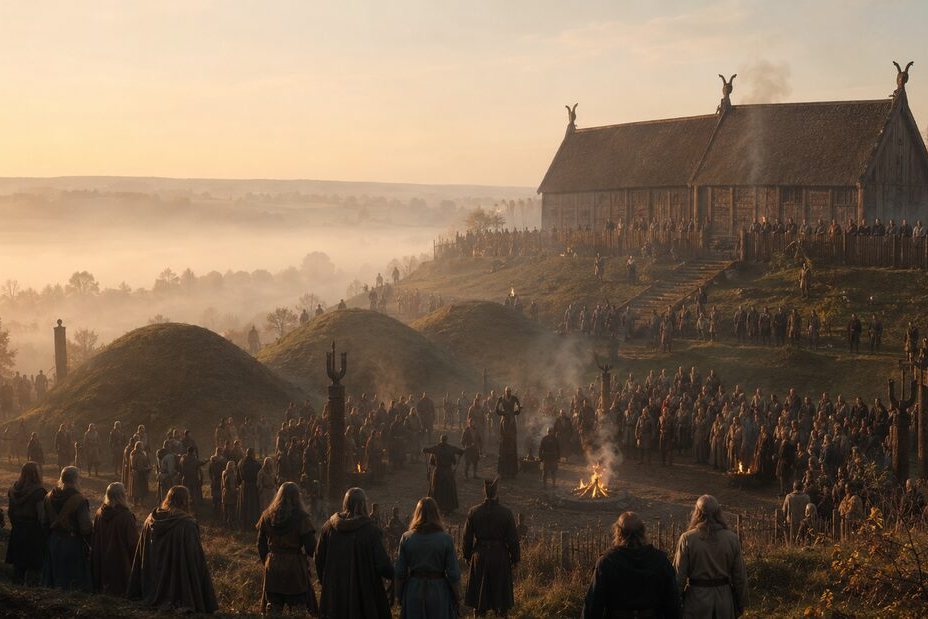
 Few lands in Central Europe carry a name as misleading as Bohemia. It is named after a Celtic people long gone by the time the ancestors of today's Czechs arrived. In between lie Germanic kings, a Frankish merchant who became king of the Slavs, fourteen princes at the font, and a fratricide whose year scholars still cannot fix. A search for traces between hard evidence and beautiful legend.
Bohemia is a basin: mountains all around, fertile land in the middle, cut through by the Vltava and the Elbe. Landscapes like that do not change their inhabitants easily – and yet this basin changed its language more than once during the first millennium. Anyone telling the early history of the Czechs must therefore separate three things cleanly: what contemporary sources say, what the spade shows, and what was written down as a foundation legend only centuries later. That distinction decides whether a story stays history or turns into national myth.
The name Bohemia goes back to the Celtic Boii. Ancient authors – Strabo and Velleius Paterculus around the turn of the era, later Tacitus – know the region as Boiohaemum, the home of the Boii. Linguistically this is a hybrid: a Celtic tribal name combined with the Germanic word for home (*haima). That very compound reveals that the Boii did not coin the name themselves; Germanic-speaking neighbours named the land after its former inhabitants.
Tacitus states the crucial point himself in the Germania: the name of the land persisted even though the population had long since changed. The most important caveat of this whole subject was thus already voiced in antiquity. Place names outlive peoples. Anyone inferring Celtic ancestry for the Czechs from the word Bohemia is confusing a geographical label with descent. More on that Celtic confederation in our article on the Boii.
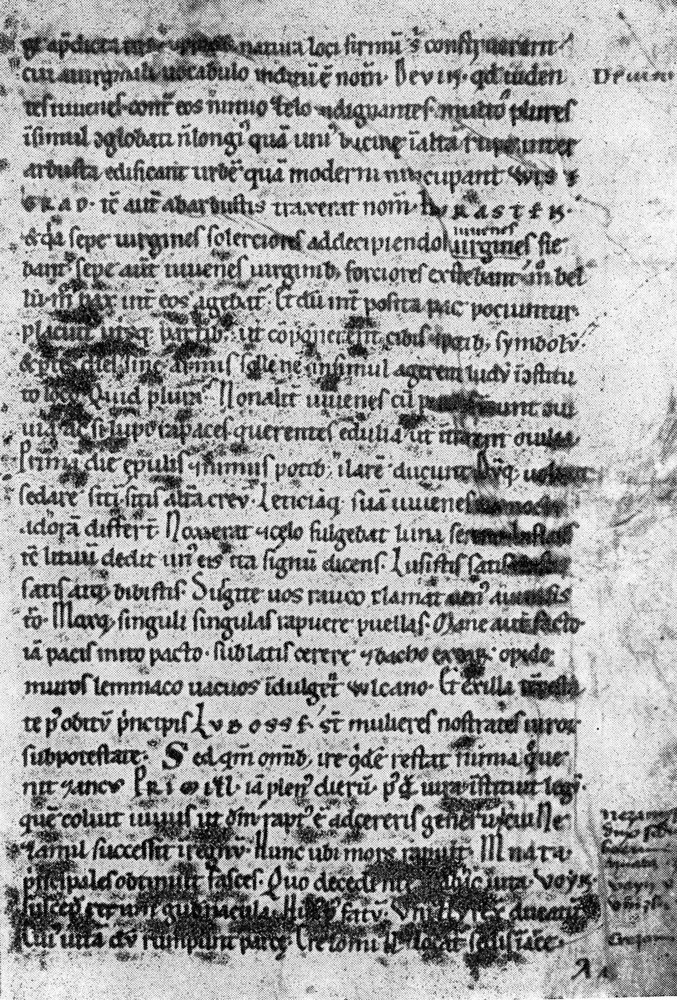
Those who displaced the Boii were Germanic groups, above all the Marcomanni. Around 9 BC their king Maroboduus led them into the Bohemian basin and built something Rome regarded as a genuine rival power: a kingship with a standing army, allies and diplomatic weight.
In AD 6 Tiberius was to destroy this realm with an enormous force – tradition speaks of twelve legions. The revolt in Illyricum forced Rome to break off and to conclude a treaty recognising Maroboduus as king. His end did not come from Rome: in AD 17 he fought an indecisive battle against Arminius, and in AD 19 the Marcomannic nobleman Catualda overthrew him. Maroboduus fled to Italy and died at Ravenna in AD 37. Related groups such as the Quadi remained significant along the Danube for centuries.
After Maroboduus, Bohemia remained Germanic in settlement – archaeological finds continue well into the sixth century, some of them associated with the Lombards. During that century the Prague basin was largely vacated: the Lombards moved south, other groups followed the general movement of the Migration Period.
Into this thinly settled land came Slavic-speaking groups. The Czech medievalist Dušan Třeštík reconstructed a route through the Moravian Gate, reaching eastern Bohemia around 530 and then spreading along the Elbe and Vltava into the interior. Caution is essential here: there is no date, no event, no land-taking with a year attached. Whether we are dealing with a large migration at all, or rather with a gradual spread of language, lifestyle and material culture, remains an open research question.
The archaeological marker of this period is so-called Prague-type pottery: hand-made, undecorated pots with narrow bases and an S-shaped profile, classically dated to roughly 540 to 680. A radiocarbon date from Běchovice near Prague falls around 525 with a wide margin of error – early, but hardly precise.
With it come small, unfortified villages of some eight to twenty farmsteads, laid out along watercourses, with sunken-featured buildings and stone ovens. Only later, in the eighth and ninth centuries, does the network of hillforts emerge – timber-and-earth strongholds that served at once as seats of power, granaries and refuges. Source criticism applies here too: a pot type is not a people. Equating Prague-type pottery with Slavs is a working hypothesis that has been critically debated for years.
The first individual who becomes tangible in Slavic Central Europe comes to us through a single source: the chronicle of the so-called Fredegar, written around 660. Every later account depends on it. Fredegar calls Samo a Frank by birth from the pagus Senonagus – whether that means Sens in France or Soignies in Belgium remains disputed.
According to the chronicle Samo went to the Slavs in the fortieth year of Chlothar II, that is 623/624, fought successfully against the Avars and was elected leader; he is said to have ruled for thirty-five years, until 658. Many scholars doubt the precision of that dating: a revolt after the failed Avar siege of Constantinople in 626 would be more plausible. Samo bears a royal title only in the ninth-century Gesta Dagoberti. His confederation included Bohemian groups and – after the victory over the Franks – the Sorbs under Dervan; whether the Carantanians also belonged rests on a much later Salzburg text and remains contested.
In 631 or 632 King Dagobert I marched against Samo with three armies: Alemanni, Lombards and the main Austrasian force. The first two succeeded; the main army was crushed after three days of fighting at a place called Wogastisburg, with the Franks abandoning weapons and equipment. Afterwards the Sorbian ruler Dervan switched sides, and Slavic raids into Thuringia followed.
Nobody knows where Wogastisburg lay. Fredegar gives no geographical detail. Suggestions include Rubín near Podbořany and Úhošť near Kadaň in Bohemia, the Staffelberg and Burk near Forchheim in Upper Franconia, as well as Bratislava, Trenčín and others – mostly based on similarities of name. None can be proved, and it is even conceivable that the name referred merely to a fortified field camp. After Samo's death in 658 the confederation dissolved; his sons did not inherit the title.
In the eighth and ninth centuries Bohemia moved into the shadow of the Frankish realm. In 791 part of Charlemagne's army marched through the land on its way against the Avars. In 805 Charles the Younger led a campaign in which, according to the Royal Frankish Annals, a leader named Lecho was killed; another blow followed in 806. In 822 Bohemian envoys appeared with gifts at the assembly in Frankfurt.
The so-called Bavarian Geographer records Beheimare with fifteen civitates in the later ninth century. Politically Bohemia was not a state at this time but a landscape with several princes acting sometimes together, sometimes against one another – caught between East Francia and the rising power of Great Moravia. In 872 a Frankish army defeated six Bohemian duces; one of them is named Goriwei.
The sharpest light on this world of princes is thrown by the Annals of Fulda. They report that in 845 fourteen Bohemian leaders – duces Boemanorum – came with their people to Louis the German at Regensburg and received baptism. The date fell in the octave of Epiphany, that is in January.
Louis received fourteen of the princes of the Bohemians together with their people, who desired the Christian religion, and ordered them to be baptised in the octave of Epiphany.Annals of Fulda for the year 845, own sense-translation from the Latin
What sounds like a missionary triumph was also a political act: baptism meant submission. It did not last. As early as 846 a Frankish army returning from Moravia ran into serious trouble in Bohemia; campaigns followed in 847, 848 and 849, the last of which ended in disaster for the Franks. The source does not name the fourteen princes.
Around 870 Bořivoj I becomes the first historically attested ruler of the Přemyslid house; he is very probably identical with the Goriwei named in 872. The legends report that he and his wife Ludmila were baptised by Methodius in the orbit of the Moravian court – usually dated to about 883/884, in connection with Svatopluk's grip on Bohemia.
Caution is obligatory here. The main source, the so-called Legenda Christiani, was written at the earliest in the 990s, a good century after the event, and its dating was disputed for generations. No contemporary account of Bořivoj's baptism exists. What is secure is the physical evidence: Bořivoj first resided at the hillfort of Levý Hradec north-west of Prague, where the first church in the land was built, dedicated to St Clement. In 895 his son Spytihněv and a prince named Witizla appeared before King Arnulf at Regensburg, detaching Bohemia from Moravia.
Around 880 Prague Castle was laid out on the spur above the Vltava – at first a ditch and a timber-and-earth rampart, soon both seat of power and ecclesiastical centre. In the tenth century Vyšehrad was added on the other bank, the stronghold linked in legend with Libuše and used in Přemyslid times among other things as a mint.
How important Prague already was is revealed by an outsider. The Jewish merchant and diplomat Ibrahim ibn Yaqub of Tortosa described the town around 965/966 as built of stone and lime and as the most significant trading place of the region; Rus and Slavs came there from Kraków, as did Muslim, Turkic and Jewish merchants. This text too survives only indirectly – embedded in the works of later Arabic geographers – so its precise wording should be treated with reserve. The eastward trade axis links Bohemia to the same long-distance world in which the Kievan Rus grew great.
In 921 Princess Ludmila was strangled at her stronghold of Tetín; tradition blames her daughter-in-law Drahomíra. Her grandson Wenceslas (Václav) ruled as a Christian prince between Frankish pressure and internal resistance – and was struck down on a 28 September at the invitation of his brother Boleslav I, in the place later called Stará Boleslav.
But in which year? The sources allow 929 as readily as 935; in both years 28 September fell on a Monday, which may explain the doubled tradition. Even the brother's role is blurred – whether Boleslav struck himself or merely let the killing happen is open. What followed is unambiguous: Wenceslas became patron of the land, his legends are among the oldest texts of the country, and a tenth-century Old Church Slavonic Wenceslas legend contains the earliest recorded use of the name of the Czechs.
In 973 Prague received its own bishopric, subordinate to the archbishopric of Mainz – a key date, because it gave the land an ecclesiastical structure and bound it firmly into the Western church order. In 982/983 Adalbert, Czech Vojtěch, born around 956 at Libice, became its second bishop.
He came from the Slavníks, a rival princely family that minted its own coins – a clear sign of rank and independence. On 28 September 995 followers of Boleslav II wiped out the family at Libice almost entirely; only a few survived, Adalbert among them, because they were abroad. Adalbert turned to mission and was killed in Prussian territory on 23 April 997. His grave at Gniezno became an anchor of Christianisation in the east and tied Bohemia to the rise of the Polans.
And the famous foundation legend? It appears in the Chronica Boemorum of Cosmas of Prague, written between about 1119 and 1125: the judge Krok, his daughter Libuše, her prophecy and her marriage to Přemysl the Ploughman, from whom the ruling house descends. Cosmas is an excellent chronicler for his own age – but for the seventh or eighth century he is literature, not a source. Some five hundred years separate the events from the writing.
One detail is often overlooked: in Cosmas the forefather who leads his people into the empty land at Mount Říp is called Bohemus, father Bohemia. The forefather Čech appears only some two hundred years later, around 1310, in the chronicle of the so-called Dalimil. The ancestor's name is thus younger than the legend itself. Anyone engraving such stories in wood or slate today should tell them as what they are: powerful medieval literature, not early history. That is exactly what we watch for in our workshop in Alsdorf when we laser-engrave motifs and inscriptions – attested history and beautiful legend stay distinguishable.
The Boii · The Marcomanni · The Sorbs · The Carantanians.
All History & Finds articles →
On a field south of Lund, where today only a small church stands, lay for almost a thousand years one of the largest …
Read more →