On 18 September 887 a Doge of Venice fell in battle off the Dalmatian coast, fighting men from the Neretva. It is a sentence that appears in almost every account of the early medieval Adriatic, usually with the word "pirates" in front of it. Yet almost everything we know about the Narentines comes from the pen of their opponents or from the viewpoint of an emperor who was never there. This article lays the sources side by side, separates what they say from what historians have made of it, and asks how much of a "nation of sea-robbers" remains once one reads closely.
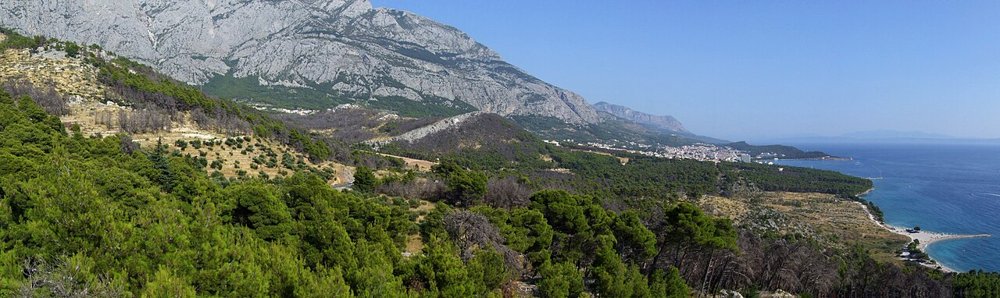
The Narentines, in scholarship also called Neretljani or, after the Byzantine emperor, Pagani, lived in the 9th and 10th centuries on the middle Adriatic coast between the mouth of the Neretva and the coastal strip near Makarska, and on islands such as Korčula, Mljet, Hvar and Brač. So it stands, in essence, in the writings, but even this map is not undisputed. There is no testimony in their own language: no inscription, no letter, no chronicle by the people of the Neretva about themselves. What we have is a Byzantine handbook from the middle of the 10th century and Venetian historiography that begins around 1000 and is embellished further in the 14th century.
It is worth keeping in mind that this imbalance shapes the picture. A group transmitted only through its enemies and a distant observer inevitably appears as a threat. Related cases of South Slavic groups on the edge of the great empires are the Croats, the Serbs and the White Croats; for all of them the same source stands at the beginning, and for all of them the same caution applies.
"Narentines" goes back to the river, called Narenta in Latin and Naro in antiquity; the Roman town of Narona lay on its lower course. The river name is thus older than the Slavs in the region. The Venetians called the people Narentani; in Serbo-Croatian they are Neretljani or Neretvani. This is a derivation from the river name and counts as secure enough to adopt here; deriving peoples' names from river names is a common pattern.
"Pagani" is another matter. Constantine Porphyrogenitus, the Byzantine emperor, explains the name himself: they were so called because they had not been baptised when all the Serbs were baptised; in Slavic, the word means "unbaptised". That is the interpretation of the emperor or his informants. The word goes back to Latin paganus, which later meant "heathen", and whether the Narentines ever called themselves that we do not know. Perhaps it was a label that outsiders attached to a group that kept to its old customs longer. That Constantine explains the name so directly at least shows that it was familiar in Constantinople.
The handbook De administrando imperio, compiled around 948 to 952 for the emperor's son, devotes a chapter of its own to the Pagani (36); related statements appear in chapters 29 to 35 on Serbs, Croats, Zachlumians and others. The origin story runs, in sense: the Pagani descend from the unbaptised Serbs, from the time of that prince who had placed himself under the protection of Emperor Heraclius (610–641). This is not a story that can be checked but a back-projection from a 10th century in which the Byzantines arranged the Adriatic coast into a framework of tribal groups and claims.
They are called Pagani because they were not baptised when all the Serbs were baptised. For "pagani" means "unbaptised" in the language of the Slavs.Constantine VII Porphyrogenitus, De administrando imperio, ch. 36 (mid-10th century); paraphrase after the Greek text in our own translation, in sense, not quoted word for word
The passage is short, and it says nothing about seafaring or robbery. It supplies an origin, an explanation of the name and a religious classification. Everything else about the Pagani in this chapter is geography, and that is thin too.
For Pagania Constantine names three administrative districts (Greek zoupania), Rhastotza, Mokros and Dalen, of which the first two lie on the coast and the third inland. In addition he lists four inhabited places (kastra oikoumena): Mokron, Beroullia, Ostrok and Slavinetza. The text gives no further place names, and it describes none of these sites.
Where these strongholds lay is a matter of interpretation. The usual identifications equate Mokron with Makarska, Beroullia with Brela, Ostrok with Zaostrog and Slavinetza with a place near Gradac. Miodrag Marković surveyed the attempts at localisation in 2013 in the Zbornik radova Vizantološkog instituta and made proposals of his own, among them Mokron at the village of Makar on Biokovo, Beroullia at Vrulja near Podgora, Ostrok at Zaostrog and Slavinetza in the area of the Baćina lakes or near Gradac. The very difference between the proposals shows that similarity of names alone does not carry the argument. Whoever reads "Mokron = Makarska" reads a plausible hypothesis, not a result.
Archaeology has so far been able to decide little here. Early medieval Slavic graves and settlement traces exist on the coast and inland, but I know of no find that could be assigned to a specific group called Narentines; pottery and grave goods say little about self-designations. The Neretva delta is itself alluvial land in which traces survive poorly, and Roman Narona lost importance in the early Middle Ages. That is a deficiency of the record, not proof against a group.
Constantine counts four islands as part of Pagania: Kourkra (Korčula), Meleta (Mljet), Phara (Hvar) and Bratzis (Brač); the identifications are customary, and the island names are less ambiguous than the stronghold names. He remarks that the inhabitants of the islands kept livestock, a hint of pastoral farming that is rarely quoted because it does not suit the image of the sea-robber. At the same time he describes two districts as having coastal ships. The text thus allows us to read that boats were built and sailed on this coast. Nothing more. On number, size or construction the chapter is silent.
One should not play this down. The South Slavs on the Adriatic were seafarers, and Constantine himself reports elsewhere that the Rus had their dugouts (monoxyla) built by Slavic tributaries. In the north, too, the sources know Slavs on the water: Helmold of Bosau describes the Rani on Rügen in the late 12th century as sea-robbers, a likewise one-sided testimony. That Slavs could build ships and sail coasts is therefore well attested. What their ships looked like compared with the longships of the Norsemen cannot be said for the Narentines, since no wreck and no drawing survives. Whoever calls them "Vikings of the Adriatic" paints a picture that does not come from the sources.
The second trace leads to Venice. John the Deacon, a chaplain of Doge Pietro II Orseolo, wrote around 1008 a history of the Venetians (Istoria Veneticorum, also called Chronicon Venetum); the doge Andrea Dandolo summarised the tradition in the 14th century in his chronicle and expanded it. Both therefore write from the Venetian side and many decades or centuries after the events; for the early years it should be noted that John in part drew on older records that have not survived.
For the 830s the Venetians report that Narentines attacked merchants on their way back from Benevento; in 839 Doge Pietro Tradonico armed against them, and a peace was concluded with their leader. The names and years that circulate in overviews vary, and the details of such episodes are given more tersely in the chronicles than the accounts suggest. What can be said with certainty is this: Venetian tradition knows repeated disputes over sea routes in the 9th century and records peace settlements with the Narentines. That sounds like two powers meeting, not like a criminal state set against a guardian of order. Duke Domagoj, too, whom John the Deacon calls the worst of the Slavic dukes, was according to tradition a prince of the Croats and not of the Narentines, and whoever confuses the two writes a story that none of the sources tells.
The best-known event stands in the chronicles for 887: Doge Pietro I Candiano marched against the Narentines and fell in battle on 18 September. According to the usual account he was the first doge to die in a battle. The place of combat is usually sought near Makarska, in the area of Mokron; that identification is an interpretation. How the battle went, how large the fleets were and why Candiano was at war there, the sources report only tersely and in a form shaped by narrators. That the doge died and Venice suffered a defeat is firm; everything beyond that belongs to reconstruction.
What follows from this, and what does not, is important. That the Narentines could defeat a Venetian force shows that they had fighting men at their disposal; whether they had ships in any considerable number or the Venetians were attacked on land, we do not know.
Constantine counts the Pagani among the Serbs, and that has played a large role in the debates of the 19th and 20th centuries. Others, among them Neven Budak, see in them a distinct group whose classification reflects a political rather than an ethnic development. Still others question whether "Narentines" were a delimited community at all; Mladen Ančić argues that the sources denote by different names the same people of the hinterland, whom he interprets as "Humljani". Florin Curta reads Constantine's Serbian classification as a hint of a temporary Serbian overlordship in the early 10th century. One should therefore be wary of the maps that circulate on stamps and in schoolbooks: the Narentines are not ancestors of a modern nation, and they cannot be grasped with today's concepts. Comparable questions arise for the Bulgarians and Slavs in the Balkans as a whole.
When Constantine calls the Pagani "unbaptised", he writes about the past: they had not been baptised, back then. He himself later mentions baptisms said to have taken place under Emperor Basil I (867–886), and the usual reading sees in them the Christianisation of the South Slavic coastal peoples. How complete and how lasting it was is open. More recent accounts suspect that the baptism of the Narentines was politically motivated and dragged on, but this assessment is also an interpretation. The name "Pagani" remained in use in any case when the group may long have been Christian, as names simply do.
Anyone interested in mission history will find in the Carantanians a different pattern, in which baptism proceeded from the Salzburg region. For the Narentines a mission history is entirely missing; we do not know who baptised them, when, or in what form their old customs lived on. The archaeology of graves might one day provide answers, but so far it does not.
Venetian tradition tells of a new war for 948 that ended with a defeat; since then, it says, Venice paid the Narentines a tribute for passage. This is a statement that later historiography records only after the end of the tribute was celebrated, and in such cases caution is called for.
Around the year 1000 Doge Pietro II Orseolo, the same one John the Deacon served, equipped a fleet. According to the usual dating it sailed on Ascension Day of the year 1000, a date that later became the city festival of the Sensa. The doge took coastal towns under his protection and moved against the Narentines. The chronicle reports that Korčula submitted, while Lastovo, in Venice's account a Narentine base, was destroyed after refusing to submit. The doge afterwards adopted the title of Duke of the Dalmatians. That the Narentine prince renounced the "old levy" also stands in the account. Here too: this is the story of the victors, written by a member of the court who celebrated the doge. How the other side saw things we are not told.
At the latest with the territorial shifts of the 11th century, when Croats and Venetians contended for the coast, the name of the Narentines disappears from the sources. None of the texts names an event that marks their end; probably they were absorbed into Croatian rule and later into the designations of the hinterland.
The word "pirate" turns up constantly in modern accounts of the Narentines. In the early sources it is not the dominant image: Constantine, the only non-Venetian source, mentions no sea-robbery. The Venetians speak of raids and prisoners, but they also report peace settlements and payments, and that can be read in several ways. One can see in it actual robbery, with a tribute standing behind it as protection money. One can also assume a competition over trade routes in which Venice, expanding its long-distance trade in the 10th century, simply portrayed the coastal inhabitants as an obstacle. Both readings are interpretations, and the second is no more proven than the first.
For similar cases in the Mediterranean the state of the sources is comparable; how one-sided raid reports can be we showed with the example of the Vikings in the Mediterranean. The claim is also often repeated that the Narentines sold their captives as slaves; for background see Vikings and slavery. A reliable individual source showing that the Narentines themselves engaged in human trafficking on a larger scale has not come my way in the primary sources; the claim comes from overview accounts and remains a conjecture until proved.
A Byzantine chapter with four stronghold names, a doge who falls in 887, a campaign around the year 1000 and a name that arose from a Roman river name: that is the solid substance. Added to it are islands, coastal strips and boats about which we know little, and a handful of hypotheses on stronghold locations, origin and baptism. The piracy that seems so naturally to belong to them is the picture of one side, the side that wrote the conflict down. Whoever stays honest says: on this coast there was a self-assured community with ships that lived with Venice in alternation of war and treaty, and more than that cannot be proved from the sources.

The White Croats · The Croats · The Serbs · The Carantanians · The Slavs of Bulgaria · Vikings in the Mediterranean · The longships · Slavery among the Vikings.
