Two early medieval peoples called themselves Croats — one on the Adriatic coast, one deep inland between the Vistula, the San and the Dniester. What connects a name that surfaces in two such different places?
Say "Croats" today and most people think of the Adriatic coast, of Dalmatia, of a country that has carried this name since the early Middle Ages. But work through the Byzantine and East Slavic sources of the tenth to twelfth centuries and a second people of the same name turns up — far to the northeast, somewhere between the upper Vistula, the San and the Dniester, on the northern approaches to the Carpathians. The sources call them the White Croats. Two Slavic groups, separated by hundreds of kilometres and by the whole breadth of central Europe, share the same core in their name: Chorvat-, Hrvat-, Chrobat-, depending on which language and which century you consult. That is not a trivial coincidence. It is one of the more stubborn puzzles of early Slavic history, and it belongs to that rare class of historical questions that no single tidy find will ever settle. Which is exactly why it rewards a patient look — much as we did elsewhere with the Cenomani, a people found both near Le Mans in Gaul and in northern Italy. The same pattern applies here: one name, two places, and the open question of whether anything beyond linguistic coincidence lies behind it.
The key source is a work the Byzantine emperor Constantine VII Porphyrogenitus compiled for his son around the middle of the tenth century: De Administrando Imperio, a handbook of foreign affairs, not a history in the modern sense. In chapters 30 and 31 it tells how the Croats came to Dalmatia. I give the content here deliberately as a careful paraphrase, not as a verbatim quotation of any modern, copyrighted translation: the Greek text states that the Croats had originally lived "beyond Bagibareia," where the "White Croats" (in one passage explicitly called ἄσπρη Χρωβατία, "white Chrobatia") now dwelt — unbaptised, tributary to a Frankish king named Otto, neighbouring a place called Belegrada, and, according to the text, on friendly terms with the "Turks" (meaning the Hungarians). From there, under seven tribal leaders and two sisters, groups are said to have moved south, driven the Avars out of Dalmatia, and settled there. Part of the people, the text continues, stayed behind in the old homeland "beyond Hungary, next to Francia," and needed "thirty days' travel" to reach a sea the text calls "dark."
These few sentences have had an outsized effect, well beyond their actual informational content. Even the place names are ambiguous: "Bagibareia" is usually read as Bavaria, though some scholars think instead of Babia Góra south of Kraków. The identity of "Belegrada" is disputed; the thirty-day journey to a "dark sea" has been read by different scholars as pointing to either the Baltic or, on a different route, the Black Sea — the field is genuinely divided here. And the mention of a King Otto is chronologically awkward: an East Frankish king of that name reigns only from 936 onward — centuries after the supposed seventh-century migration, but squarely within Constantine's own lifetime. The text visibly blends two different time layers: an old migration story and contemporary tenth-century knowledge.
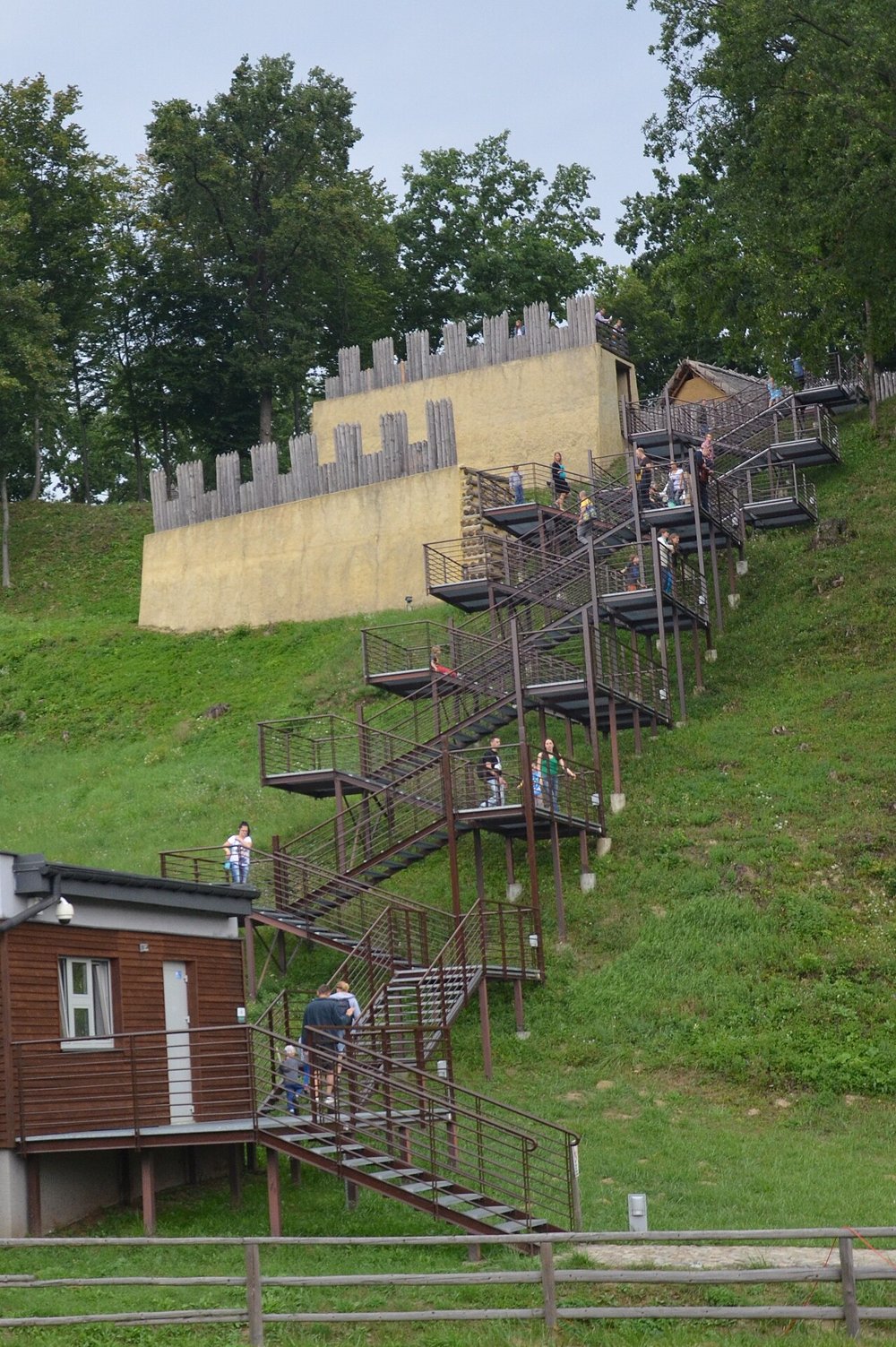
Whatever one makes of the origin legend, several sources and archaeological finds point to a Slavic population group in the Carpathian foreland that called itself — or was called — Croats. The area is usually located between the upper Vistula and the San in the west and the upper Dniester in the east, with focal points around what became Przemyśl, around fortified sites such as Plisnesk and Stilsko near modern Lviv, and further east around Halych. Archaeology documents numerous fortified hilltop settlements (grody) there between the eighth and tenth centuries, with rampart-and-ditch systems, stone ovens and in some cases considerable size — evidence of a densely settled, evidently politically fragmented Slavic landscape, but no single find that can be tied unambiguously to a bordered "realm of White Croatia." That is precisely the gap between what archaeology can show and what the written sources claim: the material culture attests to settlement density and defensive effort, not to a political unit called Croatia.
Closely tied to this region are the so-called Cherven Towns (Russian Червенские города), a group of fortified sites around Przemyśl whose allegiance between the emerging Polish state and Kievan Rus' was contested for decades. The Primary Chronicle records, under the year 981, that Grand Prince Vladimir I of Kiev took the Cherven Towns "from the Lyakhs" (the Poles). Whether the population living there was still understood as "Croat" at that point is not stated explicitly — but the geographical link to the White Croats presumed further east is plausible and widely discussed in scholarship, without being anything close to established fact.
Alongside the Byzantine court, Old East Slavic historiography also knows the White Croats. The so-called Primary Chronicle (Povest' vremennykh let, compiled in Kiev in the early twelfth century but drawing on older material) lists, in its brief ethnographic introduction, the Slavic peoples said to have scattered from a shared Danubian homeland. In that list — between the Moravians, the Czechs and the Polans — the White Croats appear in the same breath as the Serbs and the Carantanians (ancestors of the Carinthian Slavs; see also our article on the Carantanians). It is a single, unremarkable clause — yet it is one of the earliest independent confirmations that a Slavic group of this name actually existed, quite apart from Constantine's account:
А се ти же словѣне: Хорвате Бѣлии, и Серебь, и Хорутане.
"And these too are Slavs: the White Croats, and the Serbs, and the Carantanians." (own translation)Povest' vremennykh let (Primary Chronicle), Laurentian recension, introductory chapter on the distribution of the Slavic tribes, compiled early 12th century; quoted from the standard modern Cyrillic rendering of the text, own translation
What stands out is that the chronicle places the White Croats here in a series with peoples now generally located in the South Slavic world — Serbs and Carantanians — even though the wider geographical context of the passage points more toward central and eastern Europe. That shows the medieval chroniclers themselves were already wrestling with how to sort these migrating, splitting, and renaming Slavic groups cleanly.
The Primary Chronicle mentions the Croats a second time, in a different context — as a military target. Under the year 992, only a few years after the Christianisation of Rus', the chronicle records a campaign by Vladimir I "against the Croats." After that, the trail of the eastern White Croats in the written sources goes almost cold. The region around Przemyśl and the Cherven Towns remained a bone of contention between Kievan Rus', Poland and later the principality of Galicia-Volhynia for centuries — a border region in both the literal and the historiographical sense, neighbouring other East Slavic tribal groups such as the Dulebes and the Tivertsians. Whether the name "Croat" gradually dissolved into the emerging identity of Rus', survived as a local self-designation, or was always more of an outside label for several smaller groups than a single ethnic name — none of this can be settled with the sources currently available.
While the eastern White Croats fade from the record, a political entity of the same name takes clear shape on the Adriatic coast at roughly the same time — one that very much does enter recorded history: medieval Croatia, which, through principality, kingdom and shifting unions with Hungary and later the Habsburgs, developed into the modern state. We have covered the South Slavic Croats — their rulers, their Christianisation, their state formation — in a dedicated article: The Croats of the Adriatic. What matters for our present question is that this is precisely the group whose origin story Constantine VII tells in chapter 31 — and that he explicitly ties them to the northeastern White Croats as their homeland population. The two articles are therefore two sides of the same source problem: here, the people that still carries the name today and became a state; there, the people whose name eventually falls silent in the sources.
This is exactly where the real research debate begins, and it is far from settled. A central challenge comes from the early medievalist Francesco Borri, who pointed out in 2011, in the journal Early Medieval Europe, that Constantine's migration story is not confirmed by a single independent source, either contemporary or later. Borri reads the tale of the seven brothers and two sisters not as a reliable report of a seventh-century event, but as a literary pattern through which the Byzantine court of the tenth century explained the origin of an elite that had become dominant in Dalmatia by his own time — a retrospectively constructed founding legend rather than a chronicle in the modern sense.
Other scholars reach similarly cautious conclusions, if with different emphases. The Croatian historian Neven Budak has repeatedly pointed out that the "seventh-century homeland" described in the text fits suspiciously well with what Byzantium knew about the White Croats in the tenth century — a sign that an older migration legend and more recent contemporary knowledge were fused in the text rather than kept cleanly apart. The Russian archaeologist Valentin Sedov took a similar position from the archaeological side. The Serbian Byzantinist Tibor Živković went further still, suggesting that parts of the narrative may relate better to conditions in the tenth-century Bohemian sphere of power than to an early Carpathian Croatia. On the Polish side, Henryk Łowmiański had already stressed, in his monumental work on the origins of Poland, that no source truly proves the existence or exact location of a sixth- or seventh-century "White Croatia." Set against these are scholars such as the Russian historian Alexander Majorov or the Ukrainian medievalist Leontij Voitovych, who, drawing on Carpathian archaeology and local place names, argue for a genuine, if not politically unified, Croat tribal identity in the Carpathian foreland. The dispute, then, is not settled between "legend" and "fact" — it runs straight through the scholarly field: did an ethnic group called Croats genuinely exist in the early medieval Carpathians, just without the dramatic mass migration Constantine describes? Or is even that minimal core a later back-projection?
Which brings us back to the original question: why did two Slavic groups in such different places carry the same name? Scholarship generally discusses several, not mutually exclusive, explanations. The oldest and, in older literature, most popular is simply the one Constantine himself tells: a genuine split, in which part of an originally Carpathian tribe moved south and carried the old name with it. This explanation has the appeal of simplicity but, as shown above, hardly any independent confirmation. A second possibility is that the name was not a tribal name in the strict sense at all, but a title or self-designation of a warrior elite or retinue that established itself independently in two places while using the same, possibly originally non-Slavic term (an Iranian-Sarmatian root is among the hypotheses discussed, with reference to the so-called Tanais Tablets from the Don region). A third, more sober possibility is pure linguistic coincidence in word formation — though most specialists consider this comparatively unlikely, since the sound-shape of the name is too specific to have arisen twice by chance.
What must be kept firmly apart from serious scholarship is the politically charged reception history of the topic. In the nineteenth and twentieth centuries, "White Croatia" was pressed into service by various national historiographies — Greater Croatian, Pan-Slavic, in places Greater Polish — as evidence for sweeping historical territorial claims or for a particularly old, particularly pure ethnic identity. Such readings often worked from the same few, ambiguous sentences in Constantine's text, but drew conclusions the source simply does not support, and served recognisably political rather than scholarly ends. Serious modern research — whether in Zagreb, Warsaw, Kyiv or St Petersburg — now treats the question considerably more cautiously, as an open, source-critically difficult question of early history, not as confirmation of any modern national or territorial claim. Keeping this line clear between defensible early history and later political appropriation matters to us, precisely because the subject lends itself so easily to present-day misuse.
In the end there is no tidy verdict, only an honest picture of the evidence: two early medieval Slavic groups carried the same name, one on the Adriatic, one in the Carpathians. One became the core of a state that still exists today; the other disappears as a distinctly named group in the pull of the emerging Rus' and Poland. Whether genuine kinship, a shared elite designation, or something in between lies behind that, we simply do not know for certain — and that is exactly what makes the story of the White Croats one of the more interesting open chapters of early Slavic ethnogenesis. Anyone who spends time with puzzles like this quickly notices: the early history of the Slavs, the Germanic peoples and the Celtic peoples of Europe is rarely a smooth narrative. It is a puzzle of fragments, where every new find, every new reading of an old chronicle, shifts the picture again. For courage. For memory. For legends that live on.
The Croats · The Carantanians · The Dulebs · The Tivertsi.
All History & Finds articles →
A name that outlasted three decades of war: Widukind was the most famous leader of Saxon resistance against …
Read more →Vikings and Aachen? Sounds like two worlds with nothing to do with one another. Yet in the winter of 881/882 the …
Read more →The axe is the most honest tool of the Viking Age. It split firewood, built ships, cut paths through the forest - and …
Read more →