A blond Norseman lands on the Gulf of Mexico, the locals mistake his dragon ship for a feathered serpent, and the sailor becomes a god. That is the story told by a theory that has circulated in books and online forums since the 1970s. It sounds like a lost adventure. In fact, the Feathered Serpent in Mexico is around 800 years older than the earliest securely dated Norse presence in the Americas, and the tale of the white god Quetzalcoatl whom Cortés supposedly embodied took shape only after the Spanish conquest. This article looks at who made the claim, what it rests on and why it does not hold.
No. No archaeological find and no written source supports a Norse origin for Quetzalcoatl. The Mexica, the people at the heart of the Aztec empire, and those who came before them needed no outside visitors to develop a serpent god, calendars, cities or pyramids. Claiming otherwise is pseudoarchaeology: it dresses up as research but does not test its assumptions against the finds.
It still repays attention, as a case study. The theory welds together three things that each deserve a closer look: a colonial legend from the sixteenth century, a puzzling passage in an Icelandic saga, and a mural from Chichén Itzá.
The fullest version comes from Jacques de Mahieu (1915–1990), a far-right writer who emigrated from France to Argentina. As far as I can tell from what I have seen, he was no specialist in Mesoamerican archaeology. His book L'Agonie du Dieu-Soleil (Paris 1974; in Spanish as La agonía del Dios-Sol, 1977) opens, in the Spanish online transcription I consulted, with a sentence that cites no find at all: a Viking jarl (a Scandinavian noble) "probably" called Ullman came ashore at Pánuco on the Gulf of Mexico. The transcription gives the year as "1067".
On that sentence Mahieu hangs a whole world history. The locals took the ships for fabulous beasts, so Ullman entered tradition as Quetzalcoatl, the Feathered Serpent. He became the fifth king of the Toltecs and brought laws, religion, farming and metalworking. About twenty years later, as Kukulkán, he founded Chichén Itzá. His people then moved through Venezuela and Colombia to the Pacific and, around the middle of the eleventh century, set up the empire of Tiwanaku in the Andes. The figure 1067 does not fit that, since Tiwanaku would then come before the landing. Further on, the same transcription places the arrival in Mexico in the tenth century, and Juan Schobinger, in a rejoinder to Mahieu, gives his landing date as 967. Probably 967 is what is meant; I have not seen the printed book.
According to that transcription, his evidence consists of gods' names, oral traditions, body-measurement and fingerprint comparisons among the Guayaki (Aché) of Paraguay, and alleged runes on a potsherd that he himself describes as Indigenous work and says a Guayaki woman had recently scratched. The text names no direct find of Vikings at Pánuco, Chichén Itzá or Tiwanaku.
His other titles explain the rest. Mahieu also sent Templars to America and wrote about Trojans in South America. Alejandra Mailhe's article "Seudoarqueología y política en Jacques de Mahieu" in the Argentine journal ESNOA (2023) therefore reads these books as part of his political thought rather than as research.
Separately from Mahieu, there is an Icelandic variant. The author Þórunn Valdimarsdóttir argued in 1999 that men from Iceland and Ireland reached Yucatán between 998 and 1030. I know this work only through the critical account by Alex Harvey (University of York), who rates it as entertaining and very unlikely.
The starting point is Björn Ásbrandsson, known as the Champion of Breiðavík, who has to leave Iceland after an affair. Late in Eyrbyggja saga, in chapter 64, the merchant Guðleifr Guðlaugsson runs into a storm, reaches an unknown land and is seized by the locals. An old white-haired leader addresses him in Norse, asks after people in Iceland and sends him home with a ring and a sword. Who sent the gifts? Someone, he answers, who was a better friend to the lady of Fróða than to her brother. The notes in the edition I used identify him as Björn.
"[…] met with north-east winds, and was driven far to the west, and south-west, in the sea, where no land was to be seen." […] "[…] but it rather appeared to them that they spoke Irish."Eyrbyggja saga, ch. 64, English text from Reeves, Beamish and Anderson, The Norse Discovery of America (1906, sacred-texts.com; the translator of this passage is not named individually there)
That is all the geography on offer. The saga names no Mexico, no Toltecs, no pyramids and no feathered headdresses. To the crew, the inhabitants seem to speak Irish, which points less to Yucatán than to the mental map of Irish and Norse seafaring tales. Some link the story with Hvítramannaland or "Great Ireland", a land that Landnámabók places six days' sail west of Ireland. According to the summary available to me, Fridtjof Nansen and more recently Matthias Egeler read it as a mythical land built on Irish ideas, and Kirsten Seaver as a fable grown from faded knowledge of the western ocean.
Harvey adds that the sagas were written down around the thirteenth century and mix history with invention. The route fits badly too: he reckons with some 3,600 nautical miles from Iceland to Mexico and, at top speed without a single stop, about ten days at sea. Harvey also notes that 998 plus ten calendar cycles of 52 years comes to exactly 1518, the year he gives for Cortés setting sail, and calls that a possible coincidence. It proves nothing: Cortés landed in Mexico in 1519, and the return legend itself, as we are about to see, is younger than that date.
The strongest counterargument is a timeline. At Teotihuacan in the Valley of Mexico stands the Feathered Serpent Pyramid, which the Metropolitan Museum of Art dates to around 150–250 CE. Its façade shows feathered serpents in profile among shells and conches. Before construction, the museum estimates, 200 to 260 people were sacrificed, 137 of them documented archaeologically. I do not know for certain how the people of Teotihuacan understood these images or what they called the creature; interpretations range from cosmology to rulership. That it is a feathered serpent, any visitor can see.
The earliest precisely dated Norse activity in the Americas, by contrast, is the felling of trees in 1021 at L'Anse aux Meadows in Newfoundland. Kuitems and colleagues established that date in Nature (2021) from wood bearing the marks of metal blades. Around 800 years separate the pyramid from that date, and Mahieu's Ullman, whether in 967 or 1067, would still come more than seven centuries after it was built. A landing can hardly explain an image that had already stood in stone for so long.
According to general reference accounts, the cult spread to Xochicalco, Cacaxtla and Cholula after the decline of Teotihuacan around 600. The name itself shows the same independent life. The Nahuatl word quetzalcoatl combines quetzalli (precious plumage) and coatl (serpent), and the Maya form Kukulkán means the same. Nobody needed to see a dragon ship to arrive at this image: the quetzal is a Central American bird, and the region has no shortage of snakes.
More dates undo Mahieu's sequence. Chichén Itzá, which Ullman supposedly founded some twenty years after his landing, had according to reference accounts developed its core between 750 and 900; its last known hieroglyphic date is 998, and by 1100 it was already declining as a regional centre. Tiwanaku, allegedly founded by Vikings in the mid-eleventh century, flourished from about 500 to 1000 according to Popović and colleagues (Science Advances, 2021), with its decline as a political centre beginning around 950. The 17 genomes they studied also show genetic continuity in the Titicaca basin from 300 to 1500. The study did not set out to test a Viking theory, but it leaves no room for one: an empire from Scandinavia would leave more than a legend.
The Viking theory needs a second building block, the pale god who vows to return. Many popular accounts still say Moctezuma took Cortés for the returning Quetzalcoatl in 1519. Recent decades of scholarship have taken exactly that story apart.
In her article "Burying the White Gods" (American Historical Review, 2003), Camilla Townsend lays out its layers. Cortés himself, the only securely identified eyewitness whose writings date from the conquest, never wrote that he was taken for a god. He even has Moctezuma declare that he is flesh and blood like all men, though Cortés may have invented that too. Francisco López de Gómara, who never went to the Americas, was among the first to state in print, in 1552, that the Mexicans thought the Spaniards were gods. The Franciscan Motolinía connected a mortal, later deified Quetzalcoatl with Cortés's sails. According to Townsend, a mortal of that name appears only from the 1540s, and at first not in Nahuatl texts. Following Susan Gillespie, she argues that the story as we know it emerged when Bernardino de Sahagún edited the Florentine Codex in the 1560s. Around 1570, the author of the Anales de Cuauhtitlan became the first Nahua to put all the elements together.
Language plays a part as well. The Nahuas called the Spaniards teotl, which the Spaniards simply rendered as "god". Townsend considers the word much less precise: it could also mean a powerful, uncontrollable figure. She explains the later talk of omens and divine recognition by the narrators' situation: Sahagún's informants, often sons of Tenochtitlan's elite, had reasons to portray their forebears as having foreseen the disaster. In her account, the war was decided by Spanish armour, firearms, horses and ships, and by Indigenous allies such as the Tlaxcalans.
Matthew Restall, in Seven Myths of the Spanish Conquest (2003), treats belief in divine white men, according to the summaries I have seen, not as a chapter of its own but under the "Myth of Native Desolation". There the trail leads to letters of Columbus, who speaks of men "from the sky" but not of gods. I could not read the book itself. One dissenting voice deserves mention: in his book on Topiltzin Quetzalcoatl, H. B. Nicholson, according to the publisher's description, considers the expectation of a return a probable factor in Moctezuma's peaceable reception of Cortés, and some events of the ruler's life historical. So the accounts differ. Common to the debate is that, according to reference accounts, no document attests the link independently of Spanish influence.
Where does the skin colour come from, then? The writer Jason Colavito traces the description to the Franciscan Andrés de Olmos, who began his studies in 1533, and to Gerónimo de Mendieta (1596), who probably drew on him. In the translation Colavito adapts from Bancroft, Quetzalcoatl is "a white man", portly, with a broad brow, great eyes, long black hair and a large round beard. I have not seen the Spanish original, so I report this only through Colavito.
So even the colonial text delivers no blond Scandinavian. Pre-Hispanic images offer nothing either: early depictions show a snake, reference works say some Classic Maya images add a beard, and Aztec images show a human figure with a beak-like mask, a sign of the wind god Ehecatl. In this visual world, a beard is no certificate of origin.
The sequence of identifications is instructive. Some Franciscans recognised the apostle Thomas in Quetzalcoatl. Ignatius Donnelly took up the white gods in his 1882 Atlantis book. In the twentieth century he became a Viking. The pattern repeats: the god becomes a mirror for those who interpret him.
The one argument that needs a serious look does not come from Mahieu. In the Temple of the Warriors at Chichén Itzá, excavated by the Carnegie Institution from 1925 to 1928, a mural shows light-haired captives in water. According to Nancy Marie Brown's review, the Yale historian Valerie Hansen asks in The Year 1000 whether these could be Norsemen captured by the Maya, and considers a voyage to Yucatán possible. In the report I have seen, she speaks of captives, not of a god. She regards the lack of Norse finds in Mexico as a lesser objection, because the archaeological record is far from complete.
The Maya scholar Stephen Houston offers a simpler solution in a 2019 post for Maya Decipherment. The hair colour points less to Viking blood than to bleached hair, in keeping with the Sun God, who has the same colour. He also allows for an origin in the east or an unknown ethnic marker. He attributes the Viking reading to fantasists. The meaning of the image is not settled, then, but an iconographic explanation from within the Maya world is closer to hand than a voyage of thousands of kilometres from the North Atlantic.
Even if Hansen were right, the result for our question would be the same: a few castaways being drowned do not found a religion. They would be victims in a picture commissioned by an already old Maya city.
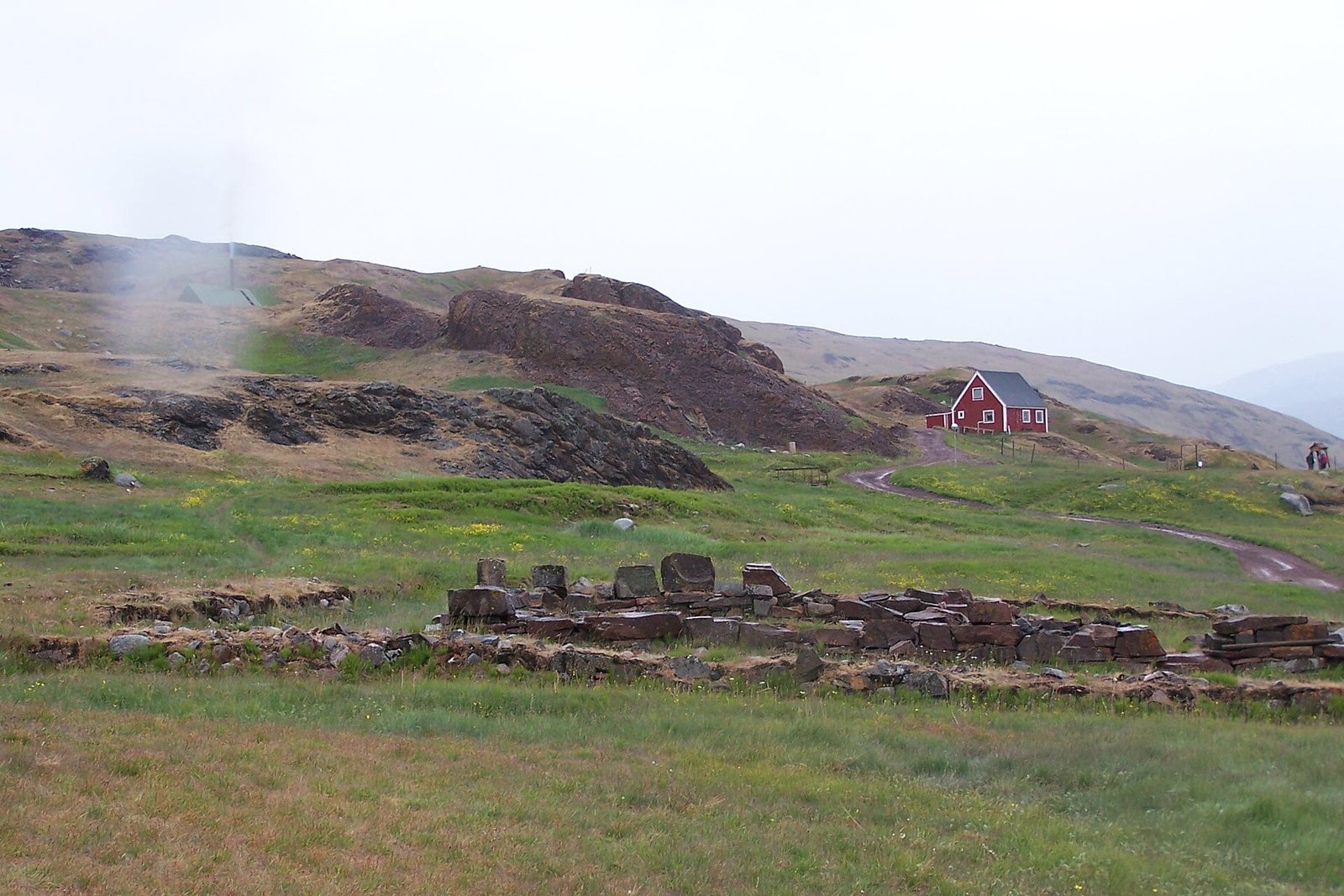
We know what a Norse presence looks like. L'Anse aux Meadows, according to the Groningen researcher Michael Dee the only confirmed Norse site in the Americas, has yielded wood with blade marks, plus buildings and a smithy described in our article on Vinland. For Mexico, as even Nancy Marie Brown notes, who leans towards Hansen's reading, no verified Scandinavian object exists. A king ruling generations of Toltecs ought to have left iron, burial customs, house forms, traces of language and runes in quantity. What exists instead is a handful of assertions.
The much-quoted Maine penny does not help. Svein H. Gullbekk (Journal of the North Atlantic, 2017) thinks the Norwegian coin from the reign of Olaf the Peaceful probably genuine, but suspects it travelled through Indigenous exchange networks, and he stresses that the evidence is circumstantial. Maine is still thousands of kilometres from Yucatán, too. For how false evidence survives, see the Kensington Runestone: it lost its case on language and rune forms, but not its followers.
Mahieu credits Ullman with farming and metallurgy. The finds tell another story. Maize, on the usual account, was bred from the wild grass teosinte about 9,000 years ago in southern Mexico, probably the Balsas valley. Metalworking came late but before any Ullman: the earliest distinctive pieces from West Mexico date to around 800 CE, perhaps as early as 600, and point by sea to Central and South America, not to the north. Dorothy Hosler has studied those connections in depth.
The cities needed no strangers either. Teotihuacan, Tula and Chichén Itzá grew out of a long development of their own, and even the building forms at Chichén Itzá that recall Tula are now generally seen as cultural exchange within Mesoamerica. Maya and Nahua scholars kept calendars and books of history that no sailor from Iceland ever saw.
That makes such theories more than harmless fancy. They follow a scheme known as hyperdiffusionism: great inventions supposedly arose only once and were spread by a favoured people. They take the achievements of Indigenous people and assign them to paler strangers. That is a racist premise, even when it comes dressed as an adventure. The real Norse need no such upgrade: that they, sailing from Greenland according to the sagas, were cutting timber in Newfoundland around 1021 is remarkable enough.
Who claimed Quetzalcoatl was a Viking? Above all Jacques de Mahieu in L'Agonie du Dieu-Soleil (1974; Spanish La agonía del Dios-Sol). Þórunn Valdimarsdóttir (1999) put forward a variant concerning Yucatán, which I know only second-hand.
Did Vikings ever reach Mexico? There is no secure evidence for it. The only confirmed Norse site in the Americas is in Newfoundland.
Was Quetzalcoatl a historical person? The god was not. Later texts merge him with Ce Acatl Topiltzin, a ruler of Tollan. Whether real events lie behind this is disputed; Nicholson considers part of it historical.
Why did the Aztecs supposedly take the Spaniards for gods? That claim comes chiefly from later Spanish and colonial texts. The Nahuatl word teotl was much broader than Spanish "dios", and several specialists doubt the belief ever existed.
Are the blond figures at Chichén Itzá proof? No. They are an open question of interpretation. Bleached hair and a link to the Sun God offer a ready explanation.
Vinland: what saga and excavation show · The Kensington Runestone · Leif Erikson · Thorfinn Karlsefni · Bjarni Herjólfsson · Viking navigation · The Greenlanders · The horned helmet myth

Vinland · The Kensington Runestone – Vikings in Minnesota or a Nineteenth-Century Forgery? · The Vinland Map at Yale: old parchment, modern ink and a real voyage that never needed it · Typically Viking?.
A teenager moves to a Norwegian factory town, develops powers he does not understand and discovers that the richest …
Read more →It is one of the most persistent pictures of the "wild Viking": the bearded warrior slurping mead from the hollowed …
Read more →A crew heaves against the hull, logs turn under the keel, and someone at the back picks up the last one and runs it to …
Read more →The sun wheel is one of humanity's oldest signs – around the world, since the Stone Age. Precisely for that reason …
Read more →