Of the Severi in the Balkans, almost one sentence survives: Theophanes says the Bulgars resettled them from a pass "towards the east". Beyond that line there is only a chieftain's name from the 760s. This article weighs what that gives us, separates it from later storytelling, and explains why the same name on the Dnieper establishes no kinship.
Anyone looking for the Severi in Bulgaria finds no battle report, no embassy and no description of their villages. They find a subordinate clause. In the chronicle of Theophanes the Confessor, written in Constantinople in the early ninth century, the story of Bulgaria's beginnings includes a note that the Bulgars subdued "seven tribes" of neighbouring Slavs and settled the Severi (Greek Σεβερεῖς) eastward from a mountain pass. A second trace is a chieftain who turns up in another passage in the 760s. As far as could be established for this article, that is the entire written record.
It is little, and for a knowledge blog it is the honest starting point. A large literature has grown around that one line. It turns the "seven tribes" into a fixed alliance, the Severi into frontier guards of the east, and the whole into the seedbed of the Bulgarian state. Some of that is plausible; some is later conditions projected backwards. This article tries to show, paragraph by paragraph, where the source stops and interpretation begins.
For orientation: the broader picture of Bulgars and Slavs in the early Middle Ages is on the page Bulgars and Slavs. This piece follows only the narrow thread of the Severi and does not repeat that overview.
Theophanes, later called abbot and Confessor, wrote his Chronographia in the early ninth century. It is organised by year, counted from the supposed creation of the world, abbreviated AM for Anno Mundi. The passage on the Bulgars stands under AM 6171. The Greek edition is Carl de Boor's of 1883, where it runs over pages 356 to 359, with the Severi on page 359. The English translation by Cyril Mango and Roger Scott (1997) has it on page 499.
More important than the page number is where Theophanes got his knowledge. He wrote some 130 years after the events. A study I read in summary, following Cyril Mango, assumes that Theophanes and the patriarch Nikephoros drew on a shared, now lost source composed around 720; it names the patrician Trajan as a possible author. That is a research thesis, not an established fact. Still, it sets expectations: the account of Bulgaria's beginnings rests on a text written from the Byzantine side and at some distance. No Bulgarian written testimony of the period exists.
Theophanes also colours his story heavily. The same study notes that he heaps negative epithets on the Bulgars and ascribes Asparuch's success to Roman sins; the passage ends by saying the Romans were put to shame "for their many offences". He wrote at a time when the Bulgarian khan Krum was threatening the capital. Anyone reading the "seven tribes" is reading a text with a purpose, not a census.
Nikephoros, patriarch of Constantinople, wrote his Short History (Historia syntomos, also Breviarium) before 806 by current dating. He tells the Bulgar prehistory more briefly and soberly: the death of Kuvrat, the division among five sons, and the settlement of the third, Asparuch, between the Dnieper, the Dniester and the Danube at a spot he calls "Onglos". Of seven tribes and of Severi he says nothing, as far as I could check. He says only that the Bulgars subjected the neighbouring Slavic tribes, some of whom guarded the land against the Avars while others watched the Roman frontier. The brief for this article named "seven tribes" for both chroniclers; that holds for Theophanes alone.
The setting in which the Severi appear is a campaign. Emperor Constantine IV had marched against the Bulgars, who had established themselves north of the Danube and were raiding Thrace. In Theophanes, Asparuch withdraws into a position he thought impregnable, the Romans panic though nobody is pursuing them, and the Bulgars cross the Danube as far as "Varna, as it is called, near Odessos". Odessos is the ancient coastal town that later became Varna. Theophanes stresses that the place was guarded at the back by the Danube and in front and on the flanks by passes and the Black Sea. Then comes the sentence that matters here.
I give it according to the English translation I read myself (Harry Turtledove's, available online); I did not consult the Greek wording for this article. The continuation, which I know only from a summary of the Mango–Scott version and from a journal article, follows after the quotation.
"When the Bulgars had become masters of the seven tribes of Sklavinoi in the vicinity, they resettled the Severi …"Theophanes Confessor, Chronographia, AM 6171, after the English translation by H. Turtledove, excerpt (public domain; own rendering)
The Mango–Scott version, as reported in the two summaries I used, goes on to say that the Severi were settled "from the forward pass of Beregaba" in the direction of the east, while the other six tribes, which were tributary to the Bulgars, were placed in the southern and western regions "as far as the land of the Avars". The summary is not guaranteed to be word for word, but both sources agree on the substance.
Several things can be read from this single sentence. First, Theophanes counts the Severi as one of the seven, since "the remaining six" are the rest. Second, the Bulgars did not merely subdue the tribes but relocated them. Third, the relocation followed a layout that sent the Severi towards the coast and the Bulgar heartland and the others to the western flank, where the Avars lived. How much of this was deliberate planning and how much the narrative tidying things afterwards, the text does not say.
Dating is a problem of its own. Theophanes places the events under AM 6171. In the reckoning that Mango and Scott give their translation, that corresponds to 678/79; the Turtledove translation I read online heads the section 679/680. Modern scholarship usually puts the conflict in 680 and 681: the battle of Ongal in 680, and the treaty in which Byzantium accepted Bulgar rule south of the Danube and paid tribute in 681. Both dates come from general surveys; I did not consult the primary evidence for them.
The gap between the reckonings is not an arithmetic slip on this page but a known feature of the chronicle: Theophanes' year framework drifts from the actual sequence in these decades. How exactly that is explained I could not verify. For the Severi, the point is simple: whoever gives an exact year for their resettlement claims more than the source supports. "Around 680/681, in the context of the state's formation" is the safest formula.
Even the word "founding" involves interpretation. The texts show a peace in which Byzantium pays tribute to a power north of the mountains. That this became "the Bulgarian state" is a judgement of later research tracing the line forward. Contemporaries would hardly have named it so.
The word on which the location hangs is klisura, a Greek-Slavic technical term for a defile or gorge in the mountains. Theophanes speaks of the "forward klisura of Beregaba" (in one rendering of the passage: ἐκ τῆς ἔμπροσθεν κλεισούρας Βερεγάβων). The usual identification sees in it the pass at Rish in the Balkan range, the Stara Planina, and the name "Veregava" brings the same region back later. Theophanes himself reports, under the year 759, a battle at this place: Emperor Constantine V was ambushed by Khan Vinekh and lost his strategos Leo. A survey article on that battle which I read calls the identification with the Rish pass tentative. This too is an open point.
What follows for the Severi? The wording "from the forward klisura towards the east" allows two readings: either the Severi were moved on eastward from that point, or they were settled east of the pass. The modern literature I read in summary understands it as settlement in the eastern part of the Balkan range. The picture of "frontier guards in the east" rests on that direction and on the reasoning that the passes towards Thrace had to be secured. The text itself names no task. It says only: Beregaba, eastward.
The number seven is the part of the tradition most often misreported. Theophanes mentions seven tribes and names exactly one, the Severi. The other six remain anonymous. Handbooks that offer lists of seven names are reproducing the identifications of later scholars, who gathered the names from other, younger sources. The Greek word that translators render as "tribes" can also mean "clans" or "kindreds"; I did not check it against the Greek text and so do not commit to whether Theophanes thought of political units or descent groups.
Names of later Slavic groups in the Bulgarian sphere are known from ninth-century sources, and this site has articles on several. The Timočani on the river Timok, according to the Frankish Royal Annals, went over from the Bulgars to the Franks in 818. The Smoljani and the Strymonites lived in the south, the Berziti and the Belegezites further west and south. Whether any of them belongs to Theophanes' "seven" is not documented. The territory Theophanes assigns to the other six, south and west as far as the Avars, matches the areas of these later names only roughly. More than a hundred years lie between.
That seven might be symbolic is raised in the literature. One web page proposing it supports it with East Slavic number folklore, which is no basis for this passage. All that is certain is that Theophanes gives the number and that it persists in later tradition. On this page, "seven" therefore counts as the chronicler's statement, not a verified quantity.
It also remains open what sort of body the "seven tribes" were. Some accounts speak of an alliance that existed before the Bulgars and formed against Byzantine attacks. Others see a category created by the Byzantine narrative itself: Slavs between the Danube and the mountains who were lumped together because they could be. A page I read sets out both positions, names no scholars and admits gaps in the evidence; that is not enough for a verdict. The general background, that the sources speak of Sklaviniai, areas with a Slavic population under their own leaders, is standard knowledge for the sixth and seventh centuries. It says nothing about the Severi in particular.
A hierarchy can be read from Theophanes. The verb he uses for the subjection of the Slavs, κυριεύειν, is also the one he uses for the sons of Kuvrat ruling their ancestral land. It denotes lordship, not alliance. The other six tribes he calls tributary. On the older view often cited in surveys, held by the Bulgarian historian Vasil Zlatarski, the relationship was more of a treaty between equals. Most historians today instead see the Slavs as subjects who kept their chiefs, customs and settlement patterns and in return gave levies in kind and foot soldiers. That is how an overview of the First Bulgarian Empire that I read puts it; I did not consult the underlying specialist literature.
Numbers are another point of dispute. An overview page on the capital Pliska asserts that Slavs formed "a strong majority" of the new state's population. That is plausible but an estimate. Archaeology yields no head count, and the written sources give no figures. For the immigrant Bulgars themselves, surveys cite about ten thousand people as a guess by John Fine and Zlatarski, while Steven Runciman assumes a considerably larger group. These are orders of magnitude, not findings.
What is not in dispute is the consequence for the Severi: if the passage holds, they were part of the Bulgar order of rule from the first moment. They stood under the khans' oversight, paid or served, and remained recognisable as a group. The second passage where the name appears shows that.
Under the years around 764/65 (the heading in the Turtledove translation; other reckonings and overview articles give 767), Theophanes reports that Emperor Constantine V secretly sent men into Bulgaria who seized "Sklabounos, the ruler of the Severi", "a man who had done much harm in Thrace". The name form is the Slavic name Slavun. This is the only place where the Severi appear as an acting group in the sources, and it falls in the time of Khan Telets and of the wars Constantine V waged on Bulgaria.
Two things follow. First, a century or so after the resettlement the Severi were still visible as a group with their own leader, and the chronicler places him "in Bulgaria". Second, this leader carried out raids into Roman territory, which Thrace invited. Whether he did so on Bulgar orders, with their tolerance or against them is not stated. A page I read concludes that the Severi still owed the Bulgars tribute; that is interpretation. The year stays uncertain as well: figures between 764 and 767 turn up, and I could not look at the passage in the Greek text or in the Mango–Scott numbering.
A note on the translation: at the first passage the Turtledove version carries a footnote suggesting that the "Sebereis" might not be Slavs at all but a non-Slavic group from Asia Minor, with the Severians of the Dnieper also possible. The note supplies no evidence and sits uneasily with the translation of the passage itself, in which the Severi are counted among the "seven tribes of Sklavinoi". I mention it because it shows how thin the tradition is: even whether "Severi" is clearly a Slavic name is discussed in footnotes.
Here lies the risk of confusion this article is meant to clear. The article The Severians deals with the East Slavic Severians on the Desna, Seim and Sula in what is now north-eastern Ukraine and south-western Russia. They appear in the Primary Chronicle and in Constantine VII Porphyrogenitus' De administrando imperio (tenth century), which names them as tributary neighbours of the Rus, among whom the Rus princes were maintained in winter. I read these statements on the East Slavs only through a summary; about the Severi of the Balkans Constantine, as far as I could check, says nothing. The brief for this article named him as a source for the Bulgarian Severi; that cannot be confirmed.
Is there a connection? The name alone does not prove one. Ethnonyms, names of peoples, recur often in the Middle Ages without the groups being related, and conversely separated fragments of an original group can keep the same name. There are examples of both in early medieval eastern Europe. In this case no known text links the Balkan Severi with those on the Dnieper. There is no migration note, no genealogy and no archaeological find that would have to be read that way.
Scholars have offered interpretations. The Polish historian Henryk Łowmiański, as reported in survey literature, took the Severians of the Dnieper to be the mother tribe of the Slavs as a whole, because the Bavarian Geographer tells of a vast realm of the "Zeruiani" from which all Slavs were said to descend. That ties an uncertain name resemblance to an even more uncertain list. The Bavarian Geographer is a ninth-century list of peoples east of the Frankish realm, and its identifications are likewise disputed. The origin of the word "Severi" itself is approached along several paths: from the Slavic word for "north" (*sěver), which geography does not support, since the Severians were not the northernmost Slavs; from a Sarmatian tribal name; from a derivation invoking a Hungarian word for "black". None of these is secure.
Two thoughts remain when one reads cautiously. First, that Slavs on the Dnieper and Slavs in the Balkans were both called "Severi" is a hint, no more. For the movement of Slavs in the sixth and seventh centuries, from the forest steppe of present-day Ukraine to the lower Danube, there is archaeological evidence, for instance the Penkovka culture with its pottery, found as far as the north-east of the Balkans. The archaeologist Florin Curta, however, warns against equating such pottery groups with particular peoples. Second, whether there was a family tie between the groups cannot be answered as long as no text or find shows a single route. On this site the two groups are therefore treated separately, with the shared name as a cross-reference.
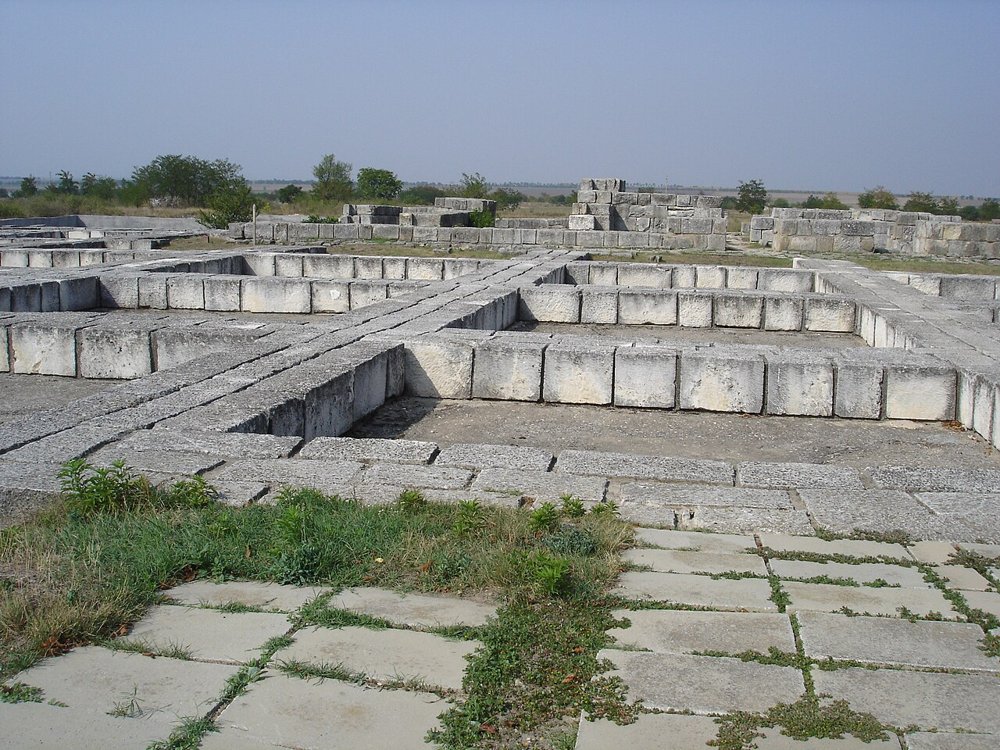
One would expect the soil of north-eastern Bulgaria to supply answers: villages of the Severi, graves, workshops. The picture is more sober. For the early Middle Ages, Slavic settlements are known in the eastern Balkans, with huts whose floors were sunk below ground level (Grubenhäuser, sunken-floor houses) and pottery of particular types. For Pliska, the site that later became the Bulgar capital, the state of research is mixed: the foundation legend, by which Asparuch laid out the place in the late seventh century, is not archaeologically documented; traces of crafts and kilns at Asar-dere belong to the eighth century, and settlement traces before the ninth century are, according to an overview page, not secure. Two Bulgarian scholars moreover see Pliska in its early phase not as a fixed capital but as a seasonal seat or a place where rulers moved around. The page I took this from is an overview; I did not read the excavation reports.
For the Severi it follows that no find or group of finds can be tied to them. A page I read admits as much: there are no artefacts or inscriptions that assign particular sites to particular tribes. This is a basic problem of archaeology in early medieval south-eastern Europe. Pottery, house and grave forms change with fashion, trade and social standing, not only with the origin of their users. Florin Curta has stressed this repeatedly. Whoever puts "Severi" on a map of the eastern Balkans therefore relies on Theophanes, not on the finds. The map in a collected volume on the Slavs in the Middle Ages that lists the "Seven Tribes" and the Severi likewise points only to this written passage, not to excavation sites.
The reverse direction is just as uncertain: whether the Severi of Theophanes are identical with the people behind the earthworks and settlement remains in north-eastern Bulgaria cannot be answered. Such ramparts are attributed in the literature partly to the Bulgars, partly to Byzantium; date and builders are disputed in each case, and I have not read the specialist papers. Archaeology shows that the region was settled by Slavs and that a Bulgar centre of power formed later. That the Severi left a firm archaeological trace in it cannot be shown.
After the 760s the name of the Balkan Severi vanishes from the sources I could consult. That does not mean the people vanished. The survey literature describes how in the ninth century Slavs, Bulgars and other groups fused into one people. The baptism under Boris I (around 864/65) and earlier administrative reforms that stripped the tribes of self-government are named as triggers. That too is a summary at second hand. The other group names that occur in eighth- and ninth-century sources are tied to places such as Belzetia: Theophanes reports for the year 798/99 Akameros, ruler of the Sklavinoi in Belzetia. That confirms that Slavic groups under their own leaders stayed visible in the Bulgarian orbit for a long time, but it says nothing about the Severi.
Why the Severi are no longer named is open. They may have merged into other designations, the sources may have stopped naming them separately, or the Byzantine chroniclers' interest may have shifted. Each of these explanations is a possibility, not information.
Several questions stay open, and the known sources cannot settle them. How large was the share of Slavs already settled in the region in the sixth century, and how large that of newcomers? Is "seven" a name or a number? Did Theophanes use a Bulgar tradition, Byzantine record-keeping or a later back-projection? And was the name "Severi" a self-designation, an outsiders' name given by Greeks or Bulgars, or an attribution by the chroniclers?
Readers hoping for certainty will not find it here. The situation shows how little a single sentence of a chronicle can carry when no counter-tradition exists. That does not diminish the subject. It makes visible the frame within which the beginnings of the Bulgarian state are argued: a handful of lines in Greek, written by men who did not like the Bulgars, and soil that gives up its information on names only reluctantly.
The overview of how Bulgars and Slavs lived together is Bulgars and Slavs. Their namesakes on the Dnieper are in The Severians. Other Slavic groups in the Bulgarian and Byzantine orbit are treated in the articles on the Timočani, Smoljani, Berziti, Belegezites and Strymonites.

The Slavs of Bulgaria · The Severians · The Timočani · The Smolyans · The Strymonites.
All History & Finds articles →
Silver was the lifeblood of Viking trade – weighed, chopped up, buried. Three of the greatest hoards show how far the …
Read more →The Silingi appear once, in the second century, in a geographer's list of peoples. Then the sources fall silent for …
Read more →The Silures were a Celtic people in south Wales. Tacitus describes them as dark-haired and warlike – and especially …
Read more →