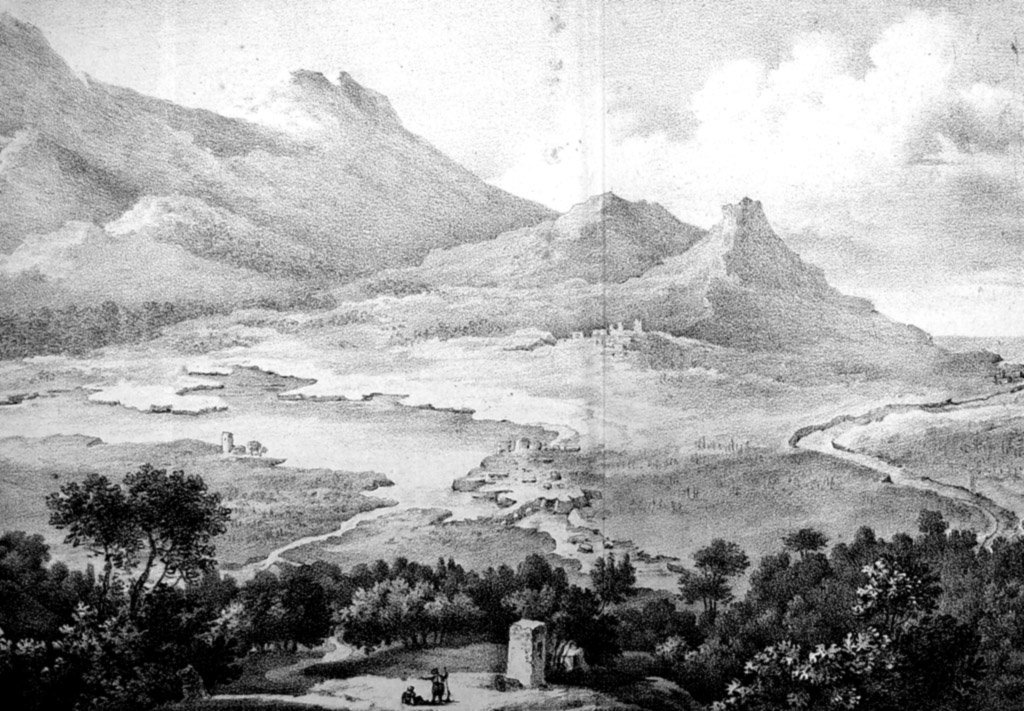
A town in the Bulgarian Rhodopes today bears the name of a tribe about which the sources say almost nothing. The Smolyani (Bulgarian Smolyani) appear in the 9th century, in the period between Byzantium and the First Bulgarian Empire, and afterwards vanish from view as a tribal name. Anyone writing about them has to keep three things apart constantly: what a text says, what scholars conclude from it, and what was told later.
Smolyani means in Bulgarian "the people of smola" or, by the usual derivation, "the resin people". The name goes back to the Proto-Slavic word *smola, which means "resin" and also "pitch" or "tar". The asterisk marks, in linguistics, a reconstructed form that is not written down anywhere. In Byzantine texts the tribe appears in Greek shape as Smolenoi or Smoleanoi (Σμολεάνοι), which renders the Slavic ending -jane, "inhabitants of …", in Greek letters.
The same root sits in two distant names: in the Smeldingi, a West Slavic tribe on the Elbe, and in the city name Smolensk in the east. Scholars have long set these names side by side, most recently the Serbian historian Predrag Komatina in a 2019 essay on early South Slavic ethnonyms. An ethnonym is a people's or tribe's name. That three names go back to the same root proves no kinship between their bearers, however; the word for resin was available wherever conifer forest grew and pitch was needed.
What the name originally meant, an activity, a settlement area in pine forest or a characteristic, cannot be decided. The claim that the Smolyani gathered and sold pitch is likewise an inference from the name, not a finding from any source.
The source situation is thin, and that belongs at the start. A tribal name like this one is mentioned only once or twice in the surviving texts and never described at length. According to what I could find in secondary literature and Bulgarian general surveys, the mention of the Smolyani revolt of 837 goes back to the Life of Saint Gregory the Decapolite. Gregory was a monk from Isauria who set out around 832/833, stayed in Thessalonica around 834 and died in 842; his Life is attributed to the deacon Ignatios, though authorship is disputed. The exact Greek wording of the relevant passage could not be checked in the course of this research. The link Smolyani – Gregory's Life therefore stands at the level "scholarship reports", not "read in the original".
To this comes the inscription of the Bulgarian ruler Presian from Philippi, discussed below. Whether the tribal name itself stands in the surviving text there I could not clarify; the connection with the Smolyani is presented in the literature as an interpretation of a fragmentary text. The tradition offers no more. For a people after whom a present-day town is named, that is little.
Anyone who reads online statements such as "the Smolyani came from eastern Germany in the 7th century" should therefore be wary. Such claims rest solely on the similarity of the name to the Smeldingi and are supported by no evidence in forums. The sources know neither a migration of the Smolyani nor a place of origin.
To place the Smolyani, it helps to look at their neighbours. From the late 6th century Slavs settled in the Balkans, called Sclaviniae in Byzantine usage. These were stretches of land inhabited by Slavic groups with their own leadership and only partly under Byzantine control. A central testimony is the "Miracles of Saint Demetrius", a collection from the 7th century compiled in Thessalonica. It names several Slavic tribes around the city, among them the Strymonites on the river Strymon, today the Struma, and the Drougoubitai. Both appear in connection with attacks on Thessalonica around 617/618 and around 677.
Later further names stand in the sources: the Berziti, the Sagudates and the Rhynchinoi. One should not imagine closed "peoples" in the modern sense. These were groups that a Byzantine author gave a name because they dealt with him as a unit, as negotiating partners, opponents or tribute payers. The Smolyani fit into this list, except that they sit farther east and higher in the mountains.
From the beginning of the 9th century a large part of Macedonia came under Bulgarian rule. The Bulgarian realm, founded in 681 as an alliance between the Turkic-speaking Bulgars and the Slavs already settled there, expanded to the south and west. For the tribes in the hinterland of the Aegean this meant they now stood between two powers.
In 836 the Bulgarian ruler Malamir died. His nephew Presian was, by tradition, raised to the throne while still a minor and at first ruled together with the kavkhan Isbul, a high court office roughly equivalent to chief minister. Presian ruled until 852. Shortly after he took office, in 837, Slavs in the region of Thessalonica rose against Byzantium.
Here the Smolyani tradition comes in: according to Bulgarian historiography it was the Smolyani who rose against the emperor in Constantinople. Emperor Theophilos asked Bulgaria for support against the rebels, but at the same time had his fleet sail through the Danube delta to free Byzantine captives who had been settled beyond the Danube under the Bulgarian rulers Krum and Omurtag. Isbul answered with a campaign to the Aegean coast of Thrace and Macedonia. The alliance broke down before it had come into being.
In the telling of the literature, Isbul on this occasion defeated a Byzantine army under Alexios Moseles, the emperor's son-in-law, and took the fortress of Philippi. These details come from a Bulgarian survey text and are in this form not tied back to a primary passage that I have checked. The basic line is secure: a conflict between Byzantium and Bulgaria over the Slavic territories in Macedonia, with Philippi as a Bulgarian success.
It remains open who held the initiative. Did Bulgaria incite the revolt to gain influence in the south? Did the Slavs call on Bulgaria for help? Or did Isbul simply exploit a situation that had arisen anyway? The texts do not say.
The most important document for this time is not a chronicle but a stone. At Philippi, in present-day northern Greece, a Greek-language inscription of the ruler Presian was found. The French Jesuit Braconnier copied it in 1707, though inaccurately; the slabs were buried again and rediscovered during excavations at an early Christian basilica between 1922 and 1933. Only two of the originally six marble slabs survive; they are now in the Archaeological Museum of Philippi. The text comprises about 43 lines, of which some 27 are missing or destroyed.
Presian, by God ruler of the many Bulgars, has sent …Presian inscription, Philippi, opening formula; paraphrase in own words, the text is fragmentary
The content of the inscription recalls the self-image of a ruler who appeals to God, and it describes events around 837. The inscription counts as testimony to Bulgarian expansion into the area between the lower Mesta and the Struma. An attribution to the Smolyani appears in the literature where Isbul's campaign is interpreted as the subjection of this tribe to Bulgarian suzerainty. "Probably" is the word English-language scholarship uses to phrase this connection; it is a possibility, not a proof. Some historians also consider it conceivable that Presian's campaign simply continued Malamir's campaign in Thrace of 836, which had been broken off by his death.
The common answer is: in the Rhodopes, in the valley of the Mesta and in the area of today's Blagoevgrad Province. The Rhodopes are a mid-sized mountain range in southern Bulgaria and northern Greece, the Mesta (Greek Nestos) a river that flows from there into the Aegean. Other maps place the Smolyani somewhat farther east, between Philippi and Plovdiv, and some accounts call them neighbours of the Drougoubitai. All these localisations are inferences from the name of the town of Smolyan, from the course of Isbul's campaign and from the assumption that the Smolyani had their territory where their name later clings.
Such a back-projection is methodologically vulnerable. The name Smolyan was officially given to the place Paşmaklı only in 1934, more than a thousand years after the early mention of the Smolyani. It shows that in the 20th century someone knew the tribe and assigned it to the mountains, not that the Smolyani lived exactly there in the 9th century. The location is plausible at any rate; secure only in a wide sense, namely that a tribe of this name is to be sought in the hinterland of the northern Aegean.
Archaeologically a tribe can hardly be grasped anyway. Pottery and graves from the early Middle Ages in the Rhodopes show a mixture of Slavic and local traditions, but no find bears a label "Smolyani". Where the sources know only a name, that name cannot be read from the soil.
Occasionally the history of the Smolyani is linked with Khan Krum (reigned around 803 to 814) and the chronicler Theophanes the Confessor. That is understandable, for both are among the most important sources for the Balkans around 800: Krum conquered Serdica, present-day Sofia, in 809 and reached out as far as Adrianople, while Theophanes describes the Byzantine campaigns against the Sclaviniae around 783/784. An explicit connection to the Smolyani I could not find in any of the accounts examined. In the literature the Smolyani appear only in connection with 837, about two decades after Krum's death in 814, and then with Presian, not with Krum.
That does not rule out that the Smolyani already existed in Krum's time and were part of the territories Krum threatened. The structure of this assumption is speculation, however: one would see them as Slavs living between Krum's realm and the remnants of Byzantine rule in Thrace. It is not documented. Whoever reads in a text that Khan Krum subjugated the Smolyani is reading a claim without a source.
For the 9th century a picture emerges of small-scale communities in Macedonia and Thrace. The sources name tribes, but their number is not fixed, and the borders between them are unknown. Whether the Smolyani belonged to a larger league or acted independently is open. The Strymonites and Drougoubitai were in the "Miracles of Demetrius" expressly partners or opponents of the city of Thessalonica; the Smolyani by contrast appear only as a keyword in the story of the dispute between Byzantium and Bulgaria.
Scholars discuss whether such tribal names in the south designated groups of people or rather districts into which Byzantium or Bulgaria divided the land. For the Drougoubitai a later administrative form suggests that the name could be transferred to a region (Drougoubiteia), until Byzantium later merged the district with the themes of Thessalonica and Strymon. The same might hold for other names; for the Smolyani it cannot be tested.
It is important to see the role of language here. The Slavs of the Balkans spoke dialects now called South Slavic; the relation to the Croats and Serbs in the west and to the Slavs in the Bulgarian heartland rests on language, not on demonstrable common descent. When Presian, according to the literature, also fought the Serbs, it happened in a space where linguistic kinship created no political unity.
For a long time the trail is lost. In the following period the Rhodopes came under Bulgarian, then Byzantine rule; in the 14th century the Bulgarian feudal lord Momchil controlled the area before the Ottomans conquered it. Under Ottoman rule the settlement was called Paşmaklı. Only after liberation in 1912 and an official decree of 1934 did it bear the name Smolyan. The name was thus chosen deliberately, out of a historical awareness that counted the medieval tradition in the 20th century as part of national history.
In 1960 the villages of Ustovo, Raykovo and Ezerovo were merged into today's town of Smolyan. Smolyan is now the administrative centre of the region of the same name. The designation "Smolyan resident" in the sense of "inhabitant of the town" shares only the name with the medieval tribe; between the two lies a long period of population history of which we know little.
The often-heard equation of the Smolyani with the inhabitants of Smolensk also leads astray. Smolensk lies in the territory of the Krivichi, an East Slavic tribe. There the name is a city name, derived from the town, and a legend of a tribe of Smolyani who supposedly founded Smolensk is not supported by scholarship. That the name was formed from the same root says nothing about a common origin.
What remains in the end? Little is secure, and that little can be stated briefly: in the 9th century, around the years of 837, the tradition knows a Slavic tribe called Smolyani in the hinterland of the northern Aegean. The name goes back to the word for resin. The tribe played a role in the dispute between Byzantium and the Bulgarian realm. Everything beyond that, from the exact settlement area through size to origins, is interpretation.
These interpretations are not worthless. They fit together into a coherent picture: Slavic communities in the mountains, standing between two empires, whose loyalty was contested and whose names survive only because they played a part in the texts of the two great powers. Whether these communities called themselves "Smolyani" or whether a Byzantine scribe assigned the name, we do not know. In the Rhodopes of the present the name lives on in streets, associations and a dialect; as the self-designation of an early medieval people it remains a puzzle. It is precisely this openness that makes it sensible to keep well-attested and weakly attested things separate.

The Strymonites · The Slavs of Bulgaria · The Berzites · The Rhynchinoi · The Sagudates.
All History & Finds articles →
A horse, a golden disc, six little spoked wheels: the Trundholm Sun Chariot is one of the most beautiful images the …
Read more →