A single sentence survives about the Berzites: a name in a list of Slavic groups that pressed upon Thessalonica in the seventh century. After that the sources fall silent. Eighty years later a Byzantine chronicle records a district called Berzitia – and it does so in a sentence about deportation: a Bulgarian ruler sends an army to carry off the inhabitants of that district and settle them in Bulgaria. Whether the two notices belong together at all is disputed to this day. This article sets out what the sources actually say, what scholarship has made of it, and why in the end it was not land but people that formed the real objective of war.
There are peoples of late antiquity and the early Middle Ages about whom books can be written: battles, treaties, names of rulers, lead seals, grave finds. And there are peoples who consist of a single word. The Berzites – Greek Berzetai or Berzitai, usually Berziti in Slavist literature – belong to the second group. They occur in the Miracula Sancti Demetrii, the collection of miracles of Saint Demetrius of Thessalonica, within a run of tribal names. After that they do not occur in the work again. No leader, no place, no action. Anyone writing about the Berzites therefore writes less about them than about the question of what may legitimately be inferred from a name.
The Miracula Sancti Demetrii are not a work of history but a collection of homilies and edifying narratives about the interventions of the city's patron saint. The first book goes back to Archbishop John of Thessalonica and was composed in the opening decades of the seventh century. The second book is by an unknown author and is placed by Paul Lemerle, editor of the standard edition, in the last two decades of the seventh century. For the history of the Balkans the text is irreplaceable, because the political historiography of those decades is almost entirely silent. It is also treacherous: its purpose is the glorification of the saint, not the recording of events. Numbers, opponents and levels of threat are subordinate to that purpose.
The catalogue of names in which the Berzites appear belongs to the account of an assault on Thessalonica that scholarship usually places in the second decade of the seventh century. The author lists the groups from which the multitude was assembled:
… τῶν Δρογουβιτῶν, Σαγουδατῶν, Βελεγεζιτῶν, Βαϊουνητῶν, Βερζητῶν καὶ λοιπῶν ἐθνῶν …
"… of the Drugubites, the Sagudates, the Belegezites, the Baiunites, the Berzites and the remaining peoples …"
Miracula S. Demetrii II,1 (ed. Lemerle, vol. I, p. 175); paraphrase translation: Glanz und Gravur
The spellings vary between manuscripts and editions; one finds Drogubites beside Dragubites, Belegezites beside Belegezetes. For the Berzites this changes nothing: the name stands there, it stands fifth, and it stands only here.
What the sentence achieves is worth noting first. It shows that in the eyes of a contemporary the hinterland of Thessalonica was not inhabited by a mass of nameless barbarians but by distinguishable groups with names of their own. Elsewhere the same author calls the Slavs expressly "our Slavic neighbours". Florin Curta has concluded from this that the groups listed came from the surrounding countryside rather than from far away. What the sentence does not achieve: it says nothing about where the Berzites lived, how numerous they were, how they were organised, or who led them. A name in a list is evidence for the existence of the name – not for a territory.
The second book of the Miracula returns to several of the groups listed. The Drugubites and the Sagudates reappear at the great siege of the 670s; by that time the Belegezites are living further south, in the region of Thebes and Demetrias, and supply the besieged city with grain. About the Berzites not another word is said. That is striking. The author was evidently well informed about where the Belegezites had moved. Had the Berzites shifted to a distant district in the same period, one would expect him to mention it. He does not. The simplest conclusion is that the Berzites were familiar to him as neighbours, and that their trace was then lost.
Only in the ninth century does a similar-sounding word surface again – in the Chronographia of Theophanes Confessor, written between 810 and 814. Theophanes records a district called Berzitia under the year 774. The context is a military operation: according to the chronicle the Bulgarian ruler Telerig dispatched an army to take Berzitia and transfer its inhabitants to Bulgaria. That is the whole of the information. Theophanes offers no geographical indication, names no neighbour, no river, no town. And – this is the decisive point – nowhere does he call the inhabitants of that district Berzites.
The year 774 was a hard one for Bulgaria. In May, Emperor Constantine V had mounted a large operation with both army and fleet, then withdrawn for no discernible reason; afterwards the two sides agreed a truce. In October Telerig broke it with the campaign against Berzitia. The chronicle gives a force of twelve thousand men together with boyars. Constantine learned of it through his informants in the Bulgarian centre of power, raised a far larger army, intercepted the Bulgarians at a place called Litosoria in the border zone, and won. Telerig drew a conclusion that tells us more about the eighth century than any battle description: he let the emperor know that he intended to flee to Constantinople, asked for the names of those who were to help him – and had the men named executed.
The sentence in Theophanes repays a second reading. Telerig did not want to conquer Berzitia in order to hold it. He wanted to carry off the population. That is not incidental cruelty but the logic of the early medieval Balkans. Labour – farmers, craftsmen, soldiers – was the scarce resource; land was plentiful. Byzantium behaved no differently: emperors resettled Slavs in Asia Minor, Constantine V brought craftsmen from Thrace to the capital, Justinian II transferred whole contingents. Anyone who wants to understand this period must give up the notion that its wars were fought over boundary lines. They were fought over people. That makes the notice about Berzitia at once disquieting and historically revealing.
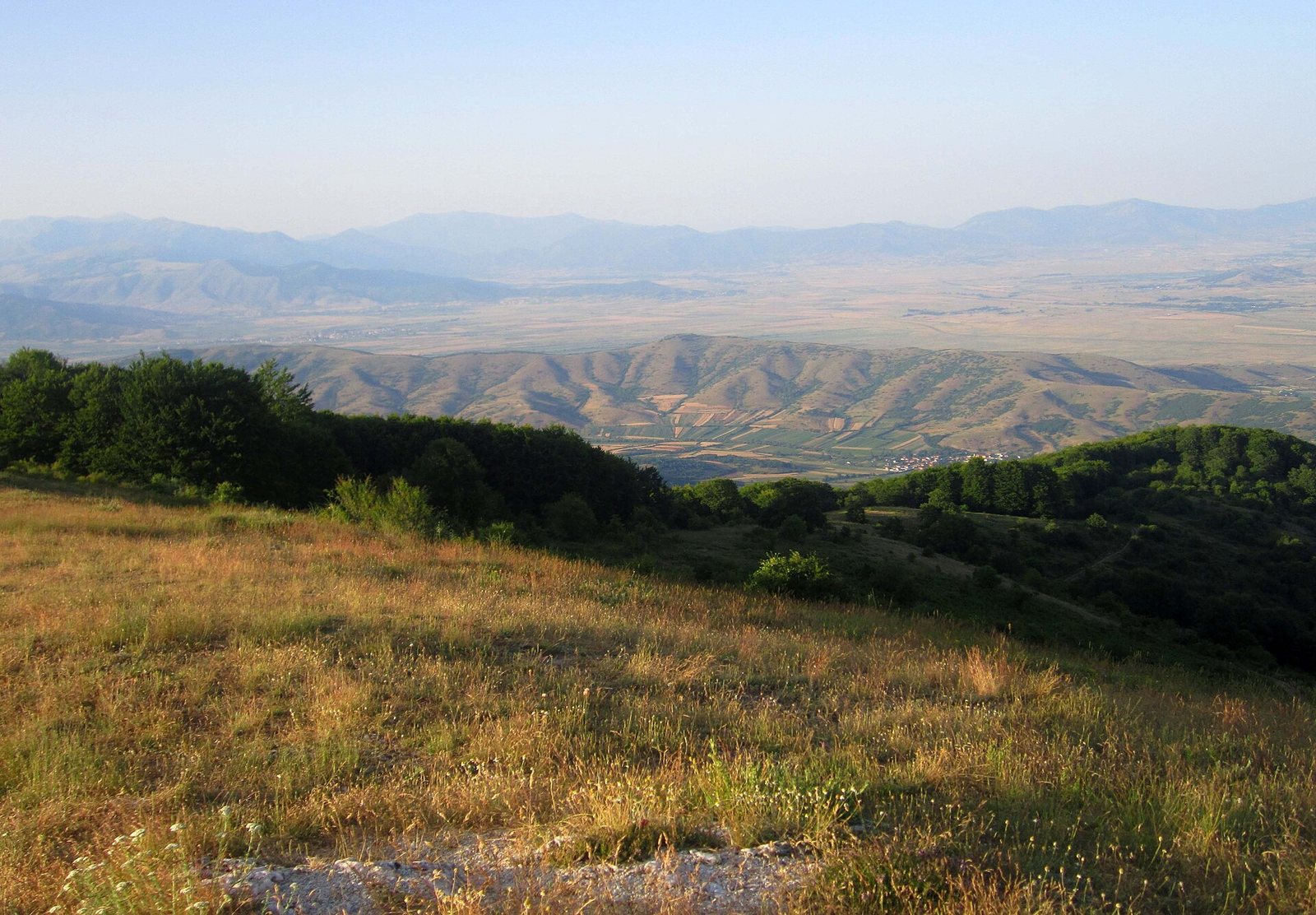
The common answer runs: in the west of present-day North Macedonia, between Ohrid, Bitola and Prilep. That answer appears in many handbooks, but it appears in no source. It is inferred, and in two steps: first Berzitia was linked linguistically to the Berzites of the Miracula, then the Berzites were placed where they were supposed to have lived. Panos Sophoulis and Florin Curta have objected that the district should rather be sought near the theme of Thrace – for instance in the area between the Struma and the Marica, which in 788 became the theme of Macedonia. In favour of this is the fact that Constantine V was evidently able to intercept the Bulgarians in the border region. Neither location can be proved.
The equation Berzites equals Berzitia equals western Macedonia has a traceable history of scholarship. The Czech archaeologist Lubor Niederle formulated it in the early twentieth century; Paul Lemerle adopted it in his commentary on the Miracula, citing Niederle expressly; from there it travelled into surveys, textbooks and maps. Curta has laid this chain bare and calls the connection "purely linguistic" – it rests on the fact that two words sound alike, and on nothing else. That is not a reproach to Niederle or Lemerle but a methodological observation: through repetition a resemblance of names turns into a map, and the map then looks like a finding.
A second and far more fully narrated episode belongs to the same region and the same era – and it too is about people carried off. Over decades the Avars had taken captives from the Roman Balkans to Pannonia and settled them in the area around Sirmium on the Sava. There a community of its own grew up, named after the place where it lived: the Sermesianoi. Their ancestors had been deported some sixty years before the events described; they had preserved their Christian character and had not lost the memory of the places their forebears came from. The Avar khagan set over them a leader named Kuber, who came from a Bulgar milieu.
Kuber rose against the khagan, and the Sermesianoi joined him. The Miracula report five or six engagements and the crossing of the Danube. The group moved south, into the wider orbit of Thessalonica, and Kuber asked the emperor for permission to settle in a plain. The emperor consented and instructed the neighbouring Drugubites to supply the newcomers with food. That was where Kuber's difficulty began: his people wanted to move on, each to the places of his ancestors. He asked the emperor to forbid this and to confirm him as their lord. The request apparently failed. The plain in which they eventually remained is called the Keramesian in the text; scholarship usually identifies it with Pelagonia around Bitola, though this is not certain.
What followed is one of the finest stories in Byzantine hagiography – and one of the most unsettling. Kuber sent his confidant Mauros to Thessalonica disguised as a refugee at the head of a group of defectors. Mauros was received, given rank and placed in charge of the Sermesianoi and Bulgars who had come over; he commanded both Slavic and Greek and could therefore move in either world. The plan to open the city from within on the night before Easter failed. In Byzantine eyes the saint intervened; in sober terms the fleet arrived in time. Mauros stayed, rose to the rank of patrikios and appears on lead seals as archon of the Sermesianoi and the Bulgars – whether the man of the seals is the same person is disputed.
It is tempting to join the two narratives: here a deported population returning, there a population about to be deported, and both in the same region. That is exactly what popular accounts often do. The evidence does not support it. In the Kuber episode of the Miracula the Berzites are not mentioned – not once. The groups that act there are the Sermesianoi, Kuber's Bulgars and the Drugubites as suppliers. Nor does the district name Berzitia occur anywhere in the Miracula. Anyone who writes the Berzites into the Kuber narrative is supplementing it. That is permissible if it is marked as such; it may not be presented as the content of the source.
For the name itself there are proposals but no accepted solution. Most often scholars think of Proto-Slavic berza, "birch" – a motif widespread in Slavic naming and underlying place names such as those around Brest or Brzezice. A second proposal starts from brdo, "hill". Both are plausible and both are unproven, for we do not know the Slavic sound-shape of the name, only its Greek rendering in a single text. A more basic problem follows: even a convincing etymology would tell us what the name means – not who bore it, nor whether those who bore it used it of themselves.
In the literature of the nineteenth and twentieth centuries a line was regularly drawn from the Berzites to the Brsjaci, an ethnographic group in central and western North Macedonia. The similarity of sound is there; the evidence is not. Brsjaci is traceable as a group name only in modern ethnography, and the explanations of it recorded there are folk etymologies – "fast and strong", "the swift ones", or a derivation from the browse fed to livestock. Between the one Greek word of the seventh century and the records of the nineteenth lie twelve hundred years without an intervening attestation. No line of descent can be reconstructed from that, however inviting it looks.
There is no class of find that could be called "Berzite". In 2012 Curta reviewed the material from present-day North Macedonia and reached a strict conclusion: the much-cited sunken-floored building at Debrešte near Prilep cannot be dated without associated finds; clay pans appear later in the southern Balkans than north of the Danube; the cemeteries of Radolišta and Sv. Erazmo on Lake Ohrid and of Vinicani near Veles belong to the so-called Komani horizon and continue late antique burial customs. His conclusion is that a Slavic settlement of Macedonia in the seventh century cannot be demonstrated archaeologically. That is a minority position, but a well-argued one – and for our subject it means that there is no ground beneath the name.
The Berzites are an object lesson. In a century and a half of scholarship a word in a list has become a tribe with a settlement area, neighbours, chief places and a political role, and a district without coordinates has become a shape on a map. None of this arose from bad faith; each step was reasonable in itself. But the sum of the steps has detached itself from the source. Anyone telling this story should therefore set two things side by side: the very thin evidence – a name, a district, an order of deportation – and the very rich history of interpretation. And it is worth remembering what the single notice about Berzitia was actually about: people who were to be carried off. Related cases show comparable patterns: the Sagudates and Rhynchines as acting groups, the Strymonites as a name of a region, the Ezerites and Milingoi as tribute-paying neighbours, and the Slavs of Bulgaria as a nameless collective.

The Drougoubitai · The Sagudates · The Strymonites · The Rhynchinoi · Melingoi and Ezeritai · The Slavs of Bulgaria · The Serbs · The Carantanians.
All History & Finds articles →
Between the world of humans and the world of the gods a bridge of light is stretched: Bifröst, the rainbow. It is the …
Read more →There is a list in Caesar, eleven names long, set down in 56 BC like an administrative memo. Most of these peoples then …
Read more →Long before the Edda was written down, the people of Gotland told their stories in stone – in images that still puzzle …
Read more →About 30 kilometres west of modern Stockholm sits a small, unremarkable island in Lake Mälaren. Walk across Björkö …
Read more →