Some peoples consist of a landscape. Others consist of a text. The Rhynchinoi consist of one man. Without Perboundos, their leader, nobody would know that they ever existed. His story is among the strangest of the seventh century: a Slavic prince who spoke Greek, dressed like a Byzantine, came and went in Thessalonica – and was executed in Constantinople. What followed was a war that brought the city to the edge of starvation for two years.
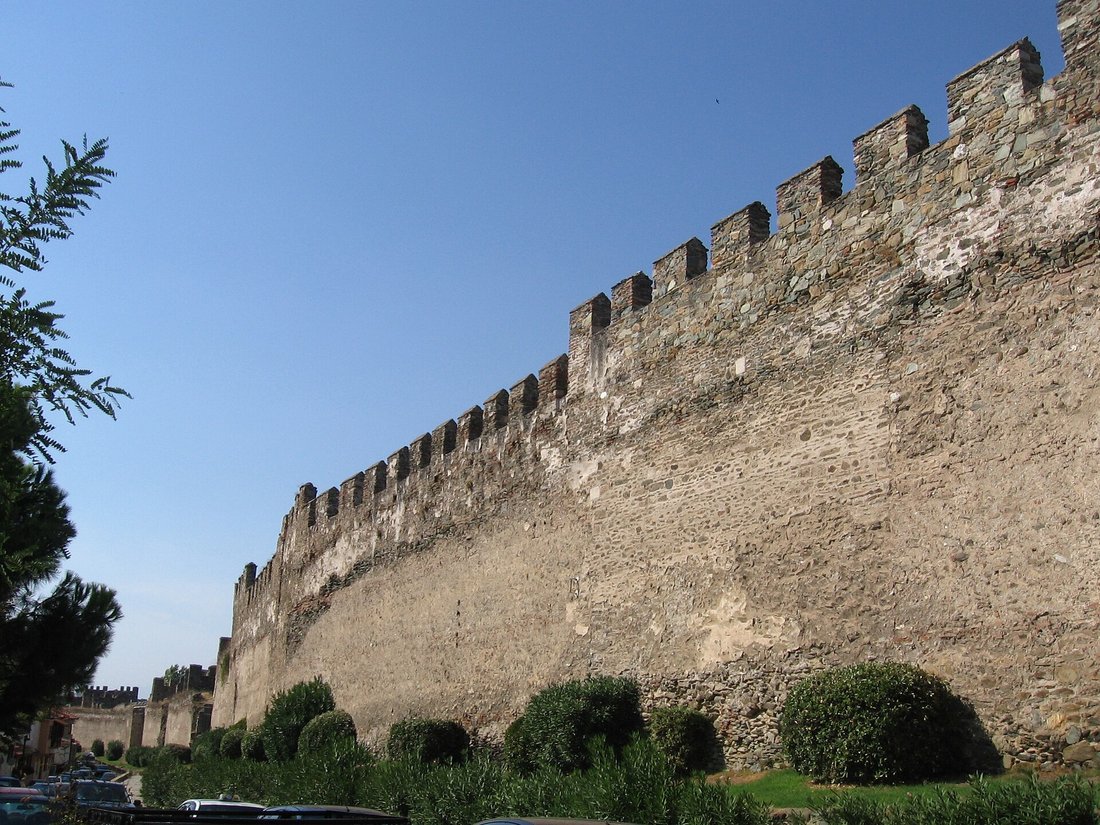
The Rhynchinoi, Greek Ῥυγχῖνοι, appear in the entire surviving record of antiquity and the early Middle Ages at exactly one place: in the account of Perboundos and the subsequent siege of Thessalonica, preserved in the second book of the Miracula Sancti Demetrii, the collection of miracles of Saint Demetrius. No inscription names them. No charter, no lead seal, no ecclesiastical list. They have no secure etymology and no securely identified territory.
This is not a gap that diligence could close. It is the source situation itself. Anyone writing about the Rhynchinoi is in truth writing about a single narrative – and about the question of how much such a narrative can be asked to carry. That is precisely why the case repays attention: it shows in pure form how early medieval Balkan history is made. Not out of excavated evidence, but out of a text that wanted to do something entirely different from writing history.
The Miracula S. Demetrii fall into two very different books. The first was composed by Archbishop John of Thessalonica in the early seventh century as a series of homilies, intended to show the townspeople that their patron saint was present and intervening. The second book is by an unknown author and was compiled in the 680s or 690s, shortly after the events it describes. It is soberer, more precise, better informed about local geography – and it is still not a work of history. It is a collection of miracles.
That shapes every sentence one extracts from it. The author narrates in order to magnify the saint. Where the defence succeeds, Demetrius intervenes; where it fails, the sins of the city are to blame. Military, political and economic matters reach us incidentally, because they provide the frame for the miracle. Remarkably, this author is harsh towards his own city: he accuses the wealthy of selling the grain stockpiled on imperial orders to foreign ships one day before the blockade began, thereby making the famine a self-inflicted disaster. He was no flatterer of the local elite. But he was no neutral chronicler either.
The standard reference is the critical edition by Paul Lemerle, Les plus anciens recueils des miracles de saint Démétrius (vol. I, text, 1979; vol. II, commentary, 1981), cited by book, miracle and paragraph. The Perboundos affair and the siege form the fourth miracle of the second book, that is II,4, with continuous paragraph numbering (Curta, for instance, refers to II,4,254 and II,4,268). Older scholarship numbers differently; anyone quoting a reference should name the edition it follows.
More important is an absence: the text gives not a single year. It dates the great assault to 25 July "of the fifth indiction" – that is, to a year within the fifteen-year fiscal cycle whose absolute position the reader was expected to know. Every date in modern handbooks is a reconstruction. Earlier scholars placed the events in 634, in 647/648, in 692, or in 685–687. Lemerle's solution prevailed: arrest and execution of Perboundos around 676, blockade from the summer of 676, main assault in July 677, imperial campaign and the end of the siege in 678 – because only this "fifth indiction" fits everything else in the narrative, above all an emperor simultaneously entangled in a grave war with the Arabs. Andreas Stratos placed the Perboundos affair somewhat earlier (around 672–675) but otherwise follows Lemerle. Whoever reads "676–678" is reading a scholarly result, not a statement of the source.
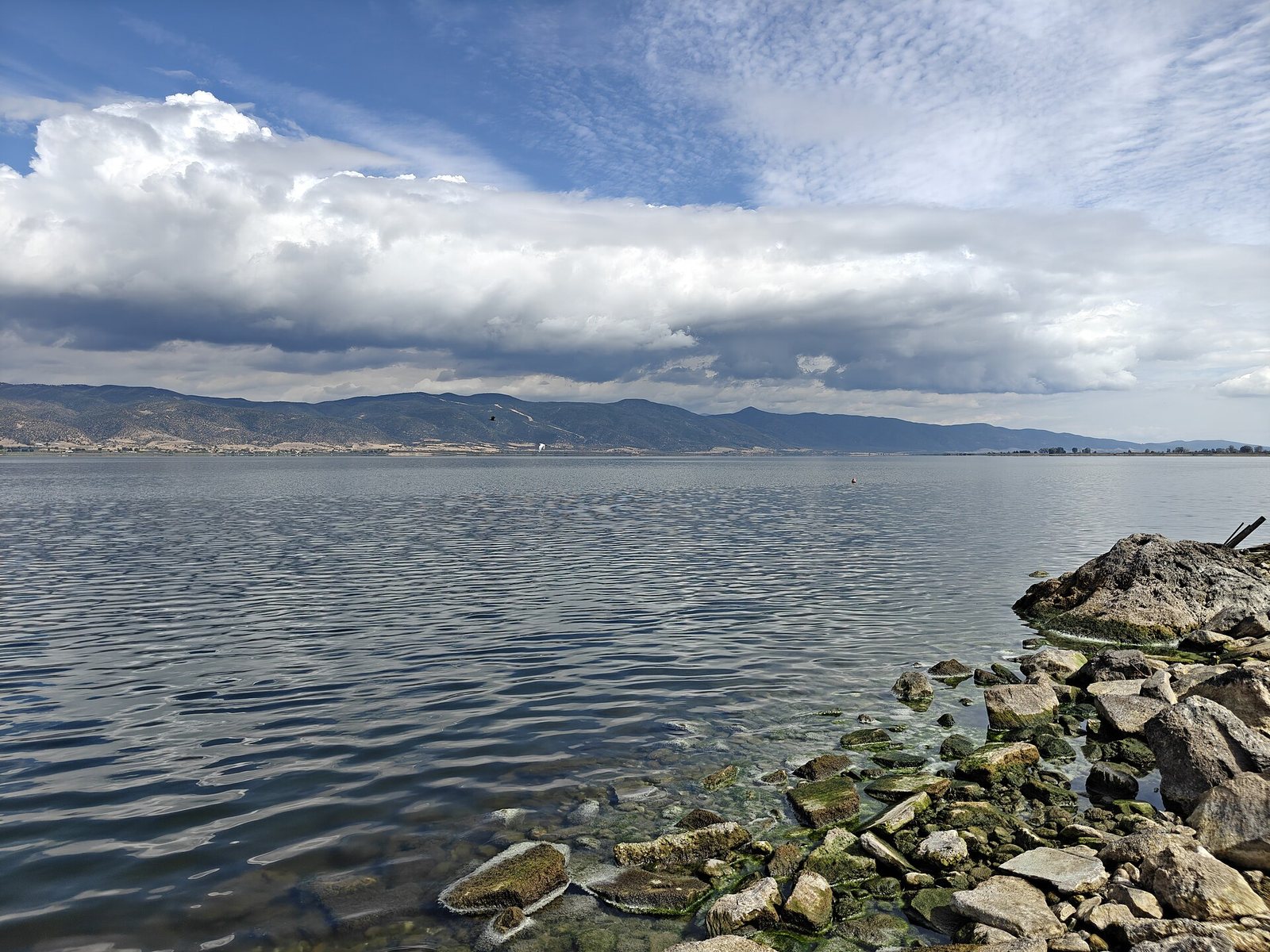
The usual localisation places them on the river that drains Lake Bolbe (Volvi), east of Thessalonica, towards the Strymonic Gulf: the valley of the modern Richios near Rentina. There lies a natural defile, a klisoura, through which all land traffic between Thessalonica and the east had to pass; the fortress of Rentina, excavated since 1976 under Nikolaos Moutsopoulos, guards exactly that point. Whoever holds the pass controls one of the most important roads in Europe.
That is a highly plausible location – but it is a reconstruction. The Miracula never say where the Rhynchinoi lived. The author takes it for granted, because he and his audience knew. Lemerle himself notes that the river from which the name apparently derives cannot be securely located, and that the identification with the outflow of Lake Volvi remains a scholarly suggestion. Assigning the excavated material from Rentina to "the Rhynchinoi" is likewise a link between text and soil that the soil itself does not supply.
The name Ῥυγχῖνοι is, on the usual reading, derived from a river called Rhynchinos – not the other way round. That matters for the language question: a river name transmitted only in Greek tells us nothing about the language spoken by the people named after it. There is no accepted Slavic etymology of the group name. The phonetic proximity to Greek ῥύγχος, "snout, beak", is noticeable but proves nothing; resemblance of sound is the weakest argument in onomastics.
The personal name is another matter. Περβοῦνδος is generally taken to be Slavic. The Bulgarian linguist Ivan Duridanov derives it from a Proto-Slavic *Per-bǫdъ (South Slavic *Prěbǫdъ) and finds the same formation in place names built as patronymics – "the people of a Prěbǫdъ". Which root lies behind the element -bǫd- is open: the future stem of "to be", or a root meaning "to be awake, to watch". What is certain is only this: the man bears a Slavic name, his people a name taken from the landscape. The tension of the whole story is already contained in that.
What the text says about Perboundos is brief and unusual. He is the leader of the Rhynchinoi. He speaks fluent Greek. He wears Roman, that is Byzantine, dress. He stays regularly in Thessalonica and evidently maintains a residence there. He is personally known to the city's administration, and when he is arrested it happens not in his own territory but in the middle of the city, during one of his visits.
This is not the image of an alien warlord lurking beyond the walls. It is the image of a neighbour who belongs without belonging. The author of Book II repeatedly calls the Slavic groups around the city simply his "neighbours"; he knows their names, their locations, and how far one must walk to reach their villages. Perboundos is the apex of that coexistence: a man who crossed the boundary several times a year without ever transgressing it.
The Miracula call him ὁ τῶν Ῥυγχίνων ῥήξ – "the rex of the Rhynchinoi". The word ῥήξ is the Greek form of Latin rex. That is striking, because for leaders of Slavic groups within the Byzantine sphere the usual term is ἄρχων; under that title they later appear on lead seals as well, for example an archon of the Belegezitai named Tichomiros in the eighth or early ninth century.
One should not build a constitutional theory on it. Whether the author used ῥήξ to mark a special standing, whether he picked up a word current in everyday speech, or whether he was simply varying his vocabulary, the text does not say. But the choice fits everything else we learn about Perboundos: he is a figure for whom the Byzantine vocabulary of order had no ready-made slot.
It begins with a report. The senior imperial official of Thessalonica – rendered in the literature sometimes as eparch, sometimes as archon – learns that Perboundos is planning something against the city. He reports this to the emperor. The emperor is Constantine IV (reigned 668–685), and he orders the arrest. The official first informs the leading men of the city, then has Perboundos seized during one of his stays, put in irons and sent to Constantinople.
Two things stand out. First: there is no battle, no border violation, no raid behind it. The trigger is a suspicion. Second: the seizure works because the man is inside the city. Byzantine authority over a Slavic prince evidently reached exactly as far as that prince was willing to put himself within reach – and Perboundos was willing, regularly.
What follows is, in Lemerle's judgement, the most astonishing element of the whole account. The Rhynchinoi and the Strymonitai, their neighbours on the Strymon, are deeply upset by the arrest – and instead of taking up arms, they send an embassy. More than that: Thessalonians travel with them. A joint delegation of townspeople and selected Slavic envoys goes to Constantinople and asks the emperor for clemency.
For clemency – not for acquittal. Lemerle drew attention to the distinction: the phrasing of the source presupposes that Perboundos was guilty of something. The petitioners do not contest the charge; they ask for mercy. The emperor, in the middle of preparations against the Arabs, promises release once the war is over. The envoys are satisfied and go home. The agitation subsides. It could have ended there.
In Constantinople Perboundos finds a helper: an imperial interpreter responsible for affairs concerning the Slavic groups. That such a post existed is one of the most revealing subordinate clauses in the entire text – the empire maintained specialists for dealing with its Slavic neighbours. This man urges Perboundos to escape and offers him a hiding place on his estate in Thrace.
The escape itself is unspectacular. Perboundos simply walks out through the Blachernae Gate. Nobody stops him. The emperor orders a manhunt and sends a fast warship to Thessalonica to warn the city and instruct it to stockpile food. The search lasts forty days. Perboundos is finally taken in a reed bed near the city of the Bizyenoi – Bizye, modern Vize in eastern Thrace. He is betrayed not by himself but by the interpreter's wife, who was observed bringing him food. The interpreter and his family are executed.
Why could a Slavic prince walk out of the capital of the empire in broad daylight without attracting attention? The source answers the question itself, and the answer is the key to the whole affair.
… φορῶν ῥωμαῖον σχῆμα καὶ λαλῶν τῇ ἡμετέρᾳ διαλέκτῳ …
"… since he wore Roman dress and spoke our language …"Miracula S. Demetrii II,4 (Greek wording of the second book); free translation: Glanz und Gravur
The author writes this without any astonishment, as the explanation of a practical matter. That is exactly where its value lies. It does not prove that Perboundos was a loyal subject, nor that he was a Byzantine in disguise. It proves that a man in this world could be both: leader of a Slavic group outside the gates of Thessalonica and, once he changed his clothes, an unremarkable man in Constantinople. The line between "us" and "them" ran through minds, not through streets. Crossing it required dress and language – Perboundos had both.
After his recapture Perboundos is again held in Constantinople, interrogated, and attempts a further escape. Thereafter, according to the source, he openly declares that he intends to raise all the Slavic groups in revolt and to take Thessalonica. He is then executed.
How reliable that confession is, nobody can check. It stands in a text that has to explain the rising that followed and that needs the executed man for the purpose. It comes from the interrogation of a prisoner who had escaped twice. And it is at the same time the only motive we possess. The honest formulation runs: the Miracula claim that Perboundos wanted the war; whether he wanted it we do not know. What we know is that his execution started it.
When the news reached the districts around Thessalonica, the Rhynchinoi rose, and with them the Strymonitai and the Sagoudatai. How much time lay between execution and revolt the text does not say; Stratos reckons with several months. The three groups divided the hinterland into sectors – on Lemerle's reading the Strymonitai to the east and north, the Rhynchinoi to the south, the Sagoudatai to the west – while attacks by sea were made jointly. Three or four raids a day, for two years: no livestock outside the walls, no sowing, no shipping.
Not everyone joined. The Belegezitai, who by then lived further south in Thessaly, not only stayed away but sold grain to the starving city. The Drougoubitai were called in only later, because they understood the building of siege engines; how far their participation extended is disputed. The great assault of 25 to 27 July failed. The real war was the blockade rather than the attack, and the famine inside the city belongs to the harshest passages in Byzantine literature. The details of that siege are set out in our articles on the Sagoudatai and the Strymonitai; here the concern is with its cause.
Once the Arab war was over, the emperor sent an army through Thrace. From that point the source names only the Strymonitai: they were defeated, their settlements near the city abandoned, and the starving Thessalonians plundered the deserted villages. A grain fleet arrived under strong escort. Afterwards the Slavs asked for negotiations. Their outcome is not reported.
The Rhynchinoi do not appear in this final section. They do not appear anywhere again. No later Byzantine office bears their name, no bishopric, no theme, no "sklavinia of the Rhynchinoi". There is no lead seal of an archon of the Rhynchinoi, although such seals are known for other groups. And there is no place name east of Thessalonica that continues their name. Anyone wishing to explain their disappearance has three options – dispersal, absorption into the neighbourhood, or simply this: the name was never more than a label for the people on a particular river. The text permits no decision.
The campaign of Justinian II in 688/689, which reached Thessalonica and involved the resettlement of large numbers of Slavs into the Opsikion in Asia Minor, is sometimes linked to these events. That is chronological context, not evidence: Theophanes does not name the Rhynchinoi, and there is no connection to them in the disaster of Sebastopolis in 692/693, when a special corps raised from Slavs defected.
Anyone hoping that archaeology might supply what the text withholds will be disappointed. In a much-cited article of 2012 Florin Curta asked whether there were any Slavs in seventh-century Macedonia at all, and answered no: the finds show no wave of immigration but communities continuing late antique burial customs, closely tied to the empire and probably Christian, with parallels pointing to Albania and southern Italy rather than to the Lower Danube.
This position is influential, but it is not uncontested. Macedonian, Bulgarian and Greek scholarship has objected – partly by pointing to written sources that explicitly attest a Slavic presence, partly to the layer of place names mapped for Greece by Max Vasmer, which is hard to reconcile with a pure continuity thesis. It remains fair to say that ethnic attribution of material culture is methodologically fraught; a pottery shape is not a people. And it is equally fair to say that silence in the ground is no proof that nobody was there. For the Rhynchinoi it simply means that there is no archaeological find that carries their name.
Scholarship often says that the Rhynchinoi formed a "sklavinia" outside Thessalonica. That is modern technical language, not the language of the source. Book II of the Miracula speaks of Σκλαβῖνοι or Σκλαβηνοί as a collective term and of ἔθνη, "peoples"; the word sklavinia does not occur in it. The only possible instance stands in Book I and is a manuscript reading which Lemerle emended to Σκλαβηνῶν – a point on which Evangelos Chrysos and Florin Curta disagree.
The term is in any case an external label. Curta has shown that it first surfaces in Theophylact Simocatta, where it is purely geographical, and that only in the early ninth century does it acquire the political sense often read back into it: a territory recently conquered and incorporated into the empire. Nobody ever called their own land a sklavinia. Anyone using the word for the seventh century should know that they are laying a later administrative category backwards over an older situation – the same problem arises with the Serbs, the Croats and the Carantanians.
Which brings us back to the opening question. How far did Byzantine authority over Perboundos actually reach? The narrative allows four readings, and none of them works without remainder.
If he was a subject, there would have been no need to negotiate for him by embassy; he would simply have been sentenced. If he was an ally, his arrest on mere suspicion would have been a breach of agreement, of which the text says nothing. If he was a hostage, he was a remarkably mobile one – he came into the city voluntarily and left again. If he was a client prince, every trace of the apparatus that makes such a status visible is missing: no title, no stipend, no seal, no charter. The evidence fits best a relationship that nobody had defined, because it worked as long as it worked.
That is what makes the case exemplary. On this frontier the empire disposed not of administration but of habit: of trade, of shared acquaintances, of an interpreter in the palace, of men who commanded two languages and two codes of dress. Such an order is durable and at the same time extremely brittle. One suspicion, one arrest, one execution – and two years later the second city of the empire was starving behind its own walls. The Thessalonians who had travelled to Constantinople together with the Slavs to plead for Perboundos had evidently seen it coming.
Of the Rhynchinoi there remain a handful of sentences in a collection of miracles, one Slavic personal name, an unlocatable river and a death sentence with long consequences. That is little. But it is more honest than any map that draws their "settlement area" with a firm line, and more durable than any reconstruction that turns a name into a people with a history, borders and descendants.
Readers interested in the other Slavic groups of this region will find them among the Ezeritai and Milingoi in the Peloponnese and among the Slavic groups of what became Bulgaria; the wider arc northwards runs by way of the Obodrites, Liutizi, Rani and Pomeranians to the Baltic. And anyone who wants to see how the same frontier between empire and outsiders looked two centuries later, when it worked instead of breaking, should look at Miklagard and the Varangians. There the foreigners served inside the palace rather than standing outside it.

The Sagudates · The Strymonites · The Drougoubitai · Melingoi and Ezeritai · The Slavs of Bulgaria · The Serbs · The Carantanians.
All History & Finds articles →
Long before there were Vikings in the sense of the sagas, there was already a town in south-west Jutland: Ribe, founded …
Read more →A sword folded double like a soft ribbon. A blade twisted like a corkscrew. A piece of iron that someone deliberately …
Read more →