Of the Slavic groups that become visible around the Aegean in the seventh century, we usually know little more than names in a list. The Belegezites of Thessaly are different: we have a lead seal naming one of their leaders, we have a grain delivery to a besieged city, and we have an archon who intervened in the struggle for the imperial throne in 799. Three fragments, no more. But together they produce an unusually concrete picture.
The Belegezites (Greek Βελεγεζίται, also rendered Velegezites) belong to those groups a modern reader happily calls a "tribe" and which in truth exist only as a name in a handful of Byzantine sentences. Two passages carry almost everything: the catalogue of names in Book II of the Miracula Sancti Demetrii and a grain episode in the same book. To this we may add a lead seal and – depending on how one reads it – an entry in Theophanes under the year 799. Anything beyond that is reconstruction.
Book II of the Miracles of Saint Demetrius was written by an unknown author in the last two decades of the seventh century; that is Paul Lemerle's authoritative dating. It is edifying literature written from inside a besieged city, not a set of minutes. That does not make it worthless; it means that every number and every intention it ascribes to the neighbours must be read as a statement made by the city.
In the first miracle of Book II (Miracula II 1, page 175 in Lemerle's edition) the Sclavene people is said to have gathered in great numbers: Drugubites, Sagudates, Belegezites, Baiunetes, Berzetes "and others". They built dugout boats, plundered Thessaly, the Cyclades, all of Achaia, much of Illyricum and part of Asia, and finally attacked Thessalonica – bringing their families, because they intended to settle in the city.
Readers of this series already know that list from other angles: it is the starting point of our articles on the Sagudates, the Drugubites and the Berzetes. Here the Belegezites stand on the attackers' side. Some sixty years later they stand on the other side of a transaction.
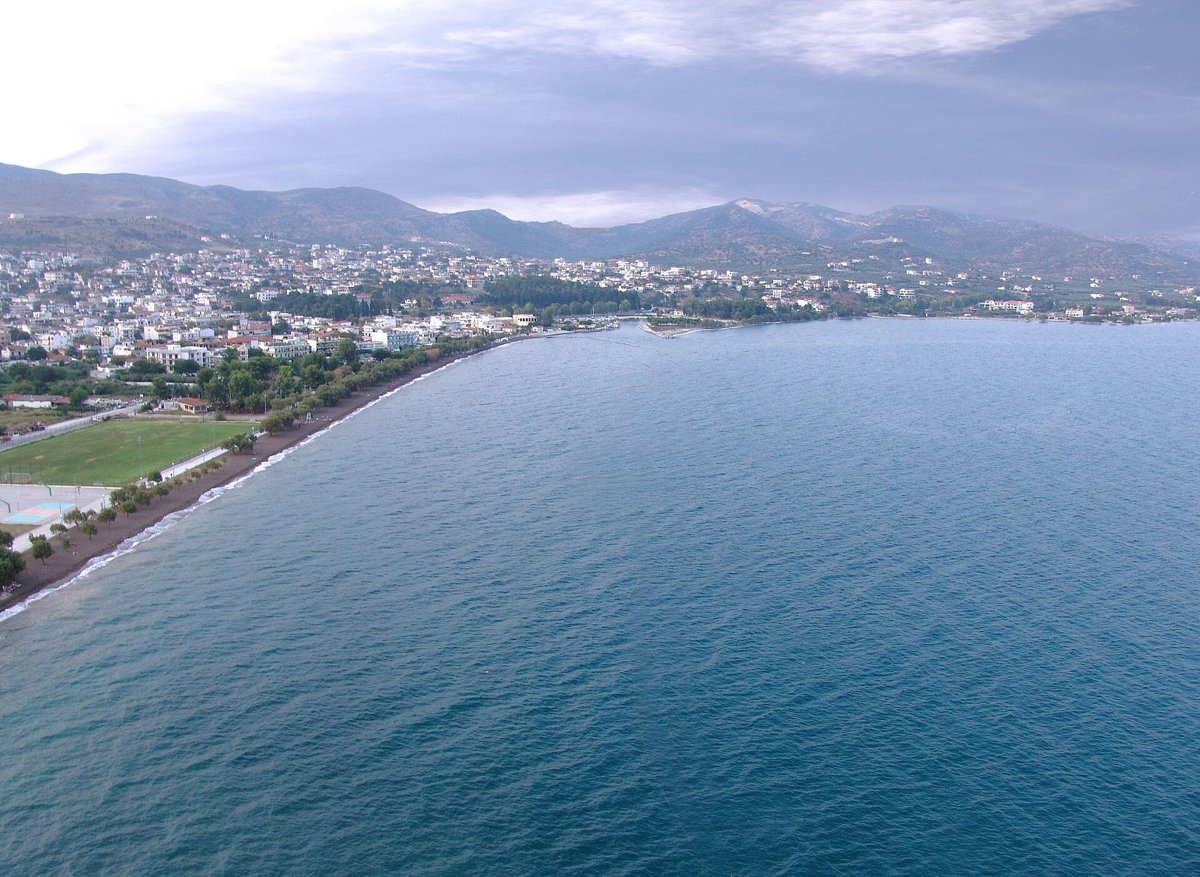
The second Miracula passage locates them as precisely as Byzantine texts ever do: in the region of Thebes and Demetrias. The Thebes meant is Phthiotic Thebes (Nea Anchialos), not the Boeotian city, and Demetrias lay at the head of the Pagasetic Gulf close to modern Volos. That places the Belegezites in eastern Thessaly, on a gulf with harbours – and that is the key to everything else.
Demetrias itself was by then hardly the Hellenistic metropolis any more. Ancient urban life there may already have ended at the beginning of the sixth century; the Oxford Dictionary of Byzantium records that its territory was settled by the Belegezites in the seventh and eighth centuries. What that settlement looked like, no source says.
The siege of Thessalonica of 676 to 678 – triggered by the execution of the Rhynchine chieftain Perboundos – is narrated in the fourth miracle of Book II. In the middle of that siege, the text says, the city's leaders decided to send their remaining seaworthy craft, dugouts and ten ships, together with prepared funds, to the Belegezites near Thebes and Demetrias in order to buy grain for the city. The passage stands on pages 214 and 218 of Lemerle's edition.
The text expressly justifies the choice by noting that the Belegezites were at that time at peace with Thessalonica. They were not among the besiegers: the attackers were Rhynchines and Sagudates, the Strymonites turned back three miles short of the walls, and the Drugubites were fetched later for their siege engines. The Belegezites sold.
It would be convenient to turn this into a picture of peaceful neighbours. The text itself does not. It reports that the Thessalonians feared the Belegezites would kill the envoys once they learned of the assault on the city – and it claims the Belegezites intended precisely that and were prevented only by the martyr's intervention. After some days the men returned with grain and vegetables.
What becomes visible here is therefore not an alliance but a commercial relationship under reservation: a large city buys food from neighbours it regards as barbarians, because the sea is safer for it than its own hinterland. And those neighbours command surpluses, harbours and the ability to negotiate. For economic history that is worth more than any battle description.
Some 120 years later a man named Akamiros appears in the Chronographia of Theophanes under the world year 6291, that is 799. Theophanes names him not as a neighbour but as a political actor inside the empire.
Ἀκάμηρος, ὁ τῶν Σκλαυινῶν τῆς Βελζητίας ἄρχων
"Akamiros, the archon of the Sclavenes of Belzetia."Theophanes Confessor, Chronographia, under the year AM 6291 (AD 799), ed. C. de Boor. Only this description of Akamiros is quoted verbatim; the translation is our own, and the remainder of the account is paraphrased below. The English translation by Mango and Scott is under copyright and has deliberately been avoided.
The report runs, in substance, as follows: at the instigation of the Helladikoi – the troops of the theme of Hellas – Akamiros planned in March 799 to free the sons of Emperor Constantine V, who were interned at Athens, and to proclaim one of them emperor. Empress Irene learned of it, sent a trusted man to Athens, had the brothers blinded and moved to the Sea of Marmara. Nothing further is heard of Akamiros.
The sons of Constantine V – the former Caesars Nikephoros and Christopher together with Niketas, Anthimos and Eudokimos – had for decades been the living alternative throne of the iconoclast party. In 792 Constantine VI had Nikephoros blinded and the tongues of the others slit. After Irene deposed her son in 797, the brothers were shipped to Athens. The plot of 799 was the penultimate attempt to use them; a last one followed in 812.
What matters for our subject is not the fate of the brothers but the constellation: a Slavic archon and regular imperial thematic troops acting together. By around 800 the Slavic communities of Greece are no longer an outside world but a factor in imperial politics. A parallel case is offered by the groups of the Peloponnese, treated in our article on the Melingoi and Ezeritai.
Theophanes does not write "Belegezites" but "Belzetia". That is the core of a dispute still open today. The majority position in recent scholarship reads Belzetia as a contracted Bel(ege)zitia, a regional name derived from the Belegezites – so Werner Seibt in his studies of the Slavic archons, so Florin Curta, so Stoyko Stoykov in his study of Sclavinia and Sclavoarchontia. Geography supports it: Athens and Thessaly lay in the same theme of Hellas.
Against it stands a weighty reference work. The Tabula Imperii Byzantini (Koder and Hild, volume 1, "Hellas und Thessalia", 1976, p. 133) regards the equation with the Belegezites as probably mistaken and derives Belzetia from the Berzetes. Anyone reading that Akamiros was "archon of the Belegezites" is therefore reading a well-founded but contested interpretation.
A genuine controversy must be distinguished from a plain mistake. In Die Slaven in Griechenland (1941, pp. 85 and 177) Max Vasmer conflated Berzetes and Bel(ege)zetes. Gennadii Litavrin took over the conflation and made Akamiros a ruler of Berzitia – and inferred from it that Berzitia had been a Sclavinia. Curta rejects both explicitly: the error goes back to Vasmer, and Berzitia is called a Sclavinia in no Byzantine source at all.
This is where our own article on the Berzetes connects. It named the Vasmer-Litavrin error – and it should be sharpened here: that Akamiros is not to be assigned to the Berzetes counts as settled; that he certainly belongs to the Belegezites counts as likely, but not as decided.
The sigillographic evidence is surprisingly good. Werner Seibt published a lead seal of the eighth or early ninth century naming an archon of the Belegezites called Tichomiros (Studies in Byzantine Sigillography 6, 1999, p. 28). That establishes for this group an office recognised by the emperor: whoever seals documents corresponds with an administration.
That the two known holders of the office – Tichomiros and, if one follows the majority reading, Akamiros – bear non-Christian names is itself a finding: integration into the empire ran through titles and seals, not through baptismal names. Caution is still in order with the phrase "Tichomiros was a prince of the Belegezites". The Miracula name not a single leader of this group; all we have is an office title on lead.
The terms scholarship uses to order such arrangements are younger than the arrangements themselves. Stoykov distinguishes Sclavoarchontias – Slavic communities inside a theme whose archon is appointed by the strategos, which pay tribute and supply auxiliaries – from Sclavinias, client formations outside the thematic system with their own leaders confirmed by the emperor. Both terms become frequent only from the late eighth century, roughly when Slavic seals multiply.
The case of Akamiros shows why the distinction is more than quibbling: an archon who sets out to proclaim an emperor commands his own armed following and stands close enough to the imperial administration to conspire with thematic troops. Half inside, half outside – that is the whole situation in a sentence.
A common short circuit holds that the Miracles of Saint Demetrius describe "Sclavinias". They do not. The text works with ἔθνη, "peoples" or "nations"; the Belegezites, Sagudates, Drugubites, Strymonites, Rhynchines and Berzetes are each an ἔθνος in their own right. For their dwelling areas the text normally uses τόπος, "place" – not "land".
Stoykov has pointed out what follows from this: two generations after the newcomers arrived, the Thessalonians still did not orient themselves by the groups' names but the other way round – they described the groups by familiar geographical markers. "The region of Thebes and Demetrias, belonging to the people of the Belegezites" is exactly such a formulation.
There is no generally accepted Slavic etymology of the name. What exists is a toponymic trail: Koder and Hild link the settlement area with the district of Velechatouia (Latin Velechativa), which appears as an imperial fiscal district in the Venetian trade privilege of 1198 and in the Partitio Romaniae of 1204; to this may be added the late medieval forms "land of the Levachatai" and the village of Levache from the cadasters of the Lykousada monastery.
The connection is not uncontested. Alkmini Stavridou-Zafraka rejects it and associates Velechativa with "Little Vlachia" in Aetolia. Anyone who wants to explain the name of the Belegezites is moving among conjectures – and ought to say so.
No burial or settlement evidence in Thessaly can be assigned to the Belegezites. The best-known find of the region is the Velestino hoard, which came to light in the 1920s not far from the Pagasetic Gulf: no gold and no silver, but bronze and lead plaques with human, animal and geometric representations.
For decades it was treated as pictorial evidence for pagan Slavic mythology – so Joachim Werner in his study of the "Slavic bronze figures from northern Greece" (1953). Florin Curta and Bartlomiej Szmoniewski contested this in 2019: they date the assemblage to the late seventh or early eighth century and read it as Middle Byzantine fine metalwork rather than images of gods. The discussion remains open; all that is certain is that the hoard identifies no ethnic group.
Curta has pushed his scepticism further still: after reviewing the evidence for Macedonia he concludes that no Slavic settlement of the seventh century can be demonstrated archaeologically. One need not follow him in this; one should not pretend the evidence is obvious either.
The end is not an event but an administrative story. The theme of Hellas had been created as early as 687/695 and covered central Greece and Thessaly. Around 800 it was divided and the Peloponnese became a theme of its own; in 805 the strategos Skleros defeated the Slavs there and an attack on Patras failed. Nikephoros I then pursued systematic settlement and Christianisation.
In Thessaly the process can be read off the episcopal lists: between 787 and 800 seventeen bishoprics appear there, seven of which disappear permanently at the beginning of the ninth century, while five bishops of newly created sees attend the council of 869. Akamiros falls precisely into this period of upheaval. After it the name of the Belegezites appears in no source at all: no bishopric, no archontia, no mention in Kaminiates, who in 904 names Drugubites and Sagudates as taxpayers in the hinterland of Thessalonica.
What remains is linguistic material. Max Vasmer's collection of Slavic place names in Greece documents a considerable number of them for Thessaly. That is a linguistic finding and attests contact and settlement – but it is not a history of peoples, and still less a statement about present-day nations.
Three things: a grain deal, a seal and a failed coup. Taken together they add up to something one would not expect from a nameless marginal group – a counterpart with which Byzantium reckoned, traded and negotiated. Anyone who remembers the South Slavic groups of these centuries only as raiders remembers half the story. We treat further cases of this kind in our articles on the Slavs of Bulgaria, the Serbs, the Croats and the Carantanians.
The Berzites · The Drougoubitai · The Sagudates · The Strymonites · The Rhynchinoi · Melingoi and Ezeritai · The Slavs of Bulgaria · The Serbs.
All History & Finds articles →
A single sentence survives about the Berzites: a name in a list of Slavic groups that pressed upon Thessalonica in the …
Read more →Between the world of humans and the world of the gods a bridge of light is stretched: Bifröst, the rainbow. It is the …
Read more →There is a list in Caesar, eleven names long, set down in 56 BC like an administrative memo. Most of these peoples then …
Read more →