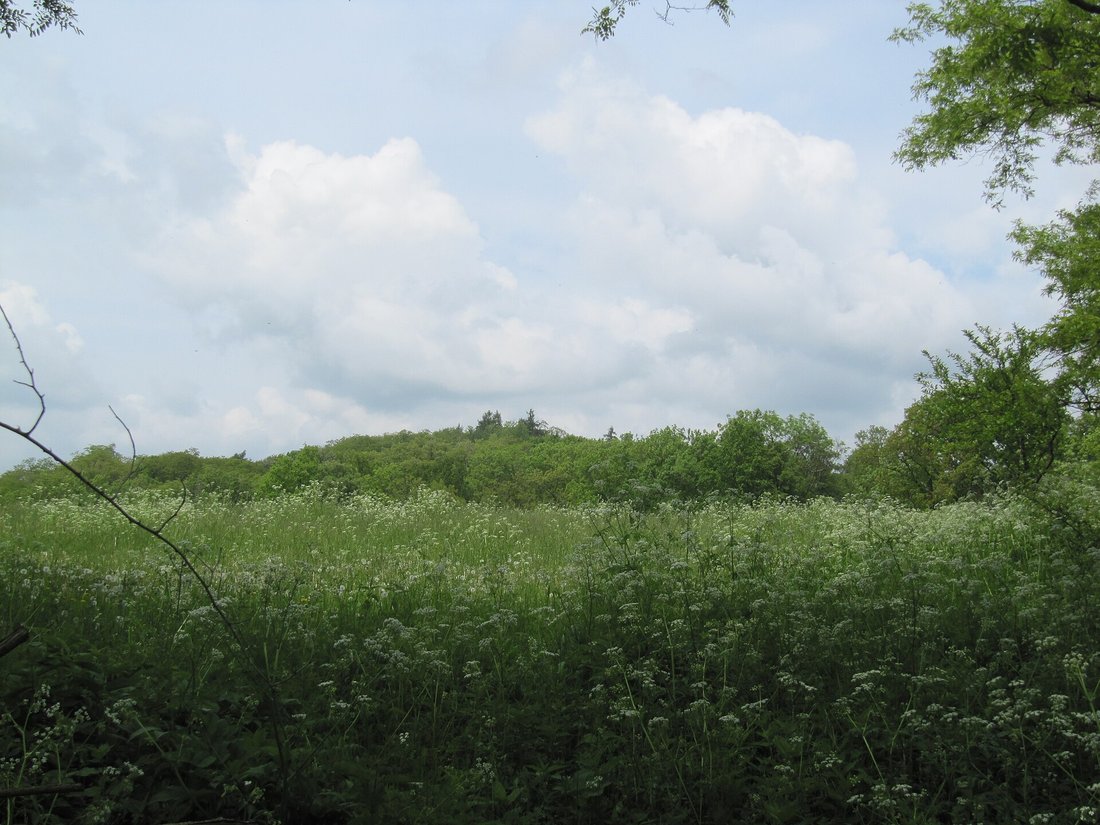
East of the Vltava, in the fertile Elbe lowlands, a group lived before the Přemyslids whose name only a few sources preserve: the Zlicans. Their stronghold at Kouřim has been excavated, their alleged prince Radslav is a figure of legend, and the most famous chapter of their supposed history, the fall of the Slavnikids at Libice in 995, can be tied to them only with reservations.
Anyone looking for the Zlicans (Czech Zličané) quickly runs into a problem: the name is thinly attested. Older scholarship of the 19th and early 20th centuries saw them as a separate West Slavic tribe in Bohemia before Přemyslid rule. They were said to live beside the Czechs proper, separated from them by a river, with the hillfort of Kouřim as their centre. The Chronicle of Dalimil, a Czech-language rhymed chronicle of the 14th century, knows a "Zlician" prince named Radslav who sat at Kouřim. Beyond this mention, written down nearly four hundred years after the events, the narrative sources offer little.
That is no accident. Early Bohemia in the 9th and 10th centuries can be grasped almost only through outside views, such as Frankish annals, and through historiography that arose later. The Prague chronicler Cosmas (c. 1045 to 1125) completed the first book of his Chronica Boemorum in 1119. It runs from primeval times to 1038 and presents history consistently from the viewpoint of the Prague ruling house. Anything concerning rival power zones therefore appears already through the eyes of the victors. Recent research handles the word "tribe" more cautiously. Such groups are now more often understood as small principalities, regional power bases with their own stronghold and retinue, rather than ethnically closed peoples with a shared descent story.
For this article that means: where "Zlicans" appears, it is chiefly a scholarly term. It refers to the people around Kouřim and in the middle Elbe valley, not to a people whose self-designation we know. More on the other Bohemian groups can be found in the article on the Czechs.
The location can only be given roughly. According to the traditional reconstruction, the Zlicans occupied the fertile lands of the middle Elbe valley east of Prague. Their main centre was Kouřim, about 40 kilometres east of the modern Czech capital. The Czech archaeologist Zdeněk Váňa, in his survey "The World of the Ancient Slavs" (1983), described Kouřim as the centre of the "second important rivals" of the Czech tribe. Where the borders ran exactly remains open. A richly furnished princely grave from the area of Kolín, with jewellery of Great Moravian type and Carolingian imports (a chalice, spurs, stirrup mounts, glass vessels), shows at least that an elite with far-reaching contacts lived here early on. Whether it saw itself as "Zlican" is not something the find can tell us.
One connection is certain: the Elbe was among the great arteries of the early Middle Ages. Upstream it led to the Bohemians in the Prague basin, downstream into the lands of the Hevelli and Sorbs and from there to Saxony. Whoever held a stronghold in the Elbe country controlled more than farmland. He sat on a trade route.
The best-known figure of the Zlician tradition is Radslav. According to Dalimil, the prince of Kouřim waged war against Saint Wenceslas (Václav), the Přemyslid duke who was murdered in 935. The date of his death fluctuates in scholarship, with 929 and 935 both named; 28 September 935 is the traditional answer. The tale leads to a duel: Wenceslas offers it, Radslav sees heavenly beings at his opponent's side and holds back. He withdraws his army to Kouřim. This is a saint's legend, not a battle report. It serves to show Wenceslas's holiness and to present the Přemyslids as the morally superior power.
Whether a real prince stands behind Radslav is unresolved. English-language scholarship calls him semi-legendary. There is a conjecture that he was a brother of the "mythical father" of Slavník, founder of the later famous Libice dynasty. That is a hypothesis without support in the early sources. Popular historical writing also circulates the claim that Duke Boleslav I destroyed Kouřim around 936 when he removed his brother Wenceslas. That link, too, belongs to tradition, not to secure knowledge.
While the written sources fall silent, archaeology speaks. The hillfort "Stará Kouřim", Old Kouřim, was investigated in the 1950s by Miloš Šolle. The fortification consisted of massive timber-and-earth ramparts, in reconstruction comparable to ancient fortresses. Váňa speaks of a triple line of defences with gates and of a shrine with a small lake. He also mentions a hall 89 metres long, which he interprets as the assembly room of a princely palace. How much of this interpretation is still held today cannot be judged here, and the word "palace" is in any case an interpretation, not a finding.
Notable are finds that look like the aftermath of a fight: outside the ditch lay the remains of unburied dead, probably defenders who fell in an attack. Animal bones point to ritual offerings. The settlement is described as very populous. After 995, when its rival Libice fell, Kouřim came under Přemyslid control, and the settlement was later refounded at another spot, with a market square and a church. The dates for how long the hillfort lasted vary in the literature and are therefore not fixed here.
About 35 kilometres north-east of Kouřim lies Libice nad Cidlinou, at the confluence of the Cidlina and the Elbe. Here sat the family of the Slavnikids (Czech Slavníkovci, a term coined by the historian František Palacký in the 19th century; the medieval sources know individuals, not a dynasty of that name). The stronghold has two parts joined by a narrow isthmus. The acropolis in the west bears visible earthen ramparts; the outer bailey, the suburbium, forms the village core today. Slavic settlement begins in the 9th century, and from the middle of the 10th century the site reaches its peak. In the eastern part of the acropolis, remains of a palace and a sacral building were uncovered, along with dwellings and burial grounds. The acropolis has been a national cultural monument since 1989. At the edge of the village, the ground plans of the Ottonian church of the 10th century and of a palace of the 11th century are marked out today.
The place stands out for something else as well: Soběslav, Slavník's heir, had silver coins struck at Libice. In doing so he broke the Přemyslid coinage monopoly in Prague. Numismatists know these silver pennies as the "Libice senars". In the early Middle Ages, the right to mint was not simply economic policy, it was a claim to rule. Soběslav the Slavnikid appears as a ruler in his own right who also moved independently in foreign affairs, with ties to Saxony and Poland. In his time, the literature says, he commanded a power base equal to that of the Přemyslids.
In older literature the Slavnikids count as rulers of the Zlicans. The location of Libice and Kouřim, two centres only a few days' ride apart, seemed to suggest it. The literature notes that Slavník's wife Střezislava was "supposedly" related to the Zlicans. The Czech historian Dušan Třeštík rejected the link firmly: even if this group could be located in north-eastern Bohemia, there was no reason to assume the Slavnikids were its rulers.
The dispute is not settled. A further reading is discussed in popular Czech literature, namely that the Slavnikids were a collateral branch of the Přemyslids. The evidence for it is thin, and archaeology is regarded as ambiguous on the question. What may be considered secure is that the Slavnikids were among the most powerful families of the country and that their sphere of rule reached far beyond Libice: according to the reconstruction as far as Litomyšl and as far east as Kłodzko on the Glatzer Neisse.
Slavník died in 981. His wife Střezislava died in 987. The sources name at least seven sons. One of them, Soběslav, became his heir. Another, Vojtěch, known as Adalbert of Prague, was born around 956 at Libice. He studied for about ten years in Magdeburg under Archbishop Adalbert, whose name he took at confirmation, and in 982 became the second bishop of Prague. The see had been founded in 973 under Boleslav II. The first bishop was the Saxon Thietmar (Dětmar), who should not be confused with the later chronicler Thietmar of Merseburg.
Adalbert's tenure was hard. He turned against the trade in slaves among Christians, against polygamy and against pagan customs. That met resistance from the duke as well as from parts of the clergy. Around 988 he went to Rome, and in 989 his half-brother Radim Gaudentius, an illegitimate son of Slavník, followed him. Both entered a Benedictine monastery on the Aventine. In 992 Adalbert returned, Boleslav having pressed for his reinstatement. In 993 the monastery of Břevnov near Prague was founded. But the conflict remained, and behind it stood the question of power between the duke in Prague and the family at Libice.
On 28 September 995, the feast of Saint Wenceslas and, by the traditional count, exactly sixty years after his murder, an army attacked Libice. Boleslav II led it, supported by the noble family of the Vršovci. Cosmas, writing more than a hundred years later, describes the assault in strong words. The duke, he says, was at that moment not master of himself but in the hands of his retainers (comites). The attackers stormed the stronghold while Slavník's brothers were celebrating Mass and cut them down before the altar. Cosmas names several brothers. Numbers and names are rendered differently in the various accounts and should therefore be adopted with caution. Soběslav and Adalbert survived because they were absent. So did Radim. Why Soběslav was missing is explained in different ways: in one version he was fighting Lusatian tribes, in another he was seeking help from the emperor in Germany.
The stronghold is stormed, the brothers are struck down before the altar: the duke, so the account runs, no longer decided for himself but stood under the sway of his retainers.Paraphrase of Cosmas of Prague, Chronica Boemorum, Book I, account of the year 995 (the exact wording is not quoted here)
It is striking how far the account aims to exculpate the duke. Cosmas writes as a Prague cathedral cleric, and the Přemyslids are his ruling house. It is their fame he wants to raise. That he nevertheless speaks of murder at the altar shows how firmly the event was anchored in the memory of the region. The Vršovci, who are also known to Thietmar of Merseburg, later counted as the third great force in Christian Bohemia. That they bore the brunt of the attack is often claimed but not proven.
The finds in the ground paint a less dramatic picture than the chronicle. More than a century of archaeological work at Libice has produced no continuous burn layer, and the stronghold apparently kept functioning after 995. Libice was attached to Prague's dominion. In the 11th century the site served as an administrative centre, in 1130 a fire destroyed the settlement, later the rampart was dismantled and villagers used the stones. Between 1228 and 1233 the village belonged to St George's Convent in Prague.
Adalbert, the bishop, never returned. He went as a missionary to the Prussians and was killed on 23 April 997 near present-day Elbląg. The date fluctuates in the sources, and the years 994 and 996 are also discussed. His body was ransomed by the Polish duke Bolesław Chrobry, the Brave, and the tomb at Gniezno became the starting point of the Polish archbishopric. Radim Gaudentius became the first archbishop of Gniezno around the year 1000. Soběslav found refuge with Bolesław in Poland, took part in imperial campaigns against pagan Slavs and died in 1004 in the fighting over the Vltava bridge in Prague, when Polish troops withdrew from the castle and an imperial-Bohemian army arrived. Anyone interested in Prague's rivals to the east will find the connection to Bolesław in the article on the Polans.
The biographies of Adalbert are among the most important sources of this period. The author of the first Vita is traditionally held to be the Roman abbot John Canaparius (around 999). The medievalist Johannes Fried, by contrast, regards this as not secure and suspects it was written down in Liège. A second Vita was written between 1001 and 1004 by Bruno of Querfurt. Radim had told the abbot in Rome of his brother's death, and canonisation followed in 999.
One can regard the Zlicans as a lost quantity. One can also take them as an example of how medieval Bohemia came about: not in one piece, but through the subjugation of neighbours, through alliances, through violence and through the power of narrative. The Přemyslids, who in the end eliminated all rivals, also determined how their opponents were remembered. That we know more today about Kouřim and Libice than the chroniclers wished to tell us is due to archaeologists who read ramparts, halls and ground plans in the soil.
What remains are places. The hillfort of Libice, the remains of Stará Kouřim, the ground plans in the village. And a neighbourhood that extends further across the region: the ties to Moravia, to the Great Moravian legacy in the jewellery of the princely graves, are covered in the article on the Moravians. For courage. For memory. For legends that live on.

The Czechs & Bohemians · The Hevelli · The Sorbs · The Polans · The Moravians.
All History & Finds articles →
Many call the Varus battle the „big bang of Germany". Yet another battle shaped our lands far more deeply – one in …
Read more →Almost everything we think we know about the pagan cult of eleventh-century Sweden – the golden temple of Uppsala, the …
Read more →