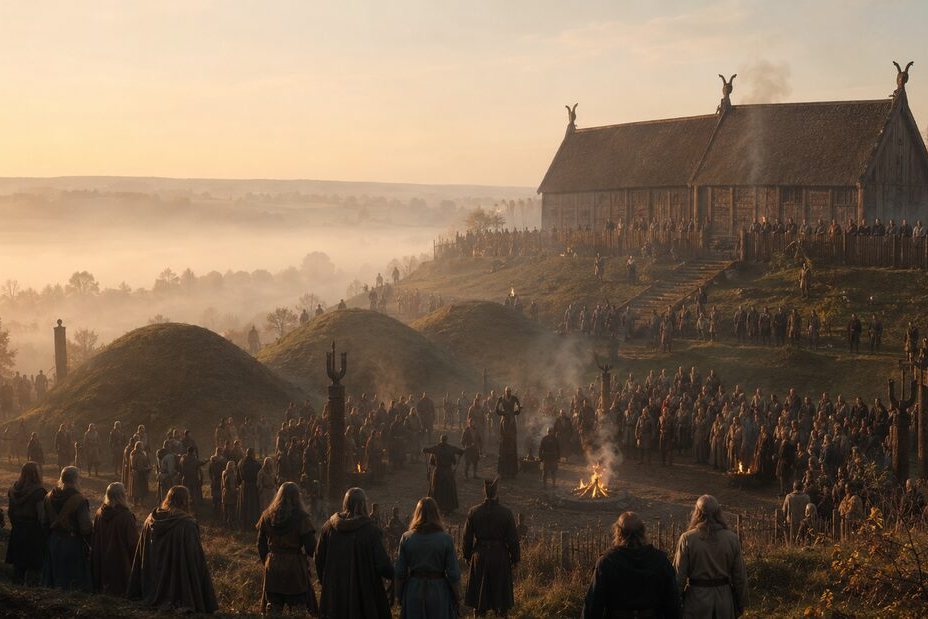
 In the 9th century a polity took shape north of the middle Danube that its neighbours had to take seriously: Frankish kings campaigned against it, a Byzantine emperor sent scholars, a pope wrote to its ruler. It left behind ramparts, church foundations and a script from which Slavic literacy grew. What it called itself, we do not know. And when it ended, we do not know either.
Contemporary texts speak of the Marauani or Marahenses, of a regnum Marahensium, a terra Marauorum, simply of Maraha or Marawa; Old Church Slavonic sources know the Moravьska oblastь. Often the polity is not named as a state at all but through its ruler: regnum Rastizi, regnum Zuentibaldi – the realm of Rastislav, the realm of Svatopluk. No fixed proper name appears in any 9th-century source. Every name we use today is scholarly convention.
The earliest secure mention falls in 822. The Royal Frankish Annals report that Emperor Louis the Pious received embassies and gifts at Frankfurt – from Obodrites, Sorbs, Wilzi, Bohemians, Moravians and Praedenecenti. The Moravians appear not as a special case but as one among several Slavic groupings on the Frankish eastern frontier, much like the Obodrites on the Baltic or the Sorbs between Saale and Elbe.
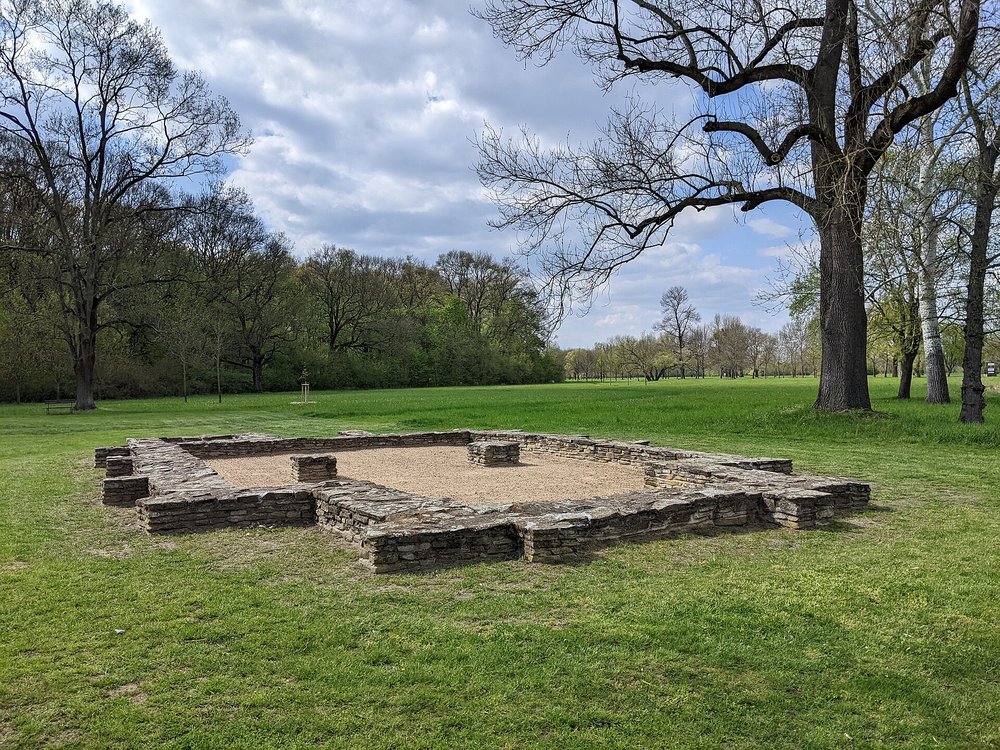
The familiar name comes from a single source: De administrando imperio, written around 950 under Emperor Constantine VII Porphyrogenitus. There we read of megale Morabia, "great Moravia". No other text of the 9th or 10th century uses the adjective in this context. And Constantine wrote roughly half a century after the collapse, from Constantinople, about a region he had never seen.
What megale even means is open. Because the emperor uses the adjective only where he speaks of events after the polity's end, Charles Bowlus proposed rendering it "old" or "former". Others read it geographically: the Moravia "further away", beyond the Byzantine frontier. Lubomír Havlík pointed to Byzantine usage for peoples' homelands – as in "Great Bulgaria". Anyone who says "Great Moravia" is using a foreign, late and ambiguous term. More precise is simply: the Moravian realm.
The evidence is thin and one-sided. On the internal affairs of the realm, 9th-century texts say almost nothing. What we have falls into three groups, each pursuing an interest.
The Frankish annals – above all the Annals of Fulda – are the opponent's perspective: they report campaigns, broken oaths and tribute, and they were written in monasteries whose geographical knowledge of Central Europe was limited. The Conversio Bagoariorum et Carantanorum, composed at Salzburg in the 870s, is a memorandum defending Bavarian ecclesiastical rights against the Byzantine mission; it argues its own case, decades after the events it describes. That same text is also the main source for the Christianisation of the Carantanians. The Slavonic Lives of Constantine and Methodius, finally, are hagiography: edifying, partisan, written to justify. None of these sources is neutral. Where they conflict, the conflict often cannot be resolved.
The first Moravian ruler known by name is Mojmír I. The Conversio reports that "Mojmír, duke of the Moravians", drove "a certain Pribina" across the Danube. Pribina fled to Ratpot, administrator of the Pannonian march, and later built his own lordship by Lake Balaton, centred on Mosaburg – present-day Zalavár. He fell in 861 fighting the Moravians.
Whether Pribina had previously been an independent prince of Nitra or a lieutenant of Mojmír is still disputed. Tellingly, the Conversio does not call him dux. Part of the scholarship sees Nitra as an autonomous principality forcibly absorbed; others regard Mojmír and Pribina simply as two among several Moravian princes. The question is charged because a Slovak line of tradition hangs on it.
One sentence of the Conversio is among the most quoted in Central European church history: Adalramus archepiscopus ultra Danubium in sua proprietate loco vocato Nitrava consecravit ecclesiam – "Archbishop Adalram consecrated a church for him beyond the Danube, on his own property, at a place called Nitrava." It counts as the first church among West and East Slavs attested in written sources. It was built, however, by a prince who was himself probably not yet baptised.
Important: the text gives no year. The usual date of 828 is a modern inference from Adalram of Salzburg's episcopate (821–836). The equation of Nitrava with modern Nitra is likewise a philological identification, not a documented one – although it is the best founded. For 831, a history of the bishops of Passau written only in the 13th century reports that Bishop Reginhar baptised "all the Moravians". No circumstances are recorded, and the Lives make clear that pre-Christian sacrificial practice continued for decades.
In 846 Louis the German campaigned against the Moravians and installed Mojmír's nephew Rastislav as duke – a Frankish client prince. He did not remain one. In 855 a large Frankish army failed; the Annals of Fulda note that the enemy was "defended by strong fortifications". In 864 the tables turned: Louis besieged Rastislav in a stronghold "which in the language of that people is called Dowina", and forced another oath of loyalty.
Between these campaigns Rastislav sought to curb the influence of the Bavarian clergy in his lands. Around 862 he turned first to Rome, to Pope Nicholas I. When no answer came, the request went to Constantinople. Church policy here was always foreign policy too.
The Life of Constantine puts into Rastislav's mouth the reasoning with which everything that followed begins:
Our people have turned away from paganism and keep the Christian law. What we lack is a teacher able to set out the true faith for us in our own tongue, so that other lands looking to us may do the same. Send us, lord, such a bishop and teacher – for from you good law goes out to every country.Life of Constantine 14; paraphrasing translation: Glanz & Gravur
The text is a saint's life, not a protocol: it formulates in retrospect what was meant to legitimise the mission. What is asked for remains striking nonetheless – not baptism, but instruction in one's own language, and law.
In 863 Emperor Michael III sent the brothers Constantine – later, as a monk, Cyril – and Methodius from Thessaloniki. Constantine created a dedicated alphabet for Slavic, the Glagolitic script, and translated liturgical texts. The language that emerged, which we now call Old Church Slavonic, rested on the South Slavic dialect of the Thessaloniki region; it was related to Moravian Slavic but not identical with it.
This was no mere translation project. In the Latin West three languages were in practice regarded as sacred. Introducing a fourth liturgical language meant undercutting the Bavarian church's claim to the country – and binding the Frankish clergy to an authority that sat neither in Passau nor in Salzburg.
In 867 the brothers travelled to Rome. Pope Hadrian II approved the Slavonic translations and ordained six of their disciples as priests; in 869 he informed Rastislav, Svatopluk and the Pannonian prince Kocel of his consent. Constantine died in Rome. Methodius was consecrated archbishop – with the title of ancient Sirmium, "to the seat of Saint Andronicus"; the letters of Pope John VIII speak of a diocesis Pannonica. An actual seat in Moravia is nowhere named.
On his way back Methodius was seized by the Frankish side and held in Bavaria for some three years, roughly 870 to 873. Only John VIII forced his release. The high point followed in 880 with the bull Industriae tuae: it placed Svatopluk under papal protection, confirmed Methodius as head of the church in his realm – including over the Frankish priests – and recognised Slavonic alongside Latin, Greek and Hebrew as a liturgical language. In the same year Methodius's fiercest opponent, Wiching, became bishop of Nitra.
Methodius died on 6 April 885. His opponents obtained from Pope Stephen V a restriction of the Slavonic rite; in 886 the disciples were driven from the country. They went south, to the Bulgarian realm. There, in the circle of Clement and Naum, the script later named after Cyril took shape – Cyrillic. Cyril did not invent it: he created Glagolitic; Cyrillic is a later development in the Bulgarian-Slavic world.
With that the balance tipped. In Moravia itself Slavonic letters disappeared within a generation. Their real afterlife happened elsewhere – and became from there the foundation of the written culture of further Slavic peoples, down to the Serbian and East Slavic tradition.
Rastislav fell in 870 through his nephew Svatopluk, who handed him to the Franks; a Frankish court condemned him, and blinded he died in captivity. Svatopluk himself was arrested in 871, returned during the ensuing revolt and drove out the Frankish governors. In 874 at Forchheim he pledged loyalty and an annual tribute – and began to expand. The Life of Methodius mentions a "very powerful pagan prince settled on the Vistula" whom Svatopluk subdued; a prelude to the region where the state of the Polans later arose. In 890 King Arnulf granted him command over Bohemia. After his death in 894 Regino of Prüm called him "a man most prudent among his people and very cunning by nature".
How far his power actually reached is disputed. Neither written sources nor finds prove the permanent annexation of large territories. Recent decades of scholarship speak rather of shifting, often merely formal overlordships than of a contiguous empire.
Archaeology supplies what the texts withhold. Mikulčice-Valy on the Morava has been investigated since 1954; 38 excavation seasons uncovered almost five hectares. The acropolis covers 7.7 hectares, the bailey 2.4. The excavation director Lumír Poláček has explicitly corrected the once-current figure of 100 to 200 hectares of suburban settlement to a maximum of 30. Around 2,500 graves have been examined, 564 of them at the three-aisled basilica alone. Of the twelve structures counted as churches, the excavators themselves list two as "hypothetical".
The second great centre is the agglomeration of Staré Město – Uherské Hradiště, extending some two kilometres along both banks of the Morava; the "Na Valách" cemetery alone yielded more than 2,000 burials. At Uherské Hradiště-Sady a church complex 22.5 metres long – 33 metres with the rotunda – and 16 metres wide was excavated. At Břeclav-Pohansko, within a magnate court of roughly one hectare, a church with 407 graves came to light and, found in 2006/2007, a second church in the bailey. Typical of the elite are the gombíky, hollow spherical buttons of gold, silver or fire-gilded copper.
Documented are: the mention of the Moravians at Frankfurt in 822; the consecration of a church by Archbishop Adalram at Nitrava (the source gives no year); the expulsion of Pribina by Mojmír I; the installation of Rastislav in 846 by Louis the German; the Byzantine mission from 863; the creation of the Glagolitic script; papal approval of the Slavonic liturgy in 867/869 and again in 880 in Industriae tuae; the consecration of Methodius as archbishop in 869 to the title of Sirmium and his Bavarian imprisonment until 873; his death on 6 April 885 and the subsequent expulsion of his disciples; Svatopluk's death in 894. Archaeologically secure are at least 30 fortified settlements, church buildings at seven sites, and the great centres of Mikulčice, Staré Město–Uherské Hradiště, Pohansko and Nitra with their recorded figures for area, churches and graves.
On the twelve-hectare hillfort of Bojná in western Slovakia, six gilded plaques 13 to 15 centimetres across came to light, bearing short Latin texts and probably belonging to a portable altar or reliquary, along with a bronze bell and two damaged ones. Stylistically the plaques were made around 800 in a Western European, possibly North Italian milieu – they are imports, older than the fortification, whose rampart is dated dendrochronologically to around 890.
From this it is often concluded that Christianity was present in the Nitra region "already before Cyril and Methodius". That is not wrong, but neither is it news: the Bavarian mission is independently attested in writing for the same region. An imported altar fitting proves an object, not necessarily a congregation. And an object of around 800 in a late 9th-century context tells us in the first instance only when it was deposited.
After Svatopluk's death the polity disintegrated quickly. In 895 the Bohemian dukes submitted to King Arnulf – the beginning of the development from which the realm of the Přemyslids emerged. Mojmír II did manage in 898 to restore a church organisation of his own with an archbishop and three suffragans. At the same time he was worn down by conflict with his brother Svatopluk II, into which Bavarian troops intervened in 898 and 899. Around 900 Moravians and Bavarians accused each other of having made alliances with the Hungarians. In 901 Mojmír II concluded peace with Louis the Child.
Then the record breaks off. The Raffelstetten customs regulations, issued between 903 and 906, still mention "markets of the Moravians" – after that, nothing. There is no date of collapse, only a disappearance from the sources. Proposals range from 902 through 903/904 to 907. Scientific dating from western Slovakia shows final repairs to fortifications even between roughly 920 and 950 – without allowing any destroyer to be read off from them.
In 1971 Imre Boba reopened the question of location in Moravia's History Reconsidered: the core territory, he argued, lay not on the Morava in the north but in the south, around Sirmium on the Serbian Morava. Charles Bowlus developed the argument in 1995; Martin Eggers placed the centre at the confluence of the Tisza and the Mureș; Péter Püspöki-Nagy and Toru Senga posited two Moravias of the same name. The arguments rest on lines of march in the Frankish annals, on Methodius's Sirmium title and on later Balkan chronicles.
Most scholars do not follow this, and the decisive counter-argument is archaeological: 9th-century centres of power can be demonstrated on the northern Morava, and not in the postulated southern regions. Critics also point out that the Balkan chronicles were written centuries later and for political purposes of their own. The excavator Jiří Macháček concedes, however, that the geographical contradictions in the written sources – which prompted Boba's challenge in the first place – still require an explanation. It remains a minority position with an unresolved remainder.
"Great Moravia" is not a self-designation but a Byzantine term from De administrando imperio, written around 950 and thus after the collapse; whether megale means "great", "old" or "distant" is unsettled. Cyril did not invent Cyrillic but Glagolitic – Cyrillic arose later in the Bulgarian realm and bears his name only in honour. Methodius's seat has not been located: "Veligrad" is first attested as a place name in 1141 and is first linked to Methodius in 14th-century legends; assigning individual churches or graves at Mikulčice to named persons, including Methodius himself, is interpretation, and is called problematic by the excavators. The Battle of Pressburg in 907 was a Bavarian-Hungarian battle; Moravian troops are not attested, and the contemporary annals record only that a battle took place and the Bavarian army was destroyed – the detailed narrative comes from Johannes Aventinus in the 16th century, and even the location is disputed. And the phrase "the first Slavic state" is shaped in part by modern national history: the Czech Republic and Slovakia both claim this legacy, which appears in the preamble to the Slovak constitution of 1992 as it did in the Czechoslovak constitution of 1948. That is not an archaeological finding.

The Czechs & Bohemians · The Polans · The Carantanians · The Sorbs · The Abodrites.
