 Some peoples end up in world history without ever having asked for it. The Mandubii are one of those cases. They held a handful of valleys in Burgundy, a hilltop town on a limestone spur, and presumably no ambition whatsoever to feature in anyone's war. Then, in the summer of 52 BC, a beaten Gallic army withdrew onto their hill, and Caesar's legions followed it. What happened next made the name Alesia immortal and turned the Mandubii into extras in other people's stories. Their own part in it fills three sentences in Caesar. The third is one of the heaviest sentences in the whole work.
Anyone looking for the Mandubii finds alarmingly little. In Caesar's De bello Gallico, the most substantial text we have on pre-Roman Gaul, the name occurs exactly three times: once when Vercingetorix marches to Alesia, which Caesar simply calls oppidum Mandubiorum, the town of the Mandubii. Once when cattle are mentioned that the Mandubii had driven into the town. And once when they are made to leave it.
To that we can add a brief note in Strabo, who mentions the Mandoubioi in the early first century AD and calls Alesia their city. He places them next to the Arverni, which does not sit well geographically – a neat illustration of how imprecise ancient geographers were about small peoples.
Everything else we know about the Mandubii comes not from texts but from the ground: from pottery, coins, inscriptions and excavation plans. That is not a deficiency, it is the norm. Most Gallic peoples have no voice. They only have sherds.
Their territory lay in what is now the Auxois, in the Côte-d'Or department of northern Burgundy. Scholarship reconstructs it from find distributions and later administrative boundaries as a small area running roughly from Alesia in the north to the region of Sombernon in the south-east – a landscape of limestone plateaus, springs and narrow valleys, holding the headwaters of the Seine and the Yonne.
They were ringed by heavyweights. To the south and west the Aedui, Rome's most important Gallic ally. To the east and north the Lingones, also pro-Roman. Further north-west the Senones. The Mandubii sat exactly in between, on a seam – and seams are rarely quiet places in antiquity.
How small their territory was is shown by what later became of it. Under Augustus it was attached to the land of the Lingones. In the turmoil after Nero's death in AD 68 it was transferred to the Aedui. It evidently did not remain an independent community with a civitas, an administrative district, of its own.
The Latin form Mandubii goes back to a Gaulish Mandubioi. The most common proposal links the first element to Gaulish mandu-, denoting a small horse or pony – which would make the Mandubii roughly the pony people. It sounds appealing, and in a landscape built on grazing it sounds plausible too.
It is still an interpretation, not a translation. Pierre-Yves Lambert has suggested comparing the name instead with a word family that yields Welsh mathru, to trample. Both proposals are linguistically defensible and neither is provable. Anyone who reads online that the Mandubii named themselves after their horses is reading a well-argued guess dressed up as a fact.
That applies to Gaulish tribal names almost across the board. They survive only in Latin or Greek transcription, mostly recorded by authors who spoke no Gaulish.
First-century BC Gaul was not a set of equal tribes side by side but a web of dependencies. Large peoples held smaller ones as clients: protection and access to alliances in exchange for loyalty, dues and manpower. Caesar describes the system at length, because he used it.
The Mandubii belonged to that second rank. Archaeologically they look economically and technically self-sufficient – Mandubian pottery is attested as early as the second century BC. Politically, though, they stood in the shadow of their large neighbours. They do not appear with a contingent of their own on the levy lists of the Gallic revolt.
That is precisely what makes them interesting. The war of 52 BC is otherwise told through the Arverni, the Aedui and the Bituriges, that is, through the great powers. The Mandubii show what that war did to people who had neither started nor fought it.
The oppidum sat on a plateau of roughly 97 hectares, some 200 metres above the valley floor, bounded by steep slopes on almost every side. Two rivers washed the foot of the hill, a plain opened to the west, and hills of similar height stood all around. Caesar describes it soberly and with a professional eye: the place could not be stormed, only blockaded.
Oppida of this size were not villages. An oppidum is a fortified central place with crafts, trade, coinage and storage – the late Celtic urban type familiar from the great Celtic princely seats, only younger and more town-like.
For the Mandubii, Alesia was probably all things at once: market, refuge, assembly place, sanctuary. That a god of smiths was later worshipped there fits a place where metal was being worked long before Rome arrived.
Vercingetorix had begun the revolt shrewdly: scorched earth, cavalry warfare, no pitched battle. Then he lost a cavalry engagement on the edge of Lingonian territory, and the plan collapsed. He withdrew with his army to Alesia. Whether the Mandubii were asked whether they wanted an army inside their walls, no source says.
Caesar followed, inspected the hill and decided on blockade. Vercingetorix sent his entire cavalry out through the unfinished lines by night to raise reinforcements at home. He then had all the grain collected, distributed among his men the cattle the Mandubii had driven in, and issued the corn in small rations.
This is the moment the Mandubii first appear – as suppliers. Their herds vanished into the rations of a foreign army camped in their town.
What Caesar then had built is the most famous siege work of antiquity. First a ditch twenty feet wide with vertical sides. Four hundred feet behind it, two further ditches fifteen feet wide, the inner one filled with river water wherever the terrain allowed. Behind those a rampart and palisade twelve feet high, a breastwork with battlements, projecting forked branches against climbers, and towers every eighty feet.
In front of that line lay a field of traps whose names the soldiers coined themselves. Cippi, gravestones, were five interlaced rows of sharpened branches sunk in a trench. Lilia, lilies, were eight rows of tapering pits holding thigh-thick sharpened stakes, covered over with brushwood. Stimuli, goads, were foot-long blocks of wood buried flush with the ground and fitted with iron hooks.
This inner line ran eleven Roman miles around the hill, with twenty-three redoubts. Facing outwards, against the expected relief army, Caesar laid a second line of fourteen miles. Technical writing calls the two rings circumvallation and contravallation, though the terms are applied inconsistently; the function matters more. Caesar's army then sat in a ring between two fronts – and the civilian population of Alesia sat inside the inner ring with them.
Caesar has Vercingetorix speak of eighty thousand picked men in the town and calculate grain for barely thirty days. For the relief army he gives eight thousand cavalry and around two hundred and forty thousand infantry.
Those figures deserve caution. Caesar wrote for a Roman audience to whom he had to sell his victory, and the larger the Gallic army, the greater the achievement. It is also striking that the detailed levy list he sets out tribe by tribe a few sections earlier does not add up cleanly to his own total. Numerals are in any case among the least reliable elements in the manuscript transmission of ancient texts.
What can be stated: it was a very large muster, and it came too late. Everything beyond that is estimate.
When the grain ran out and the expected relief failed to appear, the besieged held a council. Some wanted to surrender, others to attempt a breakout. Then Critognatus, an Arvernian noble, spoke. Caesar reproduces his speech in full, explicitly calls it cruel – and passes it on anyway.
Critognatus proposed doing what their ancestors had done in the war against the Cimbri and Teutones: living off those too old or too weak to fight. He framed it not as despair but as responsibility. A breakout, he argued, would cost eighty thousand men and deliver all of Gaul into slavery.
The assembly did not follow him. It resolved to send everyone unfit for war out of the town and to take up Critognatus' proposal only if nothing else were left. It never came to that. No source reports that anyone was eaten at Alesia. It was proposed, not carried out.
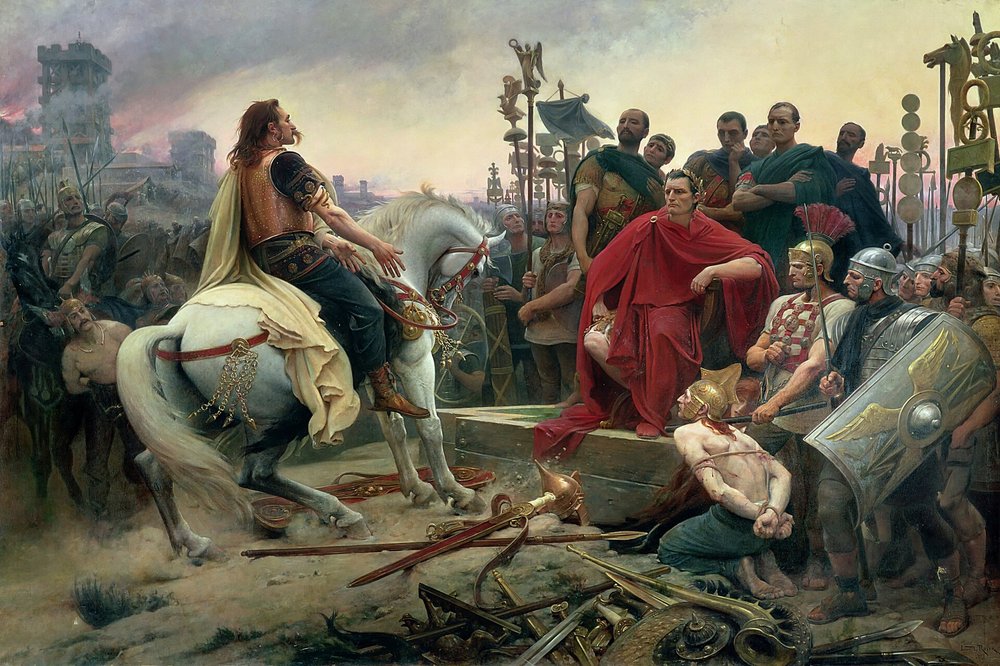
The decision fell first on the locals. The Mandubii had let the Gallic army into their town; now they were sent out of it, with their women and children. They walked down the slope towards the Roman lines, because the only grain in the region lay there.
Mandubii, qui eos oppido receperant, cum liberis atque uxoribus exire coguntur. Hi, cum ad munitiones Romanorum accessissent, flentes omnibus precibus orabant, ut se in servitutem receptos cibo iuvarent. At Caesar dispositis in vallo custodibus recipi prohibebat. – The Mandubii, who had taken them into their town, are compelled to go out with their children and wives. When these had come up to the fortifications of the Romans, weeping, they begged with every plea that they be taken into slavery and helped with food. But Caesar posted guards on the rampart and forbade that they be let in.Caesar, De bello Gallico VII.78.3–5; Latin as transmitted, translation our own
What happened next is not stated outright. It follows from the little the text does say: these people did not return into the town and did not pass through the Roman lines. They remained in the strip between rampart and hill, without supplies, until the siege was decided. Caesar never mentions them again.
The way he tells it is remarkable. The sentence stands in the same clipped administrative register as the width of a ditch. Classical scholarship has long debated why Caesar included the episode at all – not least because it follows immediately on the speech of Critognatus and answers his charge of Roman cruelty with a Roman act.
The relief army attacked three times, finally with sixty thousand picked men against a camp on the northern flank that could not be enclosed within the ring. It failed. Sedullus, leader of the Lemovices, fell; Vercassivellaunus, a relative of Vercingetorix, was captured; seventy-four standards were brought to Caesar. How those armies actually fought is a subject of its own – see our piece on the Celtic warriors.
The next day the Gauls handed over Vercingetorix and laid down their weapons. Caesar kept back the Aeduan and Arvernian prisoners to win their peoples back politically; the rest he distributed as plunder, one man per soldier. He later returned some twenty thousand captives to the Aedui and Arverni. Vercingetorix was taken to Rome and executed in 46 BC after Caesar's triumph.
Of the Mandubii the text says nothing more. Their hill now belonged to a Roman province.
The town was not razed. On the Mont Auxois a Gallo-Roman small town grew up with a forum, temples and a theatre, its population estimated at a few thousand. Its economic backbone was metalworking, above all bronze.
The most famous find attests exactly that. In a large building north of the forum, a cellar room held bronze and iron scrap, evidently the stock of metalworkers, together with a bronze vessel bearing the dedication Deo Ucueti et Bergusiae, to the god Ucuetis and to Bergusia. Ucuetis was a god of craftsmen and smiths, attested so far only here. The building was probably both sanctuary and guild house – a rarity, because ancient cult buildings almost always belong to the elite, not to artisans.
Then there is the stone of Martialis, found in 1839: a Gaulish inscription in Latin letters in which one Martialis, son of Dannotalos, dedicates a building to Ucuetis – and which gives the place name in the form in alisiia. Further dedications honour Apollo Moritasgus, Rosmerta, Damona, and Mars Cicolluis with Litavis. The spring sanctuary of Apollo Moritasgus at La Croix-Saint-Charles was re-investigated between 2008 and 2018 under Olivier de Cazanove, producing an exceptionally well preserved wooden basin. One qualification matters: all of this belongs to the Roman imperial period, not to the time of the siege.
That Alise-Sainte-Reine is the place is today regarded as settled – the route to that conclusion was politically loaded. Napoleon III was writing a biography of Caesar and saw Vercingetorix as a founding figure of the nation. In 1861 he ordered excavations; from 1862 his ordnance officer Eugène Stoffel led the work until 1865. It exposed the double lines of fortification and the main camps; weapons, Gallic and Roman coins and military equipment went largely to the national museum at Saint-Germain-en-Laye.
The obvious suspicion is that an emperor finds what an emperor is looking for. Which is why what came afterwards matters most: the aerial archaeology of René Goguey, the Franco-German excavations of 1991 to 1997 under Michel Reddé and Siegmar von Schnurbein, which examined the Caesarian lines systematically, and a LiDAR survey in 2011. The evidence supports Caesar's description on many points.
Counter-theories were plentiful all the same; some forty places have claimed Alesia. The best known is the thesis developed in 1962 by André Berthier that Alesia lay near Chaux-des-Crotenay in the Jura. Berthier worked from a profile distilled out of Caesar's text and searched for terrain that matched it. The scholarly community does not follow him: the archaeological basis is missing. The dispute is settled on the evidence, if not emotionally.
In 1865 Napoleon III had a statue 6.60 metres high erected at the western end of the plateau: Vercingetorix, made by Aimé Millet from beaten copper sheet over an iron frame, on a pedestal designed by Viollet-le-Duc. The inscription proclaims that a united Gaul, forming a single nation and animated by one spirit, could defy the universe – a free rendering of Caesar's text, carved in stone by the Emperor of the French.
The figure shows no Gaul of the first century BC but what the nineteenth century imagined one to be: drooping moustache, flowing hair, a melancholy gaze. On the common reading the face also carries features of the man who commissioned it. What is historically solid about this monument is the story of its making, not its appearance.
Since 2012 the MuséoParc Alésia has stood at the foot of the hill, with an interpretation centre by Bernard Tschumi whose timber-slat facade alludes to the Roman woodwork; sections of the siege lines have been reconstructed on the site. Of the Mandubii themselves there is little to see. They got no statue. They are the reason the place has a name.
The Arverni · The Aedui · The Lingones · The Senones · The Celtic Warriors.
