For a seafaring people the sea was both: lifeline and maw. No wonder the North gave it a divine couple. Ægir, the vast but hospitable sea-giant, is also the brewer of the gods – in his hall they hold their greatest feasts. His wife Rán, however, spreads her net and draws the drowned down to herself into the deep. A look at the two faces of the sea.
Ægir – also called Hlér or Gymir – is a giant, yet counted among the gods, so closely is he bound to them. He embodies the sea as a force, but also as a host. His wife Rán bears a name that simply means “robbery”. With a great net she draws the drowned down to herself – the same net that in another tale Loki borrows to catch the dwarf Andvari.
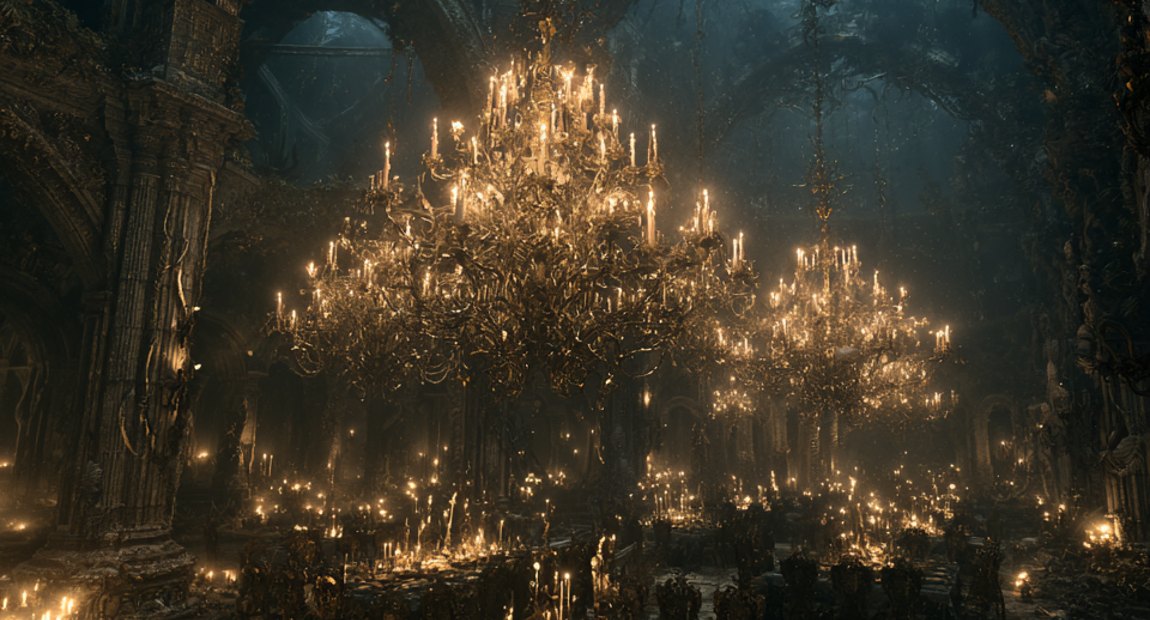
Ægir's most famous role is that of the brewer. In his hall on the isle of Hlésey the gods feast, and for that ale is needed in vast quantity. The Poetic Edda tells in Hymiskviða how Thor journeys to the giant Hymir to fetch a cauldron the size of a kettle – only then can Ægir brew for all. His hall is also the setting of the Lokasenna, that biting flyting in which Loki mocks the gods in turn. The gold that lights Ægir's hall became a kenning: “Ægir's fire” is gold in the poets' tongue.
“Strongly the spray-steed of Helgi tore itself from Rán's claws.” Old Norse skaldic verse, after the Helgi tradition (public domain)
Rán and Ægir have nine daughters – the waves, each with her own name. Whoever perishes at sea, so the idea goes, travels to Rán. A stormy sea was held to be her hunt for the ships: again and again the skalds sing of the ship that tears itself “from Rán's claws”. In the late Frithjof's saga the hero even advises that everyone carry some gold when doom threatens – for whoever comes to Rán should enter adorned.
And yet Rán's realm is no place of punishment. Her halls are described as quite comfortable, and Ægir's hall serves the gods as a feasting place. Whoever goes under in the struggle with the powers of the sea is received among the sea gods as honourably as the one whom another death calls to Hel, to Valhalla or to Freyja's Folkvangr. For a people that again and again lost people and goods to the waves, this was a consoling thought: the sea, too, receives its own with honour. Raise the horn – and Skál to a good voyage.
Ægir as sea god/giant and brewer of the gods is attested in the Poetic Edda (Hymiskviða) and in Snorri; the Lokasenna is expressly set in his hall. Rán with the net that draws the drowned, and the nine daughters as waves, stand in the Prose Edda (Skáldskaparmál); there Loki also borrows Rán's net. “Ægir's fire” as a gold-kenning is skaldically attested. The gold-for-Rán scene comes from the (late) Frithjof's saga.
Some of it is Snorri's systematising: the nine daughters as clearly named waves and the tidy division of roles are literarily smoothed. The “honourable death at sea” is a plausible interpretation, not a literal dogma, and the gold-for-Rán custom is known above all from the late Frithjof's saga (14th c.). But the core – Ægir the brewer, Rán the mistress of the drowned – is well transmitted.
Njörðr – god of the sea · Hel – goddess and realm of the dead · The longships · Thor · How the Germanic peoples honoured their dead.
All Gods & Goddesses articles →
For a seafaring people the sea was both at once: road and grave, riches and death. In the North this double nature took …
Read more →She appears rarely and never speaks a single recorded word – yet the greatest catastrophe of Norse myth springs from …
Read more →He was the fairest, the gentlest, the purest – and yet it was he whom death struck. The legend of Balder is the most …
Read more →In the halls of the gods sits one who would rather turn a fine phrase than swing an axe: Bragi, the long-bearded lord …
Read more →