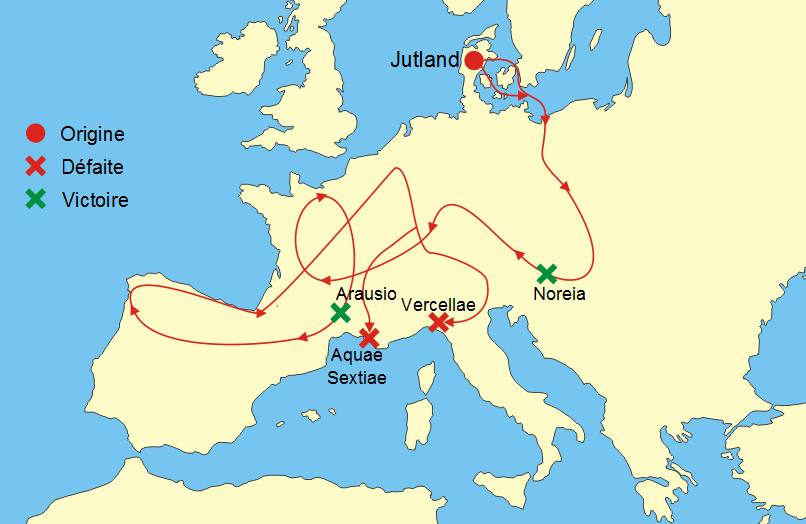
An army shouts its own name, and from the far bank the word comes back. That is how Plutarch opens the battle of Aquae Sextiae in 102 BC. The Ambrones at its centre are little more than that name, a number and a battlefield. Where they came from, and whether they were Germanic, Celtic or something else, no source decides. This article separates what is attested from what scholars infer from names and places.
In 102 BC, in the south of France, an army stands beside a river and shouts its own name. It is not an order and not a threat aimed at one particular enemy. It is a rhythm: weapons struck together, over and over, a hundred voices on one word. Then the same word comes back from the other side. Ligurians fighting for Rome are shouting it too: “Ambrones!” Plutarch, writing about two hundred years after the event, stops in his Life of Marius to explain the scene. The Ligurians, he says, recognised the word as their own inherited name.
That is nearly everything the sources give us about the Ambrones as a group: a name, a number and a battlefield. The Ambrones (Latin Ambrones, Greek Ámbrones) are counted as allies, or as part, of the movement usually tied to the Cimbri and Teutones. Where they came from, which language they spoke and whether their name belongs to any single language at all remain open questions. The wider migration is covered in our article on the Cimbri and Teutones. This piece looks more narrowly at the Ambrones, at the battle of Aquae Sextiae and at what a name can tell us when almost nothing else survives.
The Ambrones left no tradition of their own. Everything we know about them comes from Romans and Greeks who never lived next to them. The fullest account is Plutarch’s (about AD 46 to about 120), who describes the fighting on the Rhône in his Life of Gaius Marius, above all in chapters 15 to 21. He relies on older works that are now largely lost, and he writes at a distance of two centuries. That does not make his details wrong, but it calls for caution wherever a passage sounds like an eyewitness report.
The Periochae of Livy are shorter: brief summaries of a lost history. Periocha 68 says that the consul Marius defended his camp against a fierce attack by the Teutones and Ambrones and defeated both near Aquae Sextiae in two battles; “they say” 200,000 enemies were killed and 90,000 captured. Orosius, a Christian historian of the early fifth century, also names the Ambrones, together with the Cimbri, Teutones and Tigurini. In his version 200,000 fell, 80,000 were taken and barely 3,000 got away, each figure “according to report”. The numbers disagree with one another and cannot stand on their own. They show above all how deeply the defeat and the victory marked Rome.
Strabo adds a side note. In the fourth book of his Geography, discussing the mouth of the Rhône, he mentions a channel that Marius had cut and speaks of the war “against the Ambrones and Toygeni”. The editor of the English edition links both peoples to the Cimbric movement and points to Marius’s victory at Aix; who exactly the Toygeni are, we have not settled. So the name of the Ambrones appears in Strabo without any narrative of the battle.
Caesar does not mention the Ambrones. In the second book of the Gallic War (2.29) he traces the Aduatuci back to remnants of the Cimbri and Teutones who had once left their baggage and cattle on the Rhine. Ambrones do not appear there. More on that people is in our article on the Aduatuci. Caesar’s silence proves nothing about the fate of the Ambrones; it marks a gap and nothing more.
The background is the year 105 BC. At Arausio (modern Orange) on the Rhône, Roman armies under Servilius Caepio and Mallius Maximus suffered one of the worst defeats in Roman history. According to Periocha 67, which cites the annalist Valerius Antias, 80,000 soldiers and 40,000 servants and camp followers were killed, and again the figure is an ancient claim, not a count. German-language overviews list the Ambrones among those who fought at Arausio and place them at Noreia (113 BC) as well; we did not check the ancient evidence for these points one by one.
Marius, to whom Rome gave the command after Arausio, prepared with care. Plutarch describes how he built a fortified camp on the Rhône, stored supplies and dug a canal to make shipping on the river easier; Strabo confirms the canal. The Teutones and Ambrones pitched their own camp nearby and challenged him to fight. Marius refused. He kept his men behind the ramparts and had them study the enemy so that their fear would fade; Plutarch says the soldiers grew angry at the delay. Then the enemy marched past his camp, for six days according to Plutarch, and Marius followed them as far as Aquae Sextiae, today Aix-en-Provence. Strabo knows hot springs there that are called “Sextian” and mentions a Sextius who defeated the Salyes; the English edition identifies Aquae Sextiae with modern Aix.
The spot Marius picked for his camp had little water. Plutarch reports that the soldiers complained; Marius pointed to the river beside the enemy camp and said that water was there, but it would have to be bought with blood. Whether he spoke those words we cannot know. It is the kind of line ancient biographers like to give a general. The core of the story, that the question of water set off the first fight, is more modest and fits the setting.
According to Plutarch, Roman servants went down to the river to fetch water. There they ran into Teutones and Ambrones who were bathing or eating and resting. That is the moment the battle caught fire. The Ambrones, in Plutarch’s words “not fewer than thirty thousand”, broke away from their camp and went into the attack. Plutarch stresses that although they were fed and flushed with wine, they did not run in disorder. He describes a kind of marching dance.
They did not come on at random or with wild shouting, but struck their weapons together in time and leapt forward with the beat, and again and again they all called out their own name: “Ambrones!” … The Ligurians, who were the first Italians to meet them, understood the word, shouted it back and said it was their own inherited name.Plutarch, Marius 19.3–4; free translation in our own words after an English translation, Greek wording not checked
The rest of the scene can be told quickly. The Ligurians and other Roman units were drawn in, and in the end Marius’s army attacked from the higher ground. The Ambrones had to cross the river and were cut down in the water and on the bank; the survivors fled to their camp and wagons. There, says Plutarch, women stood with swords and axes and faced both the fleeing men and the pursuing Romans. For women in Germanic societies more can be found in our article on Germanic women.
That night, Plutarch goes on, the Romans spent the hours in fear and unrest instead of celebrating. The Teutones were not yet beaten. At dawn Marius sent Claudius Marcellus with 3,000 men into a wooded glen behind the enemy line. The Teutones charged uphill, met firm resistance and were pushed back until Marcellus fell on their rear. Plutarch speaks of more than a hundred thousand killed or captured. The people of Massalia, the Greek city of Marseille, are said to have fertilised their vineyards with the bones of the dead, which Plutarch takes as confirmation of a proverb. He adds that heavy rain often follows great battles.
The sentence about the Ligurians is the key to the question of the name. Plutarch does not write that the Ambrones were Ligurians. He reports that the Ligurians, by their own account, call themselves Ambrones “by descent”. Several readings are conceivable. First: the similarity of the two names is chance. Second: an old tradition really did connect a part of the Ligurians with the Ambrones, perhaps through shared ancestors in a time no one remembered. Third: Plutarch repeats a Ligurian self-interpretation set off by the sound of the word in the middle of a fight. None of these readings is backed by a second source. Plutarch does not decide between them, and neither does modern scholarship.
The echo of the Umbri of central Italy belongs to the same debate. Ancient authors regarded the Umbrians as a very old people of Italy; Pliny the Elder calls them the oldest, and he passes on the Greek explanation that their name comes from ombros, “storm, downpour”, because they had survived the Flood. That is a folk etymology, not a linguistic result. Modern literature considers the possibility that Ambrones and Umbri are related, usually as an attractive hypothesis that cannot be proved. Livy adds that Celtic names such as Insubres might point to a “Lower Umbria”, and Cato the Elder called the Gauls the ancestors of the Umbrians. These are ancient guesses at second hand; we report them without presenting them as findings.
According to German-language overviews, Rufius Festus, a late antique author, also counted the Ambrones among the Gauls. The habit of calling them “Celtic” thus has an old witness, though he wrote in the fourth century AD and reflects the knowledge of his time, not the situation in 102 BC. The suggestion that the name is Celtic (for example from ambi-, “around”, as in Ambiorix) is discussed but considered controversial and cannot be proved.
Today the Ambrones are usually presented as a Germanic group living on the North Sea coast. That assignment rests on no contemporary testimony but on comparisons of names. Two scholars are cited again and again: Hans Kuhn and Reinhard Wenskus. They suggest an origin in Jutland or on the North Sea islands, specifically around Amrum, which appears as Ambrum in a record of 1231, and possibly Fehmarn, whose old name is given as Imbria. We could not check these name forms against the records themselves; they come from secondary literature.
Older work points in the same direction. W. J. Beckers, in a study from the late 1930s (we are not sure of the exact year), counted the Ambrones among the Germanic tribes and placed them on the North Sea islands off western Jutland, perhaps including Heligoland. His witnesses were Amrum and line 32 of the Old English poem Widsith, which names a people called the Ymbre. Whether these Ymbre really are the Ambrones is an interpretation. The link is possible, not secure. Then there is Ptolemy in the second century AD, who lists a people called Ombrones on the upper Vistula; whether this means Ambrones who stayed behind is likewise only a guess.
A further argument is the spread of the element Ambr- in water names: Amper, Ammer and Emmer, perhaps also place names such as Ammerland and Emmerich. The literature considers a root meaning “water, rain”, and Hans Krahe is cited as an authority for the river names. If that holds, a tribal name meaning something like “water people” or “those living by the water” would be conceivable. It remains one possibility among others. According to the overview literature, no satisfying etymology exists. There is also a problem of transmission: a Germanic form such as Amr- could have become Ambr- in Roman sources through the insertion of a b between m and r, which happens in many languages. In that case the resemblance to Celtic and Italic names would be a product of spelling.
The picture is mixed. A Germanic origin on the North Sea is the view held most often. A Celtic background circulates as a counter-hypothesis. The Ligurian link rests on Plutarch’s sentence about the battle cry alone. Which of the three readings carries the most weight is a matter of how the clues are weighed, not of what the sources say; the question stays open.
For readers on the North Sea coast the question of the Ambrones has a particular pull, because the trail leads into the coastal landscape of present-day North Frisia. Amrum is one of the North Frisian islands in the Wadden Sea, a landscape where land and water have blurred into one another for centuries. That the Ambrones could have come from there is a hypothesis; that the island’s name can be tied to the ancient tribal name is another. Neither the record of 1231 nor the similarity of the names proves a connection across more than a thousand years. A visitor to the island is not walking on proven Ambrones country.
Closely linked to this is a story that was doubted already in antiquity: that a huge storm tide drove the Cimbri from their homeland. Strabo (7.2.1–2) calls the claim a fabrication outright and finds it ridiculous that a people would leave its home because of a flood; the sea advances imperceptibly, he says, and the Cimbri set out as a wandering, piratical folk. Here he follows the philosopher Posidonius, who, he says, rightly censured the historians for such explanations. Strabo does not name the Ambrones in this passage. The flood story survived because it seems to suit the coast, yet the source that discusses it most clearly rejects it. The coast between the Ems and the Elbe also belongs to the Chauci and, later, the Frisians; neither is the Ambrones, but they show which groups Roman authors actually name on this shore at a later date.
After 102 BC the Ambrones vanish from the sources. Livy and Orosius speak of destruction and capture, but they do not tell us whether every single Ambrone was killed or enslaved. One suggestion in the scholarship is that some captives may later have been among the rebels of the Third Servile War (Spartacus). That is speculation and not recorded; we mention it only because it keeps turning up in overviews.
A late echo in Britain, which one sometimes reads about, is also an interpretation. The Old English Ymbre and the claim that British sources called the Ambrones Saxons (which we could not verify) are read as possible hints of a remnant that stayed in the north. Our articles on the Saxons and the Angles show how careful one has to be with such links across centuries. The name Ambrones sticks in Latin and Greek texts partly because it was a memorable word, one that could be shouted a hundred times on a battlefield.
The Ambrones are a case in which everything hangs on a single word. One people calls out its name, another calls it back, an author writes it down. A great deal can be derived from that word, which is exactly why it pays to separate evidence from interpretation. What is secure is that Ambrones fought at Aquae Sextiae and lost there, that Plutarch records their battle cry and the answer of the Ligurians, and that Livy and Orosius name the defeat. Everything beyond that, from a homeland on a North Sea island to kinship with the Umbrians, is reconstruction.
The Ambrones show how antiquity perceived peoples: through names that were heard, through battle cries that were understood or thought to be understood, and through kinships fixed on a sound. For the Ambrones the gap between evidence and interpretation is wide, and the surviving sources can hardly close it.

Cimbri & Teutones · The Atuatuci · The Chauci · The Frisians · The Saxons.
All History & Finds articles →
The Ampsivarii ("those of the Ems land") were a Germanic tribe on the Ems. Tacitus records their tragic fate in the 1st …
Read more →Some peoples enter world literature because somebody was trying to describe something else. The Anartes are one of …
Read more →The Angles were a Germanic tribe from the region of Angeln in today's Schleswig-Holstein, between the Schlei and the …
Read more →The Angrivarii were a Germanic tribe on the middle Weser, in today's Lower Saxony. Their name lives on in the region of …
Read more →