Between Lake Skadar and the Adriatic coast, a South Slavic principality bore the name of an abandoned Roman city. An emperor, later Byzantine chroniclers and a chronicle written centuries after the events all report on Duklja, the last of them mixing history with legend. Read apart, the three sources show a small principality struggling for its place between Constantinople, Bulgaria and Rome.
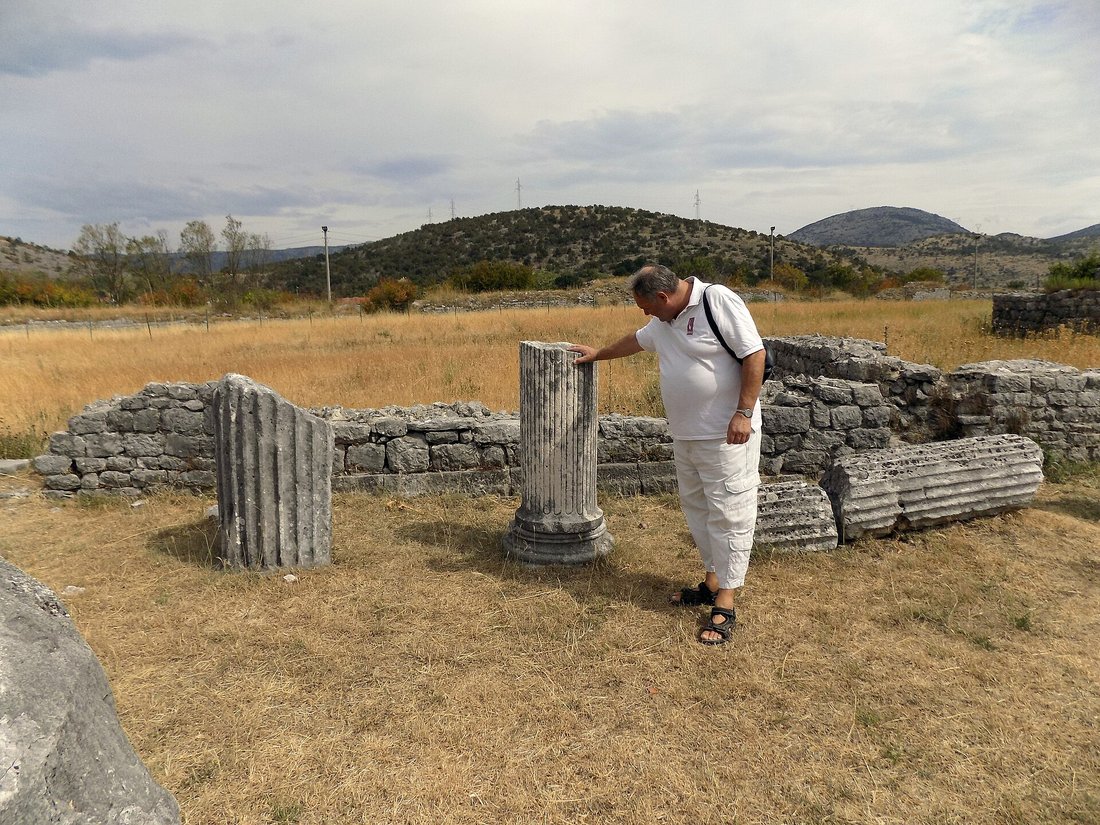
About three kilometres north of present-day Podgorica lie the remains of Doclea, the largest archaeological site in Montenegro. The city belonged to the Roman province of Dalmatia and rose in the 1st century AD to the status of a municipium, a town with self-government under Roman law. Scholars estimate that between 8,000 and 10,000 people lived there. The name is usually traced to the Docleatae, an Illyrian tribe subdued by Rome. A later legend ties it to Emperor Diocletian, but that is a medieval interpretation, not an established origin.
Excavations reveal a typical townscape: forum, temples, baths and cemeteries. Around the year 400 Doclea became a bishop's seat. Bishops are known by name from the councils of Ephesus (431) and Chalcedon (451); the last is Nemesian in 602. The largest basilica, known as Basilica A, measures roughly 34 by 17 metres. A severe earthquake destroyed the city in 518, and the end came in the 7th century, when Avars and Slavs overran the region. Whether the medieval Slavic rulers used the site systematically is not documented archaeologically; three small medieval churches at least show that the place was not entirely forgotten.
The earliest connected description of the land comes from Emperor Constantine VII Porphyrogenitus, who had his handbook De Administrando Imperio (DAI) compiled around 948 to 952 for his son Romanos II. Chapters 29 to 36 deal with the coastal region west of the empire in turn: Dalmatia, the Croats, the Serbs (chapter 32), the Zachlumi (33), the Terbounians and Kanalites (34), then in chapter 35 Diocleia, and finally the Narentines. The material draws partly on older records and partly on oral reports, and the emperor sorts it according to his own view of the world.
The chapter on Diocleia is short. Constantine has the land settled long ago by Romans whom Diocletian moved there from Rome. The Avars later laid it waste, and under Emperor Heraclius it was resettled. He derives the name from a city that Diocletian supposedly founded and that now lies deserted. That is the Roman city of Doclea. The link between city and emperor is the author's claim; archaeology does not confirm it.
In the country of Diocleia lie the large inhabited cities of Gradetai, Nougrade and Lontodokla.Constantine VII, De Administrando Imperio, ch. 35; close paraphrase based on R. J. H. Jenkins's translation
The three places cannot be located with certainty; scholars have put forward various proposals, none of which has prevailed. Striking is that Constantine does not expressly declare the Diocleans to be Serbs. For the Zachlumi, Terbounians and Narentines he points to Serbian origin. For Diocleia such a statement is missing. Some scholars read this as a sign that the emperor did not count them among the Serbian group. Others see only a gap in his source. All that is established is that the text is silent.
Only in the early 11th century does Duklja enter sources that name events. The Byzantine chronicler John Skylitzes, writing in the late 11th century, mentions a ruler named Vladimir, whom he portrays, in paraphrase, as a mild, peaceable and pious man. Jovan Vladimir ruled from about 1000 to 1016. His time fell within the long war between Emperor Basil II and the Bulgarian tsar Samuel, who sought allies against Constantinople and punished opponents.
Around 1009 to 1010 Samuel attacked Duklja. Jovan Vladimir withdrew to the fortress of Oblik on Lake Skadar but eventually surrendered to avoid famine. Samuel had him taken to Prespa, the centre of his power in present-day western Macedonia. Here the part resting on several sources ends. Everything further about captivity, marriage and death stands in a chronicle written three hundred years later.
The work in question is the Gesta regum Sclavorum (Deeds of the Slavic Kings), usually known as the Chronicle of the Priest of Duklja, in Serbo-Croatian Ljetopis popa Dukljanina. Older scholarship dated it to the 12th century and named a parish priest from Duklja as author. The Serbian historian Tibor Živković proposed a different date in 2009: the work was written around 1295 to 1301, and its author was Rudger, who became Catholic archbishop of Bar in 1298 and was expelled from the town in 1301. That proposal is debated. Both camps agree that the chronicle is very late compared with what it describes.
A Latin and a Croatian version survive, the oldest manuscripts dating from the 17th century. The work stretches from a early period under Gothic kings to the middle of the 12th century. It contains the so-called Constantine's Legend on early Croatian history, a life of Saint Jovan Vladimir and a history of the Dukljan rulers. It seems to have been shaped in the interest of a patron, the Croatian ban Paul I Šubić of Bribir. The historian Slavko Mijušković even held the chronicle to be a purely literary product of the late 14th or early 15th century, a minority view.
Scholars divide the chronicle roughly into two parts. The first chapters are considered largely unusable. There appears, for instance, Svetopelek, the eighth descendant of the Gothic conquerors, said to have ruled from Croatia to Serbia and to have led all peoples to Christianity. Scholarship classes this figure as invented. The author presents the Slavs as a peaceful people whom the Goths brought into the land, which contradicts the Byzantine sources. Chapter 36, the life of Jovan Vladimir, is rated higher. It summarises an older saint's life from between 1075 and 1089 and, by widespread opinion, contains reliable historical details, albeit with legendary embellishment.
The chronicle relates that Samuel's daughter Theodora Kosara was so struck by the prisoner's appearance, humility and gentleness that she asked her father for his hand. Samuel agreed and reinstated Vladimir as a vassal. Historians regard the union as political calculation rather than a love story. Kosara's parentage is not secure either: Skylitzes mentions a daughter of Samuel, but the manuscripts are inconsistent, and a rival thesis sees Kosara as a daughter of Theodore Chryselios. Both readings remain speculation; the marriage itself is probably historical, the framing of the story literary.
On 22 May 1016 Samuel's successor Ivan Vladislav summoned the prince to Prespa. Vladislav had murdered his predecessor Gavril Radomir in October 1015 and seized the throne. Kosara warned her husband, according to the vita, but Vladimir accepted, holding a wooden cross as a pledge of safe conduct. As he prayed in the church, Vladislav's soldiers struck him down and beheaded him. That Vladimir met his death in Prespa in 1016 is the most credible core. The scene with the cross and the wife's warning bears the stamp of martyr literature.
Vladimir was first buried in Prespa. According to the vita, Kosara brought his body to the church of Prečista Krajinska near the court in the Krajina, in southeastern Duklja. Around 1215 the relics were moved to Dyrrhachium, in 1381 Karl Thopia placed them in a church near Elbasan, and since 1995 they have rested in the Orthodox cathedral of Tirana. His feast day is 22 May. Veneration began soon after his death and has lasted for centuries, across confessional lines.
After 1016 the principality did not vanish, but the sources remain thin. Duklja becomes visible again with Stefan Vojislav, whom Byzantine authors name explicitly. Skylitzes calls him the prince of the Serbs, the chronicler Kedrenos spoke of a prince of Serbia, and Kekaumenos records him with the title of archon and toparch of the Dalmatian kastra of Zeta and Ston. Around 1034 he rose against Byzantium, exploiting the death of Emperor Romanos III, was captured around 1035 or 1036 and held in Constantinople, escaped in late 1037 or 1038, and by about 1040 controlled the coast from Ston to his capital at Skadar. The Battle of Bar in 1042 secured independence. He died in 1043, leaving power to his widow and five sons.
The chronicle makes Vojislav a cousin of Jovan Vladimir. The Byzantine contemporaries mention no ancestry, so this link is considered doubtful. Under Vojislav's son Mihailo, who ruled from about 1046 to 1081, the principality gained international recognition: Pope Gregory VII addressed him around 1077 as king of the Slavs. Under Constantine Bodin the bishopric of Bar was raised to an archbishopric in 1089, with wide ecclesiastical influence. In the 12th century the centre of gravity shifted to Raška, and Stefan Nemanja incorporated Duklja for good in 1186.
The principality's centre lay on Lake Skadar, the largest lake on the Balkan Peninsula. Its area fluctuates with the season between roughly 370 and 530 square kilometres; it is about 44 kilometres long and at most 14 kilometres wide. About 65 percent belongs to Montenegro today, 35 percent to Albania. The lake is shallow, averaging only five metres in depth, and dotted with islands such as Beška and Grmožur. A fortress that later served as a prison stood on Grmožur. Whoever held the lake and the coast held the approaches to the interior and the routes toward Dyrrhachium.
Which places belonged to Jovan Vladimir's court is unclear. The chronicle names the Krajina as the family's residence, while other accounts see the coastal town of Bar as the seat of rule. For Vojislav, Skadar is attested as capital. That the princes changed their residence over time is likely but not documented. Roman Doclea itself remained a ruin and served at most as a namesake.
The emperor writes tersely, knows Diocleia at second hand and fits it into his own system of tribute and origin stories. Skylitzes and Kekaumenos write about conflicts from the Byzantine side. The chronicle of the Priest of Duklja arose from the viewpoint of the church of Bar and a Croatian patron and fills the gaps with narrative material the earlier period never confirms. Anyone reading it must ask of every sentence whether it comes from the vita, from oral tradition or from the pen of the chronicler.
There is also the question of who the Dukljans actually were. Constantine's text leaves open whether he saw them as Serbs, as a group of their own or as descendants of the Roman population. The Byzantine chroniclers of the 11th century called Vojislav a Serb, which points to membership in a larger organising term, not to a demonstrable tribal identity. Scholars therefore advise reading medieval group labels as political and linguistic attributions, not as modern ethnic categories. Among the neighbours to the north were the Croats and the remnants of the coastal towns; to the east reached the influence of Bulgaria, which Samuel had turned into a great power. Those interested in that wider setting will find it under the Bulgars and Slavs.
That is exactly why Duklja deserves a look. A small territory whose name comes from a ruin and whose princes fought for survival between Basil II and Samuel left only a few lines in the great chronicles, but a veneration of its own and a chronicle of its own, which still provokes argument. For an engraving on slate the sober map suits better than the tale of Kosara: Lake Skadar, Doclea, Bar, three names and a span from 1000 to 1186.

The Serbs · The Zachlumians · The Travunians · The Narentines · The Croats · The Slavs of Bulgaria.
