The Manimi are one of five names Tacitus uses to describe the Lugian league between the Oder and the Vistula. Some fifty years later Ptolemy offers his own list of Lugian groups – and not a single one of Tacitus' names appears in it word for word. Only the Omanoi sound similar enough to have long been equated with the Manimi. This article asks what lies behind that equation and what two such different lists reveal about ancient ethnography.
There is no story to tell about the Manimi. No leader is known, no battle, no sanctuary, no inscription. What exists are two ancient texts that do not agree: the Germania of Tacitus, written around AD 98, and the Geography of Claudius Ptolemy from the middle of the 2nd century. One names Manimi, the other Omanoi. Whether both mean the same people is not a question any excavation could settle – it hangs entirely on letters.
That is exactly why the Manimi are useful for a look behind the scenes. We have already examined the other Lugian names one by one: the Harii with their army of the dead, the Helvecones, attested only in the accusative, the Naharvali with the grove of the Alcis, and the Helisii as a textbook case of a name in a selective list. With the Manimi a different question takes centre stage: what happens when two authors describe the same league and have almost nothing in common?
In chapter 43 of the Germania Tacitus turns to the Lugii. Their name, he writes, extends furthest and is spread across several communities; it will be enough to name the strongest: Harii, Helvecones, Manimi, Helisii, Nahanarvali. The Manimi stand in the middle of the row, in the accusative Manimos. That is the whole of Tacitus' evidence for this people.
There is no subordinate clause, no custom, no location that refers to the Manimi alone. Tacitus moves straight on to the Harii, whose black shields and night attacks he paints vividly, and then to the grove of the Naharvali. The Manimi remain an entry in an enumeration – one that Tacitus himself explicitly marks as a selection.
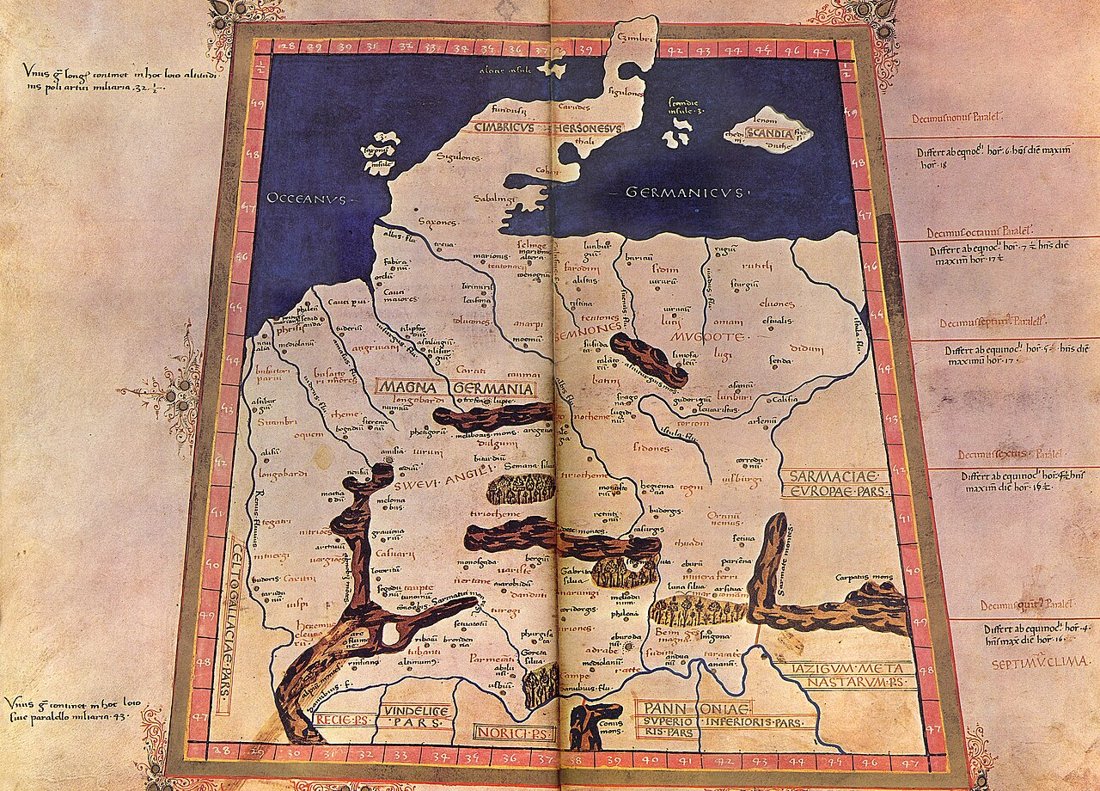
Ptolemy works quite differently. His Geography is essentially a register of places and peoples with coordinates, from which maps were meant to be drawn. For the region east of the Oder he names the Lugii three times, each time with an addition identifying a sub-group. In the common text the name forms read:
Λοῦγοι οἱ Ὀμανοί … Λοῦγοι οἱ Διδοῦνοι … Λοῦγοι οἱ Βοῦροι
"The Lugii, (called) the Omanoi … the Lugii, the Didunoi … the Lugii, the Buroi."Claudius Ptolemy, Geography 2.11 (paragraph numbering varies between editions); only the three name forms from the Greek text are drawn together here, English rendering made by us
The form is striking: Ptolemy does not write "the Omanoi" but "the Lugii, the Omanoi". The league name comes first, the individual name follows as a distinction. According to Ptolemy the Omanoi lie south of the Burgundians, whom he places between the Oder and the Vistula, and below them the Didunoi as far as a range he calls Askiburgion. The Buroi he places further south, near the sources of the Vistula.
The equation Omanoi = Manimi is genuinely represented in the scholarly literature, and not as a fringe opinion. Günter Neumann mentions it in the collective entry "Lugier" of the Reallexikon der Germanischen Altertumskunde (2nd edition, vol. 19, 2001), and Klaus Tausend takes it for granted in his paper "Lugier – Vandilier – Vandalen" (1997). Older scholarship, such as Gudmund Schütte in his reconstruction of Ptolemy's maps of northern Europe (1917), already put the two names together.
But one should say precisely what the equation rests on: a similarity of sound and the fact that both names stand under the umbrella of the Lugii. Nothing more. Manimi and Omanoi are not the same form; one has to assume either a lost or an added syllable. That is not unusual for ancient ethnic names that passed through several languages and many copies – but it remains an assumption. The equation is plausible, not proven.
A separate entry "Manimi" in the major reference works could not be traced for this article; the Manimi are treated in the context of the Lugii. That in itself is a finding: scholarship simply does not have enough material on this name for an article of its own.
The name forms wobble on both sides. In some editions and overviews Ptolemy's groups appear as Iomannoi and Idounoi, in others as Omanoi and Dounoi or Didounoi. An obvious explanation for the initial I is the Greek article hoi, which could be written together with the following name or divided differently in transmission. For the second name short and long forms compete.
Such fluctuations are not a side issue. Anyone comparing Omanoi with Manimi is comparing two forms that are each already editors' decisions. Hang the letters differently and the similarity shifts as well. That is why careful accounts phrase such equations cautiously and speak of a "usual" or "generally accepted" identification rather than a certain one.
Of Tacitus' five names, at best one reappears in Ptolemy. Conversely, Tacitus knows neither Didunoi nor Omanoi in that form. This minimal overlap is what makes the Manimi genuinely interesting, because it shows how ancient ethnography came into being.
Neither Tacitus nor Ptolemy ever travelled between the Oder and the Vistula. Both wrote at second and third hand: from the reports of traders, officers, envoys and older writers. An amber trader moving from the Danube to the Baltic knew different names from an officer negotiating with an embassy. A traveller heading north learned the names of the people with whom he stopped – not those of the neighbours two valleys away.
Then there is the question of who does the naming. A name may be a self-designation, a label given by neighbours or a rendering by an interpreter. The same group could thus appear under two names in two reports, and two different groups under similar-sounding ones. An ancient author's list is therefore first of all a list of his sources.
The three ancient witnesses to the Lugii lie far apart in time. Strabo writes under Augustus and Tiberius and names the Lugii as a large people within the realm of the Marcomannic king Maroboduus, without sub-groups. Tacitus writes around 98. Ptolemy composes his Geography around the middle of the 2nd century but relies in large parts on older models, above all the geographer Marinus of Tyre.
This means Ptolemy's information may be older than his book. Klaus Tausend built a layer model from this. In Ptolemy he sees an earlier state of the league, in Tacitus a later one in which new groups with Germanic names stand beside the old ones. Whether or not one follows the model, it makes clear that two lists need not describe the same moment. Placing them side by side like two photographs taken on the same day may mean overlooking half a century or more.
Then there is the working method. Ptolemy assigned longitude and latitude to every people and place. For the interior of Germania he had hardly any measured values; he worked with route data, days of travel and estimates. The result is distortion of the kind familiar from his depiction of Britain, and it occurs east of the Rhine as well.
For the Omanoi this means that their position "below the Burgundians" is a point on a calculated map, not a description from the ground. Anyone deriving a modern landscape from it is stacking uncertainty on uncertainty. Modern reconstructions place the Lugii as a whole north of the Sudetes and western Carpathians between the Oder and the Vistula. A more precise address for the Manimi or Omanoi does not exist.
One peculiarity sets the Manimi apart from their neighbours in Tacitus' list. Klaus Tausend regards Manimi as the only one of the five names that is pre-Germanic, while he places the Harii, Helvecones, Helisii and Naharvali rather in a Germanic setting. Ptolemy's three group names he considers non-Germanic altogether. Reinhard Wenskus had already, in 1961, seen the Buri, Manimi and Dunoi as non-Germanic fragments that joined Germanic groups under the name of the Lugii.
This fits well with the equation Manimi = Omanoi: if precisely the name that stands out in Tacitus is also the only one with a counterpart in Ptolemy, it may belong to the older layer of the league. But it must be added honestly that a convincing etymology is lacking. Which language lies behind Manimi and what the word means is unexplained. "Pre-Germanic" is at first a negative statement here: no satisfactory Germanic interpretation has been found.
A further, older suggestion links the Manimi with the Atmonoi, whom Strabo names as a branch of the Bastarnae. This link rests on sound alone and is rarely maintained today.
One name connects both lists beyond doubt, just not in the same way. The Buri appear in Ptolemy as "the Lugii, the Buroi". Tacitus names them too, but counts them not among the Lugii but among the Suebi, because they resembled them in language and way of life. Later the Buri appear in the Marcomannic Wars as an independent partner of Rome.
This is a helpful control case. The same group stands inside the Lugian league in one author and outside it in the other. Either their affiliation changed, or the authors classified by different criteria – Tacitus by language and custom, Ptolemy by position on the map. Both are possible, and both show that membership of a league was not a fixed property but a classification that shifted with the point of view.
Archaeologically the Lugian area is usually linked with the Przeworsk culture, which from the late 3rd century BC into the Migration Period covered large parts of present-day Poland. Characteristic are cremation cemeteries, weapons in men's graves and a distinctive pottery. Kazimierz Godłowski considered it defensible to connect the Lugii wholly or partly with this cultural area.
Godłowski himself warned, however, against inferring a people directly from a material culture. For individual names such as Manimi, Helisii or Omanoi this applies all the more: no cemetery and no settlement can be assigned to any of these names. Archaeology supplies a frame in which the Lugii may have lived – it does not supply a house number for the Manimi.
After the 2nd century the Lugii largely disappear from the sources; the Vandals take their place. Pliny the Elder already knows the Vandili as a large eastern group but does not mention the Lugii at all. Helmut Castritius interprets this as two names in parallel use for a largely overlapping population, one of which later prevailed.
No line can be drawn to the Manimi themselves. What is attested is something else: Ptolemy names the Silingi below the Semnones, and the scholarly literature derives the name of Silesia, via Mount Ślęża and the river Ślęza, from these Vandalic Silingi. Tausend identifies them with Tacitus' Naharvali. The Manimi play no part in this chain – anyone linking them to Silesia regardless stretches an interpretation beyond its evidence.
In the end little remains of the Manimi, but something important. They show that ancient lists of peoples are not censuses but second-hand snapshots: dependent on informants, on the period from which the news came, and on the language a name passed through before it was noted down in Latin or Greek.
Anyone who puts Norse and Germanic names on wood, slate or glass today faces a related question: which form of a name is the "right" one? Often there are several, and each has its own history. With the Manimi the honest answer is that we know two spellings from two worlds that probably belong together – and that precisely this uncertainty is part of the name's story.

The Lugii · The Helisii · The Harii · The Helvecones · The Nahanarvali · The Buri · The Vandals · The Suebi.
All History & Finds articles →
Some ancient peoples left cities behind, others graves, others at least a name cut into a tombstone. The Marsigni left …
Read more →