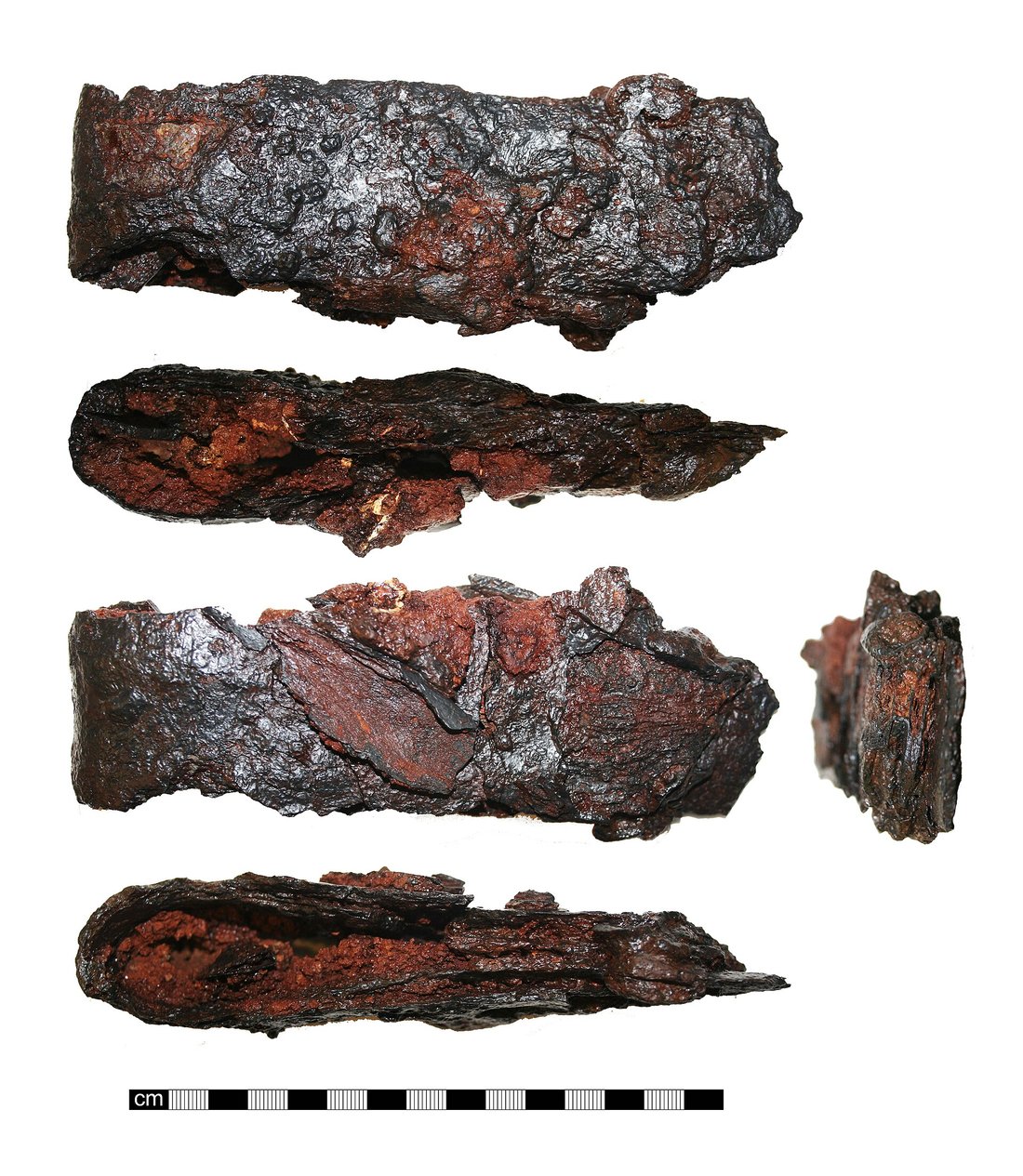
Hold a well-preserved blade from the Migration or Viking age in the right light and you notice something strange: a pattern ripples across the steel like waves, plaitwork, or a sleeping serpent. That is not engraving and not chance, but pattern-welding – one of the most demanding crafts of early smithing. Let us look closely at how it was made, what it could do, and, just as importantly, what it was not.
Pattern-welding is a process in which several iron and steel rods with differing properties are forge-welded together, twisted, and drawn out again. Grind and etch the finished blade afterwards, and the boundaries between the different materials emerge as a visible pattern: herringbones, waves, looped bands, often with a serpentine flow through the core of the blade.
A clean distinction matters from the very start, because few subjects are muddled as often: pattern-welding is a composite technique made from several folded and twisted rods. It has nothing to do with Indian crucible steel (wootz, sold as "true Damascus"), whose pattern arises from the solidification of a single melt. Two entirely different roads to a superficially similar image – more on that later.
Pattern-welding flourished in the Roman imperial period, the Migration age, and the early Viking age – roughly from the 2nd to the 10th century. It is the true signature of early medieval blade smiths, and a chapter that belongs in any honest conversation about the Viking sword.
To understand pattern-welding you first have to know the basic problem of early ironmaking. What came out of the bloomery furnace was not uniform steel but a spongy bloom – a lump of pure iron, carbon-rich steel, phosphoric iron, and slag, all mixed together. Good, evenly carburised steel was scarce, expensive, and almost impossible to obtain in large pieces.
The smiths' answer was as pragmatic as it was ingenious: sort the material by its properties, forge it into narrow rods, and build the blade from several of them. Soft, tough iron formed the backbone that absorbed bending and blows; hard steel went where cutting mattered. Thus a stubborn raw material became a capable weapon – and necessity became an art form.
From the same logic the pattern arose almost as a by-product: weld rods of differing composition, twist them, and the inner layering became visible at the surface. What began as a material strategy was soon staged deliberately.
The sequence is essentially the same everywhere, even if every workshop had its own tricks. First, thin rods of different iron types are stacked and forge-welded at white heat – a delicate moment, for scale or a cold hearth means a cold, unreliable weld. This packet is drawn out, folded, and welded again, producing many fine layers.
The decisive step for the classic wave-and-serpent pattern is the twist: the layered rod is turned on itself while glowing. Where the layers wind around the axis, forging them out again yields the characteristic "woven" look. Several such twisted rods – some counter-twisted, some twisted only in sections – are laid side by side and welded. This produces herringbone, lozenge, or the famous banded patterns.
Only at the very end does the pattern appear. The blade is ground, finely polished, and etched with a mild acid – plant juices, vinegar, or tannins, for instance. The different iron types react differently and stand apart in brightness and tone. The pattern, let us stress, is therefore a surface phenomenon, revealed by grinding and etching – not a solid image stamped through the metal. Regrind a pattern-welded blade hard, and you can alter or even partly lose the pattern.
An often overlooked but central point: on most high-quality blades, the pattern-welding forms only the core and the faces. The cutting edge itself is a separate strip of hardenable, higher-carbon steel, welded around the pattern-welded core.
This makes great metallurgical sense: the soft, tough, patterned core gives the blade spring and stops it snapping; the welded-on steel edge can be hardened and holds its bite. The beautiful core and the sharp edge are thus two separate components with two different jobs. That is a key to judging these blades correctly – and to dispelling the biggest myth, namely that the pattern itself made the blade sharp or strong.
What modern metallography reveals in pattern-welded steel is soberingly beautiful. Cut a section, polish it, and etch it with dilute nitric acid in alcohol (the classic Nital etch), and the layers stand out clearly under the microscope. You see alternating layers of nearly pure, low-carbon iron, of higher-carbon steel – and, crucial for the pattern, of phosphoric iron.
This phosphoric iron is the true "bright" partner in the pattern. Studies of measured blades typically find roughly 0.4 to 1.4 weight-percent phosphorus there. Phosphoric iron resists the weak etching acids better than ordinary iron and therefore stays silvery-bright, while the higher-carbon layers darken. Exactly this contrast produces the image.
And strength? Mechanical tests on re-forged samples (Thiele et al. 2015, Archaeometry) systematically compared iron, phosphoric iron, steel, and pattern-welded combinations. The result: pattern-welding gives no significant mechanical advantage. It makes the blade neither harder nor noticeably tougher than a sensibly built piece of a few layers. The phosphoric iron was apparently chosen chiefly because it etches bright – that is, for looks. Pattern-welding is thus, plainly put, first and foremost craft and display, not an engineering trick.
What is secure: Pattern-welding is a composite technique of twisted, forge-welded rods of differing composition; the pattern is revealed at the surface by grinding and etching. The bright layers are typically phosphoric iron (roughly 0.4–1.4 % P). On quality blades the cutting edge was welded on as a separate steel strip. Metallography and mechanical testing (Thiele et al. 2015) show no significant strength gain from the pattern itself. And as early as the 6th century, Cassiodorus (Variae V,1) describes patterned blades of the Warni.
That contemporaries perceived this pattern as something special is no modern guess – we have an awestruck first-hand witness. Around 523/526 the Ostrogothic king Theoderic, in a letter drafted by Cassiodorus, thanks the king of the Warni for a gift of precious swords. Cassiodorus, a Roman-educated official, visibly gropes for words for what he is seeing:
Harum media pulchris alveis excavata quibusdam videntur crispari posse vermiculis: ubi tanta varietatis umbra conludit, ut intextum magis credas variis coloribus lucidum metallum.
"Their middle, hollowed with beautiful grooves, seems as if it could curl with tiny worms: there plays such a shadow of variety that you would sooner believe the shining metal to be woven from many colours." – Cassiodorus, Variae V,1 (to the king of the Warni, c. 523/526); translation: Glanz & Gravur
This sentence rewards close reading, because it hits the mark with startling precision. Cassiodorus sees "tiny worms" (vermiculi) – the twisted pattern looks like crawling serpents. He sees a play of light and shadow, a metal that appears "woven from many colours". And in the same letter he praises how the blades are freshly ground and polished with a "shining powder" until the iron shines like a mirror. That is a description of etched, polished pattern-welded steel, some fifteen hundred years old. The "serpent in the sword" owes the technique its byname to this day.
If the blade already carries an image, the question naturally follows: did that image mean anything? The honest answer: we do not know for certain. No contemporary text explains that a herringbone stands for this and a wavy band for that. Blade names, pride of origin, the aura of an heirloom – all of that survives in poetry, but a fixed "pattern symbolism" cannot be proven.
The case is different with inlaid marks. In later blades a strip was often chiselled into the pattern-welded or homogeneous core and filled with twisted wire of bright or patterned material – producing legible inscriptions and symbols in the very middle of the blade. Most famous is the signature +VLFBERHT+, along with pious formulas such as +INNOMINEDOMINI+. Here the blade truly carries a "message" – but it is inlaid script, not the weld pattern itself. If these famous blades interest you, there is more in the piece on the Ulfberht sword.
If pattern-welding brings no mechanical advantage and costs enormous labour – why did smiths cultivate it for centuries? Because the pattern was exactly what one expected of a prestige weapon: a visible proof of skill, material, and rank.
To make a pattern-welded blade meant binding the scarcest material (good steel and clean phosphoric iron) through many hours of work into an object one could not buy but only give – witness the Warni gift to Theoderic. The sword was no mere tool but a token of status, a diplomatic gift, an heirloom. The pattern was the language in which that value became visible. That is what the effort was about: not sharper, but more beautiful, rarer, more meaningful. For a broader view of equipment and rank, see our weapons lore.
Pattern-welding did not fall from the sky with the Vikings. Its roots reach deep into the Iron Age. Even among the Celtic La Tène swords and in the Roman imperial period there are blades made of composite rods, and mature, deliberately twisted pattern-welding is already fully developed in the great bog finds of the Migration age – such as the northern European army sacrifices.
From there an unbroken line runs through the Merovingian and Carolingian workshops into the Viking age. Cassiodorus' Warni letter stands right in this chain: it attests that around 500, in the Germanic north, blades were forged of a quality for which a Roman court gave explicit thanks. The Vikings, then, were not the inventors but the last great masters of a very old art.
Impressive as the technique was, it vanished. The reason lies in the progress of steelmaking. As soon as larger quantities of uniform, well-carburised steel became available, the whole effort lost its point: one could now make blades from a few homogeneous layers, or even from a single piece, that cut just as well or better – without the endless folding and twisting.
Over the course of the Viking age, pattern-welding therefore recedes from the blade body. In its place comes the inlaid inscription: the blade now advertises itself with a legible name like +VLFBERHT+, no longer with the woven pattern. The later, high-quality Ulfberht blades consist at the core of homogeneous, high-carbon steel and are precisely not pattern-welded – a neat proof that better metallurgy replaced the old showpiece technique. On how blades are ordered by their forms, see the Petersen typology.
Let us return to the most stubborn misunderstanding. In the trade, pattern-welded steel is often called "Damascus steel", and that is exactly what sows confusion. Two things must be kept cleanly apart:
Pattern-welded damast is what this article is about: many layers of different iron types, welded and twisted, the pattern revealed by etching the boundaries. That is the early medieval Germanic technique. Wootz or crucible steel (the "true", originally Indo-Oriental Damascus) is something quite different: a high-carbon steel whose pattern comes not from welded layers but from carbide precipitation as a single melt slowly solidifies. Both look patterned, but arise by wholly different routes, from different times and regions.
The famous crucible-steel Ulfberht blades belong metallurgically nearer the wootz world – and for that very reason are not a case of pattern-welding. Throw the two together, and you blur exactly what makes each technique special.
Myth-check: Pattern-welding is not the same as wootz/"Damascus crucible steel" – one technique welds many rods, the other lets a melt solidify. The weld pattern does not make a blade sharper or unbreakable; tested, it shows no mechanical advantage (Thiele et al. 2015). Nor are there "magic runes forged in" – the visible pattern is a surface phenomenon revealed by grinding and etching, and legible inscriptions like +VLFBERHT+ are separately inlaid wires, not weld pattern. And finally: the sharp edge is a separately welded steel strip, not the woven pattern itself.
What fascinates us most about pattern-welding is the underlying idea: a material is worked so that its inner structure becomes a visible language of signs. The smiths of the Migration age did not simply paint an image onto the steel – they made the material itself into the pattern. Surface and meaning coincide.
Precisely this thought carries into our own workshop. When we engrave a motif in natural slate or wood, we work not against the material but with it: the grain of the wood, the fracture edge of the slate, the bright cut on a dark ground – that is our version of the old principle of turning structure into an image. Pattern-welding reminds us that ornament and craft in the north were never mere decoration, but a way of making rank, skill, and history legible. More on the roots of this thinking in our piece on Norse smithing.
The Viking Sword · The Ulfberht sword · Weapon Lore · La Tène Swords · The Petersen Typology.
