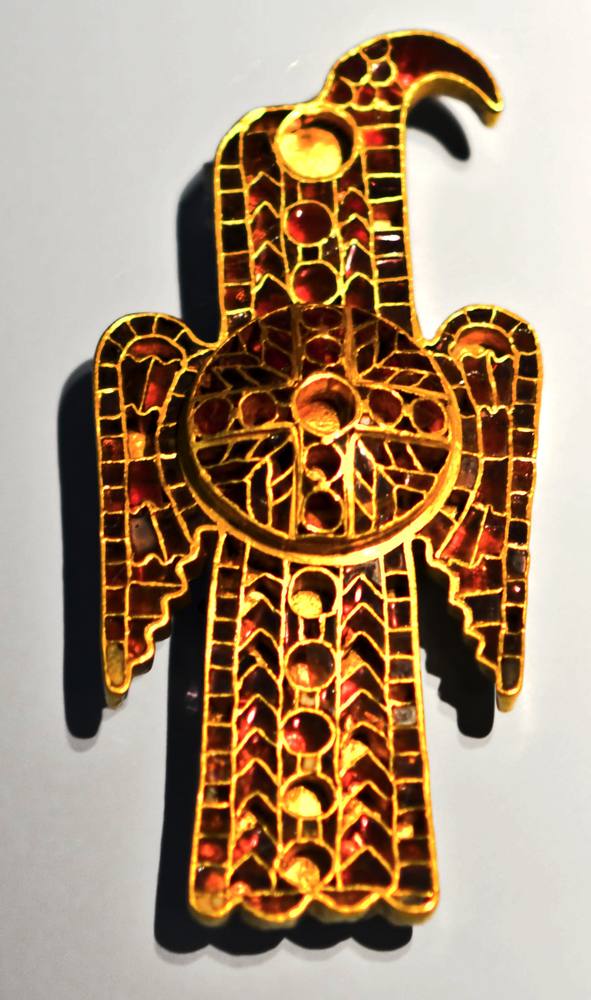
Read "Tervingi" and most people think "Visigoths". The sources allow that equation only with reservations. The Tervingi were a Gothic grouping that lived north of the lower Danube in the fourth century, wrung treaties out of Rome, asked for admission at the river in 376 and defeated a Roman emperor at Adrianople in 378. This article follows the texts, separates evidence from interpretation and says plainly where we can only guess.
The Tervingi, Latin Tervingi and usually spelled Theruingi by Ammianus Marcellinus, were a Gothic grouping of the third and fourth centuries. Their territory lay between the lower Danube and the Dniester, by the usual reckoning in what is now Romania and the Republic of Moldova, in the regions of Wallachia and Moldavia. That placement is a reconstruction from scattered hints, not a tribal border drawn by any ancient author. What is firm is only this: Roman writers located them north of the river, and Roman campaigns against them crossed the Danube into a hinterland the Romans called Gothia.
The name first appears around 291/292 in a speech praising the emperor Maximian, the so-called Panegyric, traditionally attributed to a Claudius Mamertinus. Later mentions include Eutropius, who places the Tervingi in Dacia north of the Danube for 369, and Ammianus Marcellinus, our most important witness. Ammianus was a Roman officer and historian from Antioch who wrote his Res gestae in Rome in the 390s; Book 31 deals with the Gothic war. For the Tervingi he is the main source, but not a neutral one: he writes as a Roman, after the events, with a sharp eye for the failures of Roman administration.
Alongside him stand Jordanes, a sixth-century author who summarised a lost work by Cassiodorus in his Getica and therefore writes some two centuries after the events; the church historians Sozomen and Socrates of the fifth century; the poet Claudian around 400; Eunapius and Zosimus, whose accounts depend heavily on lost material; and the Passio Sabae, the account of the martyrdom of the Goth Sabas. Each has a viewpoint. To understand the Tervingi you have to lay them side by side and let the contradictions stand.
A word on terminology: "grouping" is chosen deliberately. Whether the Tervingi were a "people" in the sense of shared descent is disputed. Many scholars see the Gothic groups of the fourth century as political formations that gathered around leaders and military success and took in new members. The origins of the Goths as a whole are treated in the article on the Goths; here the subject is the part Rome called Tervingi.
What "Tervingi" means, we do not know. There are proposals. In 1911 Moritz Schönfeld connected the name with a Gothic word for "tree" or "wood", which would yield "forest people"; this is the most popular reading and is often presented as fact. It is a suggestion derived from the sound of the word, not a finding of the sources. No ancient author explains the name. The Swede Johannes Svennung thought instead of a Scandinavian origin meaning "ox people". Both readings are possible in the present state of research; neither is secure.
Herwig Wolfram, whose book on the Goths long shaped the German-language debate, held Tervingi and Greuthungi to be exonyms: each group would have called the other by these names, while the Tervingi called themselves "Vesi". That is a bold thesis and a contested one. Peter Heather called the equation of Vesi with Tervingi "entirely arguable, but so is the opposite". This is a question the sources alone cannot settle, and whenever we write the forest-people sentence, we should attach "perhaps" to it.
The spellings vary too: Tervingi, Theruingi, Thervingi, and in Eutropius even forms such as Terviginti. That is not unusual for names a Roman scribe wrote down by ear, and it says nothing about the group itself. In this article we write "Tervingi" and give the Latin form where it matters.
The prehistory of the Tervingi lies in darkness. Gothic groups appear in the third century on the north coast of the Black Sea and on the Danube; the raids of the years around 268 end at Naissus, where, according to Zosimus and others, the emperor Claudius II defeated the Goths. Whether Tervingi were among them we do not know; the sources do not name them there. The Historia Augusta, which lists a series of defeated peoples that might include the Tervingi, probably dates only to around 400 and is weak evidence.
The ground firms up in the fourth century. Jordanes reports that the Gothic ruler Ariaric made a treaty with Constantine around 332, after Constantine's son had defeated the Goths. Roman gold medallions found in Gothic regions are connected with this peace. Whether Jordanes means the Tervingi specifically is interpretation; he says "Goths". That a treaty existed and lasted for decades is considered likely, for into the 360s the Goths appear on the Danube as allies and suppliers of soldiers to Rome.
That changed in 366/367, when Tervingi supported the usurper Procopius, who had rebelled against the emperor Valens. Procopius fell in 366. Valens took this as a reason for war. According to Ammianus (27,5) he led troops across the Danube in 367 but found no opponent, because the Tervingi withdrew into the mountains that Ammianus calls Montes Serrorum. The following year a flood prevented another crossing. In 369 Valens managed to push deep into the territory. Athanaric had to retreat and made peace.
Athanaric is the first Tervingian figure we can grasp with any confidence. Ammianus calls him Athanarichus Theruingorum iudex, "judge of the Tervingi" (31,3,4). It is notable that Ammianus writes iudex and not rex, "king". Scholars read this as a sign that in the fourth century the Tervingi had no fixed royal dynasty but a leading stratum from which a leader was chosen for a limited time. That is an interpretation. Jordanes, by contrast, looking back, gives the Tervingi kings.
The scene of 369 is one of the best-known images of the period. According to Ammianus (27,5,9), Valens and Athanaric did not negotiate on land but in boats in the middle of the Danube. Athanaric is said to have declared that he had sworn an oath never to set foot on Roman soil. So the meeting stayed on the water. Beyond that core, peace on the water, the summaries I rely on give nothing more; I have not checked the economic terms of the treaty.
In the literature Athanaric is often presented as Fritigern's opponent and as a "pagan" traditionalist. That has a true core, but it simplifies. Socrates and Sozomen, church historians of the fifth century, and Zosimus report a civil war between Athanaric and Fritigern in which Fritigern received Roman help and became a Christian in the process. Ammianus and Philostorgius do not mention this war. A source that is otherwise as precise about the Tervingi as Ammianus, yet is silent about a civil war, is a reason for caution. What remains is a recognisable tension between Athanaric and other Tervingian leaders.
Christianity reached the Tervingi not through a mission campaign but by detours. Roman captives, carried off on raids into Asia Minor, brought their faith with them; by tradition Wulfila also came from such a family, with ancestors said to have come from Cappadocia on one side or the other (exactly how is open). Wulfila, Latin Ulfilas, lived by the usual dating from about 311 to 383. The fullest source is a letter from his pupil Auxentius of Durostorum, written soon after his death; shorter notices come from Socrates, Sozomen, Theodoret, Philostorgius in the summary of Photius, and Jordanes.
According to these witnesses Wulfila was consecrated bishop; scholarship prefers the year 341 (336 has also been proposed). He worked among the Goths and, around 348, after a persecution of Christians, had to withdraw with a group of followers into Roman Moesia, to the area of Nicopolis. Little is known of his later life. He took part in the Council of Constantinople in 360 and died in Constantinople in 383. Whether the persecution of 348 affected the Tervingi in the narrower sense, the sources say only of "Gothia"; the attribution is an inference from the region.
Wulfila's creed is called "Arian". The term is blurry. What is meant is the Homoian current, formulated at the Synod of Sirmium in 357, which described the relation of Father and Son as "like" rather than "of one substance". "Arian" is the polemical label of later opponents. Wulfila and the Goths simply called themselves Christians. Why the Goths adopted this branch has a simple but unattested explanation: in Wulfila's day the imperial court at Constantinople, under Constantius II and later Valens, leaned largely toward the Homoian side.
Wulfila is famous for the Gothic Bible. He is regarded as the creator of the Gothic script, which rests mainly on the Greek alphabet and takes signs from the Latin alphabet and from runes. The Bible translation is traditionally dated to about 369 and ascribed to him. Linguistic research has doubted this: style and translation technique point to a team of translators, possibly under his direction. Large parts survive in later manuscripts, among them the famous Codex Argenteus, made in Italy in the sixth century; the manuscripts are therefore much younger than Wulfila's time. The Gothic Bible is the largest monument of the Gothic language and the oldest long text in any Germanic language. But the link to the Tervingi remains an inference: they spoke a dialect of Gothic, and the surviving manuscripts were made centuries later and in Italy.
In the 370s Athanaric persecuted Christians. Sozomen speaks of more than three hundred victims. Ammianus does not mention the persecution. It is best accessible through the Passio Sabae, a martyr account in the form of a letter from the Gothic church to the church of Cappadocia. According to it, Sabas died in April 372, after Easter, in the land beyond the Danube. Historians value the Passion because incidentally it shows village life and the order of Gothic settlements: there were village heads, communal sacrifices, oaths, and an administration that had Christians tracked down.
The account tells that Sabas refused to eat sacrificial meat. He was banished and came back. When the village was asked to name its Christians, he said aloud that nobody should swear an oath on his behalf, he was a Christian. After Easter 372 a prince named Atharid had him and the priest Sansalas arrested. Sabas was beaten and drowned in the river Musaeus. Christians recovered the remains and sent them into the Roman Empire; Bishop Ascholius of Thessalonica received them, and Basil of Caesarea later obtained relics through the commander Junius Soranus. Letters of Basil from the mid-370s mention the transfer. The skeleton of the account is therefore well supported.
The details, by contrast, belong to the saint's tale. Thorns, pestle and turns of conversation are hagiography. The river Musaeus is traditionally identified with the Buzău in Romania, but other rivers have been proposed. The date 12 April is the Western one; the Eastern church keeps the day differently. For the Tervingi the Passion shows that there were Christians among them, that they lived as a minority, and that the authorities at times saw them as a threat. It proves no more than that, and it does not prove that Athanaric personally pronounced every death sentence.
Archaeologically, the area in which Tervingi and Greuthungi are suspected is linked with the Sântana de Mureș–Chernyakhov culture, named after sites in Romania and Ukraine (Chernyakhiv near Kyiv). It lasted roughly from the second or third century into the fifth and spread over parts of present-day Ukraine, Romania, Moldova and Belarus. That distribution is much larger than any territorial statement in the written sources about the Tervingi, and therein lies the problem.
What the finds show is a picture of settled farmers: settlements in river valleys, mostly unfortified, the largest known, Budesty, said to cover about 35 hectares. Wheat, barley and millet were grown; cattle were the main livestock and metalworking was widespread. Graves follow two rites, cremation and inhumation, the dead often lying with the head to the north. Grave goods are mostly pottery, bone combs and iron tools; weapons are almost entirely absent. The wheel-thrown pottery shows influences from the Sarmatian, Roman and La Tène spheres, and Roman amphorae attest trade.
How to read this picture is disputed. Soviet scholars saw ancestors of the Slavs in it. Many western and Polish scholars linked the culture with the Goths. Today the majority reckon with a mixture of groups already living there, including Sarmatians and Getic-Dacian populations, with a possible Germanic share. Peter Heather holds that Gothic immigration from the Wielbark area played a large part; Guy Halsall and Michael Kulikowski dispute the link with the Wielbark culture, and Kulikowski doubts that Goths existed as a distinct group before the third century. A genetic study of 2019 tentatively assigned three individuals to the Gothic component but described the culture as ethnically mixed overall.
For this article that means: the Chernyakhov culture is the find frame in which the Tervingi lived, but not proof of them. Anyone who calls a grave of this culture "Tervingian" relies on an assumption, not a finding. The idea that the culture's end in the fifth century was caused by the Huns is likewise treated more cautiously today: the political order seems to have broken down rather than a population simply vanishing.
Ancient authors already speak of two Gothic groups. Besides the Tervingi, Ammianus names the Greuthungi (Greuthungi), who by the usual reckoning lived in the steppe east of the Dniester as far as the Don; as their neighbours he lists the Tanaitae. The name of the Greuthungi is explained in various ways, for instance as "gravel people" or "steppe people", an explanation as uncertain as the forest people. Both names are, according to Wolfram, more geographical labels than tribal names. In the sources the Tervingi are often paired with the Greuthungi: in the Historia Augusta, Greuthungi stand with "Austrogothi" and Tervingi with "Visi".
On the other side Jordanes is decisive. He equates the Greuthungi with the Ostrogoths and makes Ermanaric the ancestor of Ostrogothic kings such as Theoderic. Against this equation stands the fact that Ammianus describes him differently: as a leader with a smaller realm. Most modern historians reject the simple equation. Around 399/400, in a poem about a rebellious group in Phrygia, Claudian is the first to name the Ostrogoths and sets them beside the Greuthungi; however, he mostly uses the names side by side and mixes them. On this basis the relationship of the groups cannot be settled. What belongs to the Ostrogoths is the business of the page on the Greuthungi; here it is enough to say: the Greuthungi are neighbours, not a subgroup of the Tervingi.
In 376 the two groups act together. Alatheus and Saphrax, who led the Greuthungi for the still young king Videric, crossed the Danube, according to the summaries, and joined the Tervingi under Fritigern. According to the same summaries, Ammianus himself names a Greuthungian king Vithericus whose request for admission was at first refused. How the two fit together I have not checked in the wording, and I treat it as open.
Ammianus opens Book 31 with the appearance of the Huns, a mounted people he describes in unfriendly terms. In the early 370s they subdued the Alans and then the Greuthungi. Ermanaric, whom Ammianus presents as a Greuthungian ruler, took his own life; his successor Vithimir fell in battle. Athanaric faced them on the Dniester. Together with other leaders, among them Munderic and Lagarimanus, he was defeated and withdrew into the mountains, a region called Caucaland. The dating of his flight is not secure.
The Tervingi who did not follow Athanaric moved to the Danube. Their leaders were Alavivus and Fritigern. They asked Emperor Valens for admission. Why? The standard reason is that the Huns drove them. More recent authors, such as Hoppenbrouwers and Blockmans, suspect that after the negotiations of the war of the 360s other motives also played a part. That too is interpretation; Ammianus names the Huns, and he had no interest in playing down the responsibility of the Roman administration.
Valens agreed. Ammianus writes (31,4,8) that Fritigern was admitted first, together with Alavivus: et primus cum Alavivo suscipitur Fritigernus. The emperor ordered that they be given food and land to farm. The Romans ferried the Goths across the river in boats, on rafts and in hollowed tree trunks; many drowned in the swollen stream. Ammianus describes the Roman officials who welcomed this influx as a source of recruits and gold, and he interprets it as the beginning of the ruin of the Roman world.
How many Goths crossed the Danube is unknown. Eunapius gives 200,000 people, considered an exaggeration. Peter Heather estimates some 10,000 warriors among the Tervingi; Noel Lenski assumes 40,000 to 50,000 warriors for all the immigrants together. Worlds lie between these figures, and none can be tested against a source.
Supply failed. Responsible, according to Ammianus, were the commanders Lupicinus in Thrace and Maximus. They exploited the need of the starving Goths and traded dogs for slaves; among the Gothic children who fell into servitude this way were sons of chieftains.
"… as many dogs as their insatiability could scrape together from everywhere, they gave for a single slave each."Ammianus Marcellinus, Res gestae 31,4,11: quantos undique insatiabilitas colligere potuit canes, pro singulis dederunt mancipiis (public domain; own translation)
This is the passage on which the charge against the Roman officers rests. What is notable is to whom Ammianus ascribes the greed: to insatiabilitas, insatiability, on the Roman side. Anyone who reads the sentence as evidence of Gothic rapacity reads it against its author.
Escalation came at Marcianople. According to the summary, Lupicinus had Fritigern and Alavivus seized at a banquet; Fritigern escaped, Alavivus vanishes from the sources. The Goths rose, and the army of Lupicinus was destroyed at Marcianople. That began the Gothic War, which lasted from 376 to 382.
The Goths ravaged Thrace. First, groups already serving in the Roman army joined the revolt; at Adrianople they besieged the city, failed, and scattered across the countryside. In 377, at Ad Salices, the "Willows", there was a bloody draw between the Goths and Roman troops under Traianus; Profuturus fell. The Romans tried to block the passes of the Haemus and failed; raids reached the Rhodope mountains and the Hellespont. Fritigern withdrew into a wagon fort and later won Hunnic and Alan horsemen to his side.
In 378 Valens marched out from Constantinople with Sebastianus. Gratian, the western emperor, was held up by fighting on the Rhine. On 8 August Fritigern offered peace; Valens refused and attacked on 9 August without waiting for Gratian. That was against the advice of his cavalry commander Victor, who wanted to wait. While talks were under way, the Gothic cavalry under Alatheus and Saphrax returned from foraging and fell on the Roman flanks. The Roman army dissolved; the killing went on until evening. About two thirds of the army was lost, by Heather's estimate between 10,000 and 15,000 men, by Williams and Friell about 20,000. Gothic losses are unknown.
Valens's end is unresolved. He may have fallen on the field; his body was never found. A later story, that he fled into a farmhouse which the Goths set on fire, stands as an alternative and is not secure. It should not be told as fact by anyone who wants to be honest. Ammianus 31,12-13 is the main account; Zosimus and Socrates also tell of the battle.
Later authors made Adrianople the turning point in Rome's fall. Scholarship weighs that: the defeat destroyed the core of the eastern field army, but it meant neither the end of Rome nor the beginning of an ordered Gothic kingdom. Whether Gratian chose Theodosius or the eastern army forced him when Theodosius became emperor on 19 January 379, the sources do not explain.
After 378 the Goths divided, probably because the large army was hard to feed, as Heather suggests. The Greuthungi moved to Pannonia, the Tervingi to Macedonia and Thessaly. In 379 a Roman officer, Julius, had Goths in the East massacred, which set off unrest. On 3 October 382, after negotiations under Richomeres and Saturninus, peace was declared. The Goths were settled inside the Empire as foederati, allies with their own leaders, in Scythia, Moesia and perhaps Macedonia. The orator Themistius celebrated it as a Roman victory but admitted that the Goths could not be defeated.
Fritigern vanishes from the sources after 381. He may have died in Greece, or he may have been deposed as part of the peace; this cannot be decided. Athanaric arrived unexpectedly in Constantinople in January 381, was received by Theodosius and died there soon after. Jordanes, Orosius and Zosimus describe a treaty of friendship under which Tervingi were settled as federates. Ammianus and Themistius, by contrast, see Athanaric as an exile seeking refuge. Here, too, the sources contradict one another, and the article does not decide for either side.
After 400 the names Tervingi and Greuthungi disappear from the sources. They did not disappear because the people vanished, but because new designations came into use.
The standard narrative of Gothic history, going back to Jordanes, presents the Visigoths (Visigothae) as successors of the Tervingi; he links Athanaric with later kings from Alaric I to Alaric II. There is this much truth in it: a large part of the Goths who later built a kingdom in Gaul and Spain had their roots in the Gothic War of the fourth century. But the road was not straight. The Goths who sacked Rome in 410 are not simply the Tervingi of 376: since the peace of 382 they had merged with other groups, among them Greuthungi, Roman deserters and people from the surrounding lands, and they had new leaders.
Research calls this ethnogenesis: a grouping forms anew over decades by taking in members, selecting traditions and adopting a common name. The name "Visigoths" appears only in the late fourth and fifth centuries. The Notitia Dignitatum (around 388-391) names "Vesi" and "Tervingi"; Wolfram reads this as an equation, Christensen holds the two to be separate units, which would point to separate groups. Whoever equates "Tervingi" and "Visigoths" decides an open question in favour of one side.
A related example of the problem is other groups with Gothic ties: the Gepids, whom Jordanes portrays as kin of the Goths, the Vandals as another great grouping of the Migration Period, or the Heruli, who according to Jordanes were subjugated by the Goths in the Black Sea region. Behind the "Gothic" family stand many groupings that older literature called "tribes". The question of where the name comes from, whether it is connected with the Gutones on the Vistula or with the Gotlanders, reaches beyond the Tervingi and is disputed.
I found no verifiable link between the Tervingi and the Rhineland or Aachen, and I do not construct one. Any connection could only be made through general Gothic history, and that would be speculation.
The wider frame and the neighbours: The Goths, Gepids, Vandals, Heruli, Gutones and Gotlanders.

The Goths · The Greuthungi · The Gepids · The Vandals · The Heruli.
All History & Finds articles →
The Vikings had no central state power. Law and politics arose at the assembly of free people – the Thing.
Read more →Thor's hammer stands for protection and blessing: Mjölnir is the thunder god's weapon for smashing giants, but also the …
Read more →Thorstein the Red (Old Norse Þorsteinn rauðr) was, according to Icelandic tradition, the son of Olaf the White of …
Read more →