Along the river Bug, an early medieval Slavic group settled that the Primary Chronicle covers in a single terse sentence: they were called Buzhans, and later Volhynians. We read that sentence in the Old East Slavic original, explain why their exact relationship to the neighbouring Dulebes is still discussed carefully among historians, and draw a clear line between what the sources actually establish and what scholars merely consider plausible.
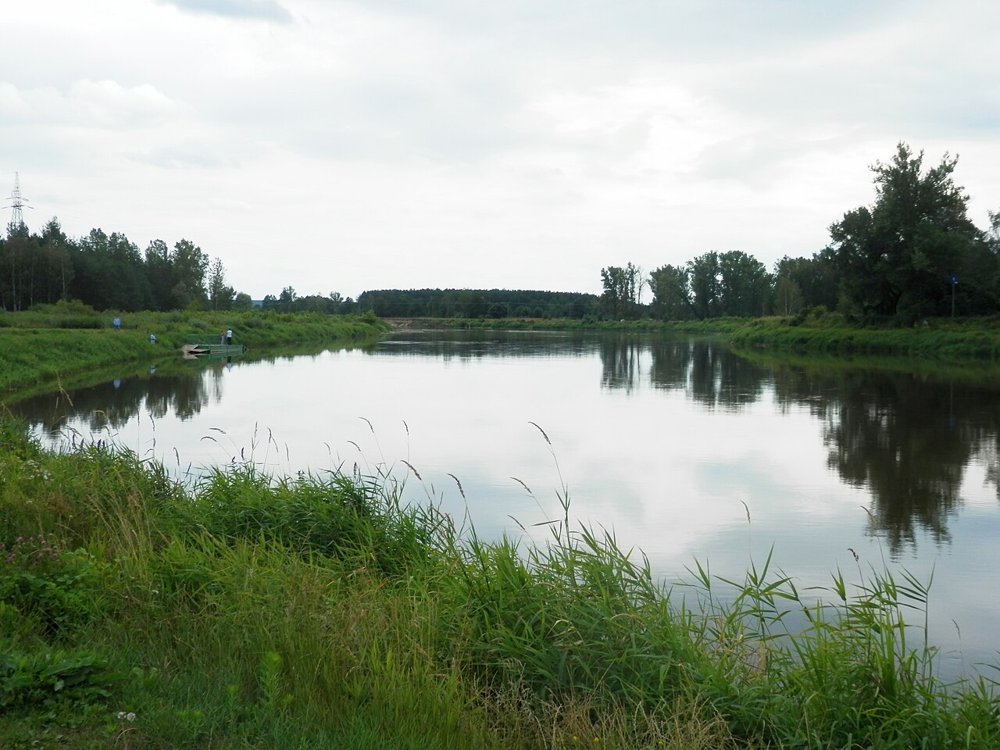
Anyone drawing a map of Eastern Europe around the year 900 would inevitably run into a river that still marks a border today: the Bug. It rises in what is now western Ukraine, curves northward in a wide arc, and for long stretches forms the boundary between modern Poland, Ukraine and Belarus before joining the Vistula near Warsaw. Along its upper and middle course, in the heartland of the historical region of Volhynia, an early medieval Slavic group settled that took its name from exactly this river: the Buzhans, Old East Slavic Бужане, often transliterated in scholarship as Bužane.
We know them almost exclusively from a single source, but it happens to be one of the most important texts early East Slavdom produced: the Povest' vremennych let, better known as the Primary Chronicle or the Chronicle of Nestor, compiled in the early twelfth century at the Kiev Cave Monastery. The chronicle opens with a long, undated introduction in which the author arranges the Slavic peoples by where they settled, before the year-by-year annals proper begin. It is exactly there, in this ethnographic preface, that the name of the Buzhans appears, along with a small puzzle still debated today.
For several tribes the chronicler follows the same pattern: he names a river or a landscape and derives the tribe's name from it. The Polotchane are named after the river Polota, the people living along the Dnieper near Kiev become Polyane because they settled in the open field (pole). He explains the Buzhans the same way: they sat along the Bug, and were later called Velynyane — an older form of what we know today as Volhynians, named after the place or district of Velyn' on the Bug.
This derivation is preserved word for word, though with small variations between manuscripts. We quote the passage in the Old East Slavic original and give our own translation, kept as close to the original as we could manage, since we had no modern translation on hand whose exact wording we wanted or were entitled to use for a blog article.
А бужане, зане седоша по Бугу, послеже же велыняне.
"The Buzhans, however, so called because they sat along the Bug, were later called Velynyane [Volhynians]."Povest' vremennych let (Primary Chronicle), ethnographic introduction preceding the year-by-year annals, following the text of the Laurentian codex (cf. the edition of D. S. Likhachev, PSRL vol. 1). Our own translation from the Old East Slavic.
What stands out is how sparse this is. No prince is named, no battle, no event — just a river, a name and a later name. For a chronicler who a few lines further on tells of princely murders and military campaigns, that is strikingly thin. Almost everything we know about the Buzhans as a distinct entity hangs on this one sentence.
Which brings us to the genuinely interesting problem, and it is worth looking at closely. Elsewhere in the same chronicle, in another undated passage, we read of the Dulebes, said to have already settled on the Bug in the sixth and seventh centuries and to have suffered terribly there under the Avars — the notorious episode in which Avar warriors harnessed Dulebe women to their wagons in place of draught animals. There it states that the Dulebes lived along the Bug "where the Volhynians now are" — Дулѣби же живяху по Бугу, кде нынѣ волыняне. Combine both sentences and an obvious chain emerges: Dulebes – Buzhans – Volhynians, three names for the same population on the same river at three different times. Our companion article on the Volhynians traces exactly this chain in detail.
What the chronicle does not explicitly state, however, is the middle link itself: neither passage says whether "Buzhans" was already in use as a self-designation during the Dulebe period, whether it arose only after Avar pressure as a new, narrower name for the population that remained on the Bug, or whether we are simply looking at two chronologically offset views of the same, politically shifting group. This is exactly where scholarship has grown more cautious than older survey accounts sometimes were.
The archaeologist Valentin V. Sedov, in his standard works, grouped the Volhynians, Buzhans and the older Dulebian community within a shared, older "Dulebian" cultural sphere, without simply equating them — for him they represent successive political forms of organisation of the same population rather than interchangeable labels. Boris A. Rybakov, for his part, was mainly interested in the political dimension: he connected the Dulebes with a once-leading Slavic tribal community mentioned by a tenth-century Arab travel writer under a ruler named Madjak, and suspected behind this an early Slavic polity in the Bug region, later broken up by the Avars — an intriguing but explicitly hypothetical reading, resting on a chain of identifications rather than on a direct source statement.
Text-critical historians such as Aleksei S. Shchavelev go a step further back and ask the basic question: how reliable is the chronicle's ethnographic introduction as a source for actual ninth- and tenth-century tribal boundaries at all? Shchavelev shows that the chronicler, writing around 1100, was himself drawing on older, partly contradictory oral and written traditions and arranging them into a list that reads more neatly than reality probably was. That does not mean the Buzhans are invented — the chronicle names them explicitly and locates them precisely. It only means that on the question of how unbroken and how ethnically uniform the continuity Dulebes–Buzhans–Volhynians really was, caution is warranted. Readers who want to learn more about the Dulebes themselves will find them in our article on the Dulebes.
Geographically the picture is clearer than the naming question. The area the chronicle assigns to the Buzhans, and later to the Volhynians, lies along the upper and middle course of the western Bug, at the core of the historical region of Volhynia — today, roughly, the border area between northwestern Ukraine and eastern Poland. To the north the settlement area reached into the marshy watersheds toward the Pripyat; to the south it approached the Carpathian foreland; to the east it merged, with no sharp boundary, into the territory of the Drevlyans, to whom we have dedicated a separate article. This is transitional country: fertile black-earth soils in the south, denser forest in the north, a river network allowing contact in several directions at once — west to the Vistula, south to the Dniester, east to the Dnieper.
For a river that lent its name to two Slavic peoples, the word Bug itself is worth a brief look, and here things become, quite incidentally, linguistically interesting. The linguist Max Vasmer records, for the western Bug, an etymology linking the word to Old Norse baugr, "ring," and to the Germanic verb biegen, "to bend" — something like "the bent one" or "the winding one," fitting the river's strongly meandering course. This etymology is not certain; Slavic derivations have also been proposed, and the more southerly, differently named Southern Bug in today's central Ukraine, despite the similar-looking name, probably has a different linguistic root altogether. But that the very river of the Buzhans might, linguistically, brush up against Old Norse vocabulary is a pleasant footnote — nothing more, and we do not want to make more of it than that.
While the written record stays thin, the ground has more to say. Archaeologically, the Volhynian region falls within the distribution area of the so-called Luka-Raikovetska culture, named after two find-sites in today's Ukraine, which shaped the Slavic forest-steppe zone from roughly the seventh/eighth to the ninth/tenth century. Characteristic features include simple, usually undecorated or lightly grooved pottery, semi-sunken pit-houses with stone ovens in a corner, and — especially in the earlier phase — cremation burial. As early as the late nineteenth century, antiquarians such as Nikolai Veselovsky and Vyacheslav Antonovych-Melnyk excavated hundreds of burial mounds in the Volhynian countryside, in which the shift from older, smaller cremation mounds of the so-called Holovne type to younger, larger inhumation burials of the tenth to twelfth centuries can be traced — an archaeological echo of exactly the transition the chronicle records in words: from an older, river-bound tribal name to a younger, princely-territorial order.
Among the diagnostic small finds of this later phase are so-called temple rings, ornaments of bent bronze wire, which archaeologists often use to sketch, very roughly, the settlement areas of individual East Slavic tribes — though this use, it must be said honestly, remains methodologically contested, since jewellery types travel, get inherited, and do not respect ethnic boundaries cleanly. Sedov himself analysed such distribution maps extensively and repeatedly stressed that archaeological culture areas and the tribal names recorded in the chronicle often overlap, but can never be shown to coincide completely.
To understand why scholarship has grown so cautious about the Buzhans, one has to look once more at the history of the Dulebes, whom the Primary Chronicle links to one of the most drastic episodes in its entire early section. Referring to the time of the Byzantine emperor Heraclius, roughly the early seventh century, the chronicler reports that the Avars, a mounted people then dominant in the Carpathian basin, subjugated the Dulebes and forced their women to pull the Avars' wagons in place of horses or oxen. The chronicler adds that this reign of terror still lived on generations later as a proverb — "they perished like the Obri" — a fixed phrase for vanishing without a trace that he apparently still knew from oral tradition.
Scholars generally read this episode not as pure invention but as an echo of real Avar-Slavic conflicts of the sixth and seventh centuries, for which comparable reports of Avar violence against subjugated groups exist independently, for instance among Byzantine authors — though no Byzantine author names either the Dulebes or, for that matter, the Buzhans. This passage tells us nothing directly about the Buzhans themselves; but it does show the period and the kind of pressure under which the older order on the Bug came under strain, an order out of which, on the most cautious reading, something like the Buzhans and eventually the Volhynians later emerged.
An independent confirmation of the Buzhans from outside Rus can only be claimed with great caution. The so-called Bavarian Geographer, a Latin list of peoples and strongholds from the ninth century, records among the tribes east of the Elbe and the Danube a name "Busani" credited with the striking figure of 231 strongholds (civitates). The resemblance to "Buzhans" is obvious, and many historians identify the Busani with them accordingly. Yet this identification is not certain: the Bavarian Geographer's list as a whole is notoriously difficult to map onto known Slavic tribes, several of its names remain disputed to this day, and alternative proposals exist for the Busani too.
Even more caution is needed with a second, often-cited outside source: the Arab travel writer al-Mas'udi, who in the tenth century reports on a once-powerful Slavic tribe called Walitaba or Valinana under a ruler named Madjak, to whom other Slavic tribes had once owed tribute, before internal discord broke that supremacy apart. Boris A. Rybakov and other Soviet historians connected this passage with the Dulebes or Volhynians, seeing in it a memory of an early medieval Slavic polity on the Bug that the Avars later destroyed. That is a fascinating reading — but it remains a reading, not a proven identification, and even if one accepts it, it concerns primarily the Dulebes or Volhynians, not specifically the Buzhans. As far as current scholarship can tell, there is simply no Byzantine or Arabic source naming the Buzhans directly, and that should be said plainly.
What happened afterward really belongs to the political history of Volhynia, which we tell at greater length in our article on the Volhynians. For the Buzhans themselves, only this much can be said: the name never reappears in a dated annal entry of the Primary Chronicle. Wherever the chronicle, from the late tenth century onward, reports on the region along the Bug — for instance on Prince Vladimir of Kiev's 981 campaign against the so-called Cherven towns — it speaks exclusively of Volhynians and their fortified towns, never again of Buzhans. The older, river-derived tribal name had apparently already been replaced by then with the younger, place- and district-derived designation — a pattern observable among several East Slavic tribes, already described in the nineteenth century by the historian Nikolai P. Barsov: older, kinship-based tribal names gave way to younger, territorially and politically defined designations once stable principalities with fixed centres took shape.
The Buzhans, then, do not vanish from history — they vanish only from the chronicle's register of names, while their land, their paths along the river, and presumably their population live on in what would henceforth be called Volhynia. It is a quiet, almost administrative kind of transition, without the great battle or the last prince later ages love to tell of. Which is precisely what makes the Buzhans instructive: they remind us that a chronicler's tribal lists are not snapshots but the product of centuries of realignment — and that a people can lose its name long before it loses its history.
For courage. For remembrance. For legends that live on.

The Volhynians · The Dulebs · The Drevlians · The Dregovichi · The Polans · The Krivichs.
