 Caesar names them in a single line, together with their neighbours across the Seine. After that the Caleti all but vanish from history – and yet they left behind a landscape that still carries their name: the Pays de Caux in Normandy. Between chalk cliffs, enormous earthworks and a Roman theatre, it is possible to reconstruct what is genuinely documented about them. And what is not.
Anyone who has read the article on the Veliocasses already knows the passage. When Caesar lists, in the spring of 57 BC, which Belgic peoples had banded together against him, two names stand side by side: the Caletes and the Veliocasses. One north of the Seine, one south of it, with a river between them that did not separate the two but connected them.
The Veliocasses at least gave their name to a city – Rouen was their chief town, and the Vexin still carries their name. The Caletes managed something similar, only more quietly: the Pays de Caux, that plateau between Le Havre, Dieppe and Fécamp which breaks off at the coast in the famous white cliffs, is named after them. And otherwise? Otherwise the sources are thin enough to read through in an afternoon.
The ethnonym is unusually transparent. Caleti or Caletes, Greek Κάλετοι, belongs to a Gaulish stem calet- meaning simply “hard”. The root survives in the Celtic languages: Breton kalet, Welsh caled, Old Irish calath. Through Indo-European it is related to Germanic hard – and, to the amusement of etymologists, to Latin callere, “to be hardened, callous”.
“The hard ones”, then. One should not turn that into a character study. Such names are the self-descriptions of warrior communities and occur all over the Celtic world; the Nervii and the Bellovaci are named just as programmatically. What a people says about itself and what it actually was are two different things.
In 57 BC Caesar counts the Caletes among the Belgae. Five years later, in the same work, he lists them among the peoples “who border on the Ocean and who in their own usage are called Aremoricae” – among the Armoricans, that is, together with the Veneti, the Redones and the Osismii. Both at once does not quite add up.
Scholarship has come to terms with the fact that it does not add up. Edith Wightman left the question open in her study of Gallia Belgica: the coinage of the Caletes is of Belgic type, their alliances in 57 BC were Belgic – but under Roman administration they belonged to the province of Gallia Belgica only briefly, if at all. The neat tripartite division of Gaul into Celts, Belgae and Aquitani with which Caesar's first book opens is the author's ordering device, not a finding. Anyone who sorts the Celts into such boxes is sorting Roman administrative logic, not identities.
The first and most important mention stands in the second book of the Gallic War. The Remi report to Caesar which contingents the Belgic coalition intends to raise. The Bellovaci provide the largest number and claim the supreme command; the Suessiones and Nervii 50,000 each. Then follows the row of smaller peoples:
Quindecim milia Atrebates, Ambianos decem milia, Morinos viginti quinque milia, Menapios novem milia, Caletos decem milia, Veliocasses et Viromanduos totidem, Atuatucos decem et novem milia.
“Fifteen thousand the Atrebates, the Ambiani ten thousand, the Morini twenty-five thousand, the Menapii nine thousand, the Caletes ten thousand, the Veliocasses and Viromandui the same number, the Aduatuci nineteen thousand.”Caesar, De bello Gallico II,4; translation: Glanz & Gravur
That, in numbers, is everything we know about the military capacity of the Caletes. They stand between the Menapii and the Veliocasses, well below the Morini with their 25,000, well above the nine thousand of the Menapii. The totidem – “the same number” – in the next clause is incidentally the reason why no separate figure exists for the Veliocasses and Viromandui either: Caesar spared himself the repetition.
And now the uncomfortable part. These figures do not come from a muster roll but from a report which a Roman commander wrote to the Roman senate about his own war. Add the list up and you arrive at more than 300,000 men under arms – an order of magnitude that is simply not plausible for Iron Age logistics in northern Gaul. Big numbers make big victories. Caesar had every reason not to let them shrink.
There is more: Caesar himself says he has the figures from the Remi, that is, from allies who had their own interest in making the threat look large. What the list reliably shows is not the strength of the Caletes but that they existed, that they were perceived as an independent political entity, and that they joined the Belgic coalition. That is less than it sounds. It is not nothing either.
Five years later, while Vercingetorix is shut up in Alesia, the assembly of Gaulish leaders decides not to call up every man capable of bearing arms but to impose a fixed quota on each people. The list is long and detailed: 3,000 each from the Aulerci Eburovices, the Lexovii and the Veliocasses, 8,000 from the Parisii, 4,000 from the Atrebates. And then, at the end, a collective entry for “all the communities which border on the Ocean and which by their own usage are called the Aremoricae” – Curiosolites, Redones, Ambibarii, Caletes, Osismii, Veneti, Lemovices, Venelli.
Eight peoples, one shared figure. And that figure is not secure in the manuscripts: editions vary between twenty and thirty thousand, which is why both numbers circulate in the literature. What fell to the Caletes is stated nowhere. Anyone who reads that they sent 20,000 men to Alesia is reading a number that in the text belongs jointly to eight peoples. Incidentally, the Lemovices appear twice in the same list, once with 10,000 and once among the Armoricans. This list is not a register. It is literature.
The third and final appearance is no longer in Caesar himself but in the eighth book, which his officer Aulus Hirtius added after Caesar's death. In 51 BC the Belgic north rises once more. Hirtius reports that all the Bellovaci capable of bearing arms had gathered in one place and that the Ambiani, Aulerci, Caletes, Veliocasses and Atrebates had joined them. The camp lay on wooded high ground surrounded by marsh, the baggage further off in the woods – a disposition showing that lessons had been learned from 57 BC.
Command lay with several chieftains, but the rank and file obeyed one man above all: Correus, of whom Hirtius drily notes that the army followed him because it knew how bottomlessly he hated the name of the Roman people. Correus falls in an ambush that goes wrong; after that the revolt collapses. For the Caletes this means that in the end they fought not as an independent power but as the following of the Bellovaci, whose clients they apparently were. It is the last sentence ancient historiography devotes to them as actors.
Where Caesar is silent, the ground speaks. The territory of the Caletes is strewn with large fortified enclosures of the late Iron Age, and some of them are astonishingly big. Sandouville at the Seine estuary covers 144 hectares, placing it among the largest such sites in all Gaul. The Fossés de Bénouville near Étretat come to 64 hectares, L'Hôpital near Quièvrecourt to 63, the Cité de Limes at Bracquemont north of Dieppe to 52. The Camp du Canada at Fécamp is comparatively modest at 20 hectares – and nonetheless the most famous.
It is famous because Mortimer Wheeler and Katherine Richardson, in their survey of northern French hillforts, named an entire rampart type after it: the Fécamp type, a massive, broadly sloped earthen bank with a flat-bottomed ditch, found in northern Gaul and southern Britain. Whether this type really represents a “Belgic” building tradition or simply an answer to a particular kind of warfare is still debated. The Cité de Limes at any rate shows how these people thought: a headland, 75 metres of sheer cliff above the sea to the north, a rampart along the valley crest to west and south. They blocked off what was hard to reach anyway. Readers interested in the equipment of these warriors will find more under Celtic warriors.
Here it gets delicate. Almost every guidebook states that Lillebonne was “the capital of the Caletes before the Roman conquest”. That is in all likelihood wrong. The town centre of Lillebonne has so far produced no traces of Gaulish settlement; the Roman city looks like a new foundation on open ground, datable to the Augustan reorganisation of Gaul between roughly 16 and 13 BC.
Where the pre-Roman chief place lay, nobody knows. In 1866 the Abbé Cochet proposed a name – Calidu or Caledu – derived from Gaulish coins and supported by a medieval tradition in Orderic Vitalis and the Chronicle of Fontenelle which speaks of a “Cité Calète”. It is a pretty construction. It has only two problems: the medieval tradition is roughly a thousand years younger than what it is supposed to attest, and the coin bearing the name very probably does not belong here at all.
Which brings us to numismatics, a minefield in this corner of Gaul. There are gold staters descended from Macedonian models, and bronze coins – among them the striking type “au monstre enroulé”, a coiled creature with spines and tendrils, and the type “à la roue” with its wheel. Much of this is assigned to the Caletes. Much of it could equally belong to the Veliocasses, the Ambiani or the Bellovaci. The classifications of Simone Scheers and of Louis-Pol Delestrée and Marcel Tache expressly treat several of these attributions as hypothetical.
The special case is the silver coin with the legend CALETEDU. Claude Bouterouë assigned it to the Caleti in 1666 – purely on the strength of the similarity of the names. Modern scholarship locates this coinage in central Gaul, in the zone where deniers rather than staters were struck; Jean-Baptiste Colbert de Beaulieu devoted a study of his own to the question. Put differently: the name from which the nineteenth century reconstructed the capital of the Caletes probably comes from a coin at home several hundred kilometres further south. This is how certainties are made.
What the Romans built, by contrast, is well within reach. Iuliobona – the name combines the Julian family with the Gaulish element bona, interpreted either as “foundation, settlement” or as “spring” – arises under Augustus as the chief town of the civitas Caletorum. Ptolemy in the second century places the town expressly in the territory of the Kalētai.
The location is the whole point: right bank of the Seine, at the end of a road from Lutetia to the coast, with a river harbour and the estuary on the doorstep. From here ships went to Britain and upriver into the interior of Gaul. The city receives an orthogonal plan, as far as the terrain permits, two bath complexes, an aqueduct, a mithraeum, wealthy domus – and a theatre that still stands. A second Caletan place lay at Caracotinum on the Seine estuary, the later Harfleur, founded around AD 15.
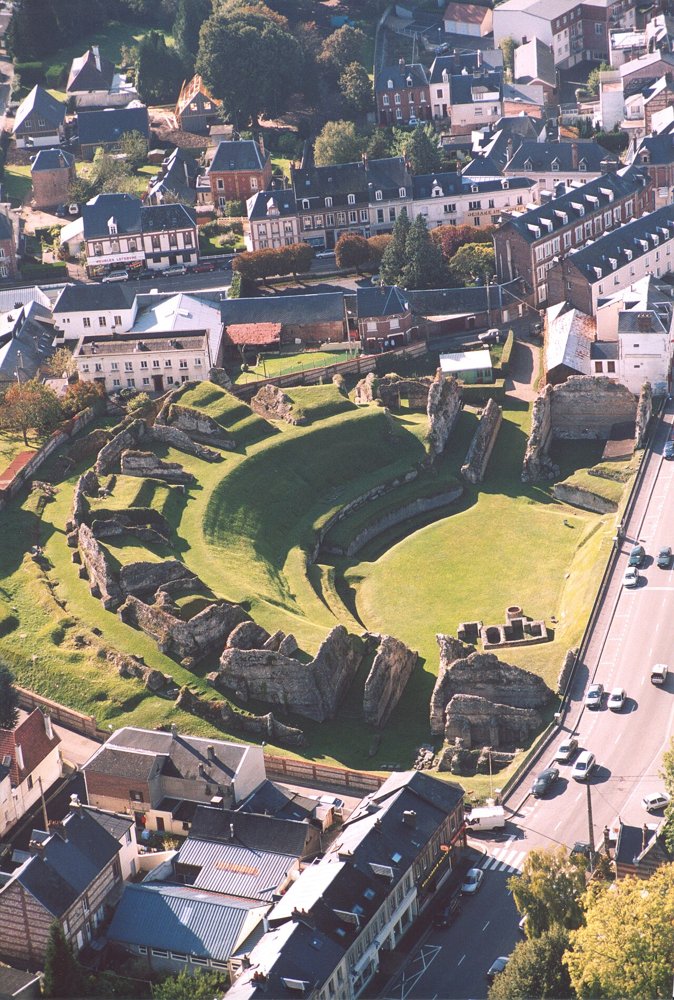
The theatre is the best preserved ancient entertainment building in northern France, and it is a hybrid. It measures a good 106 metres on its long axis, the arena 47.30 by 35.50 metres, and it combines a stage for comedy and tragedy with an arena for beast hunts and gladiatorial combat – a “theatre-amphitheatre” of the kind typical for Roman north-western Gaul. Published seating figures diverge widely: the numbers based on Vincenzo Mutarelli's excavations give a good 5,000 places, tourist accounts happily double that. The building type is documented; the head count is not.
Four building phases between the first and third centuries can be distinguished: a small first structure, then the rebuilding as a theatre-amphitheatre with an ellipsoidal arena, then an enlargement by a peripheral gallery carrying additional rows of seats. In the last quarter of the third century performances end. The vomitoria are walled up, the building becomes a place of refuge – and inside the arena baths are built from reused blocks taken from funerary monuments. A theatre that turns into a fortress and helps itself from its own cemetery: the third century can hardly be illustrated more sharply.
The history of research is nearly as eventful as the building. Until 1740 no description of Lillebonne mentions a theatre; the Comte de Caylus identified it in 1764. Destructive excavations begin in 1812, the département buys the site in 1818, and in 1840 the theatre appears on the very first French list of historic monuments. Campaigns follow from 1908 to 1915, under Albert Grenier from 1935, interrupted in 1939 – between 1940 and 1944 the German local commander was even buried in the theatre – then Maurice Yvart, then Georges Duval, and finally Mutarelli from 2007 to 2010. The stage building lies to this day beneath a road and has never been examined.
On 23 July 1823 workmen some 300 metres east of the theatre struck a bronze statue: an Apollo with a lyre, close to two metres tall, gilded, stylistically dated to the second century. It is the largest known bronze of a deity from Roman Gaul. It stands today in the Louvre; recent materials analysis has shown that the gilding was renewed at least once – the statue was in use long enough to need a refresh.
In 1870 a second showpiece came to light in a garden: the great mosaic of Lillebonne, originally 8.56 by 6.80 metres, from a suburban villa. It shows a stag hunt with a decoy call and a sacrifice to Diana, and is dated to the third or early fourth century. Today it lies in the Musée des Antiquités in Rouen, shrunk to 5.73 by 5.92 metres and so heavily restored that Jean-Pierre Darmon was able to demonstrate that passages long held to be original are the work of a modern restorer.
The genuinely exciting part, however, sits small in a corner. The mosaic carries an inscription: T(itus) Sen(nius) Felix c(ivis) Puteolanus fec(it) – Titus Sennius Felix, citizen of Puteoli, made it or had it made – et Amor c(ivis) K(...) discipulus, “and Amor, his pupil”. What lies behind the K is open: Karthaginiensis, from Carthage – or Kaletorum, a citizen of the Caletes. In the second case we would have here the name of a local craftsman apprenticed to an Italian master. One would rather like to know. A craftsman who signs his work is a very intelligible figure across two thousand years.
In the late third century Iuliobona contracts. The city acquires a wall still enclosing about 50 hectares, and it takes the stone for it from its own monuments. After the Diocletianic reforms it no longer appears in the late antique administrative lists as a chief town: the territory of the Caletes is merged with that of the Veliocasses into the civitas Rotomagensium, with Rotomagus – Rouen – as its capital.
With that the political existence of the Caletes ends. Two peoples become one administrative unit, out of which the archbishopric and then Normandy will grow. Lillebonne remains a small town with a very large theatre inside it. Rouen becomes the metropolis of Lugdunensis Secunda – and, within barely a millennium, the capital of a duchy founded by a Northman.
The name outlives everything else. In 843 the region appears as pagus Calcis, in 1206 as Kaleto, today it is the Pays de Caux. An Iron Age people's name, handed down through the Roman civitas, the Frankish pagus and the Norman county to the road signs of a modern département. The Caletes themselves had been gone for some eight hundred years by then.
And then, much later, comes a postscript. The same Seine estuary that gave the Caletes access to the sea and the Romans the harbour of Iuliobona becomes, in the ninth century, the invasion road of the Northmen. In 911 the West Frankish king cedes the land around Rouen to a Scandinavian leader named Rollo – the nucleus of later Normandy. Whether the Pays de Caux belonged to it from the start is stated in no contemporary charter; our main source for the agreement is Dudo of Saint-Quentin, writing roughly a century later and producing a courtly commissioned work. What is documented is only the outcome: the Scandinavian place names of the Pays de Caux, all those settlements in -tot, -bec and -fleur, lie today over a landscape that still bears the name of a Gaulish people. Two layers of history, the same soil.
The Caletes are named three times in Caesar (De bello Gallico II,4; VII,75; VIII,7), and further in Strabo, Pliny, Ptolemy and Orosius. Documented are: the contingent of 10,000 men in the Belgic coalition of 57 BC, the mention among the Armorican coastal peoples in 52 BC, and participation in the Bellovacan revolt under Correus in 51 BC. Archaeologically secure is a dense landscape of large late La Tène fortifications in the Pays de Caux, among them Sandouville with 144 hectares. Also secure are the Augustan foundation of Iuliobona as chief town of the civitas Caletorum, the theatre of Lillebonne with its four building phases and its conversion into a stronghold in the late third century, the gilded bronze Apollo found in 1823 (now in the Louvre), the hunting mosaic found in 1870 with its craftsman's inscription (now in Rouen), and the merger with the Veliocasses into the civitas Rotomagensium in late antiquity. And the place name: Pays de Caux, attested in 843 as pagus Calcis.
“10,000 warriors” is not a census. Caesar states himself that his figures come from the Remi, that is, from allies, and they add up to more than 300,000 men under arms – logistically implausible. Caesar wrote an account of his own command, not a statistic. “20,000 men to Alesia” is misleading. In the text that figure applies jointly to eight Armorican peoples, and even it varies in the manuscripts between XX and XXX milia. What fell to the Caletes is stated nowhere. Lillebonne was not the capital of the Caletes before the Romans. The town centre has produced no Gaulish settlement traces so far; Iuliobona is an Augustan new foundation. The pre-Roman chief place has not been located. “Calidu/Caledu” is a nineteenth-century hypothesis. Abbé Cochet derived the name in 1866 from a coin legend – and that legend, CALETEDU, had already been assigned to the Caletes by Bouterouë in 1666 purely on the similarity of names. Modern numismatics places the coinage in central Gaul. Coin attributions are unreliable in general. Types migrate back and forth in the literature between Caletes, Veliocasses, Ambiani and Bellovaci; several assignments are expressly regarded as hypothetical. “Camp de César” does not mean a camp of Caesar. The names Camp de César and Cité de Limes for the site at Bracquemont are modern popular labels, as everywhere in France; the place has nothing to do with Caesar. Celts, Gauls and Belgae are not clean categories. Caesar assigns the Caletes once to the Belgae and once to the Armoricans. The tripartite division of Gaul is the author's ordering device. The theatre's seating capacity is not known. Excavation-based estimates give a good 5,000, popular accounts up to 10,000. And the agreement of 911 stands only in Dudo. No contemporary charter text exists.
The Veliocasses · The Bellovaci · The Morini · The Atrebates · The Eburovices.
