 Between the Seine and the Avre lived a Gallic people whose name has had a remarkable career. The Eburovices became the civitas Ebroicorum, and the civitas became the city of Évreux. In between lie a revolt against Rome in which the Eburovices killed their own council, three thousand men in the relief army before Alesia, and one of the largest temple towns in northern Gaul, now lying beneath wheat fields.
Most Gallic peoples have vanished from the map. A few managed to pass their name on: the Parisii to Paris, the Remi to Reims, the Turones to Tours. The Aulerci Eburovices belong to that small group. Around AD 400 their territory is listed as civitas Ebroicorum; in 511 the place appears as Ebroicas, around 1034 as Ebroas. From this came Évreux, the administrative seat of the Eure department in Normandy. The town's Roman name, Mediolanum Aulercorum, disappeared entirely. So it was not the Roman designation that survived but the name of the people who lived there before Caesar. That is more than an anecdote. It shows how stable the pre-Roman districts remained: the boundaries of the later civitas and those of the medieval diocese of Évreux correspond closely.
Eburovices territory covered roughly the modern department of Eure: the Seine to the north, the Avre to the south, the Charentonne to the west. It is open country, chalk plateaus cut by river valleys, good arable land, and a region one travels through rather than around. To the north lay the Veliocasses around Rouen, to the west the Lexovii around Lisieux, to the south the Carnutes, whose sanctuary Caesar places at the centre of Gaul. Seen this way, Caesar's Normandy campaigns make more sense. The Eburovices did not sit on the edge of things but at a junction between the Seine valley, the Channel coast and the Veneti of Brittany. Ancient sources never describe them as a naval power, but they had a share in the alliances formed along that coast; neighbours such as the Redones and the Namnetes belonged to the same web.
The name is usually reconstructed as Gaulish *Eburouīcēs and translated as "those who conquer by the yew". It breaks down into eburo- and the suffix -uices, "fighters, victors". The second element is unproblematic and occurs in several Gallic ethnonyms. The first is not. Eburo- is normally connected with the yew, comparing Old Irish ibar; but Middle Welsh efwr means cow parsnip, an entirely different plant. The same root probably underlies the Eburones on the Lower Rhine and Eburacum, Roman York. The reading "yew-conquerors" may certainly be quoted, but it should be labelled as reconstruction. No ancient source says the Eburovices fought with yew bows or yew spears. That is an inference from a word to a weapon, not a documented fact.
"Aulerci" is not a single people but a collective label. Ancient sources name the Aulerci Eburovices around Évreux, the Aulerci Cenomani around Le Mans (Roman Vindinum) and the Aulerci Diablintes around Jublains (Noviodunum). In his Alesia chapter Caesar additionally names Aulerci Brannovices, and places them among the clients of the Aedui, far to the east. What linked these groups remains unclear. The Celticist Venceslas Kruta considered it possible that they were pagi split off from a larger unit in pre-Roman times. This cannot be proved. What is certain is that the three western Aulercan groups formed separate civitates with their own capitals under Rome. The Diablintes lost their independence in late antiquity and were absorbed into the civitas of the Cenomani; Jublains declined to a village. The Eburovices, by contrast, kept their unit intact into the Middle Ages.
The first securely documented appearance of the Eburovices is also the harshest. In 56 BC, while Caesar was occupied with the Veneti on the Atlantic coast, his legate Quintus Titurius Sabinus moved against the Venelli in what is now the Cotentin. Their leader Viridovix had taken supreme command over all the peoples in revolt. In those same days the Eburovices and the Lexovii decided for war as well. Caesar records how that decision was taken in a single sentence:
Atque his paucis diebus Aulerci Eburovices Lexoviique, senatu suo interfecto quod auctores belli esse nolebant, portas clauserunt seque cum Viridovice coniunxerunt.
"And within those few days the Aulerci Eburovices and the Lexovii, having killed their own senate because it refused to be the author of war, shut their gates and joined forces with Viridovix."Caesar, De bello Gallico III.17.3; translation: Glanz & Gravur
The sentence is terse, but it says a great deal. First, the Eburovices had a council, which Caesar renders with the Roman word senatus, and this council could decide on war and peace. Second, it was against war. Third, there was a faction able to overrule it by killing it. Such internal fractures run through Caesar's entire account, from Vercingetorix, driven out of Gergovia by his own relatives, to the Arverni and the Carnutes. The conflict did not run neatly between Gauls and Romans but straight through the individual peoples: on one side an elite that had come to terms with Rome, on the other a war party. Caesar does not report this neutrally. He has an interest in showing his opponents as oath-breakers and agitators. That does not make the underlying structure less plausible, but the sharpening is his.
Militarily it was over quickly. Sabinus entrenched himself, allowed himself to be challenged to battle for days, and did nothing. Then he sent a Gallic deserter into the enemy camp with the story that the Romans meant to slip away that night. Viridovix's levy consequently ran uphill towards the Roman camp at speed, loaded with brushwood to fill the ditches, and arrived out of breath. Sabinus ordered a sortie from two gates. The cavalry handled the pursuit. Caesar sums up the result flatly: all the peoples involved surrendered at once. At the end of the same book he notes that he quartered his army for the winter among the Aulerci and the Lexovii, among others — that is, among those who had just been at war with him. Billeting was part of the punishment and at the same time the cheapest form of occupation.
Four years later the Eburovices were on the other side again. When Vercingetorix was shut up in Alesia, the assembly of Gallic chiefs decided not to call up every man capable of bearing arms but to impose a fixed quota on each people. Caesar transmits this list, and it is one of the most valuable sources we have for the order of magnitude of Gallic polities. The Mandubii, in whose town the fighting raged, do not appear in it. The Eburovices do: "Veliocassis, Lexoviis et Aulercis Eburovicibus terna" — three thousand each from the Veliocasses, the Lexovii and the Aulerci Eburovices. The Aulerci Cenomani supplied five thousand, the Parisii eight thousand. These figures should not be mistaken for a census; they are target strengths for a levy, quoted by Caesar for his readers, and his own totals do not add up elsewhere. As a ranking they remain informative: the Eburovices were a middling people, not a great power.
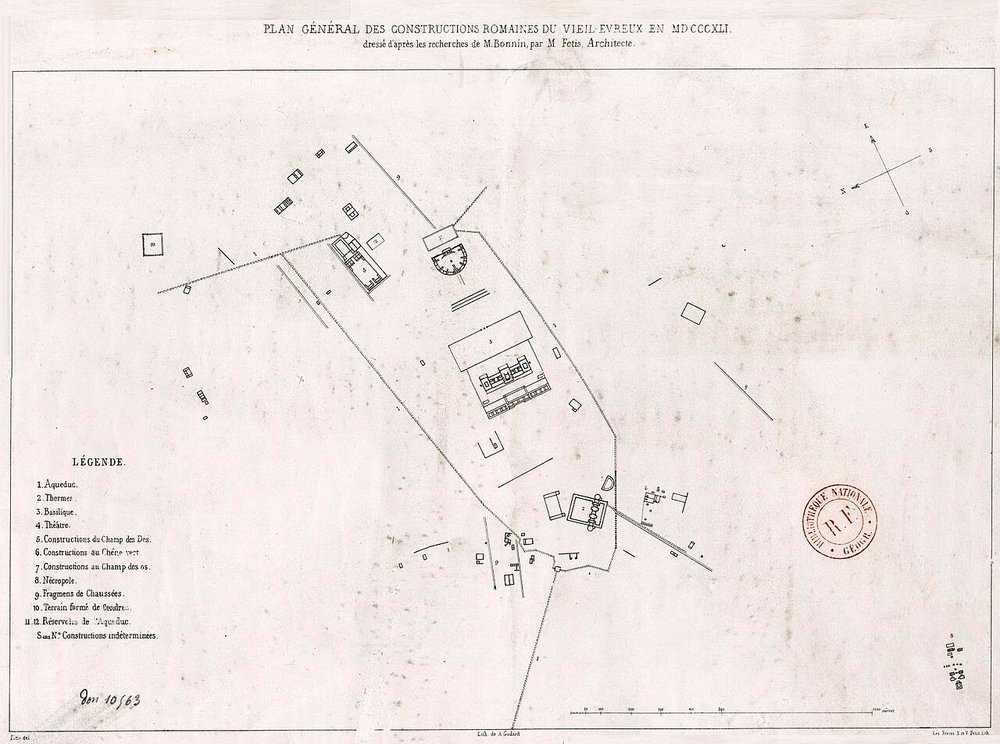
Caesar names the Aulerci Eburovices explicitly twice: De bello Gallico III.17.3 (joining Viridovix after killing their own senate, 56 BC) and VII.75.3 (three thousand men for the relief army before Alesia, 52 BC); III.29.3 records winter quarters "in Aulercis Lexoviisque". Pliny, Naturalis historia 4.107, lists them as "Aulerci qui cognominantur Eburovices"; Ptolemy, Geography 2.8.9, as Αὐλίρκιοι Ἐβουρουικοί. Archaeologically established are the temple town at Le Vieil-Évreux with its hexagonal ring street of roughly 5.6 km, an area of some 230 to 250 hectares, a theatre about 106 m in diameter, a bath complex measuring 109 by 84 m and an aqueduct of about 27 km, together with the abandonment of the site from around AD 250. A votive altar from the site names a deus Gisacus. Around AD 400 the civitas Ebroicorum appears in the late Roman administrative lists.
The Eburovices struck their own coinage. Numismatic literature assigns them hemistaters — half staters in precious metal — along with bronzes and potins. The visual language is that of northern Gallic issues: a stylised head on the obverse, a galloping horse on the reverse, and with them a boar, a wolf, rings, tendrils, occasionally a bird. The boar is strikingly frequent on their coins, both as a small symbol beneath the horse and as a standard in its own right. One bronze carries a legend that has been read in very different ways and in which the tribal name itself has been suspected. Caution with attributions is essential here: the same types were assigned in turn to the Caleti, the Veliocasses and the Ambiani during the nineteenth and twentieth centuries. The present ordering rests largely on the work of Simone Scheers, who also catalogued the coin holdings of the museum in Évreux. A substantial part of that collection comes from a single excavation: in 1936 Marcel Baudot recovered 149 coins at the fanum of Cracouville near Le Vieil-Évreux.
The Roman capital of the civitas was called Mediolanum Aulercorum. Mediolanum is one of the most common Gallic place names of all; Milan carries it too. It is usually interpreted as "middle of the plain", though many scholars assume a solemn, possibly sacral overtone: the centre of a territory rather than a mere topographic statement. The town was developed towards the end of the first century BC, under Augustus, with a theatre, baths and a forum. Where the pre-Roman centre lay is unresolved. One widely repeated suggestion places it on the Saint-Michel heights above Évreux; but no excavated oppidum can currently be assigned to the Eburovices with confidence. In the third century Mediolanum received a heavy wall, remains of which can be seen today in the museum at Évreux. Theatre and baths lay outside it and were given up.
Seven kilometres to the east, up on the plateau, the real anomaly took shape in the first century AD. At first two residential quarters grew around a sanctuary and a forum on an ordinary grid. Under Trajan those quarters were demolished and replaced by something without parallel in the Roman world: the public buildings stayed in the centre, while the housing was pushed to the periphery and forced into a hexagonal ring street some 5.6 kilometres long, beneath which the water conduit ran. Every house stood along this ring and faced inwards, towards the sanctuary. The complex measured about 1.8 kilometres across and covered 230 to 250 hectares. At its centre lay the baths, the great sanctuary of some 6.8 hectares, and a theatre with an estimated capacity of around 7,000 spectators. Water arrived by an aqueduct roughly 27 kilometres long and was distributed from a water castle into three branches. This is not a town in the ordinary sense. It is a pilgrimage built in stone.
The name of this complex is likewise a reconstruction. It rests on a votive inscription from the site dedicated to a deus Gisacus — "[A]ug(usto) deo Gisaco / [Ta]uricius Agri/[co]la de suo po/suit" — and on a later saint's life mentioning a villa "at Gisacum". Of the god himself we know almost nothing. He is generally assumed to have been equated with Apollo in Roman cult, as was customary with local deities and as characterises Celtic religion under Rome more broadly. A find of 1840 supports this: a bronze Apollo, 83 cm high, from the temple precinct, wearing a mural crown and thereby marked as the tutelary god of the town. From the same context comes a bronze Jupiter that ranks among the finest ancient bronzes found in Gaul. Both stand today in the museum at Évreux. Further statues point to cults of Hercules, Mercury and Minerva. What ritual actually took place here, and whether druids had any part in it before the conquest, no source tells us.
"Those who conquer by the yew" is a linguistic reconstruction, not a self-description; eburo- cannot be pinned firmly to the yew, and yew weapons of the Eburovices are recorded nowhere. The place name "Gisacum" is equally inferred, from a single votive inscription and a medieval saint's life whose historical value is disputed; the ancient name the temple town used for itself is unknown. In VII.4 Caesar names only "Aulerci" in general among the allies of Vercingetorix, not the Eburovices, and Camulogenus, who commanded at Lutetia, is called simply "Aulercus" — which branch of the Aulerci is meant, the text does not say. Assigning him to Évreux is interpretation. And the famous hexagon of Gisacum is a street and housing ring, not a rampart: the temple town was unfortified.
From about AD 250 Gisacum was given up. It does not look like a catastrophe but like a decision: the sanctuary was closed, the buildings taken down. The usual explanations cite the crisis of the third century, the first incursions into north-western Gaul, the complete absence of fortification at a purely religious site, and the economic collapse. The inhabitants moved to Mediolanum, which withdrew behind its new wall. The plateau became a quarry for building in Évreux — the third-century town wall was partly raised from the material of the abandoned temple town. The temple itself probably fell in the fourth century. After that only a village remained on the plateau. The site was rediscovered in the early nineteenth century; excavation continues today, at the temple and the theatre among other places, and the drought of the summer of 1976 once again revealed its full extent on aerial photographs.
What remains is the continuity of the name. The late Roman administration no longer named the district after the town but after the people: civitas Ebroicorum. From that formula came the name of the city. The diocese of Évreux, whose boundaries largely follow those of the old civitas, carried this division through the entire Middle Ages. Anyone speaking of Évreux today is pronouncing, without knowing it, the name of a people Caesar described in one hard sentence.
The visual language of these coins — the boar beneath the galloping horse, a head built from a handful of lines, tendrils and rings filling the field — is craft under the harshest conditions: a tiny surface, one die, no second attempt. Anyone who engraves such motifs quickly notices how much decision sits in every line. In our small family workshop in Alsdorf we work with a laser rather than a die, but the question is the same: what do you leave out so that the essential can stand. The Celtic warriors and their imagery are, for us, above all that — a school of omission.
The Mandubii · The Veneti · The Arverni · The Aedui · The Parisii.
