Drive today through the country around Teterow, Gnoien or Demmin and you see fields, avenues of trees, brick churches. Hardly a sign tells you that a tribe of its own once lived here. The Circipani left no chronicle; we know them only through outsiders, through annalists, bishops' histories and war reports. This article gathers what those sources actually say, separates it from what later scholars concluded, and states openly where we could only read secondary literature.
In Latin sources they appear as Circipani, Cyrcipani or, in an early spelling, Zcirizspanis; German writers use Circipanen and Zirzipanen alike. The name is usually read as "those living around the Peene", from Latin circum ("around") and the river name. That is an interpretation by modern scholars, not testimony of the sources: whether the scribes understood it so, or whether it comes from a Slavic word they merely dressed in Latin, cannot be decided. The link with the river does fit the location.
The Circipani belonged to the Elbe Slavs, the term historians use for the West Slavic tribes east of the Elbe, between the Baltic, the Elbe, the Saale and the Oder. Their language is classed as Polabian, and they left no writing. Everything written about them comes from Franks, Saxons and Danes, mostly clergy, who described Slavs as pagans, tributaries or enemies. These texts have to be read with care: they say a great deal about the interests of the writers and only occasionally something about the lives of those described.
A few terms at the outset. A tribe here means an association of settlement communities with a common name and a manageable territory, not a state with fixed borders. A stronghold in the early medieval north-east is rarely a stone building; it means a ring rampart of timber, earth and sand, often on islands or in wet lowlands. A Burgward is the district belonging to such a fortress in imperial and later territorial administration. Researchers also use the word for Slavic fortress districts; whether the Slavs themselves had a matching word, we do not know.
The descriptions of the territory come from modern literature and are therefore reconstructions, not statements of the sources. According to them, Circipania lay in the middle of today's Mecklenburg-Western Pomerania: around the Teterower See, south of the Recknitz and Trebel, west of the Malchiner and Kummerower lakes, that is, in the area of the former districts of Güstrow (eastern part) and Demmin. The literature names Demmin, Dargun, Krakow am See, Sukow and Altkalen as fortress districts. One account gives a line east of Güstrow as the western limit.
One single primary source gives a contemporary description of the position, and it is brief. Helmold of Bosau, a parish priest in eastern Holstein and author of a chronicle of the Slavs, writes around 1170 about the Lutici: the Peene and the town of Demmin separated the Tholenzi and Redarii from the Kicini and Circipani, who lived on the other side of the river. That is all the geography the source supplies; the sentence is given below as a quotation. Helmold did not see the region himself; he relied on reports and, as scholars suspect, on Adam of Bremen. That the Peene was a boundary river is therefore secure. Where exactly the Recknitz ran to the west of it, and how densely the country was settled, the texts do not say.
Anyone who knows the map notices the neighbours easily. To the west lay the Kessini around the fortress of Kessin on the lower Warnow near Rostock, with whom the Circipani are often named together. To the south and east lived the Redarii and the Tollensians (on the Tollense), who belonged to the same league and fought them in the eleventh century. In the west ruled the Obodrites, a Slavic association in western Mecklenburg and eastern Holstein. East of the Peene lived Pomeranians; in the sources they appear above all as conquerors of the twelfth century, not as old neighbours of the Circipani. A small correction follows from this: the Pomeranians mattered greatly to the Circipani in the twelfth century, but they were not the neighbouring tribe in the narrow sense.
According to the literature, the earliest mention stands in the Annales Sangallenses maiores, the larger Annals of St Gall, under the year 955, where the name appears as "Zcirizspanis". The context is the battle on the Raxa, a river that scholars identify with the Recknitz or, less probably, another watercourse. King Otto I defeated a Slavic army under Prince Stoignew there on 16 October 955. Widukind of Corvey tells how Otto and his margrave Gero had bridges built, surprised the Slavs and caught Stoignew in a wood; he was beheaded, and about seven hundred prisoners were executed. In the text we read, Widukind does not name the Circipani.
The St Gall annals are terser. According to the German summary we could consult, they say in effect that Otto and his son Liudolf defeated the Zcirizspanis and made them tributary ("fecit illos tributarios"). We give this Latin half-sentence only from Wikipedia; we did not check the annals themselves. What follows from it must be put cautiously: around the middle of the tenth century the name of the Circipani was known in the Frankish realm, and they were connected with an East Frankish campaign in which they are said to have been forced to pay tribute. That they were permanently subjugated does not follow. In any case, a little over thirty years later, in 983, the situation turned; the great Slavic uprising that started from Rethra ended imperial rule east of the Elbe for the time being.
A side note on the battle: which tribes fought there, and in what roles, is not uniform in research. The English overview of the battle names the brothers Nako and Stoignew as leaders and does not mention the Circipani; it relies on Widukind, Thietmar and the annals. Whoever calls the Circipani "opponents at the battle on the Raxa" therefore rests on the annals entry alone. That is possible, but thin.
Between the end of the tenth and the middle of the twelfth century the Circipani are part of a group that Adam and Helmold call by changing names: Wilzi, Lutici, Liutizen. Helmold lists four peoples (Kicini, Circipani, Tholenzi, Redarii) and writes that because of their bravery they are called Wilzi or Lutici. He names as their common centre the widely known Rethra, a sanctuary whose location is still not securely determined. The idea of a fixed "Lutician federation" with a constitution is a construction of research; the sources know mainly loose alliances that tightened in time of war and fell apart again afterwards.
… the Peene and the town of Demmin separate them from the Tholenzi and Redarii. … The Kicini and the Circipani live on this side of the Peene. … Because of their bravery these four peoples are called Wilzi or Lutici. Their town is the very widely known Rethra.Helmold of Bosau, Chronica Slavorum I, 2; paraphrase in our own wording after an English rendering (jassa.org, translator not named there); the Latin wording was not checked, ellipses mark cuts
The position of the Circipani is striking here. Modern literature describes them as a "sub-tribe of the Lutici", yet some accounts at the same time place them as formerly Obodrite. That fits a picture the sources suggest rather than prove: the Circipani and Kessini lay on the edge of the league, politically between the Obodrites in the west and the Redarii and Tollensians in the east and south. Anyone who wants to bind them more firmly to one side or the other is arguing from later events, not from a text.
A further hypothesis: one passage in the literature holds that the Kessini split off from the Circipani around the year 1000, possibly after the loss of their prince at the Raxa. This rests on the observation that the Kessini are absent from earlier sources and first appear in Adam, while the Circipani are said to appear in a charter of Otto I of 965. We could not see the charter, and absence from the record does not prove a new foundation. The assumption is plausible, but unproven.
The densest picture comes from the reports on the so-called Lutician fraternal war, told by Adam of Bremen (Book III, chapter 21) and Helmold (Book I, chapter 21). The modern accounts agree on the core and differ in the detail, and that difference is worth naming. They agree that the Redarii and Tollensians claimed precedence in the league because of their old sanctuary Rethra. The Kessini and Circipani resisted and refused to pay the levy. In the fighting the Kessini and Circipani are said to have defeated their opponents several times, according to one account three times. The defeated called on the Obodrite prince Gottschalk, as well as Duke Bernhard II of Saxony and the Danish king Sven Estridsson.
How it ended is told differently. One German account has the Circipani and Kessini lose and mentions booty of 15,000 silver marks. Another has the Circipani emerge as victors who bought peace with 15,000 pounds of silver. We were not able to read the two primary texts at this point and therefore cannot decide the question. Only the figure of 15,000 as a sum mentioned in this connection is secure; who paid, and whether it was marks or pounds, stays open here. According to a quoted version, Adam adds sourly that our men returned home in glory, that Christianity was not discussed, and that the victors cared only for booty. This sentence too we give only in substance, at second hand.
It is regarded as secure that Gottschalk, who for a time ruled an Obodrite realm from Holstein to Mecklenburg, subdued the Circipani and Kessini in the course of this war and imposed tribute on them. An English account reports that he built new fortresses and had the old fortifications of the conquered removed. When Gottschalk was killed in 1066, this rule dissolved. Whether the Circipani were then left to themselves, we do not know; the sources are silent.
Fights in the years 1114 and 1121 are often named; only part of this can be confirmed. For 1114 the literature reports that the Saxon duke Lothar of Süpplingenburg, later king and emperor, fought with Margrave Henry of Stade against the Kessini prince Dumar and his son. Three hundred Circipani horsemen are said to have belonged to this force. In that source the Circipani would thus be allies or tributaries of Lothar, not his opponents. This rests on a single Wikipedia article; the primary passage, probably Saxon annalistic writing, we did not see. A second article on the Lutici does not mention the riders. We therefore list the claim as to be verified.
The year 1121 concerns the Kessini: Lothar marched against them again and took their main fortress, which the Annalista Saxo calls "Kizun". The Circipani are not mentioned here. Whoever presents 1121 as a "fight against the Circipani" confuses the neighbours. According to the literature, in these years the rule of Saxon and Obodrite princes over the Kessini hardened, and the Circipani were drawn into the same current, though individual steps cannot be named.
The name Demmin recurs in the sources, mostly as a point of orientation. Helmold names the Peene and Demmin as the limits of the diocese of Oldenburg and of the Slavic mission. Otto of Bamberg, the missionary to the Pomeranians, visited Demmin in 1128 according to the literature; his biography calls it a "civitas Pomeraniae" and says he lodged in an old fortress outside the town. The first charter in which the fortress appears is a papal confirmation for the Pomeranian bishopric of 14 October 1140. In the twelfth century the place is thus firmly within the Pomeranian field of view; whether it had earlier been a Circipani stronghold can only be inferred from the sources.
A regional account reports that the Circipani built a border fortress at the beginning of the tenth century, later called Haus Demmin, which controlled the eastern part of their territory, with Teterow named as the main fortress. In Wikipedia this stands without a reference. The claim that the centre lay near Loitz we have found confirmed nowhere and leave out.
In the summer of 1147 the army of the Wendish Crusade, a campaign of Saxon princes and bishops against pagan Slavs approved by the pope, also moved on Demmin. According to the English account the Saxon army failed to take the fortress. According to the German account the besieged averted conquest by pointing to their earlier baptism through Otto of Bamberg. Both can be reconciled: the siege failed, perhaps with negotiation. The literature on the Circipani themselves equates the Wendish Crusade with devastation in the land; we lack details.
Around 1150 the Circipani appear once more in Helmold, in connection with the Obodrite prince Niklot. The prince came, Helmold says, to Lüneburg while Henry the Lion was absent. He complained that the Kicini and Circipani were gradually rising against him and refusing even the smallest tribute. Count Adolf of Holstein then rode to his help with Holsatians and Stormarn men, and the rebels, as the chronicler has it, bought themselves free with a great deal of money and made up the unpaid dues in full and more (Helmold I, 71; after an English rendering, the dating "around 1150" from secondary literature). What is secure: in the twelfth century the Circipani stood under Obodrite overlordship and paid tribute. One account gives Niklot's rule over the Circipani as 1131 to 1160; we know those years only from a single overview.
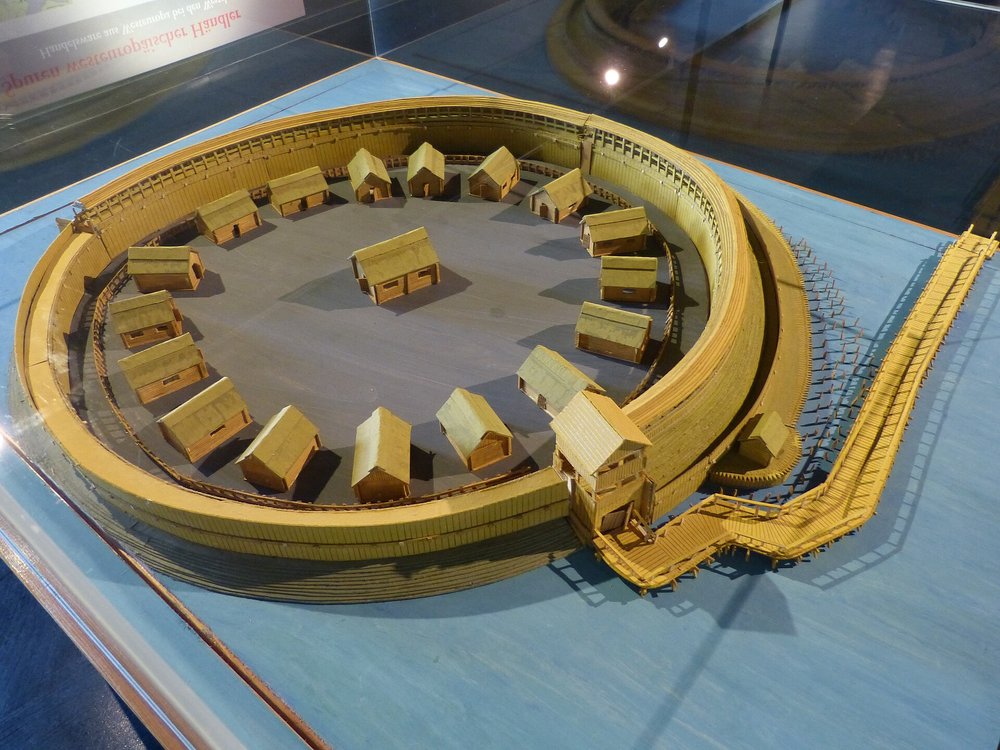
In the following decades things became tight for the Circipani. Danish armies, which under Waldemar I harried the Baltic coast, advanced into the country several times after 1170. Saxo Grammaticus, the Danish chronicler, mentions for 1171 a fortress that research connects with the stronghold at Behren-Lübchin, a fortified island fortress of the tenth to twelfth centuries between Trebel and Recknitz. That the Danes captured it in 1171 is regarded as probable, but this is an attribution, not a secure identification. Finds from the site are now held in the open-air museum at Groß Raden.
Towards the end of the twelfth century the east of the country, the Demmin area, fell to the Duchy of Pomerania; the west went to the Obodrites, whose princely house later produced the dukes of Mecklenburg. At the beginning of the 1230s Borwin III of Rostock subdued the last part, according to the literature. The Treaty of Kremmen (1236) shifted the Pomeranian border in favour of Brandenburg. After that the tribal name disappears. The lands were settled by German colonists called in by the territorial lords; the remaining Circipani, by widespread opinion, merged into the population. On church maps the name survived longer as a province of the diocese of Cammin. That the tribe was "almost exterminated", as one overview writes, is a judgement without evidence in the texts we consulted; what is certain is the loss of people through wars and plundering, not its extent.
The chronicles say almost nothing about the everyday life of the Circipani. Archaeology helps here, and what we can say from it remains general. Slavic settlements of the north-east consisted of log buildings in farmsteads and villages, the strongholds of timber-and-earth ramparts, often on islands in lakes and river lowlands where water was both protection and a route. Behren-Lübchin is such a case; its position in the triangle of Trebel, Recknitz and Warbel fits the pattern. To this come pottery classed as "Late Slavic" and traces of farming, stock-keeping, fishing and crafts. About features of Circipani culture that set it apart from its neighbours, our sources allow nothing reliable.
The same holds for religion: Adam of Bremen and Helmold describe idols and temples of the Redarii at Rethra, not of the Circipani. Membership of the same league means that similar ideas were possible; for the Circipani it is not attested. Names of Circipani gods, sacrificial customs or cult places we do not know, and whoever names them is inventing.
A short ordering of the statements. Established is what at least two sources, or one source with clear wording, support: the name, the position on the Peene, membership of the Wilzi or Lutici, the tension with the Redarii and Tollensians, the tribute situation under Niklot. Plausible, but not proven, are the splitting off of the Kessini, participation in the battle on the Raxa in 955, and the assignment of the Behren-Lübchin fortress to Saxo's report of 1171. Interpretation remains the derivation of the name from "around the Peene", the talk of a league with a fixed constitution, and the sentence about extermination. And legend is everything one might tell about gods, princes and sacrificial customs of the Circipani: the sources are silent, and no assertion belongs in that gap.
One thought for the road: whoever travels to the Baltic at Rostock or Greifswald by the B 110 or B 104 crosses this country without knowing it. Between Gnoien and Teterow lie the lakes that were once part of the Circipani's routes, and the brick churches of the area stand on land that was settled anew only after the tribal name had ended. Anyone who loves the northern coasts finds here one of the quiet pages of Baltic history.
In our family workshop in Alsdorf we make laser-engraved slate plaques with Nordic-Germanic motifs. For peoples like the Circipani there are no pictorial signs of their own that we could document, and so we invent none. The story of this tribe lives in names and places, not in symbols, which is one more reason to tell it carefully.

The Circipani · The Kessini · The Tollensane · The Abodrites · The Liutizi.
All History & Finds articles →
The Cotini and Osi were two peoples in the highlands on the edge of Germania, in the Carpathian region. Tacitus names …
Read more →