They never wrote a single line about themselves. Everything we know about the Tollensians comes from the chronicles of their opponents: one sentence in a monastic annal, a few lines by a canon of Bremen, and ramparts in the soil of north-eastern Germany. It is enough to sketch a people who lived without a king, failed in their claim to lead a federation, and were broken in a war among kin. And it is enough to clear up a stubborn confusion: the world-famous Tollense Valley battlefield has nothing to do with them.

The Tollensians – Latin Tholenzi, in older records also Tolonsenis and Tolensane, in Polish Dołężanie – were a West Slavic tribe in the south-east of what is today Mecklenburg-Vorpommern. They belonged to the four core peoples of the Lutici federation. Of their language, their institutions and their beliefs we possess not a single testimony written by themselves. The Elbe Slavs of this region were without writing; what survives was set down by Saxon monks, a canon of Bremen and a Holstein parish priest – men on the other side, militarily and religiously.
That is not a footnote but the basic condition of every statement about this people. We see the Tollensians only where they caught a chronicler's eye: at war, paying tribute, in revolt. Their everyday life, their farms, their dead remain dark, except for what excavation yields. Anyone writing about them therefore writes two things at once: the little that stands in the record, and the limit of what may be concluded from it.
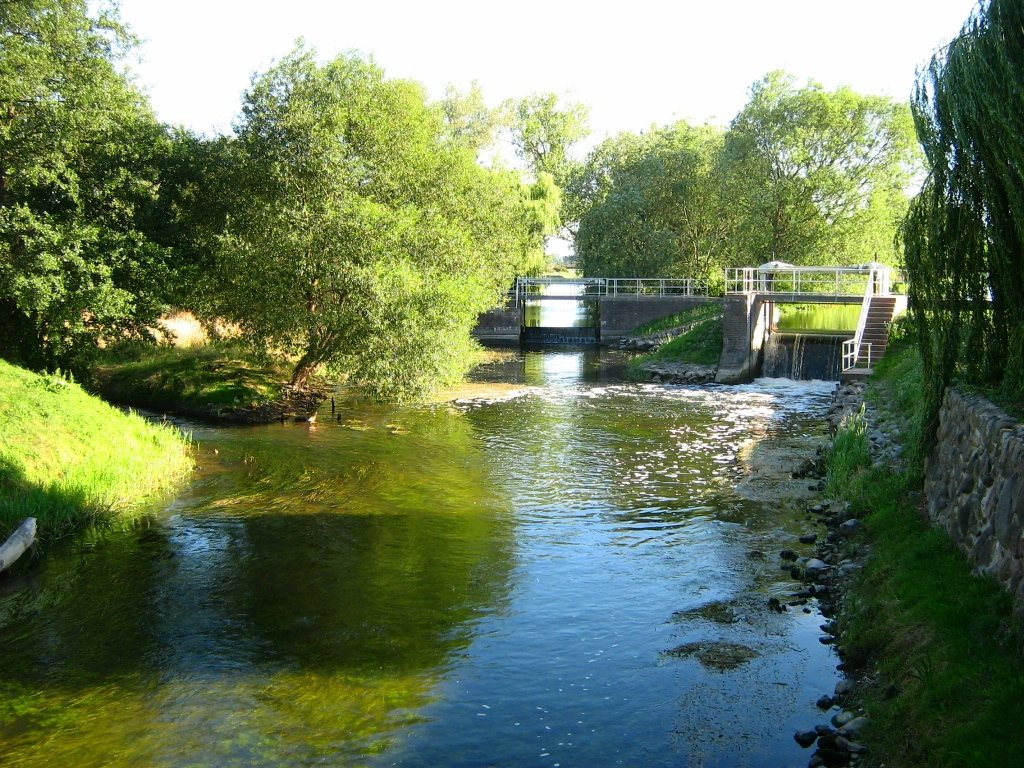
The Tollensians settled along the lower and middle course of the Tollense, roughly between Altentreptow and Demmin, north-west of Lake Tollense. To their west lay the Circipani around Lake Teterow and Demmin, to the south the Redarii, to the east the Ukrani, and on the lower Warnow the Kessini.
Here a closer look pays off, because the obvious assumption misleads. The name suggests the Tollensians sat on Lake Tollense. Scholarship sees it differently: Fred Ruchhöft, working by elimination, places the Redarii between Neubrandenburg and Neustrelitz, in the later lands of Stargard and Wustrow – and that territory includes Lake Tollense. The Tollensians, accordingly, sat downstream to the north. The lake that carries their name lay, on this reconstruction, in the neighbours' territory. This is not a detail for map enthusiasts. It shows how strongly our picture of "tribal territories" is steered by modern names, and how little the sources themselves say about borders.
The river name Tollense is traced to a Slavic formation on the root dol- ("valley", "lowland"; compare dolina); the Polish form of the river name is Dołęża, that of the tribal name Dołężanie. The sense is clear enough: people who live in a valley bottom – and the Tollense does in fact run for long stretches through a broad glacial valley with high banks.
Less clear is the direction. Was the river named after the people or the people after the river? Both are linguistically possible, and the sources do not decide it. Comparable names in the federation help only so far: the Kessini are named after their stronghold Kessin, the Circipani after the Peene – and even there two readings compete, "around the Peene" and "beyond the Peene". For the name of the Redarii no accepted explanation exists at all; proposals range from Germanic through Slavic to Greek derivations. Anyone offered a tidy etymology for tribal names of this period should be sceptical.
The earliest mention of the Tollensians is not in Adam of Bremen but roughly a century earlier, in a terse annual entry of the Greater Annals of St Gall. A Swiss monastic scribe records on which day King Otto I fought a Slavic coalition, who belonged to it and how it ended. The entry is close to the events and dry in tone; it is also the proof that by the mid-tenth century the Tollensians were perceived as a distinct entity.
Eodem anno Otto rex et filius eius Liutolf in festivitate sancti Galli pugnaverunt cum Abatarenis, et Vulcis, et Zcirizspanis, et Tolonsenis, et victoriam in eis sumpsit, occiso duce illorum nomine Ztoignavo, et fecit illos tributarios.
In the same year King Otto and his son Liudolf fought, on the feast of Saint Gall, against the Abodrites and the Wilzi and the Circipani and the Tollensians, and he won the victory over them; their leader named Stoignew was killed, and he made them tributary.
Annales Sangallenses maiores, entry for the year 955 (MGH SS 1, ed. Ildefons von Arx, p. 79); translation: Glanz & Gravur
Behind that single sentence stands the battle on the Raxa of 16 October 955. Widukind of Corvey describes it at length (Res gestae Saxonicae III,53–55): after his victory on the Lechfeld, Otto had pushed into Slavic territory, was halted at a river called the Raxa, could move neither forward nor back, and hunger and disease broke out in the Saxon camp. Only a crossing found elsewhere – with the help of allied Slavs – decided the engagement.
What followed belongs among the harshest passages of Ottonian historiography. Widukind reports that the head of the slain Stoignew was set up on the battlefield and that 700 Slavic prisoners were beheaded there; the fallen leader's counsellor was blinded and had his tongue cut out. For the Tollensians the defeat meant tribute. And one further point deserves note: where the Raxa lay nobody knows for certain to this day. The specialist literature usually identifies it with the Recknitz, sometimes with the Elde. The Tollensians, then, fought far outside their own valley.
During the tenth century a confederation formed between Warnow, Havel and Oder that the German sources call the Lutici. Adam of Bremen equates them with the older Veleti: Leuticios, qui alio nomine Wilzi dicuntur (Gesta II,22). Whether the same population really stands behind both names is regarded in scholarship as unproven.
Politically this federation was an exception. It had no prince and no king. Decisions were taken in assemblies, by consensus, and whoever defied a resolution was punished severely. Thietmar of Merseburg describes for the Lutici a graduated system of fines that distinguished by social rank (Chronicon VI,25) – an indication that "without a king" did not mean "without hierarchy". Elsewhere Thietmar speaks of a way of life libertas more Liuticio, freedom in the Lutician manner (Chronicon VIII,5). For the neighbouring principalities that was precisely the provocation: there was no ruler to baptise, subdue or buy.
In 983 the Lutici rose and destroyed imperial rule in the Northern and Billung marches; the bishoprics of Brandenburg and Havelberg effectively collapsed. Thietmar, himself a bishop, pointedly does not lay the blame on the heathens alone: he speaks of warriors who had once been servants and had become free through "our injustices" (iniquitates, VI,25). That is a remarkable sentence from the pen of an opponent.
The Tollensians are not singled out in the accounts of 983 – as almost always, they appear as part of the whole. For the following decades the pattern holds: the federation negotiates, fights and changes sides collectively. In 1003 it allied with Henry II against Poland, from 1033 to 1035 it was at war with the empire again, and in 1056 it crushed a Saxon army at Havelberg. A year later it broke apart from within.
The point of contention was the sanctuary. The federation had a central cult site, Riedegost or Rethra, in the territory of the Redarii; there the images of the gods stood, there sacrifices were made and an oracle consulted, there the warriors were seen off. Thietmar describes the stronghold as three-cornered with three gates and names the highest god Zuarasici (VI,23); Adam of Bremen knows it as Rethra, with nine gates and a god Redigast. Two witnesses, two divergent pictures – and that within some sixty years.
Because this sanctuary lay in their sphere, Redarii and Tollensians claimed leadership in the federation. That is exactly what ignited the conflict that broke into the open in 1056/57. It is worth stating plainly what is not known here: Rethra has never been located. No site is regarded as secure, and the famous "Prillwitz idols", presented in the eighteenth century as a temple treasure, have long been proved forgeries.
The main source is Adam of Bremen, Gesta Hammaburgensis ecclesiae pontificum, Book III, chapter 21 in the MGH numbering (older editions also number it III,22 – chapter references to Adam should therefore always name the edition). Adam writes, in substance: of the many peoples of the Winuli only four, called "by us Leutici, by themselves Wilzi", contend among themselves for precedence and power – the Kicini and Circipani who live this side of the Peene, the Tholenzi and Redarii who live beyond it.
Then comes the sentence on which most summaries founder: when the quarrel turned to war, the Tollensians and Redarii were beaten by the Circipani – although the Kessini came to their aid. The war was renewed and the Redarii were crushed; a third time the Circipani were again victorious. The battle lines were therefore not "two against two", and the Tollensians stood three times on the losing side.
Only then did the defeated call in help from outside. Adam names three powers: the Obodrite prince Gottschalk, Duke Bernhard of Saxony and the king of the Danes. For seven weeks, he writes, the Tollensians and Redarii maintained the immense host of the three rulers out of their own resources, and the Circipani fought back valiantly. Many thousands of pagans fell on both sides, still more were led off into captivity. In the end the Circipani bought peace by offering fifteen thousand talents.
Adam's verdict is bitter and aimed at his own side: our men, he writes, came home in triumph, but of Christianity there was no mention – the victors were intent only on booty. He even names his informant, a prominent Nordalbingian. What the Tollensians gained he does not say outright, but it can be read off the page: they had lost the war, turned it into a result only with foreign armies, fed a foreign host off their own land for seven weeks – and there was no longer any leadership of the federation to win, because the federation in its old form no longer existed.
What is documented
Secure are the existence of a people called Tholenzi/Tolonsenis on the Tollense, their membership among the four core peoples of the Lutici, their first mention in 955 in the Annals of St Gall in connection with the battle on the Raxa, and the civil war of 1056/57 according to Adam of Bremen III,21. Secure too is Adam's substance: the Kessini fought on the side of the Tollensians and Redarii, the Circipani won three times, and peace was bought with fifteen thousand talents. Archaeologically secure is a dense landscape of Slavic ring-forts in the Tollense valley, among them the Kastorf rampart near Knorrendorf and the late Slavic fortification of Haus Demmin at the confluence of Peene and Tollense (about one hectare, main fort and outer bailey, first recorded in writing in 1128, destroyed in 1164 and finally in 1177).
The federation never recovered. In 1066 the Lutici landed one more heavy blow: the Obodrite prince Gottschalk was slain, the aged bishop John of Mecklenburg was captured, mutilated, and his severed head sacrificed at Rethra on 10 November. The answer came at once – Bishop Burchard of Halberstadt sacked Rethra in the winter of 1067/68, and King Henry IV led a further campaign in 1069.
The Tollensians appear only rarely thereafter. For the year 1110 it is reported that together with the Redarii they threw off German overlordship after Emperor Henry V had been defeated in the war against Poland; Lothair of Supplinburg, newly made Duke of Saxony, put the rising down. After that the Lutician lands fell apart among the neighbours: in 1128 the Pomeranians pushed deep into the region, in 1147 the Wendish Crusade devastated it, and during the twelfth century it was divided between the Duchy of Pomerania, Obodrite Mecklenburg and the March of Brandenburg. The Tollensians fell to the Duchy of Pomerania and vanish from the record.
Because the written sources are so thin, the weight falls on archaeology – which can say a great deal about settlement and very little about tribal identity. A dense chain of Slavic ring-forts lies in and around the Tollense valley. Well investigated is the Kastorf rampart in the municipality of Knorrendorf on the western shore of Lake Kastorf. Near Altentreptow, between Buchar and Pripsleben, stood an early to middle Slavic fortification of the eighth to tenth centuries, since levelled completely by modern agriculture; north of the town lies the fort site with the Slavic name Conerow.
The most impressive structure stands at the mouth of the valley: Haus Demmin, a late Slavic complex of roughly one hectare in the lowland where Peene and Tollense meet, with main fort and outer bailey. It is first recorded in writing in 1128, razed in 1164 after Henry the Lion's victory, rebuilt, and finally destroyed in 1177. To whom these strongholds belonged in the tenth century no find can say. Demmin itself is assigned in the literature sometimes to the Circipani, sometimes to the border zone – ramparts carry no tribal names.
Anyone wanting to know whether a sherd dates from the time of the Tollensians works with pottery groups. Feldberg ware, named after the Feldberg rampart and defined in 1961 by Ewald Schuldt, is wheel-turned and richly decorated with comb-drawn lines and wave bands; it differs sharply from the hand-formed, undecorated ware of the earlier Sukow-Dziedzice group. It was originally placed in the eighth to ninth centuries, today rather in the ninth and tenth.
It is followed by the Menkendorf group of the ninth and tenth centuries, named after finds from the Menkendorf rampart, and that in turn by Teterow, Vipperow and Weisdin wares. This sequence is a good tool – and a good illustration of the discipline's limits. It yields time horizons, not ethnic groups. A Feldberg sherd tells you when a farmstead was occupied; it does not tell you whether the occupants called themselves Tollensians.
And so to the greatest misunderstanding attached to this name. Anyone searching for "Tollense" today ends up almost inevitably at the Tollense Valley battlefield – the most famous Bronze Age site in Europe. In 1996 a volunteer heritage warden reported a human upper arm bone with a flint arrowhead embedded in it, spotted from an inflatable boat at low water along the bank. The site lies east of Weltzin in the municipalities of Burow and Werder, district of Mecklenburgische Seenplatte. It has been systematically investigated since 2007, and funded by the German Research Foundation since 2010, under the direction of the State Office for Culture and Heritage of Mecklenburg-Vorpommern, the Lower Saxony State Office for Heritage and the University of Greifswald.
The figures are striking: by 2024 some 12,500 bones from at least 150 individuals had been recovered, almost exclusively men aged between 18 and 40; the minimum number of individuals calculated from femora is 125. Added to this are about 50 bronze socketed arrowheads, wooden clubs, a gold spiral ring, two rings of tin – the oldest tin finds in Germany – and, in 2016, a closed assemblage of 31 objects that the excavators interpret as the personal equipment of a warrior. A study published in "Antiquity" in 2024 assigns part of the arrowhead types to a region between modern Bavaria and Moravia, supporting the thesis that fighters from the south met local forces here.
Radiocarbon dating places all of this at roughly 1300 to 1250 BC. And that is exactly the point.
Between the Bronze Age violence in the Tollense valley and the Slavic Tollensians lie some 2,200 years. That is more time than separates us from Caesar. The dead of Weltzin died while Ramesses II ruled in Egypt and the battle of Kadesh was still recent memory in the eastern Mediterranean. Slavic population reached this region only about a millennium and a half later. The two "battles on the Tollense" have nothing in common but the watercourse – and even the name only came into being with the Slavs.
The spatial closeness is nonetheless remarkable: the early medieval fort site of Conerow north of Altentreptow lies within sight of the meadows under whose peat the Bronze Age bones lay. Whoever drove cattle there in the tenth century walked over a mass grave he knew nothing about. That is not myth but topography: the same valley, the same ford, the same crossing of water route and land route – and therefore twice, in wholly different worlds, a militarily interesting place.
Myth check
The "Tollense Valley battlefield" is not the battlefield of the Tollensians. It dates to around 1250 BC; the Tollensians first appear in AD 955 – some 2,200 years later. The figures for the Bronze Age event should also be read carefully: in 2024 state archaeologist Detlef Jantzen explicitly distanced himself from the earlier extrapolation of 4,000 to 5,000 combatants. Second: the tidy line-up "Kessini and Circipani against Redarii and Tollensians" is secondary literature, not source – Adam writes that the Kessini came to the aid of the Tollensians and Redarii. Third: the English Wikipedia claims that the Tollensian and Redarian side was victorious; according to Adam the Circipani won three times, and the matter was decided only by foreign armies. Fourth: "Redarii" and "Tollensians" are two different peoples, not one double name. Fifth: the Bavarian Geographer does not name the Tollensians; the Talaminzi recorded there stand for the Daleminzi on the Elbe. And finally: Rethra has never been located, and the eighteenth-century "Prillwitz idols" are proven forgeries.
What is left is a people whose name we know, a valley, three lost wars and a date. No prince's name, no name for their chief stronghold, not a word of their language beyond what survives in the river name. The Tollensians are thus a model case for the history of the Elbe Slavs as a whole: unlike the Sorbs, who still exist as a people, and unlike the Obodrites, whose princely line passed through Niklot into the House of Mecklenburg, they leave behind almost nothing but landscape.
That is no reason for pathos in either direction. Early medieval tribal confederations are not the forerunners of modern nations, and the struggles between Saxon dukes, Danish kings, Obodrite princes and Lutician assemblies cannot be pressed into a scheme of perpetrators and victims – in 1057 Slavs fought Slavs, and it was the defeated themselves who fetched the foreign armies. What remains is a river in north-eastern Germany that carries two catastrophes in its name which never met each other. Anyone who keeps the two apart has already understood more than most guidebooks.
The Liutizi · The Kessini · The Circipani · The Abodrites · The Rani (Rügen) · The Sorbs.
Annales Sangallenses maiores, entry for 955 (MGH SS 1, ed. Ildefons von Arx, p. 79) · Widukind of Corvey, Res gestae Saxonicae III,53–55 (MGH SS rer. Germ. 60) · Thietmar of Merseburg, Chronicon VI,23–25 and VIII,5 (MGH SS rer. Germ. NS 9, ed. Robert Holtzmann) · Adam of Bremen, Gesta Hammaburgensis ecclesiae pontificum II,18; II,22; III,21; III,51 (MGH SS rer. Germ.; chapter numbering follows the MGH edition, older editions differ) · Helmold of Bosau, Chronica Slavorum I,2 · Sebastian Brather / Christian Lübke: Lutizen, in: Reallexikon der Germanischen Altertumskunde, 2nd ed., vol. 19, Berlin/New York 2001, pp. 51–56 · Wolfgang Brüske: Untersuchungen zur Geschichte des Lutizenbundes, 2nd ed., Cologne/Vienna 1983 · Fred Ruchhöft: Vom slawischen Stammesgebiet zur deutschen Vogtei, Rahden/Westf. 2008, esp. pp. 105–107 · Joachim Herrmann (ed.): Die Slawen in Deutschland, Berlin 1985 · Sebastian Brather: Feldberger Keramik und frühe Slawen, Bonn 1996 · Detlef Jantzen et al.: A Bronze Age battlefield? Weapons and trauma in the Tollense Valley, in: Antiquity 85 (2011), pp. 417–433 · Leif Inselmann et al.: Warriors from the south? Arrowheads from the Tollense Valley and Central Europe, in: Antiquity 2024 · State Office for Culture and Heritage Mecklenburg-Vorpommern, Tollense Valley Project and Find of the Month June 2009 (Haus Demmin) · University of Greifswald, Tollense Valley Project.
All History & Finds articles →
Sometimes a whole world of gods sits on a thumb-sized piece of bronze. The four Torslunda dies from the island of Öland …
Read more →From above they look as if drawn with a compass: perfectly circular ramparts, divided into exact quarters, with four …
Read more →