Between the Elbe and the Drawehn hills, in today’s district of Lüchow-Dannenberg, lived Slavs whose language survived until the middle of the eighteenth century. What they called themselves, we do not know. The tribal name “Drevani” appears, as far as we could trace it, in a single charter form of 1004, and the Höhbeck, which many connect at once with the Drevani, gets by without that name in the Frankish annals. This article lays the evidence side by side, separates source from interpretation, clears up the confusion with the East Slavic Drevlians and says honestly where a landscape name has turned into a people.
Anyone typing “Drevani” into a search engine quickly lands on Prince Igor, who was killed by the Drevlians in 945. That is a different people. The Drevlians were an East Slavic tribe in the forest land north of Kyiv, known from the Primary Chronicle. The Drevani discussed here sat in the west of the Slavic world, on the left bank of the middle Elbe, in an area that is now called the Hanoverian Wendland. Between the two lie more than a thousand kilometres as the crow flies. We know of no shared history, and we found nothing that would claim one.
That the names resemble each other is still no accident, only a harmless one. By the usual interpretation both go back to the same Slavic word: *drěvo, “tree, wood” (the asterisk marks a reconstructed form, attested nowhere). “Forest people” or “forest dwellers” is the sense, as Polabian linguistics reads it for the Drevani and tradition for the Drevlians. A name that obvious could arise in many places without the bearers knowing of each other. We therefore treat the two groups separately and ask everyone who has strayed in from the Igor murder to turn briefly to the other page.
To sort the spellings in advance: the literature has Drevani (the Latin form of the source), Drevaner, Drawänen, Drewanen and Drewjanen side by side. Polish works say Drzewianie połabscy, that is Polabian Drzewians. “Drewjanen” is, like “Chutizen” or “Linonen”, a modern Germanization. And one more thing at the start: the word “tribe” has to be read with caution here, for reasons the next section shows.
The earliest attestation found so far comes not from a chronicler but from a place name. The Göttingen name researcher Jürgen Udolph gives for the village of Clenze the form “1004 Claniki in Dreuani”; the linguist Ewa Rzetelska-Feleszko likewise says the Drevani are “first mentioned in 1004” with this phrase. German Wikipedia writes the same: the name was “first named in connection with the place Clenze in 1004 as Drevani”. The source itself, a royal charter, we could not read. A search leads to a charter of Henry II of 2 November 1004, issued at Magdeburg (Regesta Imperii II,4 no. 1585); whether it is really the one meant we have not checked.
What can be read from the three words? Claniki is Clenze. in Dreuani says where it lay. Grammatically that can be a landscape name (“in the land of Dreuani”) or the designation of a group of people (“among the Drevani”); the phrase allows both. For a charter scribe in the Magdeburg orbit who had to locate property, naming the area was enough. Whether the people there called themselves this, whether Saxons called them this, or whether the name first clung to the landscape and later passed to its inhabitants, cannot be taken from this line. Here lies the same problem as with the Linones and many other Elbe Slavs: the name comes from outside, written by people who wanted to put in order what they heard.
A further form, “Klinizua”, is often drawn on for Clenze in the literature and placed in the 950s or 960s. Udolph comments critically on it in a footnote; we saw the exact wording only in fragments. We therefore do not use this form.
A second, equally important finding concerns the silence before. We searched the Latin text of the Royal Frankish Annals (Annales regni Francorum) up to 811, which touches the Elbe and the Wendland: “Drevani” or a similar form does not occur. For Thietmar of Merseburg, the Quedlinburg Annals, the Annalista Saxo and Helmold of Bosau we lack a systematic check; we met no hit there, but that is no proof. In other words: the testimony for a people called Drevani is, as far as we have seen it, thin.
The name lives on in the landscape. The Drawehn is a ridge of geest (sandy glacial upland) and woods west of the Jeetzel lowland. Wikipedia gives for its name the derivation “probably forest land” and points to the Sorbian drjewo, “wood”. According to the same source the delimitation of the area rests on evidence of the fourteenth to sixteenth centuries; the name was thus really used in the Middle Ages. From the landscape, linguistics arrived at the term Dravaeno-Polabian, meaning the Polabian dialect of this region.
The name “Wendland”, by contrast, is young. According to Wikipedia it appears only around 1700, when a pastor from Wustrow wrote about the language and customs of the Slavic inhabitants and called the people of the Dannenberg districts “Wends”. “Wends” is the old German word for Slavs in general, not a self-designation. The “Lüneburg Wendland” became the “Hanoverian Wendland” when the area was limited to the Kingdom of Hanover; the name became known nationwide only in the 1970s in connection with the protests against nuclear facilities. Whoever speaks of the “Wends” of the ninth century thus uses an eighteenth-century term for a landscape that did not yet carry that name.
The most famous place of the Wendland stands in the sources without Drevani. The Höhbeck is a ridge roughly two by four kilometres in size, an Ice Age push moraine that rises about sixty metres out of the Elbe lowland. At this point the Elbe valley is only two to three kilometres wide, elsewhere up to twelve; whoever wanted to cross the river or watch shipping found a good place here. On the Höhbeck lies the Vietzer Schanze, a rectangular rampart of about 70 by 170 metres, and it is equated with the castellum Hohbuoki of the annals, the Frankish fort (a smaller fortified base) on the Elbe.
The Royal Frankish Annals are a court-centred yearly chronicle of the Carolingians. Under the year 810 several reports stand in one sentence that reached Emperor Charles when he was with the army on the Aller. One of them concerns the Höhbeck:
… the fort called Höhbeck, set on the Elbe, in which Odo, the emperor’s envoy, and the garrison of the East Saxons were stationed … taken by the Wilzi …Annales regni Francorum, year 810. Latin text after the online version of the Latin Library, excerpts read: “… castellum vocabulo Hohbuoki Albiae flumini adpositum, in quo Odo legatus imperatoris et orientalium Saxonum erat praesidium … a Wilzis captum …”. Own translation, by sense; omissions are marked, and we did not check the syntax around “captum” against the MGH edition (Kurze 1895). According to the literature cited in the text, the Elbe fortification was restored in 811, “castellum Hohbuoki superiori anno a Wilzis distructum in ripa Albiae fluminis restauravit” (quoted after Schneeweiß, not seen in the original).
Three things follow from this passage. First: the attackers are the Wilzi, who lived east of the Elbe. The Höhbeck lay on the left, Saxon bank and was an outpost of the Frankish realm with an East Saxon garrison. Second: the sentence names Odo as “legatus”, the emperor’s envoy; the passage says nothing about Charles himself going to the Höhbeck. He received the news at the Aller and went home after arranging Saxon affairs. Whoever reads of “Charlemagne’s campaign to the Höhbeck in 810” reads more than is there. Third: there is no mention of Drevani. The annals know in this region Saxons, Wilzi and, across the river, Linones, but no inhabitants of the Drawehn.
Archaeology has supported the identification. In investigations from 2006 (a Göttingen research project on Slavic settlement of the lower middle Elbe), dendrochronology, the dating of timbers by tree rings, determined three exact felling years among 25 samples: 805, 809 and 810. Other timbers were considerably older, 656 to 724. Together with the unusual rectangular shape and a gate renewal after fire destruction, the identification with the fort is regarded as probable. Wikipedia calls it more cautiously an attribution, “not an established fact”. We follow that wording: very well founded, but interpretation. The name Hohbuoki is often explained as “high-lying beech wood”; that cannot be proved, not least because archaeology found hardly any beech wood.
What the Höhbeck means for the Drevani is another question. It shows that the middle Elbe around 810 was a border zone where Franks, Saxons and Slavs met, and that the river drew the line there. It says nothing about who lived in the Drawehn around 810. According to the excavations the Höhbeck first held an Elbe-Germanic settlement before the Slavic period; the Saxons left the area, in the interpretation, around the middle of the ninth century, and afterwards Slavs settled there. That is a finding with interpretation, not a word of the sources.
That Slavs settled in the Wendland is well attested archaeologically and by place names, even if the datings vary in detail. Wikipedia says for the Drawehn that the Slavs immigrated “in the ninth century”; a presentation by the round-village associations puts the westward movement of the Slavs “around 800”. Overview pages on the Slavic hillforts (timber-and-earth strongholds) of the area name sites at Hitzacker, Clenze, Lüchow, Dannenberg and Gartow; these compilations are amateur research or secondary literature, and we have not checked them against excavation reports. For anyone who wants to hike there they still offer usable pointers.
The language of the places is revealing. Udolph has shown that older layers lie beneath the Slavic names: the name of the Dumme, a tributary of the Jeetzel, is pre-Slavic in his view, and so probably is Gartow, after the river name Garte. Slavs thus took over names that were there before them. On the origin of the Elbe Slavs he argues that the names in the Wendland connect mainly with Bohemia, then with Slovakia, southern Poland and Austria, and that the immigration down the Elbe occurred very early. That is a scholarly position, not a consensus, and we report it without adopting it.
Slavic in the area are, among others, the names Lüchow (Polabian Ljauchüw), Clenze, Mammoißel and Pommoißel, as well as field names such as Zieleitz or Güsteneitz. Surnames like Kofahl (“smith”) and Riebock (“fisherman”) live on to this day. That is the most tangible trace: whoever looks for a Slavic word finds it on the map.
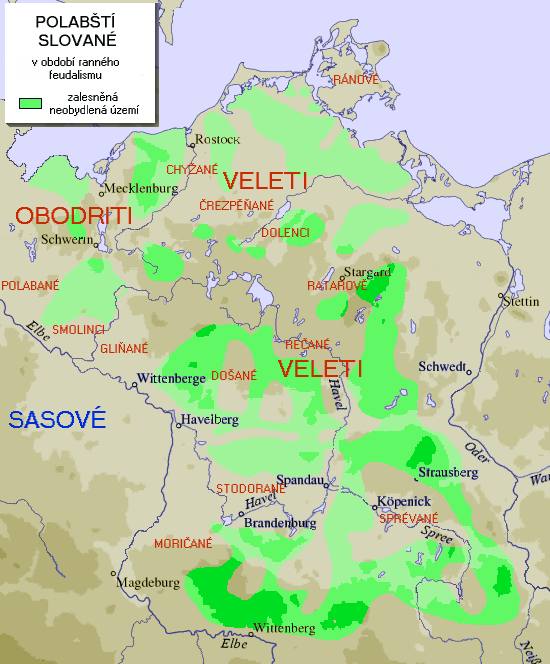
The Drevani are basically a spatial term between neighbours. East of the Elbe, opposite the Höhbeck, lay the Linones; whether they also sat on the left bank, in the area of today’s Wendland, is regarded as an open question. Further east the Wilzi were active, who took the Höhbeck in 810. In the north the area touched the Saxons, to whom the Bardengau also belonged, mentioned several times in the annals (780, 785, 799), and further north the land across the Elbe that was later called Nordalbingia. In the west the Saxon heartland adjoined, which Charles had subdued in long wars.
The collective term Polabians (“those on the Elbe”) covers Slavs on the lower Elbe, and the Drevani are counted among them; the Wendland was the westernmost point of the Slavic language area, and the language name “Dravaeno-Polabian” reflects this classification. More disputed is the assignment to the Obodrites. English and Polish Wikipedia assert that the Drevani belonged to the Obodrite confederation until they came under German rule from the ninth century. A source that proves this we did not find. In the annals we read, the Obodrites appear further north and northeast. We therefore regard the assignment as a hypothesis and not as a finding.
The picture of the Wendland likes to show a Rundling village: farmsteads standing in a circle around a green, with a single access. In popular belief the form counts as “typically Slavic”. Research has not confirmed this. The older assumption that Rundlinge were a Germanic settlement form did not hold; the assumption that they were purely Slavic did not either. By the current state, as German Wikipedia summarizes it, they are a planned village form of the high medieval colonization of the land, arising from about 1150, with mainly Slavic inhabitants. The main argument is the absence of Slavic pottery at the Rundling sites: people evidently settled only when this pottery was no longer in use. Among the occasions considered are that Slavs were resettled from the Elbe and Jeetzel lowlands because of rising water levels, or that landlords wanted to expand grain farming; who had the villages laid out and why the form became circular is unresolved.
Old maps record some 200 Rundlinge around 1800. About 100 villages still show the form; a survey by the Rundling association in 2014 counted some 210 villages with a Rundling history, of which only nine are fully preserved. Inclusion in the German tentative list for UNESCO World Heritage failed in 2014 and again after an application in 2021. That does not diminish the importance of the villages, only the timeline. Rundlinge are testimony of the German-Slavic contact zone of the high Middle Ages. They are only indirectly connected with the Drevani of the year 1004: the same landscape, built later and differently.
The best source for the Slavs in the Wendland is not a chronicle but their language, and it is transmitted late. Polabian (from po Labe, “on the Elbe”) is a West Slavic language known only from a few records of the seventeenth and eighteenth centuries. Its variety in the Wendland is called Dravaeno-Polabian. The collectors include J. F. Pfeffinger, who compiled a dictionary in 1698 on the Lüneburg dialect; Christian Hennig von Jessen, pastor in Wustrow, whose Vocabularium Venedicum arose around 1705 (one source gives 1710 for publication, another 1679 to 1719 for the work) and comprises about 2,800 words, of them up to 600 loans from German; also J. G. Domeier (1744, about 300 words), Gottfried Wilhelm Leibniz (1717, 137 words) and S. Buchholtz with a Lord’s Prayer (1753).
Hennig’s informant was the Polabian-speaking farmer Johann Janieschge from Klennow. What stands on paper is thus the Slavic of a village, not of a “nation”. The dialect basis of the sources differs, which makes reconstruction around 1700 difficult, and the records are inconsistent, in German script, with the collectors’ own signs. That is the price of a dictionary written down by listeners.
A role of its own is played by Johann Parum Schultze (1677–1740), a peasant scholar and village mayor who spoke Polabian himself. He wrote in High German a chronicle of rural life in the Wendland and added a word list; according to Rzetelska-Feleszko it stands in a village chronicle of 1724/25, whereas the Rundling Museum says the chronicle was written between 1720 and 1740. The original is regarded as lost; the Polish count Jan Potocki had a copy made on his visit in 1794. Schultze worried that the language might vanish and wrote, by sense, that then nobody would know what a dog is called in Wendish. In 1724/25, by his statement, only three people still knew the language, though his statements contain contradictions. The Slavicist Reinhold Olesch published the most important texts between 1959 and 1987, among them a Thesaurus of about 2,000 pages.
When Polabian died out depends on the witness. The usual date is 1756, when the farmer’s wife Emerentz Schultze died in Dolgow, according to German Wikipedia aged 88. The Rundling Museum, by contrast, names an 80-year-old woman in Dolgow who died in 1759; English Wikipedia gives 1752 for the Hanoverian Wendland and also states 1756. We leave it at “around 1750” and point out that the figures vary. More important is the timeline: between the charter attestation of 1004 and these speakers lie some 700 years. Whoever calls them “Drevani” names them after a word that their ancestors need hardly ever have used. Assimilation, the gradual absorption into German, took about 500 years according to Polabian linguistics; remnants held on in the Altmark and southwestern Mecklenburg until the late seventeenth century.
Written tradition on the Wendland sets in more broadly only in the twelfth century, after 1004. According to Wikipedia, Dannenberg is first named on 18 October 1157 in a Magdeburg charter; a castle that existed under Volrad I of Dannenberg (1153–1169), who was commissioned by Henry the Lion with settlement, is regarded as the forerunner of the palace. Lüchow is first mentioned in 1158. The county of Lüchow passed in 1320 to the House of Brunswick-Lüneburg; the line of the Counts of Dannenberg ended in 1303. For 1223 it is reported that the Danish king Valdemar II was held prisoner in Dannenberg castle; the statement is given in Wikipedia without a footnote and we have not checked them. The Slavic did not vanish abruptly in the process: in the villages Wends and Germans lived with equal rights and duties, in the towns Wends were excluded from citizenship and guilds until about 1700, which made moving to town harder and kept the language in the countryside. That figure comes from a presentation by the Rundling associations and is unsupported.
Why this matters for the article: between 1004 and the turn of the eighteenth century the tribal name Drevani does not appear as an acting body, as far as we see. What survives are landscape names, place names and the language. They support with great certainty the statement that Slavs lived here. They support only very weakly the statement that they understood themselves as Drevani.
Established are the charter form “Claniki in Dreuani” of 1004, the naming of the fort Hohbuoki on the Elbe in 810 with Odo, East Saxons and the Wilzi, the existence of a Slavic language in the Wendland until the middle of the eighteenth century and its transmission by Pfeffinger, Hennig, Schultze and others. Interpreted are the equation of the Vietzer Schanze with the fort (well founded), the derivation of the name from *drěvo (“forest”) and the dating of Slavic immigration to the eighth or ninth century. Presumed is that the Drevani belonged to the Obodrites or to the Linones; neither is attested. Told are the legends that make the Wendland the scene of a Varus battle, a Charlemagne campaign or an unbroken Slavic tradition. They are modern stories, not sources.
We do not know what the Slavs of the Drawehn called themselves. We do not know whether the Drevani of 1004 were a body with leadership or merely the inhabitants of a stretch of land. We know no prince of the Drevani, no cult, no chronicle of their own. Whether they were part of the Obodrites, the Wilzi, the Linones or a small group of their own also remains open. Open are the beginnings of Slavic settlement on the left of the middle Elbe, the relation to the Saxon population before 800, the dating of many hillforts and the question of how exactly the name Drevani came into the charter of 1004. The Drevani are an example of how much can hang on a single name and how little it carries.
For our work this has a consequence. In our family workshop in Alsdorf near Aachen we laser-engrave motifs from the Viking, Germanic, Celtic and Slavic worlds on slate. For the Drevani there is no established imagery, no find, no sign that could be assigned to them, and we invent none. Whoever feels drawn to the Wendland can ask us for an individual motif; our articles on the Polabians and Obodrites offer starting points from the surroundings.

The Drevlians · The Polabians · The Wilzi · The Linonen · The Abodrites.
All History & Finds articles →
Between Lake Skadar and the Adriatic coast, a South Slavic principality bore the name of an abandoned Roman city. An …
Read more →