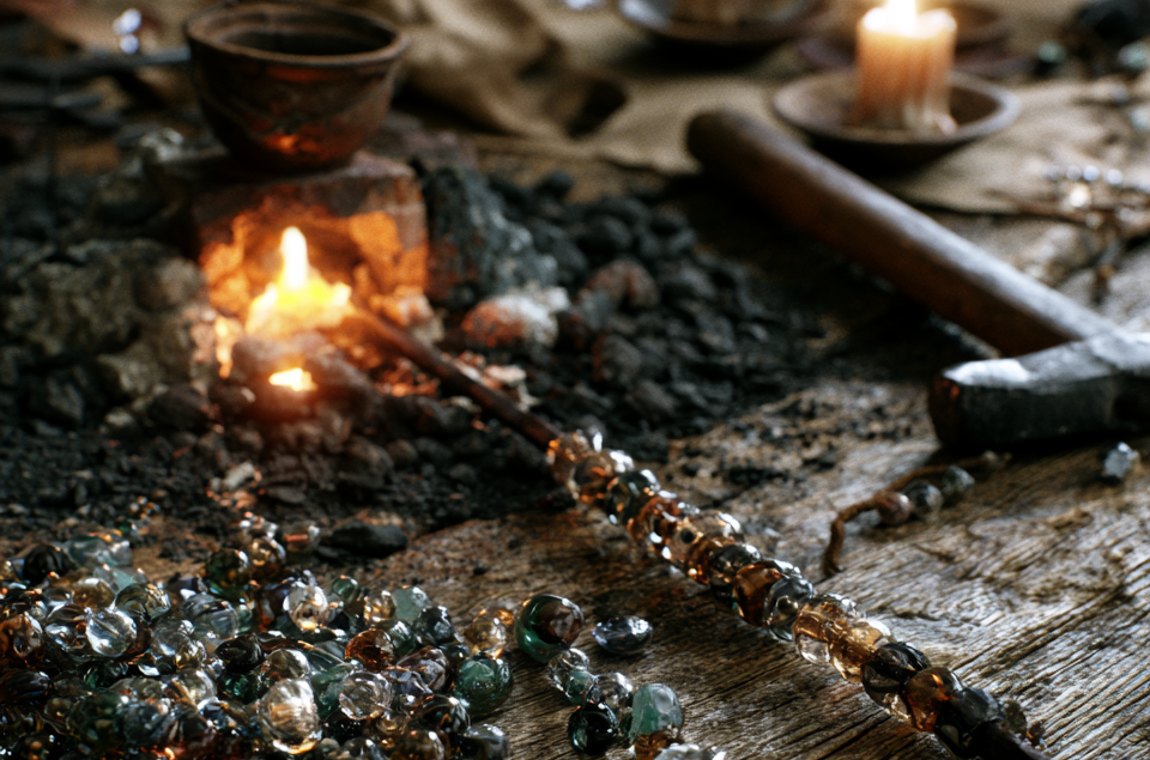
Amber from the Baltic, red carnelian beads from the Orient, clear rock crystal carried from far away: the Viking-Age North did wear stones – but rarely the ones you find on today's crystal-shop shelf. This overview sorts out which gemstones are actually attested, where they came from, and what people valued in them. And it says honestly where old trade goods have turned into modern myths.
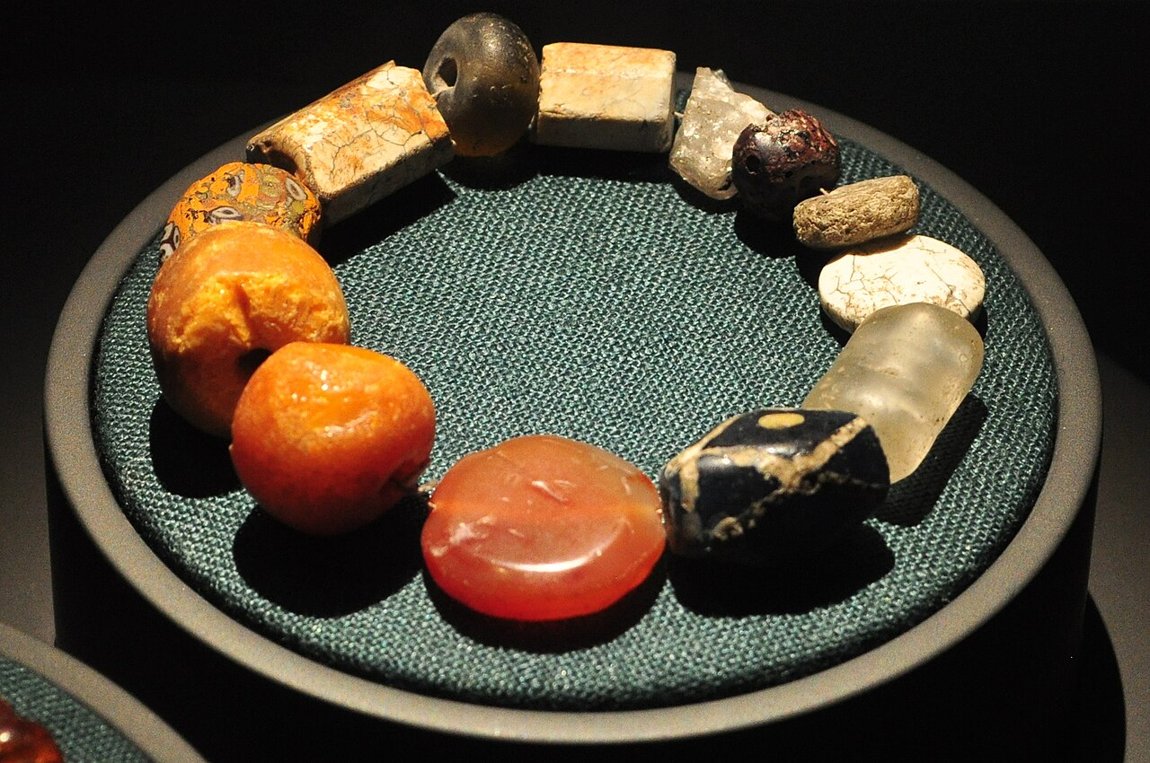
When we say "gemstone" today we picture cut diamonds, facets and carats. The Viking Age did not know that world in the same way. Stones were worn, yes – as beads on strings, as inlays in brooches and sword pommels, as pendants. But their value rarely lay in mineralogical purity; it lay in colour, sheen and above all origin. A red stone that had travelled thousands of kilometres from the east spoke of wealth, reach and connections. That is the honest core of a Norse "gemstone lore" – it is about trade, status and aesthetics, not secret powers.
One thing up front: much of what is casually counted as "Viking jewellery" today simply is not, historically. So this overview draws a clear line between the stones that genuinely turn up in graves and trading places, and the decorative stones that only later ages made popular. You may love both. You should just know what you are wearing.
No material is bound to the North as closely as amber. It is not a mineral but fossilised tree resin, washed up along the shores of the southern Baltic – warm in tone, light in the hand, electrostatic when rubbed. Long before the Viking Age it travelled as coveted goods along the "amber road" to the Mediterranean and Rome. Viking-Age trading places such as Hedeby and Ribe preserve whole workshop layers of amber waste: beads, gaming pieces, small pendants, even Thor's hammers were cut from it.
"They alone of all peoples also scour the sea, and are the only ones to gather amber – which they themselves call glaesum – in the shallows and on the shore itself."
Tacitus, Germania 45 (on the Aestii of the Baltic coast), public-domain translation from the Latin original
In the same chapter Tacitus marvels that these people receive good money from the Romans for a substance they themselves find useless. Exactly that tension – worthless at home, precious far away – makes amber the model case of Norse long-distance trade. If you want the full story, read our piece Amber – the gold of the Baltic.
When a bright red-orange bead stands out in a Viking-Age woman's grave, it is often carnelian – a variety of chalcedony. Such beads are a fingerprint of long-distance trade: carnelian (and banded agate) was mined and worked mainly in India and the Near East and reached the North along the Russian river routes, the Volga road. Together with silver dirham coins, these beads show how far the network of the Rus stretched – to the Caspian Sea and beyond.
The stone was not native; it was imported and expensive, and that is exactly what made it attractive. It was usually worn as a bead among glass and silver beads, and its typical facetted or barrel-shaped cut betrays that it arrived already worked from the east. To own a carnelian bead was, in effect, to own a travelling status symbol. More in Carnelian – red beads from the Orient.
Rock crystal, the glass-clear quartz, appears in richer assemblages as a bead or as a cut, mounted sphere – sometimes set in silver and worn on a chain. It too reached the North largely through trade routes from the east and south-east. Its clarity and cool sheen made it a prestige object; where it was set in silver, the real craft often lay in the mount rather than the stone. Because rock crystal looks so light and pure, it remains a popular stone today – including for our rock crystal pieces and for rune sets made of real stone. Historically it was a sign of far-reaching connections, not an "energy stone".
Deep-red garnet (mostly almandine) is among the most splendid stones of the early period – though it belongs more to the Migration and Merovingian eras than to the Viking Age proper. In cloisonné, wafer-thin garnet plates were laid into gold cells so that whole brooches and sword fittings seemed to glow. Famous finds such as those from Sutton Hoo show this fire at its finest. This garnet, too, was distant goods: much of it came from India and Sri Lanka.
Towards the Viking Age, garnet cloisonné becomes rarer; taste shifts to silver, filigree and animal-style ornament. To place the red splendour of the earlier period, read Garnet – the fire of the early princely graves.
Jet, like amber, is not a mineral in the strict sense but fossilised wood – deep black, light, polishable to a high gloss. Its most famous source lies on the English coast near Whitby. The Romans already prized it; in the Viking Age jet was worked into arm-rings, beads and pendants and traded across the North Sea, for instance to Jórvík (York). Its deep black and contrast with silver made it popular. More in Jet – the black stone of Whitby.
Stones almost never appeared "bare" in the North. They were beads on strings between the oval brooches of women's dress; they sat as inlays in metal; they hung as small pendants. The real wealth of a necklace often lay in the mixture: local and imported glass beads, a carnelian among them, a rock crystal, perhaps silver and a piece of amber. Such a necklace was portable proof of how far a family's trade connections reached.
That is the real "magic" of Norse stones: not a claimed effect, but the story of the road they had travelled. Whoever wore an oriental carnelian bead wore a piece of long-distance trade around the neck.
Three great axes explain which stones went where. From the southern Baltic, amber flowed in every direction. Along the Russian river systems, the Volga route, came carnelian, rock crystal and Islamic silver from the Orient. And across the North Sea ran goods such as jet from England, pottery and basalt quern-stones from the Rhine – among much else. Stones are an especially telling marker here because they can be placed geographically: where a carnelian lies in the ground, the network reached as far as the Orient.
The real art often lay not in the stone but in its handling. Amber and jet are soft enough to be cut, turned, drilled and polished with simple tools – the workshops of Hedeby and York turned out beads, rings and pendants almost in series. Harder stones such as carnelian and rock crystal, by contrast, mostly reached the North already cut and drilled from the east; Norse craftsmen set them, strung them or mounted them in silver. In garnet cloisonné, half the mastery lay with the goldsmith: he built the cells, backed them with patterned gold foil so the light bounced back, and fitted wafer-thin stone plates precisely.
This division of labour explains a lot: where a stone was imported, the North showed its skill in the setting. Where it was native – amber, and to a lesser degree jet – a craft of its own arose, with workshops, series and trade. For us today that is a nice through-line: with our pieces too, the work lies in clean setting, combining and engraving – the stone brings colour and character, the hand makes the object.
A modern jeweller grades a stone by clarity, cut and carat. Viking-Age taste worked differently. What was wanted were strong, speaking colours: the warm gold of amber, the glowing red of carnelian, the deep black of jet, the silvery clarity of rock crystal. A stone was allowed inclusions as long as the colour held and the sheen carried. Red was especially coveted – not from some firm symbolic reason we could safely prove, but because red stones were rare, imported and therefore expensive. A word of caution here: a fixed "Viking colour symbolism" for individual stones cannot be cleanly derived from the sources. What can be said is simpler and more honest: striking colour plus distant origin equalled prestige.
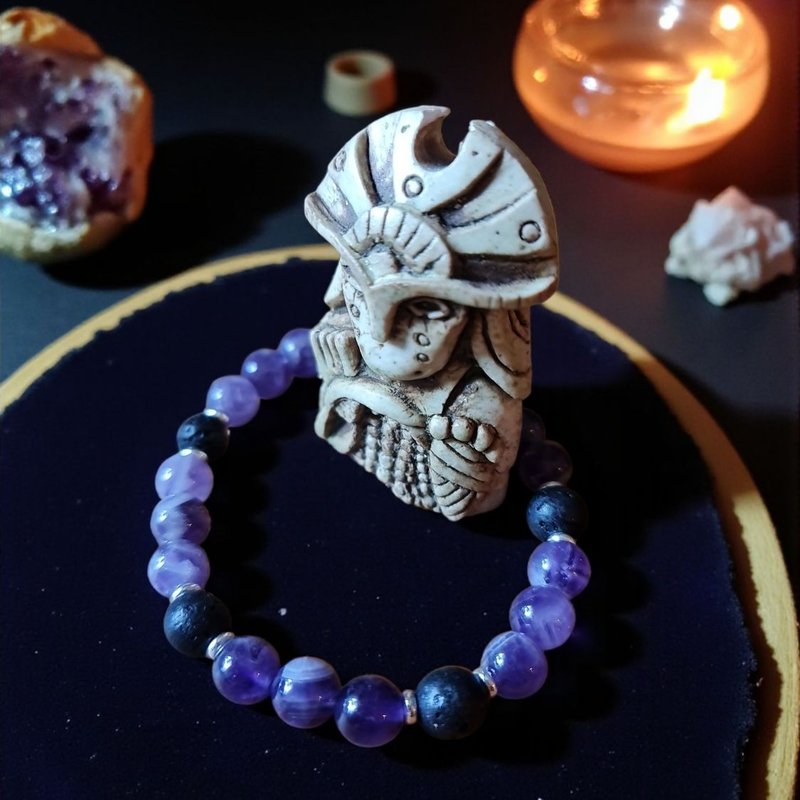
Honesty pays here, because many popular decorative stones simply have nothing to do with the Viking Age. Amethyst (purple quartz), moonstone, peridot (olivine, yellow-green), tiger's eye and malachite are beautiful stones – but they are modern decorative stones, not attested parts of Viking-Age dress. Some were known elsewhere in antiquity; others only became popular through later sources, cutting techniques and modern trade. Tiger's eye, for instance, owes its familiar look to modern availability and cutting; malachite was ancient as a pigment but not a Norse dress stone.
That is no flaw. A bracelet of amethyst or tiger's eye is a beautiful, modern piece in a Norse-inspired spirit. It just should not be sold as "genuine Viking". We therefore label such stones honestly as modern decorative stones – the attested line runs through amber, carnelian, rock crystal, garnet and jet.
This distinction matters to us because it is part of the brand: we tell the real story of the stones – long-distance trade, status, craft – and do not embellish them with invented effects. That is more honest and, frankly, the more exciting story.
In our workshop we work with real stones – as gemstone bracelets and as rune sets of real stone. We choose them for colour, structure and quality, set and combine them, and where it fits engrave clean motifs and runes into them. What we tell you about them is the provable story: which stone historically mattered, which is a modern decorative stone, and where the roads led.
A rune oracle of rock crystal, amethyst or snow quartz is a modern, handmade object – beautiful, durable, honestly described. We explain the runes themselves from the surviving rune poems, and place oracle-casting as a modern practice. So you get a piece that looks and feels as if it came from the North – without fairy tales about effects no one can prove.
The Viking-Age North knew stones as beads, inlays and pendants – attested above all are amber from the Baltic, carnelian and rock crystal from the Orient, garnet in the cloisonné of the earlier era, and jet from England. Their value lay in colour, sheen and distant origin, not in claimed powers. Amethyst, moonstone, peridot, tiger's eye and malachite are beautiful but modern decorative stones. And the "healing stone" idea is modern esotericism without scientific support. We stick to the real story – and to real stone.
Amber – the gold of the North · Carnelian – the Vikings' red beads · Rock Crystal · Garnet · Amethyst · Moonstone.
All Everyday Life & Craft articles →
Few plants mattered as much to the people of the far North, and are as thoroughly underrated today, as angelica. To us …
Read more →When we think of Vikings, we often see grey-brown figures in undyed wool. That is a mistake. Whoever could afford it …
Read more →The Viking of film and television wears grey, brown and grime. The real Norseman wore red, blue and yellow – and was …
Read more →The Viking Age was anything but grey. When people picture Norsemen today, they often imagine mud-brown tunics and sooty …
Read more →