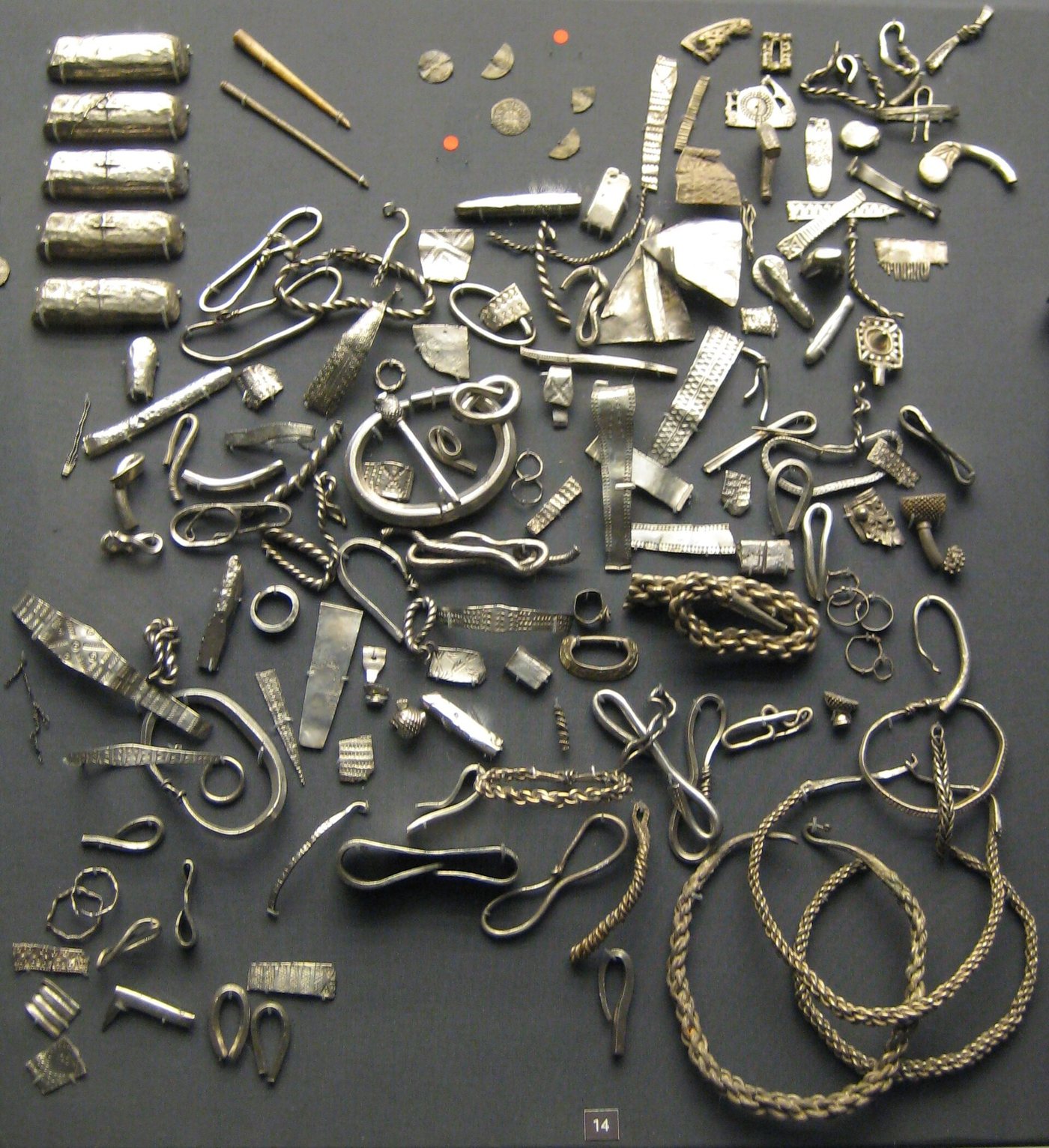
Between the Broads and the North Sea, a cluster of Norfolk villages carry names that sound as if they came from Denmark: Ormesby, Rollesby, Scratby, Hemsby. As early as 1695 an English scholar took them as the mark of the first Danish settlement in the country. The cluster is real, and nothing else in England matches it. Whether that makes Flegg a Viking settlement is another matter. This article tests the names, the coast, Domesday Book and the metal finds one at a time and shows how far each will carry.
Flegg is the land in eastern Norfolk north of Great Yarmouth, split in Domesday Book into two hundreds (the administrative divisions of a county), East and West Flegg. Open Domesday, the online edition of the survey of 1086, lists 25 places there. Seven in East Flegg and six in West Flegg have names in -by, the Old Norse word for a farm or village: Filby, Herringby, Mautby, Ormesby, Scratby, Stokesby and Thrigby in the east, and Ashby, Billockby, Clippesby, Hemsby, Oby and Rollesby in the west.
The counts differ. Gillian Fellows-Jensen, who has researched these names at Copenhagen, says thirteen. Simon Wilson's 2018 MPhil thesis reaches fourteen out of 27 settlements, eight in East and six in West Flegg. Where the fourteenth name comes from I could not establish from the part of his text accessible to me; he explicitly treats the two Ormesbys as one place, so they do not explain the difference. The pattern is hardly affected.
Lesley Abrams, who has written on the history of research into these names, states how unusual it is: no such density occurs anywhere else in Norfolk, or in the rest of England. Elsewhere in the county -by names are scattered. That is the puzzle. Why should this small district behave so differently from its surroundings?
"Isle of Flegg" is common usage in the literature, and it rests on a vanished landscape. In the Roman period this was the so-called Great Estuary, which according to the Norfolk Heritage Explorer followed the Rivers Thurne, Yare and Waveney and came within about 7 kilometres of modern Norwich. Historic England says it reached south as far as Burgh Castle and up to 12 kilometres inland. The Roman fort at Caister, built in the early third century, stood on the south-eastern edge of the island, some 335 metres north of the former shoreline. Today this is marshland, much of it drained, and the Halvergate Marshes recall the old arm of the sea.
One gap matters here. The descriptions I could check concern the Roman period; for the Middle Ages they say only that the area had become marsh by then. How open the water was around 880 they do not tell us. From the sources I read, this cannot be clearly established. Edmund Gibson in 1695 called Flegg "a Peninsula", almost surrounded by water, while Fellows-Jensen and Wilson speak of an island in the Viking Age.
The location is not in dispute. Whoever controlled the estuary sat on the waterway between the North Sea and the country around Norwich, and Wilson builds his thesis on that. Fellows-Jensen and, by her citation, Abrams and Parsons think along similar lines. Domesday also shows what the coast lived on: for Caister, the Norfolk Heritage Explorer records forty-five salt-houses, a striking figure for one place.
Written evidence for settlement in East Anglia is brief. According to the Anglo-Saxon Chronicle, the Great Army wintered in East Anglia in 866 and at Thetford in 870, killing King Edmund that same winter. Then, after Guthrum's defeat by Alfred, comes the entry on which nearly everything rests:
"This year went the army from Cirencester into East-Anglia, where they settled, and divided the land."Anglo-Saxon Chronicle, entry for 880 (879 in some reckonings), as given by the Avalon Project in a public-domain nineteenth-century translation
The sentence gives neither places nor numbers. It does not say who exactly settled, and it says nothing of Flegg. The entry for 896 is also telling: the Danes secure "an asylum for their wives among the East-Angles". That at least shows Scandinavian families finding support in East Anglia at this time. Whether in eastern Norfolk, the Chronicle does not say. In 917, as Fellows-Jensen summarises, the English regained control of most of East Anglia. That is the frame for the Flegg debate, which rests on traces that become visible only decades or centuries later.
The history of the question starts early. The topography of Norfolk begun by Francis Blomefield, whose Flegg section was written after his death in 1752, probably by his continuator Charles Parkin, reports the view of Sir Henry Spelman that the Danes first settled here, as this part of the county lay nearest the sea and was easy to defend. Edmund Gibson wrote it into his 1695 edition of Camden's Britannia: here the Danes seem to have made their first settlement, "we find 13 villages ending in by". So the figure still in use today was already on the page.
The author disagreed. He did not doubt the Danes, but doubted that they named the villages, and took the ending to be British, a view nobody now holds. In the nineteenth century the Dane Worsaae returned to the case. The point stands: the equation "-by means Dane" is more than 300 years old and was already questioned in the eighteenth century.
The argument took its modern form in the twentieth century. In Anglo-Saxon England (1943) Frank Stenton had combined place-names, coins and charters into an overall picture of Scandinavian settlement. Against this came what Abrams calls a wave of revisionism, shaped in part by Peter Sawyer's The Age of the Vikings (1962, second edition 1971), whose assessment she calls "minimalist". As Wilson presents it, Sawyer held that many -by names were coined by the English, and that a -by with a personal name in a remote spot more likely marks a change of ownership: a new Scandinavian lord taking over something already there. He did not deny Scandinavian influence on the name map itself.
Kenneth Cameron, a mainstay of the English Place-Name Society, worked on names in the territory of the Five Boroughs in the east Midlands. He observed that many -by places occupied less favourable sites on river tributaries and concluded, in a sentence Wilson quotes, that the Danes came as colonists, developing virgin land and establishing new settlements. He allowed that some English places were taken over and renamed. One scholar saw farmers on new land, the other new lords on old land.
This matters for Flegg: in the texts I could read, the contrast does not come from a study of Norfolk. The debate arose elsewhere and is applied to Flegg after the fact. Paul Cavill shows from the Midlands that either explanation can hold depending on the district: he reads the -by names around Leicester as farms carved out of unused land, and hybrid names in the Trent valley as English villages that changed hands.
Flegg fits Cameron's picture of poor new land badly. Natural England describes north-east Norfolk as low-lying and fertile, with light sandy soils that eased clearance in the early medieval period. R. H. C. Davis noted in a 1955 footnote that the villages on the highest land of the two hundreds have English names, namely Caister, Winterton, Somerton and Martham, and that except at Caister and Yarmouth there was no evidence of pre-Scandinavian settlement. That sounded like Cameron's model: the English on the best ground, the newcomers in between.
The finds have since moved on. Historic England records occupation at Caister from the seventh to the eleventh century, apparently by a high-status, possibly monastic community. Martham has produced Early Saxon brooches, Middle Saxon pottery and a disc brooch. Flegg was not empty before the Vikings, and Davis's qualification no longer holds as written. Whether the -by places themselves had older predecessors is a separate question. For the area around Billockby and Clippesby, the Norfolk Heritage Explorer explicitly calls this unclear, and the parish has so far yielded no Early or Middle Saxon finds. For the parish of Stokesby with Herringby, by contrast, it records Middle and Late Saxon pottery.
Abrams connects Scratby, Rollesby and Ormesby with men called Skrauti, Hrólfr and Ormr. Clippesby is read as the farm of a Klyppr. Names like these read like a land register. Wilson calculates that over three quarters of the Flegg names, 78 per cent, contain a personal name or byname, more than in any other region of the Danelaw, and attributes this to particular social and political circumstances.
Fellows-Jensen is more cautious, but counts a different set: of the 27 East Anglian bý names, her article in Nomina 37 keeps only eight as certainly containing a Norse personal name. She does not say there which eight, or how many lie on Flegg, so the two figures cannot be compared directly. Herringby shows why. It was long taken as the farm of a man called Hæringr. She now follows David Parsons, who proposes Old English hǣring, simply "herring". The founder becomes a fish, and evidence for a Scandinavian perhaps becomes a hint of fishing. Billockby has three solutions on offer: a personal name Bithlak (Sandred), a byname from biðill "wooer" plus the name Áki (Ekwall, Watts, Wilson), or a common noun (Fellows-Jensen). Fellows-Jensen, according to Wilson, derives Ashby from English æsc "ash tree", and the Norfolk Heritage Explorer calls Stokesby a mix of Old English and Old Scandinavian. According to Wilson, Fellows-Jensen takes such English components to point to older places that were renamed.
Something else is missing on Flegg: the so-called Grimston hybrids, English -tūn joined to a Norse personal name. According to Fellows-Jensen they are spread across East Anglia except in the Fens and on Flegg. Naming here apparently ran differently from the surrounding country.
Domesday Book of 1086 comes two centuries after the settlement. Its East Anglian part, Little Domesday, is especially detailed. In her study of the free peasantry of East Anglia (Norfolk Archaeology 27), Barbara Dodwell calculated the share of free peasants in the rural population: about 74 per cent in East Flegg and 65 in West Flegg, among the highest figures. Oby, a small place, shows this in detail. Nearly every entry there lists freemen, some under the abbey of St Benet of Holme, others under Roger Bigot.
Dodwell concluded that many of these free men descended from the Danish settlers of the ninth century. In 1955 Davis attacked this idea, which goes back to E. W. Robertson (1862): it rested on the distribution of free peasants, not on any knowledge of Scandinavian peasant society. The correlation is there; the cause remains open. The article on the Danelaw also treats the sokemen as a disputed argument.
On the economy, Wilson argues that -by places and English-named places had equal economic status and a diverse economy. Size can be roughly checked: Open Domesday's household estimates for the -by places run from about 14 (Thrigby) to 59 (Mautby), while Caister reaches 113, Somerton 94 and Winterton 81. So the largest places do not have -by names. These are, however, modern calculations with fractions for shared entries, size is not status, and the position in 1086 says little about 880.
Since metal detectorists began reporting finds, and the Portable Antiquities Scheme began recording them from 1997, the picture has shifted. For Viking Identities (2013) Jane Kershaw assembled just over 500 brooches and pendants in Scandinavian and Anglo-Scandinavian styles, dated from about 870 to about 1050. According to her university, UCL, they concentrate in rural Norfolk and Lincolnshire, and are rare in Yorkshire and the north-east Midlands. She reads this as a sign of Norse women, not only warriors. How she weighs it against the DNA data is covered in the article on Viking women.
For Flegg this gets harder, because Kershaw's finding concerns the region, not the island. The brooch records that targeted searches of the Norfolk Heritage Explorer gave me come from Burgh and Tuttington, Wiveton, Marlingford, Marham, Tasburgh and Aslacton, none from Flegg. That is only a sample, but the parish summaries for Martham, Fleggburgh and Caister also mention no Viking find. Boulton (2023), according to the publisher's description, even singles out a cluster of finds south of Norwich that matches a group of names there.
Wilson, by contrast, infers from "specific Scandinavian metal work finds" that a distinct Scandinavian culture may have survived on Flegg. His list of figures includes trefoil brooches, one with an animal motif in the Jelling style, a Borre-style strap-end and a Scandinavian disc brooch. The chapter itself was not accessible to me, so I cannot give findspots or counts. Then there is Kershaw's own caution that the distribution must be interpreted with care. What turns up depends also on where land is ploughed and where detectorists are allowed.
Several explanations circulate for the density, and Fellows-Jensen herself offers three without committing: Flegg may have been a Viking base in the ninth century. A Danish enclave may have survived after the English recovered East Anglia in 917. Or the area kept a strategic role in protecting traffic to the Continental markets, a point she credits to Abrams and Parsons.
Wilson proposes a planned colonisation that took over existing English settlements and grew from the orbit of the Middle Saxon site at Caister. "Productive sites" of this kind are places yielding unusually many coins and metal objects. Wilson's is a postgraduate thesis, not a peer-reviewed monograph, but the only freely available single study of Flegg known to me. Boulton's 2023 book gives Flegg its own section according to its contents, and according to the publisher reckons with several phases of settlement and possible direct migration from Scandinavia. I have not read it.
Abrams remains the most cautious: Flegg may reflect a different date, a different density of Norse speakers or a different kind of takeover. Norfolk's six hundred-names with Scandinavian elements may represent influence from above rather than spoken language. Building a story of Scandinavian Norfolk from place-names, she calls an exercise in speculation.
It depends on what the phrase means. A fortified camp, or a village shown by excavation to be Scandinavian, is not known to me on Flegg, though Wilson's archaeology chapter stayed unread. That people lived there who spoke Norse, or at least answered to lords with Norse names, is the most plausible reading of the names, and nearly all the scholars cited here share it. What stays unproven is date, number and process: whether in 880, after 917 or in waves, whether farmers or lords, whether new foundation or takeover. The coast explains why the place was attractive, not what happened there. For the wider picture, see the overview of Vikings in England.
Where is Flegg? In eastern Norfolk, north of Great Yarmouth, between the Broads and the North Sea. The name survives in East and West Flegg and in Fleggburgh.
Is Flegg an island today? No. The arm of the sea silted up into marsh; "island" is a term used in the literature for its earlier position.
What does -by mean? It is the Old Norse word for a farm or village. The first part is often a personal name but may be something else, as probably the herring in Herringby.
What was the dispute between Sawyer and Cameron? Sawyer read many -by names as changes of ownership on existing land; Cameron saw new settlements on previously unused land. Neither was working specifically on Flegg.
Can you see Viking remains there? What you can see is chiefly the place-names on the map and the remains of the Roman fort at Caister, occupied into the eleventh century. I know of no Viking monument to visit there.
The Danelaw · Vikings in England · Did Viking women travel too? · The Great Heathen Army · Guthrum · Alfred the Great · Viking jewellery · Viking agriculture

The Danelaw · The Vikings in England – from Lindisfarne to 1066 · Did Viking women travel? · The Great Heathen Army · Guthrum.
All History & Finds articles →
A man takes three ravens to sea, lets them fly and follows the third. He winters in a fjord in north-western Iceland …
Read more →The Fosi were a Germanic people known from exactly one sentence. Around AD 98 Tacitus names them in the Germania as …
Read more →Step out of our workshop in Alsdorf and look west, and you are looking at the heartland of a power that grew out of a …
Read more →Picture a jewellery box about the size of a thick book, carved from the bone of a stranded whale, and on every side …
Read more →