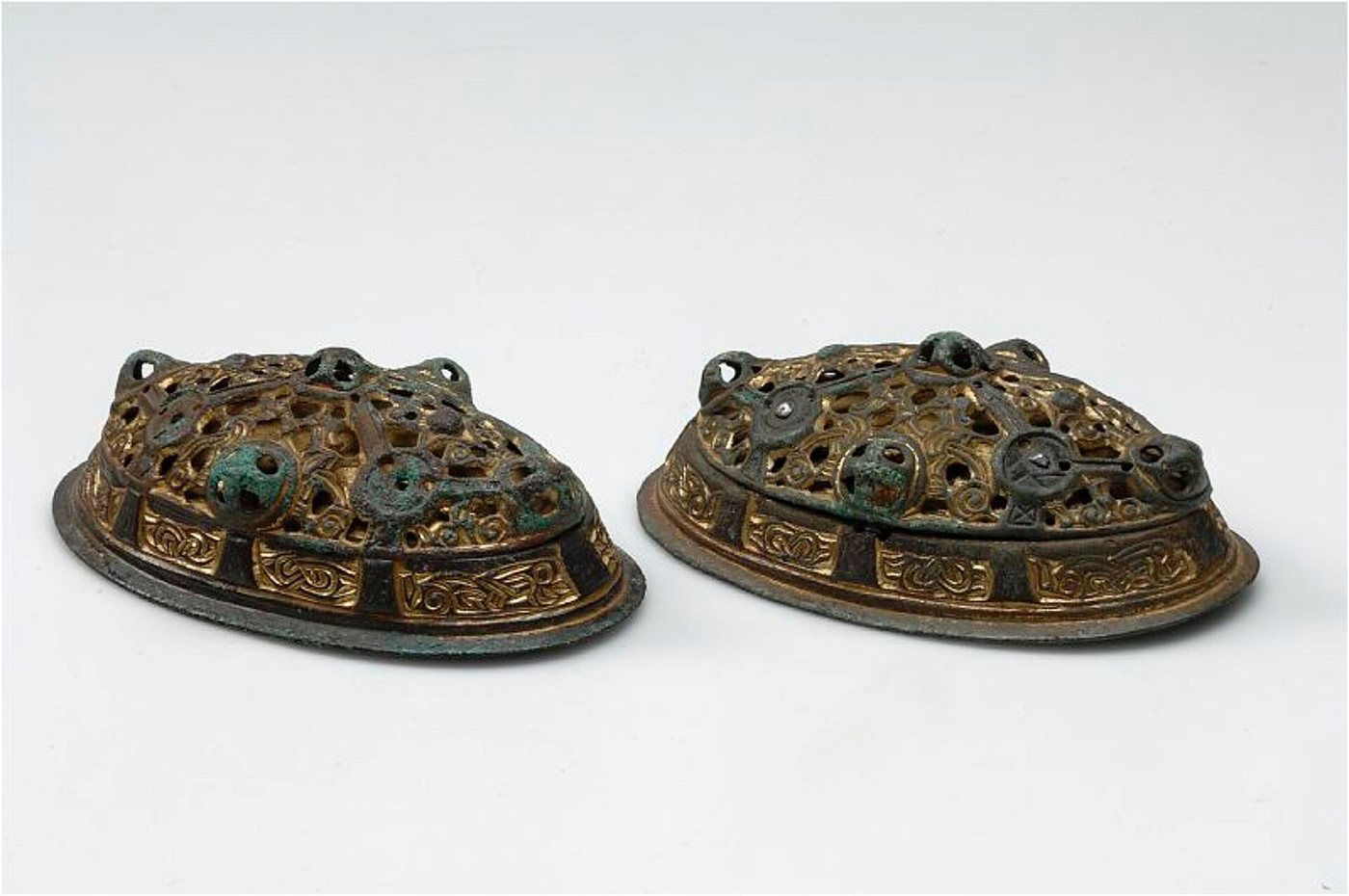
Does mitochondrial DNA "prove" that Viking women colonised new lands? A 2014 headline said so. The study behind it says, more cautiously, that women may have been involved, and rests on 45 skeletons from Norway. Thirteen years earlier another study had found that the maternal lines of Icelanders came mostly from the British Isles. For England, genetics says almost nothing on this question at all; there the evidence is brooches ploughed up in Norfolk and Lincolnshire. This article separates what each study measured from what later became of it, and shows why Iceland and England give two different answers.
Scandinavian men went west in the ninth century; nobody disputes that. The open question is how many Scandinavian women went with them: a few leaders' wives, whole family groups, or nearly as many women as men? It sounds simple, yet no region lets us answer it by counting. The answer has to be inferred from traces that each show only part of the picture.
Two regions dominate the debate, and their evidence is almost a mirror image. Iceland has strong genetic data and medieval settlement accounts but no mass of female jewellery. England has hundreds of jewellery finds, place-names and a few sentences in a chronicle, but no comparable genetic measure of maternal lines. Carrying the results from one to the other is the commonest mistake in this debate.
Law and daily life are covered in Women in the Viking Age, today's ancestry tests in Am I descended from the Vikings? and growing up in Viking childhood. This article is about the method behind the sentence "the women came too".
Mitochondrial DNA, or mtDNA, sits outside the cell nucleus and passes only from a mother to her children. The Y chromosome passes only from father to son. Compare the two lines in one population and you can estimate whether its founding men and founding women came from the same regions. That is why the method became so important here: it separates the sexes, which the rest of the genome long barely allowed.
Three limits belong in any honest account. First, mtDNA is a single path through a family tree. A woman with a Norse father, a Gaelic mother and Norse as her language carries Gaelic mtDNA and appears in the statistics as a "Gaelic" line. The test records the origin of the line, not the woman's birthplace, language or legal status. Second, the classic studies sample living people and calculate backwards across more than a thousand years of random change, which geneticists call drift. Third, "Scandinavian" and "Gaelic" are statistical reference groups, again mostly modern. Agnar Helgason and his colleagues say themselves that "Gaelic" is only a convenient label for mainland Scottish and Irish populations.
These limits do not make the results worthless, but they explain why "37 per cent of maternal lines" must not become "37 per cent of female settlers were Scandinavian", even though the 2001 press release from deCODE, the company involved, put it roughly that way.
The best-known study appeared in 2001 in the American Journal of Human Genetics. Helgason's team analysed mtDNA from 1,664 newly sampled people and added 3,444 existing European sequences. For Iceland it put the Scandinavian share of maternal lines at 37.5 per cent and the Gaelic share at 62.5 per cent. A companion study of 2000 had given about 80 per cent Scandinavian ancestry on the paternal line. That is the source of the neat picture of Norse fathers and Irish mothers, also taken up in our article on the Icelanders.
The confidence interval, the range in which the true value probably lies, is quoted less often. For the Scandinavian share it runs from 21.5 to 57 per cent. At the top end, Scandinavian women would actually be the majority among maternal lines. The direction of the finding holds, because even 57 per cent is well below the paternal figure. The number itself is far softer than its decimal place suggests. The authors also call their estimator heuristic, since the short DNA stretch they studied does not allow unambiguous family trees.
Often lost in the retelling: even by this study, a substantial part of Icelandic maternal lines came from Scandinavia. Scandinavian women did go to Iceland. They were simply, measured by lines, less common than Scandinavian men. Jane Kershaw sums up the results for Iceland, the Faroes and the Western Isles by saying Norse men outnumbered Norse women about two to one. That is derived from ancestry shares; it is not a headcount on a ship.
Nor does the origin of the other lines force a single story. Helgason and his colleagues reckon with young unmarried men taking local wives in coastal settlements, but also allow for already mixed families moving on from the British Isles later. How many of these women were abducted, how many freely married and how many were themselves Norse-raised daughters of mixed unions cannot be read from the lines. Slavery was certainly part of this world, but its share of the statistic is unknown. The voyage of Auðr from Scotland to Iceland shows what such a route looked like in storytelling; it is a saga account, not a measurement.
The written sources, incidentally, underrate the West. Helgason cites Jón Steffensen's 1975 analysis of the Book of Settlements: 16.7 per cent of the recorded genealogical lines of women lead to the British Isles, but only 4.7 per cent of those of men. The direction of the difference agrees with the genetics; the size does not.
Samples from the settlement period itself avoid part of that backward calculation. In 2018 a team led by S. Sunna Ebenesersdóttir published genome data in Science from 27 early Icelanders, 24 of them from pre-Christian burials. Mean Norse ancestry in the settlement population was 56.6 per cent (confidence interval 43.1 to 70.2), against 70.4 per cent in Icelanders today. With a p-value of 0.058 that difference was suggestive but narrowly missed the usual threshold for significance. Some of the dead were genetically unmixed Scandinavian or British-Irish, others mixed.
A side result matters for our question. Norse ancestry stood at 57.9 per cent in men and 52.1 per cent in women, and the difference was not significant. To conclude that early Icelandic women were just as Norse as the men would stretch this too far. Of the 24 pre-Christian dead, 19 were male, or 79 per cent, which the authors read as a difference in burial custom or in the chance of discovery. So few women can hardly yield a sex difference. Here "not significant" expressly does not mean "the same".
The key refinement came in 2005. Sara Goodacre and her colleagues set Y and mtDNA data for the North Atlantic side by side in Heredity. They estimated overall Scandinavian ancestry of about 44 per cent for Shetland and about 30 per cent for Orkney, with roughly equal contributions from men and women in both. The Western Isles came out at about 15 per cent, with a marked male excess. Iceland showed the highest overall share at about 55 per cent and also the widest gap between the sexes.
From this came a simple hypothesis: near Scandinavia, families tended to settle; further away, lone men who started families on the way or on arrival. Brian McEvoy and Ceiridwen Edwards named distance as the simplest explanation that same year. For the Faroes, Thomas Als and colleagues reported in 2006 an excess of British Isles ancestry among female settlers and the strongest asymmetry of all, while warning about the effect of drift in so small a population.
Distance is an interpretation, not a measured law. It fits the North Atlantic pattern plausibly but cannot simply be applied as a rule to England.
The Irish study by McEvoy, Brady, Moore and Bradley (2006), by contrast, contributes nothing on women. It examined only the Y chromosomes of Irishmen with supposedly Norse surnames and found scarcely any Scandinavian trace.
In December 2014 one study made the rounds. NOVA's headline claimed that mitochondrial DNA "proves" women were instrumental Viking colonisers. Phys.org said Viking families travelled together; Fox News said Viking women colonised new lands too. A co-author was quoted saying the work overthrew the nineteenth-century idea of Vikings as mere raiders.
The paper itself is by Maja Krzewińska, Erika Hagelberg and colleagues, in the Philosophical Transactions of the Royal Society B. It tested 80 skeletal samples from the Schreiner Collection in Oslo. Sequences came from 69 skeletons, 45 were accepted as authentically ancient, and after removing likely maternal relatives 43 people remained. Only a short stretch of mtDNA, hypervariable region 1, was studied. The dead came mostly from northern and central Norway, the find circumstances are partly poorly documented, and some skeletons were handled without precautions against contamination.
The actual result is this: the ancient Norwegians resemble ancient Icelanders and present-day people of Shetland and Orkney. The authors' conclusion varies in strength: the abstract says the analyses "indicate" that Norse women were important agents of the expansion, the discussion that women "may" have been involved in colonisation. They also argue that women from Orkney and the Western Isles contributed to the settlement of Iceland. The paper offers no new percentage of Norse against Gaelic, and it does not explicitly refute Helgason; it cites him for the haplotype-sharing method.
Between paper and headline, then, lie three leaps: from "indicate" and "may" to "proves", from a similarity to a travelling party, and from a small Norwegian dataset to "the Vikings". It says nothing direct about England and certainly nothing about families on one ship. A similar maternal line on Orkney and in Norway does not show when or with whom women travelled.
For the Danelaw, the parts of eastern England under Scandinavian rule, there is no measurement to match Iceland's comparison of paternal and maternal lines. I know of no study that reliably establishes a sex ratio for Danish settlers in England from genetic material. The Angles and Saxons of the fifth century and the Danes of the ninth came from neighbouring regions and were genetically very alike. The 2015 "People of the British Isles" study itself conceded that the two inputs cannot be definitively separated. The large genome study by Margaryan and colleagues (2020, 442 ancient genomes) does report a major influx of Danish ancestry into England, but its abstract says nothing about the share of women. I could not consult the full text.
Kershaw and Ellen Røyrvik took this up in Antiquity in 2016 and estimated 20,000 to 35,000 original migrants, a figure from two rough models. What matters here is how they reach the women: not through the genome. Their statement that the evidence points to the migration of family groups rests on names and metalwork. So "DNA proves Viking women in England" is simply misattributed. The DNA results Kershaw cites in 2018 come from the North Atlantic, not England.
England's strongest argument comes from metal detectorists. Since the late 1990s the Portable Antiquities Scheme has systematically recorded their finds, just under 50,000 early medieval items by Kershaw's 2018 count. Among them stand out small brooches in Scandinavian style that women used to fasten their dresses: disc, trefoil, square and also oval brooches. They carry Borre and Jellinge ornament, and their pin fittings follow Scandinavian construction. The types are described in our article on Viking jewellery.
The figures are often conflated, and they count different things. In a publisher's piece on her book Viking Identities (2013), Kershaw writes of over 500 items of Scandinavian-style jewellery. The 2016 paper with Røyrvik has close to 500 single finds of Scandinavian metalwork of the late ninth and early tenth centuries; the paper discusses bullion, weights and amulets alongside dress fittings but does not break the 500 down by type. More than 125 finds belong to female brooch types with close parallels above all in Denmark and unknown elsewhere in England. In 2018 she gives over 150 diagnostically Scandinavian jewellery items plus numerous local imitations. Her estimate that perhaps 3,000 to 5,000 items of female jewellery circulated in the Danelaw over a century is, in her own words, back-of-the-envelope.
The argument runs as follows. The pieces lie widely scattered in the countryside rather than clustered in trading places, where one would expect merchandise. Most are base metal, which fits women of middling status rather than a small elite. Their dating matches the recorded settlement from about 870, and new styles still arrive after the West Saxon conquest of the 920s, though in reduced numbers. Strikingly, some Danelaw women kept wearing brooch forms long out of fashion in Scandinavia, which suggests a consciously maintained heritage.
The accounts of the map do not agree. In 2013 Kershaw's publisher's piece has female jewellery concentrated in rural Norfolk and Lincolnshire and rare in Yorkshire and the north-east Midlands, traditionally seen as the heartlands. In 2018 she names especially Yorkshire, Lincolnshire and Norfolk. She also warns that detecting activity differs by county, so the distribution must be read with care.
A brooch does not prove an immigrant. It may be a gift, a traded item, or the jewellery of an Englishwoman with a Scandinavian husband or neighbours. Kershaw finds gifts and trade the weaker explanation, but names them expressly as a counter-position. The many local imitations show that the style was wanted without any sea crossing. The argument supports a minimum number of female migrants better than a quota.
How fragile the step from dress to origin can be is shown by a case from Orkney. At Westness on Rousay a richly equipped woman lay with a pair of oval brooches. According to Janet Montgomery and colleagues her isotope values probably point to a childhood in north-east Ireland or eastern Scotland, not Scandinavia. Isotopes, variants of elements such as strontium and oxygen in tooth enamel, reflect the environment of childhood. So this woman wore Norse dress and probably did not grow up in the North. How often that happened is unknown.
The graves form the other objection. England has about 40 Viking-Age individual burials; by Kershaw's account the women's graves among them can be counted on one hand, and they lie mainly in areas settled by Norwegians via Dublin and the Irish Sea. Her explanation is that many settlers were soon buried in unfurnished Christian cemeteries and cannot be recognised archaeologically. That is plausible but hard to test.
The best-known woman's grave lies at Adwick-le-Street near Doncaster. She wore a mismatched pair of oval brooches and was buried with a latch-lifter and an iron knife, dated about 850 to 900. Exhibition texts sometimes call her "Norwegian". Kershaw is more precise: her isotope values fit the Trondheim area but also parts of north-east Scotland. A woman from Coppergate in York, in an unfurnished grave dated 880 to 1030, shows similar values. The problem runs deep: roughly 80 per cent of published individuals from Britain and Ireland fall within the same broad strontium range, which Montgomery's team wryly call the "strontium of doom".
Shane McLeod took another route in Early Medieval Europe in 2011. For eastern England up to 900 he evaluated only Norse graves sexed from the skeleton rather than judged by grave goods. On that basis the ratio of women to men may have lain between a third and roughly equal. He concedes, however, that the sample may be biased and that it cannot fix the number of female settlers. The anthropologist Kristina Killgrove objected that words like "wife" assume something bones do not show: the women might also be sisters or slaves. The press picked the study up at once, among them the Daily Mail and USA Today.
Repton in Derbyshire gives a view of the Great Army. A mass deposit holds the remains of at least 264 people, according to the University of Bristol about 80 per cent male and about 20 per cent female. New radiocarbon dates place them in the ninth century. The research team stresses, though, that this does not prove they belonged to the army, even if the link seems very likely. Whether the women came from Scandinavia, joined in England or had nothing to do with the army remains unanswered.
In writing, the army of 865 to 878 stays male: the Anglo-Saxon Chronicle mentions neither women nor children in those years, as McLeod points out. The silence proves nothing, for the chronicle writes from a West Saxon viewpoint and records military events. The picture changes in the 890s, when a new army crossed from Francia.
"… having committed their wives and their ships and their booty to the East-Angles …" – "And the Danes procured an asylum for their wives among the East-Angles, ere they went out of the fort."Anglo-Saxon Chronicle, under the years 894 and 896 as numbered in this edition, English text from the Avalon Project (Yale), which names no translator; to my knowledge the public-domain version by James Ingram (1823)
Manuscripts and editions number these years differently, which is why some accounts, including our older article on women, say 893. At the capture of the camp at Benfleet ("Barnfleet" in the Avalon text) the same chronicle lists money, women and children as booty, among them the wife and two sons of the leader Hæsten, whom King Alfred returned. So the army of the 890s demonstrably moved with dependants, and lodged them among the East Angles, where Scandinavian settlers already lived.
Two reservations remain. The chronicle does not say where these women came from; after twenty years of settlement they could be English or Frankish. And the evidence applies to the 890s, not automatically to the army of 865. Place-names add only isolated detail: a small group joins female Norse personal names to the endings -by and -thorpe, such as Gunby and Ingerthorpe. A name alone does not prove birth in Scandinavia.
Iceland was settled from about 870 from Norway and via the British Isles, from a world where Norse people had lived among locals for decades. Paternal and maternal lines can be separated because the two source groups are genetically distinguishable. England was reached at the same time mainly from the Danish area, and its migrants met a genetically similar population, so the same test scarcely works.
The conclusions also differ in kind. For Iceland, genetics points to many women from the West and a smaller but clearly present Scandinavian share. For England, jewellery, names and chronicle point to Scandinavian women in the countryside, without our being able to put a figure on their share. Kershaw adds language: Old Norse survived in parts of the Danelaw into the eleventh century, which she explains by Norse-speaking mothers. That remains an inference about how children acquire language, not direct evidence. Whether there really was more family migration in the Danelaw than in Iceland seems likely but cannot be clearly established as long as no analysis of ancient genomes from England answers this question.
Did women go on campaign as well? For the 890s the Anglo-Saxon Chronicle names women and children with the army. It is silent on earlier campaigns, and whether the roughly 20 per cent women in the Repton deposit belonged to the army is considered likely, not proven. This evidence says nothing about women fighting; for that see our article on the shield-maiden.
Is it true that around 60 per cent of Iceland's mothers were Irish? About 62.5 per cent of present-day Icelanders' maternal lines are assigned to a Gaelic reference group from Ireland and Scotland, with a wide range. That is an estimate for lines, not a count of women, and "Irish" is too narrow.
Why is there no comparable mtDNA study for England? The Danes and the earlier Angles and Saxons came from neighbouring areas and are genetically hard to separate. Only more ancient genomes, securely dated, could bring clarity.
How many Scandinavian women lived in the Danelaw? Nobody knows. Kershaw speaks of potentially thousands, based on rough calculations from jewellery finds. No robust figure exists.
Women in the Viking Age · Viking childhood · Am I descended from the Vikings? · The Icelanders · The Danelaw · Viking jewellery · Auðr the Deep-Minded · Slavery among the Vikings · The Great Army

Viking women · Vikings without Scandinavian genes? What the great 2020 genome study shows, and what it does not · The Danelaw · The Icelanders · Am I Descended from the Vikings? What DNA Tests Really Reveal.
All History & Finds articles →
In the summer of 789 Charlemagne led the only army of his reign that he personally took deep into Slavic territory …
Read more →In 1979, excavators on Kanonicza Street in Kraków uncovered something that surprised even specialists: 4,212 iron bars …
Read more →The Vyatichi lived on the upper Oka and the Moskva, paid tribute first to the Khazars and then to Kiev, and resisted …
Read more →A river, a handful of chronicle lines, and a name that has outlived its tribe by more than a thousand years: the story …
Read more →