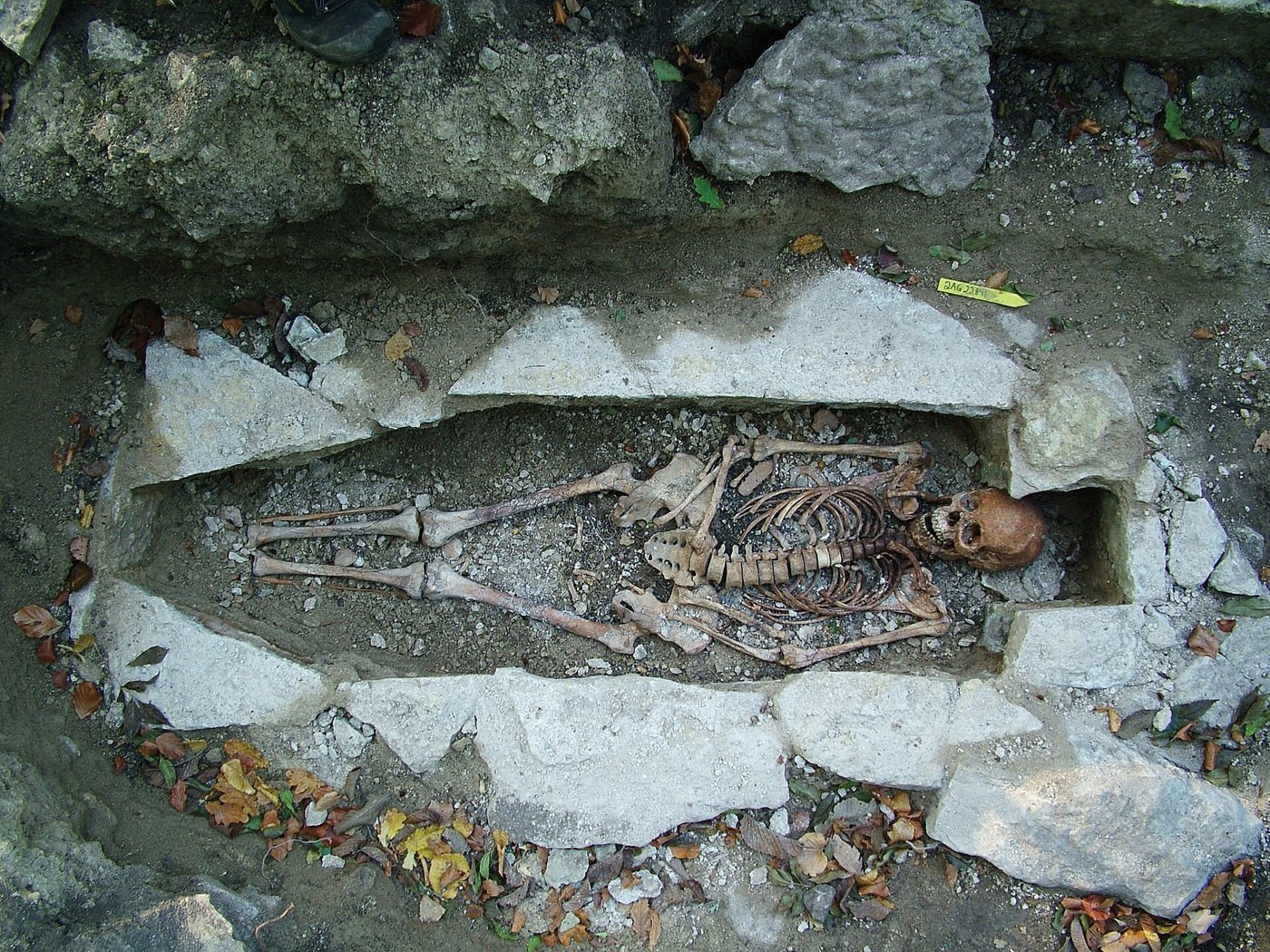
In September 2020 the news went round the world: the largest DNA study of the Viking Age had shown that Vikings were not all Scandinavian and often had brown rather than blond hair. The paper by Ashot Margaryan and his colleagues in Nature is more careful than the press release. Its most famous finding rests on two people from Orkney, it carries a dating error corrected later, and it gives no figure for how many Vikings were blond. This article sets the study, the correction and the press wording side by side.
The paper is called "Population genomics of the Viking world" and appeared in Nature, volume 585, pages 390 to 396. Ashot Margaryan, Daniel Lawson, Martin Sikora and Fernando Racimo share first authorship, and the senior authors include Eske Willerslev, Rasmus Nielsen and Thomas Werge. The team analysed the genomes of 442 people from sites between Greenland and present-day Ukraine.
That number sounds like 442 Vikings, and it is often passed on that way. In fact the sample runs from the Bronze Age, around 2400 BC, to the early modern period, around 1600. Adding up the study's groups gives roughly this picture: 2 people from the Bronze Age, 10 from the Iron Age, 43 from the early Viking Age, 333 from the Viking Age, 23 from Norse Greenland and 31 from the medieval and early modern periods. The University of Cambridge press release also points out that men, women, children and babies are included.
That alone shifts the question. In contemporary sources, the preprint notes, "Viking" meant something like "pirate" or "sea warrior". A baby in a tenth-century cemetery was certainly neither. So the study works with a period and a cultural area: anyone who belongs in time and archaeology to the world of the Scandinavians and their diaspora enters the dataset, whether or not they ever boarded a ship. About the men on the raids that initially says little.
The distribution is uneven too. For the Viking Age proper, 118 people come from Sweden, 78 from Denmark, 33 from Russia, 32 from England, 29 from Norway and 17 from Iceland. For the Iron Age, the key comparison for anything said to have "changed", the entire dataset holds just 10 people. The preprint itself describes sampling of earlier periods as "still sparse".
One point matters for everything that follows: the paper exists in several versions, and they differ. The printed version in Nature is terser. Many details in this article, such as group sizes, depths and some sample numbers, come from the 2019 preprint (bioRxiv) or a manuscript copy (HAL). Where the difference matters, it is stated.
Ancient DNA is degraded and contaminated with foreign DNA. Sequencing depth says how often a given position in the genome was read on average. Here the median is about 1×, and the Viking Age samples range from 0.1× to 11×. So for a typical individual each position was captured about once on average, and for some far less. For many analyses the team filled gaps statistically, a process called imputation, and selected 298 people with more than 0.5× for it. That is enough to recognise patterns of ancestry. For claims about one person's individual traits it gets tight, which will matter when we come to hair colour.
Ancestry appears in the study as a blend of components with names like "Danish-like", "Swedish-like", "Norwegian-like" and "North Atlantic". These labels mislead easily. Ninth-century Sweden and Norway did not exist in the modern sense, and the authors say outright that the components do not match the inhabitants of today's countries exactly or exclusively. "Danish-like" means a genetic profile that particularly resembles that of modern Danes. It does not mean that this man thought of himself as a Dane or came from Denmark. The data, the authors remark, follow topographic boundaries more than present-day borders.
The method says nothing about a person's language, faith or sense of self. It compares stretches of chromosome with those of other people and estimates whom they most resemble. Any report saying that someone "was not a Viking" goes a step beyond what the method can do.
Perhaps the most durable result is the least spectacular, and it got few headlines. Within Scandinavia the genomes show clear structure. The south is diverse: the authors describe Denmark, southern Sweden, Gotland and Öland as transport zones and maritime enclaves. The Scandinavian heartlands further north received much less from outside. Gene flow within Scandinavia ran broadly from south to north.
Gotland fits this picture, with Danish-like, British-like and Finnish-like components side by side, as befits an island in the middle of the Baltic sea lanes. Genetic diversity is high on Öland too, and earlier isotope studies had already identified a large share of non-locals there. Isotopes, particular forms of atoms from water and food deposited in the teeth, show where someone grew up. Genomes show whom they descended from. That both traces converge at the same places makes the finding sturdier. The authors mention similar isotope patterns for the warrior cemetery at Trelleborg and the burial ground at Galgedil on Funen.
The authors draw a clear conclusion: Vikings were not simply a direct continuation of Scandinavian Iron Age groups, and foreign gene flow from the south and east began already in the Iron Age. On this reading the Viking Age continued an older movement rather than making an abrupt break. With just 10 Iron Age samples the exact timing stays open, as the paper concedes.
The abstract states the basic pattern: Danish ancestry into England, Swedish ancestry into the Baltic, Norwegian ancestry into Ireland, Iceland and Greenland. This roughly matches what written sources and archaeology have long suggested.
The exceptions are just as telling. At Gnezdovo in western Russia, an important stop on the river routes of the Rus, Danish-like ancestry turned up. From this the authors infer that the eastward journeys were not carried by people from present-day Sweden alone. That finding rests on one sample and removes only the pattern's exclusivity.
England is similar. The dead from two execution sites in Dorset and Oxford carry Danish-like and Norwegian-like components as well as significant "North Atlantic" ancestry, which resembles that of the British Isles. If these were defeated raiding parties, the authors write, such forces were made up of men of different origins. That "if" is in the text and belongs in every retelling: that the dead actually belonged to an army is an assumption based on the find context and earlier work.
How much of this survives today is covered at length in our article on Viking descendants and DNA tests. Here, just one figure that is often misquoted. The printed paper says the Viking Age contribution "does not exceed 6%" in England. That is an upper limit on a share of ancestry, and it applies to England. Danish-like ancestry can hardly be separated from the legacy of the Angles and Saxons. The Cambridge release turns this into 6 per cent for the UK population, in places even worded as if it were the share of people. The preprint gave different values: about 4 per cent Norwegian-like ancestry in the British Isles and, for Danish-like ancestry, only an upper limit of 16 per cent. Setting 4 against 6 per cent therefore compares versions and measures.
Anyone with only the headline "not all Scandinavian" in mind should look at the ship burials at Salme on the Estonian island of Saaremaa. There 41 men lay in two boats, of whom the study tested 34 for kinship. According to the authors, the burial is nearly half a century older than the first documented raid on Lindisfarne in 793. The group proved genetically very uniform and Swedish-like, and isotopes and grave goods point to the Mälaren region.
Among the dead were four brothers lying side by side, along with a third-degree relative of one of them, such as an uncle or cousin. For one of the earliest archaeologically visible voyages across the Baltic, that means at least part of the crew boarded as a family. The Cambridge release concludes that the men probably came from a small town or village. That is an interpretation, not a measurement.
Kinship also reveals two long-distance links. A man from Galgedil on Funen (VK279) and a man from Oxford (VK144) were second-degree relatives, such as half-brothers or uncle and nephew. Two people from Öland and from Skämsta near Uppsala were distant relatives of the third or fourth degree, buried some 300 to 400 kilometres apart.
So Salme belongs in the same study as Orkney. The Viking world held mixed communities and also closely related groups from a single area. The preprint speaks of "a coalescence of Viking worlds".
The study's most quoted story is set on Orkney. In the press release version it goes like this: men were buried with swords in Viking graves but were genetically not Scandinavian. They were Picts who "became" Vikings without mixing with Scandinavians. Picts is the name for the early medieval inhabitants of northern and eastern Scotland, known above all from symbol stones and accounts by outsiders.
The printed paper says the following. Two people from Orkney, "buried in Scandinavian fashion", resemble present-day Irish and Scottish populations genetically and are "probably the first Pictish genomes published". Two others carry about 50 per cent Scandinavian ancestry. From this the authors conclude that Viking identity was "not limited to individuals of Scandinavian genetic ancestry". Sample numbers and exact values do not appear there. The HAL copy names VK202 and VK207 with over 85 per cent "North Atlantic" ancestry, whose haplotypes, stretches of DNA inherited together, link them to two local skeletons, and VK204 and VK205 with around 50 per cent. According to Sigurd Towrie of Archaeology Orkney, the eight Orkney people in the study come from three sites: three from Newark in Deerness, two from Buckquoy and three from the Brough Road, both in Birsay.
Four caveats go with this, and most retellings leave them out.
First, these are two people on one archipelago. That suffices to show such a thing happened. It says nothing about how common it was.
Second, the press wording "without mixing" conflicts with the local finding: people of about half Scandinavian descent lay on the same islands. Both existed, and "without mixing" holds at most for the ancestry of these two individuals.
Third, the swords come from the press material. There, the archaeologist Søren Sindbæk speaks of two skeletons "buried with Viking swords in Viking style graves". The printed paper mentions no swords. The National Museums Scotland blog refers only to two burials with grave goods from Buckquoy and Birsay. The site descriptions I could find name no sword either: at Buckquoy a man with spear, knife, whetstone, ring-headed pin and a coin of King Edmund (940–946), at the Brough Road a man with knife and antler comb (after Shane McLeod). Whether these are exactly the sampled graves could not be settled, because the assignment sits in the supplement, which I could not see. The swords are therefore not disproved, but not documented either.
Fourth, there is a correction that is almost never mentioned. The 2019 preprint still listed four people with over 85 per cent "UK" ancestry: VK201, VK202, VK203 and VK207. In 2021 Nature published an Author Correction: the dates for VK201 and VK203 in the supplementary table were typos. Rather than the tenth century, they belong to the Iron Age, VK201 to the fifth to sixth century and VK203 to the first to seventh. The printed paper speaks of only two people anyway, and the HAL copy names them as VK202 and VK207. It seems likely that the other two are the "two local Pictish skeletons" that VK202 and VK207 were compared with. That cannot be established unambiguously from what I had. Comparing the versions does show one thing: the finding narrowed between preprint and print, and anyone reading about "four Picts" today is reading an outdated claim.
The label "Pict" is itself an inference. No gravestone names these men so, and no Pictish language or self-designation can be read from a skeleton. The argument runs: local ancestry, closeness to older local dead, islands that belonged to the Pictish sphere before Norse settlement. The authors are right to say "probably".
Daniel Lawson says in the press release that people with two genetically British parents and Viking burials were found in Orkney and Norway. The printed paper mentions five such people in Scandinavia, and the preprint describes them as having over 80 per cent "UK" ancestry. I could not check individual cases from Norway. Why such people lay there, whether as willing incomers, spouses or descendants of captives, the genome does not say.
Some people in Scandinavia carry large amounts of southern European ancestry: VK365 and VK286 from Bogøvej in Denmark, VK442 and VK350 from Öland, VK265 from Kärda in southern Sweden. The authors stress that nothing comparable appears in their Scandinavian Iron Age samples, while cautioning that this sample is very small. The Cambridge release has Willerslev saying no one could have predicted these significant gene flows before and during the Viking Age. The printed paper speaks of over 50 per cent southern European ancestry as the first evidence in Scandinavia but gives no value per person. It offers no overall share of foreign ancestry among Viking Age Scandinavians either.
The Kärda group, dated to the middle of the Viking Age, can be pinned down best. Statistically it fits only one single source: early medieval Longobards from Hungary. It also shows reduced genetic diversity. The model says the Longobard samples are the best available approximation in the reference data. It does not say that Longobards who had lived in Hungary centuries before settled in Småland. Reference groups depend on what happens to have been sequenced.
Who were these people? The study does not know. Traders, spouses or unfree people would all be possible, and places like Birka attest wide trade connections. For the five named individuals, nothing shows which of these applies.
The 2023 study by Ricardo Rodríguez-Varela, Anders Götherström and colleagues in Cell supports the basic finding with other samples. It identifies three sources of inflow into Scandinavia: the eastern Baltic, the British-Irish Isles and southern Europe. British-Irish ancestry is widespread from the Viking Age on, Baltic ancestry concentrates on Gotland and in central Sweden, and southern European ancestry mainly affects the south. It adds a result less visible in 2020: in some regions today's inhabitants carry less foreign ancestry than the Viking Age and medieval dead would suggest. The authors offer two possible reasons. Newcomers may have had fewer children, for instance unfree people or priests, or the graves may mirror the population in a skewed way. Cremation was long the norm, which can shape which skeletons survive.
From the east came ancestry that is clearest on Gotland and in central Sweden and weak or absent in most Danish and Norwegian samples. It resembles Finnish and Baltic populations. Salme shows the counter-movement across the same sea.
Headlines sometimes turned this into "Asian genes". The paper is narrower: for some Scandinavian groups the model needs a further source, either Caucasus-related or East-Asian-related ancestry. The latter, says the printed version, is "consistent with previously documented gene flow from Siberia". Two people from northern Norway, VK518 and VK519, show affinity with present-day Saami. So the subject is mainly neighbours to the north and northeast who had long lived in the region. Visitors from China or Mongolia cannot be inferred from this. Rodríguez-Varela and colleagues attribute today's north-south gradient in Scandinavia mainly to differing levels of Uralic ancestry, probably in place by the Viking Age or earlier.
"Many had brown hair," Eske Willerslev said in the University of Cambridge release. That became the headline. In the paper the result looks different: the printed version mentions neither brown nor blond hair. Together with the preprint, there are three separate observations.
The first, set out only in the preprint: for 22 variants with large effects on eye and hair colour, frequencies among Viking Age people closely match those of present-day Scandinavians.
The second, also from the preprint: the best-covered individuals differ. VK42 from Skara carries variants associated with brown eyes and dark hair, VK1 from Greenland variants for blue eyes and lighter hair. Hence the authors' conclusion that there is no single "Viking phenotype". It would fit almost any large population.
The third: polygenic scores sum up many small genetic effects into one number. The comparison set 148 Viking Age samples from Denmark, Sweden and Norway against 20,551 present-day Danes for 16 traits. Only the black hair score still differs after correcting for the number of tests (P = 0.00089). That is the real core behind the headline. The authors state explicitly that they cannot conclude whether selection lies behind it or something else, such as the greater diversity of origins in their sample. A higher group average, especially from thinly read genomes, is also no statement about the share of blonds or brunettes. No such figure appears in the main text.
The abstract for its part speaks of strong differentiation in pigmentation genes over the last millennium. That sits in some tension with the statement about the 22 variants, though both can be true because they concern different analyses. In addition, gene variants translate into a colour only as a probability, which our article What did Vikings look like? treats more closely.
It is revealing where the image of the blond Norseman comes from in medieval sources themselves. The Eddic poem Rígsþula tells how the wandering god Ríg, identified in the prose introduction with Heimdall, fathers the three estates. The poem survives only in the fourteenth-century Codex Wormianus, and proposed dates run from the tenth to the thirteenth century. The first son, Þræll the thrall, is called "hörvi svartan". The passage is unclear: the manuscript has hǫrfi svartan, editors emend to hǫrundsvartan, "dark-skinned", while Henry Bellows in 1923 translated "his hair so black". Whether skin or hair is meant stays open. He also has wrinkled skin and a bent back. Karl, the free farmer, is red and ruddy. Of the ancestor of the nobles it then says:
Bleikt var hár, bjartir vangar, ötul váru augu sem yrmlingi. – Fair was the hair, bright the cheeks, keen the eyes as a young serpent's.Rígsþula, stanza 34 (numbering of heimskringla.no), Old Norse from heimskringla.no, my own translation
The poem is no census. It shows that fair hair could be imagined as a mark of nobility and dark colouring as a mark of servitude, a ranking of looks. Anyone citing sources for blond Vikings has here the ideal of a narrow elite, which says little about a genetically mixed reality.
It does not show that Vikings were "really not Scandinavian". The authors contradict what they call the myth of purely local Scandinavian ancestry. They do not assert the opposite. Salme and the less mixed heartlands are just as much part of the result. The paper offers no total for how many Viking Age people had foreign ancestors, and its selection could hardly bear one: it consists of surviving skeletons, not a cross-section of the population.
Nor does it show who thought of themselves as what. Grave goods can express belonging, but also the taste of the mourners or a local fashion. It does not show who took part in raids either: even Dorset and Oxford remain interpretation. For a sentence like "Viking was a job" it supplies the word's meaning, not proof.
It stays cautious for the North Atlantic as well. The 23 people from Norse Greenland, traced back to Erik the Red, show according to the authors neither admixture from North American populations nor long-term inbreeding. With only one well-covered genome from the late period, even that remains a careful indication. The debate over an Indigenous ancestress in Iceland is covered in our article on Vinland and DNA.
So were Vikings not Scandinavian? Many were, but not everyone in graves of the Viking world had Scandinavian forebears. Southern Scandinavia was more mixed than the heartlands. The study gives no overall share.
How many Picts received Viking burials? The printed paper names two probable cases from Orkney, and a manuscript version gives their numbers as VK202 and VK207. That shows it happened, not how often.
Did Vikings have brown rather than blond hair? Both occurred. The 22 major pigmentation variants resemble those of present-day Scandinavians, and the data do not yield a share of blonds.
Where did the southern European ancestry come from? That remains open. The Kärda group is best described statistically by early medieval Longobards from Hungary, which is only an approximation. Route and reason are unknown.
Does the study still stand? Yes, with the 2021 correction. In 2023 Rodríguez-Varela and colleagues confirmed the inflows with other data and found that foreign ancestry later fell again in some areas.
Viking descendants and DNA tests, What did Vikings look like?, Vinland and DNA, The warriors of Salme, The earls of Orkney, Slavery among the Vikings, Kievan Rus, The Danelaw

Am I Descended from the Vikings? What DNA Tests Really Reveal · Did Scandinavian women go too? What genetics shows for Iceland, what brooches suggest for England, and what the headlines made of it · Indigenous DNA in Iceland · What did Vikings look like? · What does "Viking" mean?.
All History & Finds articles →
The image of the Viking as a mere raider hides what really held the Norse world together: a far-reaching trade network …
Read more →There is one number that sobers up everyone approaching Norse arms and armour for the first time: from roughly two and …
Read more →Anyone sailing west out of Norway carried no compass and yet had a remarkably clear destination: the arc of islands …
Read more →The Vikings did not come only in summer. In the late ninth century a Danish army settled into fortified winter camps on …
Read more →